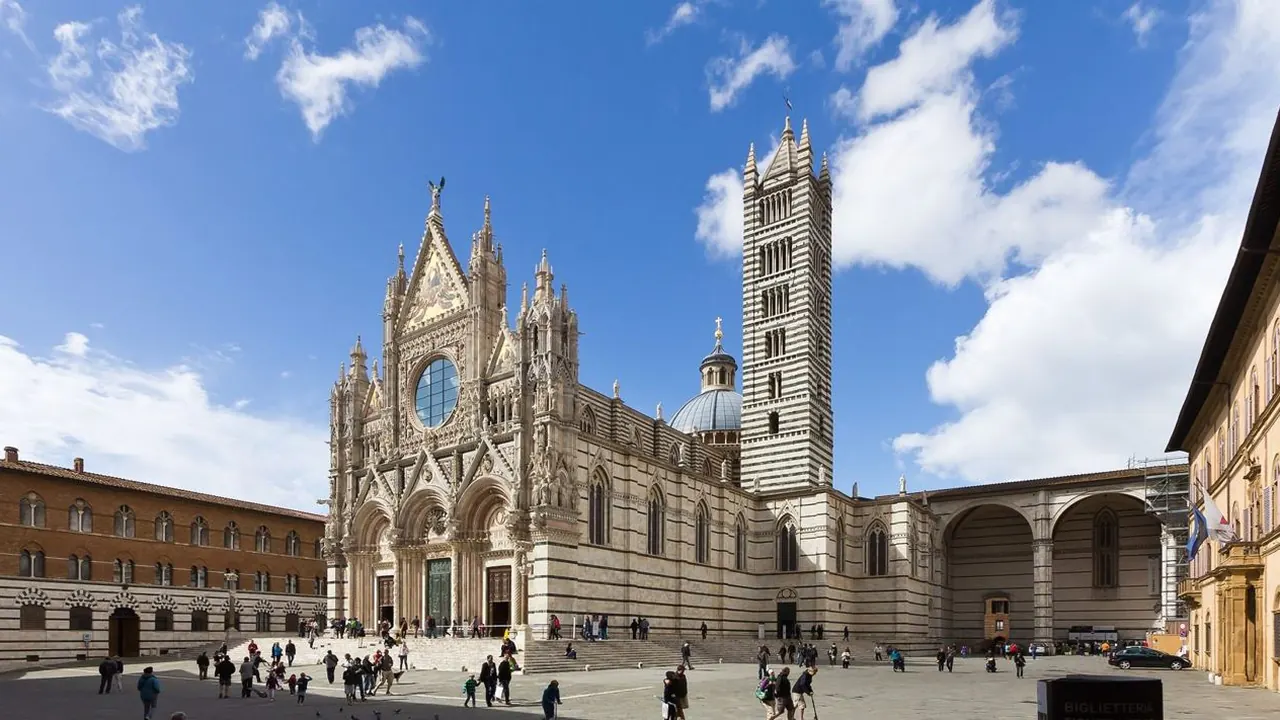
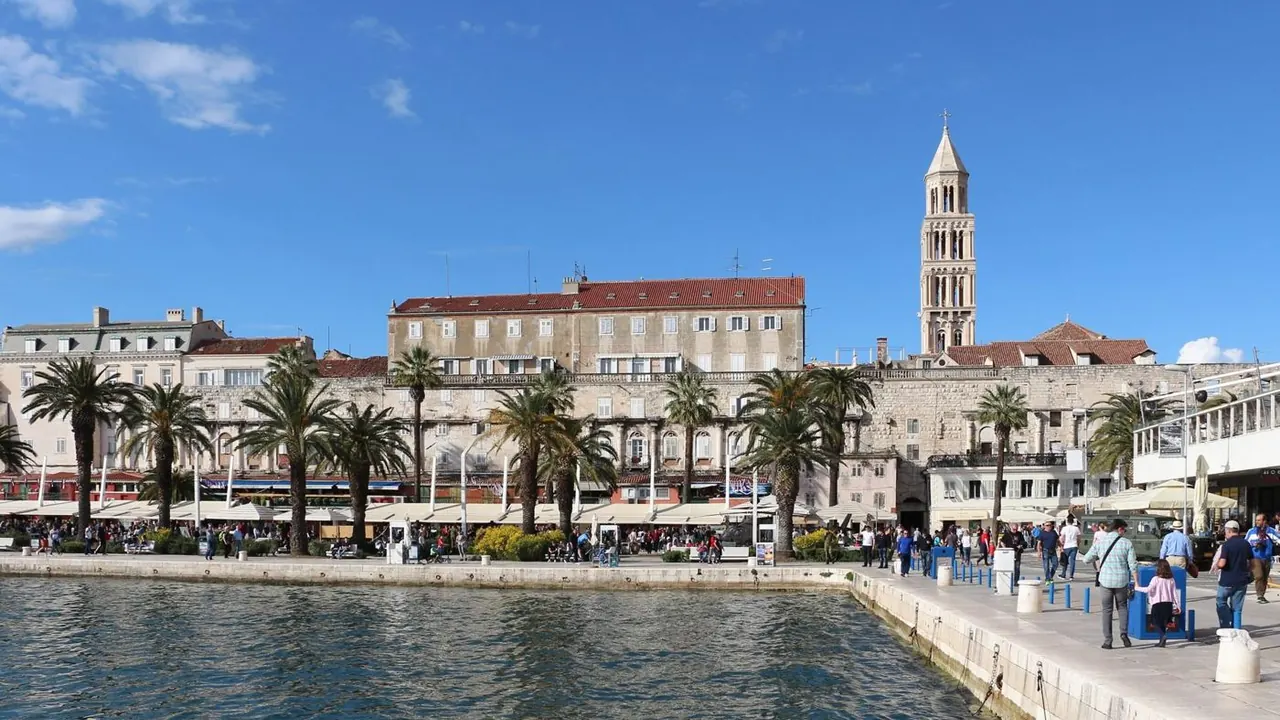
Photos: Siena by Raimond Spekking, CC BY-SA 4.0, cropped; Split by Bernard Gagnon, CC BY-SA 4.0, cropped.
Siena or Split?
Our verdict in twelve categories, each scored against the same fixed benchmark cities, and the climate month by month, so you can choose for your trip.
Choose Siena for
- day trips
- wellness
- culture and sights
Siena suits a traveller who wants art, architecture and countryside more than the sea. The whole medieval centre is the attraction, from the Campo to the Duomo and its museums. Around it lies the densest spread of hill towns, abbeys, wine villages and hot springs you could ask for. It works best for a slow, food-and-wine trip with a hire car, and evenings are a long dinner rather than a night out.
Choose Split for
- beaches
- nightlife
- families
Choose Split when swimming, islands and the outdoors come first. You can walk from a Roman palace to the beach. Ferries take you out to Brač and Hvar, and mountains, canyons and Marjan's pine woods are all close by. Summer evenings in the palace alleys are lively. It is also the easier choice with children, and the better one for anyone who would rather not drive.
Scoreboard
Twelve categories on one fixed scale from 0 to 100. The shaded stretch is the gap between the two.
Your match
Pick a travel style or drag the sliders, and both match scores follow your weighting.
Wins on day trips and wellness with your weighting.
Wins on beaches and nightlife with your weighting.
What matters to you?
Category by category
What the scores mean for a trip.
Beaches & swimming
Here Split wins easily. You can walk from the palace to a swim. Bačvice is shallow and sandy and full of locals playing picigin, while the coves around Marjan are quieter, with pine shade and deeper water. Most of the shore is pebble or concrete, and the islands have longer beaches.
Siena is inland. The nearest real beaches are on the Maremma coast, well over an hour's drive away, so swimming there usually means the pool at your hotel or agriturismo.
Food & drink
The two cities eat about equally well, but the cooking is very different. Siena's food comes from the land: hand-rolled pici, ribollita, cinta senese pork and wild boar, and a baking tradition of panforte and ricciarelli. Its wine is the stronger card, with Chianti Classico, Brunello and Vino Nobile all poured by the glass in the city's enoteche.
Split cooks from the sea: grilled fish, black risotto, octopus under the peka, and pašticada for the meat course. Its fish market and the Pazar make it easy to see what is in season. In both cities the best meals are in family places on the back streets, Siena's contrade or Split's Varoš, and neither offers much beyond its own regional cooking.
Culture & sights
Siena has more to see, and more of it is great art. The whole medieval centre survives intact. Lorenzetti's Good and Bad Government frescoes, the Duomo with its marble floor and Pisano pulpit, Duccio's Maestà, Santa Maria della Scala and the Pinacoteca easily fill two or three days.
Split has one extraordinary monument rather than a whole city of them. Diocletian's Palace is a Roman complex that people still live in, with the cathedral set inside the emperor's mausoleum. After that, the Meštrović Gallery is the main addition, and two days are usually enough.
Nightlife
Split is far livelier after dark, at least in summer. Bars spill into the palace's stone alleys and stairways, and the beach bars and clubs around Bačvice keep going into the early hours. From October the scene shrinks to a few bars.
Siena goes quiet before midnight for most of the year. A night there means dinner and a glass of wine on the Campo. The nights around the Palio are the one time its streets stay full until late.
Nature & outdoors
Split has the wilder setting. Marjan's forest park and cliffs are a walk from the centre, and Mosor and Kozjak offer ridge hikes. Biokovo rises above 1,700m, Omiš has rafting and canyoning on the Cetina, and Krka's waterfalls are an easy trip. Add sea kayaking and sailing among the islands, and Split covers both mountains and sea.
Siena's countryside is gentler: the bare clay hills of the Crete Senesi and the farmland of the Val d'Orcia. Cycling is the main outdoor activity here, on the white gravel strade bianche that start at the edge of town. There is walking on the Via Francigena, but no high mountains or coast.
Day trips
Siena has the richer choice of day trips. Florence, San Gimignano, Monteriggioni, the Chianti villages, Volterra, Pienza, Montalcino and Montepulciano are all close. Abbeys such as Monte Oliveto Maggiore and San Galgano add more. The catch is that most of these places really need a car.
Split's trips are fewer but easier without one. Trogir is about half an hour away, Šibenik about an hour, and Salona and Klis are on the edge of the city. In summer, ferries reach Hvar, Brač and Vis straight from the harbour, though winter timetables take more planning.
Good for families
Split is the easier city with children. Bačvice is shallow enough for small children to paddle, Marjan gives them shade and space to run, and a ferry to an island is often the highlight of the trip. The July and August heat and crowds are the main drawback.
Siena is safe and mostly free of cars, and older children enjoy the Torre del Mangia and the contrada drummers. Its steep lanes are hard going with a pushchair, though, and there is nothing built for children, which is why many families stay at a countryside farmhouse with a pool.
Getting around
Both centres are small and car-free, but Split is simpler to get in and out of. The palace, Varoš, the markets and Bačvice are all within about fifteen minutes' walk. The ferry port, bus station and railway station sit together at the harbour.
Siena's centre is compact too, but it is built over three ridges, with escalators climbing from the station in the valley. Trains are slow, buses are the better link to Florence, and wine country really calls for a hire car. In both cities, steps and polished stone make pushchairs and heavy bags hard work.
Shopping & style
Neither city is worth the trip for shopping, and what you bring home is mostly food. In Siena that means panforte, pecorino and wine, plus majolica ceramics and contrada scarves, Italian shoe and leather shops along Banchi di Sopra, and the weekly market by the Fortezza Medicea.
Split's best browsing is at the Pazar, with dried figs, honey and local brandies. Olive oil and Dalmatian wine make good souvenirs, the chains are on Marmontova, and the shops inside the palace are mostly souvenir stalls.
Affordability
Siena's costs come from scarce beds and ticketed sights, while Split's come from the summer peak. There are few rooms inside Siena's walls, and they get dear in summer and around the Palio. The cathedral complex and the civic museums also charge separately. An osteria lunch with house wine, or a night at an agriturismo outside town, keeps the bill down.
In Split, July and August raise room rates near the old town. Fish on the waterfront is sold by weight, and ferry tickets add up for a family. Bakeries, the Pazar, local buses and the palace sights cost little, and rooms are far cheaper in May, June and late September.
Live music & performing arts
Neither city has a big stage calendar, and what each offers is quite different. Siena's musical life grows out of two respected schools. The Accademia Chigiana holds summer concerts and masterclasses in palaces and churches, and Siena Jazz adds performances by its teachers and students. In winter the Teatro dei Rinnovati, inside the Palazzo Pubblico, and the Teatro dei Rozzi stage drama and music, but for opera you would go to Florence.
Split has the opera that Siena lacks. The Croatian National Theatre puts on opera and ballet, which need no Croatian, and the Split Summer Festival stages opera under the open sky in the Peristyle. Klapa, the unaccompanied male harmony singing often heard in the palace's domed vestibule, is a sound you will not find in Tuscany. Once summer ends, the programme thins out to bar bands and the odd concert.
Wellness & relaxation
Siena is the better place to rest, mainly because of the warm springs around it. Rapolano's travertine pools are about half an hour away, and further south are the steaming square at Bagno Vignoni, the free woodland pools of Bagni San Filippo and Petriolo's sulphur river. All of them fit well with a stay at a rural spa or farmhouse.
Split has no spa tradition beyond its hotels. What it offers is fjaka, the slow Dalmatian habit of long coffees on the Riva. It is easiest to enjoy in May, June and September, or among Marjan's pines.
When should you go?
Pick your month. The climate figures are measured averages, not a forecast.
Siena in July
Split in July
Daytime high, °C
Rainfall in the month, mm
Where the figures come from
Siena's temperatures are measured 45 km from the centre, at Arezzo.
Siena has no rain gauge within 25 km of the centre, so its rainfall comes from a gridded climate dataset read at the city rather than from a gauge further away.
Temperature and rainfall are climate normals, averaged over the years shown. Siena: 2006-2017 (rainfall 1991-2020) normals, Arezzo (45 km from centre). Split: 1991-2020 normals, Split / Marjan (0.9 km from centre).
The two cities run almost the same summer curve. July and August reach about 31°C in both, which is hot for climbing Siena's ridges or hiking the slopes behind Split. Late spring and the end of September are better for walking in either city. The big difference is rain. Siena has wet spells in March, May and September and is wettest in November at 127mm. Split's summer is very dry, with only 25mm in July and long, sunny days from May to August.
Split is the only one with the sea for swimming. The water is pleasant from June, peaks around 25°C in August and stays swimmable into early October. Winters are mild and damp in both cities, but Siena is a touch colder and greyer, so the cool months there are better spent in museums than outdoors.
Which traveller are you?
On a beach and sun trip, Split is the clear choice. Bačvice and the Marjan coves are a walk from the old town, the summer sea is warm and the islands are a ferry ride away. Siena's nearest beaches are a full day's outing.
For a culture and arts trip, Siena gives more. It has a whole UNESCO-listed medieval city, Lorenzetti's frescoes, Duccio's Maestà and several museums around the Duomo, plus San Gimignano and Pienza close by. Split has one superb Roman palace and a short list after it.
On a relaxing and wellness trip, Siena has the advantage. Rapolano, Bagno Vignoni and the free pools at Bagni San Filippo bring warm thermal water within easy reach of a farmhouse stay. Split has no bathing tradition, and its midsummer old town is loud until late.
Before you go
| Measure | Siena | Split |
|---|---|---|
| Official language | Italian | Croatian |
| Currency | Euro (EUR) | Euro (EUR) |
| Sockets | CFL230 V, 50 Hz | CF230 V, 50 Hz |
| Driving side | Right | Right |
| Time zone | UTC+1, UTC+2 in summer | UTC+1, UTC+2 in summer |
| Emergency number | 112 | 112 |
| Elevation | 322 m | 0 m |
| Main airport | Florence Airport, Peretola (FLR)55 km from centre46 non-stop destinations | Split Saint Jerome Airport (SPU)12 km from centre69 non-stop destinations |
| Public holidays this year | 13 days | 14 days |
By the numbers
| Measure | Siena | Split |
|---|---|---|
| City population | 52,812 | 160,577 |
| People per km² | 446 | - |
| Museums within 10 km | 30 | 11 |
| UNESCO World Heritage sites within 50 km | 5 | 4 |
| Swim season, months above 21 °C | - | 4 months |
Where else could you go?
Every comparison below shares a destination with this one, so you can follow Siena or Split somewhere new.