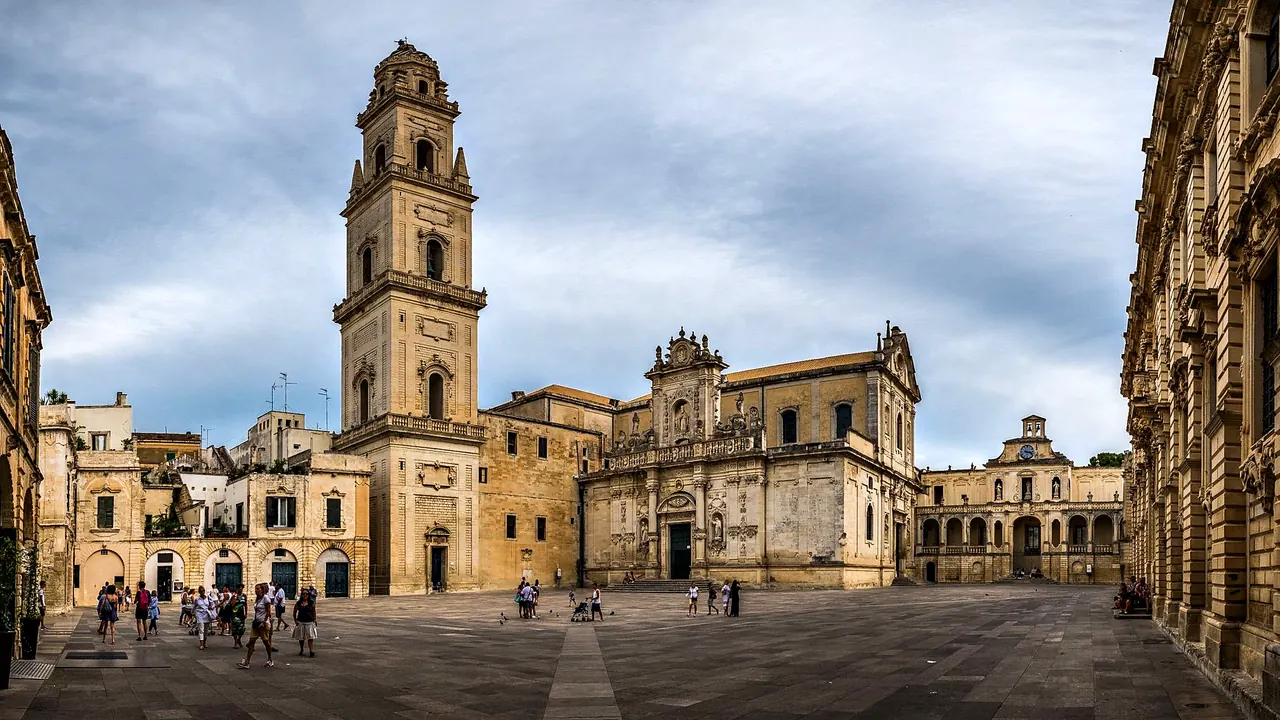
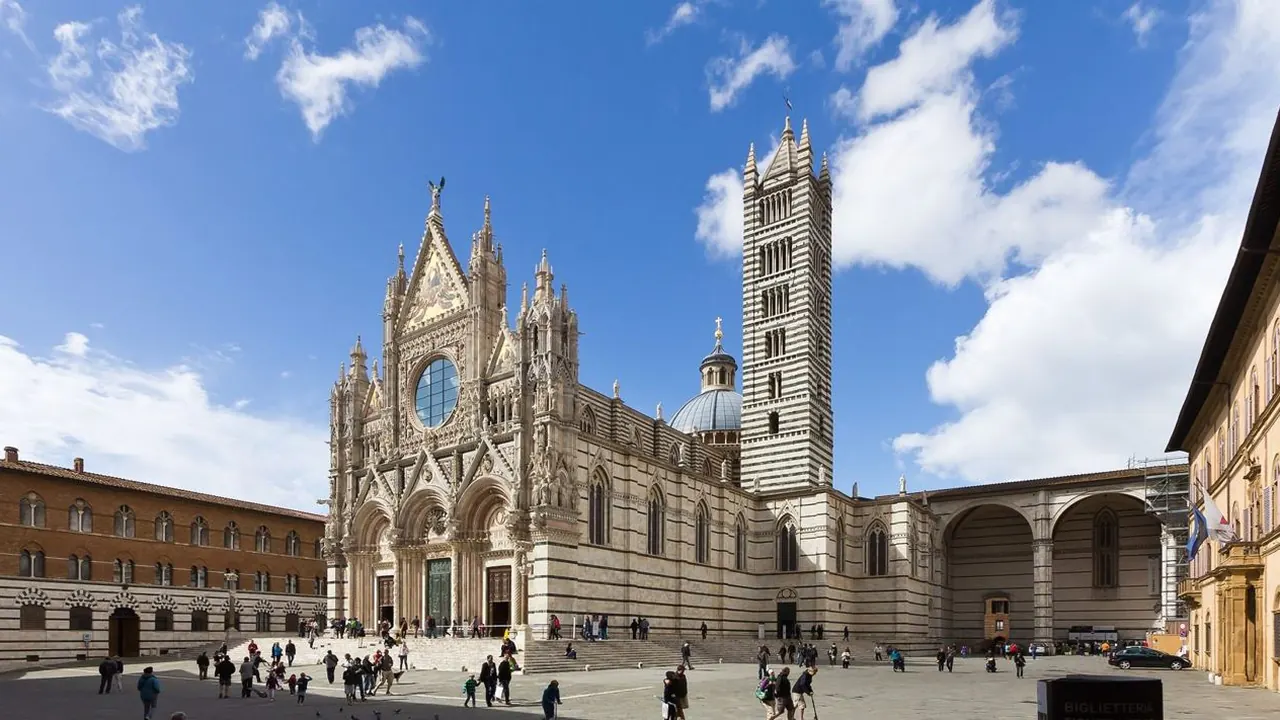
Photos: Lecce by Giuseppe Milo, CC BY 3.0, cropped; Siena by Raimond Spekking, CC BY-SA 4.0, cropped.
Lecce or Siena?
Our verdict in twelve categories, each scored against the same fixed benchmark cities, and the climate month by month, so you can choose for your trip.
Choose Lecce for
- beaches
- prices
- nightlife
Lecce suits travellers who want a summer trip that mixes sea and stone. Its Baroque old town makes a handsome base, and the sandy coves and clear Ionian shallows of the Salento are within easy driving distance. Days can go to the beach and evenings to the piazzas. It costs less than Siena for most of the year, its flat streets and shallow beaches make it easier with small children, and nights out run a little later.
Choose Siena for
- day trips
- getting around
- nature and the outdoors
Siena is the better choice if art, history and the Tuscan countryside are the point of the trip. The medieval centre holds some of the finest painting in Italy. Beyond the walls are the hill towns, the wine country and the hot springs of southern Tuscany. There is no sea and it costs more, but for touring in spring or autumn, with a glass of Brunello at the end of the day, it is hard to beat.
Scoreboard
Twelve categories on one fixed scale from 0 to 100. The shaded stretch is the gap between the two.
Your match
Pick a travel style or drag the sliders, and both match scores follow your weighting.
Wins on beaches and prices with your weighting.
Wins on day trips and getting around with your weighting.
What matters to you?
Category by category
What the scores mean for a trip.
Beaches & swimming
This is where the two differ most. Lecce is 12km inland, but the Salento coast is the reason many people come. The limestone coves and sea stacks of Torre dell'Orso are about half an hour away, and the clear, shallow Ionian sands of Punta Prosciutto take about 40 minutes. In summer, a morning on the beach and an evening in town is the normal routine.
Siena has no sea at all. The Maremma beaches are well over an hour's drive, so a swim takes the whole day, and most visitors make do with a farmhouse pool.
Food & drink
The two eat about as well as each other, and both stick firmly to their own region. Lecce's food is southern peasant cooking. You start the day with a warm pasticciotto and iced espresso with almond milk, and later eat ciceri e tria and fava purée with wild chicory, with dark Negroamaro to drink.
Siena's table is heavier and Tuscan: pici with duck ragù, cinta senese pork, wild boar and panforte from bakeries that have been going for generations. Its wine is the stronger draw, with Chianti Classico and Brunello poured by the glass in its enoteche.
Culture & sights
Both towns are complete historic townscapes, but Siena has the greater art. Lorenzetti's Good and Bad Government, Duccio's Maestà, the Duomo with its Piccolomini Library and the Sienese school in the Pinacoteca can fill two or three serious days.
Lecce is Baroque rather than medieval. Its honey-coloured limestone is carved into fruit, beasts and cherubs on Santa Croce, and Piazza del Duomo glows at dusk. There is also half a Roman amphitheatre under Piazza Sant'Oronzo. Its pleasure is in strolling rather than in great collections.
Nightlife
Neither town is worth the journey for its nights out alone, but Lecce gives you more to do after dinner. Its old-town lanes are lined with wine bars and small cocktail bars, and on weekends students fill them for most of the year. Siena's university supports only a few pubs and wine bars, and its centre has gone quiet well before midnight.
Summer widens the gap. Lecce's dancing moves out to the open-air discos and beach clubs on the coast around Gallipoli, which means a drive but gives you a proper night out. Siena has almost no clubs nearby. Its one stretch of late nights comes with the Palio, when each contrada sets long tables in its own streets. That makes it a festival evening shared by the whole neighbourhood rather than a round of bars.
Nature & outdoors
Siena has the finer landscape on land. The bare clay hills of the Crete Senesi and the cypress-lined Val d'Orcia begin close by. Strade bianche gravel roads lead straight out of town for cyclists, and walkers have the Via Francigena and the beech woods of Monte Amiata.
Around Lecce the plain of olive groves is flat, and the outdoors means the coast. There are clifftop paths from Roca Vecchia to Otranto, boat trips into sea caves, snorkelling and diving, and birdwatching at Le Cesine. Water lovers may well prefer it.
Day trips
Siena has the better choice of day trips, with one of Europe's finest clusters of towns around it. There are San Gimignano's towers, Volterra, the Chianti villages, Pienza, Montalcino and Montepulciano, the abbeys of Sant'Antimo and San Galgano, and Florence about an hour and a quarter away by bus.
Lecce has a good spread of its own: Otranto's cathedral mosaic, island Gallipoli, white Ostuni and the trulli of Alberobello. The best of these are further apart, though. From either base, a car makes the outings far easier.
Good for families
Lecce is the easier place with young children. Its old town is flat and largely traffic-free, and the piazzas fill with families in the evening. The shallow sandy beaches around Porto Cesareo are ideal for paddling.
Siena's steep, stepped lanes are tough with a pushchair. It works better for older children, who enjoy climbing the Torre del Mangia and watching the contrada drummers. Many families stay at a countryside farmhouse with a pool.
Getting around
Lecce's weak point is getting beyond the town. Its flat old town is easy on foot, and fast trains run north to Brindisi and Bari. Across the Salento, though, the local railways are slow and infrequent and the beach buses run only in summer, so most visitors hire a car for the coast and the smaller towns.
Siena is better connected. Escalators climb from the station in the valley to the upper town, and buses run to Florence and the nearby towns. The price is the climbing, because its three ridges mean steep slopes and stepped lanes. In both towns, drivers park outside the walls.
Shopping & style
Neither is a shopping destination, but what you take home differs. Lecce's craft is cartapesta, papier-mâché saints and nativity figures made in old-town workshops, plus carved limestone and Grottaglie ceramics. Siena offers more clothing, shoes and leather along Banchi di Sopra, along with majolica, contrada scarves and a large weekly market by the Fortezza Medicea.
Affordability
Lecce is the cheaper of the two for most of the year. B&Bs in old palazzi are fairly priced, and street pastries and trattoria meals cost little. August is the exception, when rooms, beach loungers and a hire car all get expensive.
In Siena, the few rooms inside the walls are always in demand and jump in price around the Palio. The separate charges for the cathedral and civic museums add up. Staying at an agriturismo outside town helps.
Live music & performing arts
The two are evenly matched, but the music is very different. Lecce's distinctive sound is pizzica, the tambourine dance heard at village festivals all summer, which peaks at the huge open-air Notte della Taranta in Melpignano. Siena's music is classical and jazz: summer concerts from the Accademia Chigiana in palaces and churches, Siena Jazz, and winter seasons at the Rinnovati and the Rozzi.
Wellness & relaxation
Siena is better placed for taking the waters. Rapolano's travertine pools are half an hour away. Further south are the steaming medieval bath at Bagno Vignoni, the free white pools of Bagni San Filippo and Petriolo's hot sulphur river.
Lecce has one main spring, Santa Cesarea Terme, with sulphur pools in sea grottoes under an hour away. Otherwise rest there means a spa at a converted masseria and the long afternoon break.
When should you go?
Pick your month. The climate figures are measured averages, not a forecast.
Lecce in July
Siena in July
Daytime high, °C
Rainfall in the month, mm
Where the figures come from
Lecce's temperatures are measured 38 km from the centre, at Brindisi.
Lecce has no rain gauge within 25 km of the centre, so its rainfall comes from a gridded climate dataset read at the city rather than from a gauge further away.
Siena's temperatures are measured 45 km from the centre, at Arezzo.
Siena has no rain gauge within 25 km of the centre, so its rainfall comes from a gridded climate dataset read at the city rather than from a gauge further away.
Temperature and rainfall are climate normals, averaged over the years shown. Lecce: 1991-2020 (sunshine 1981-2010) normals, Brindisi (38 km from centre). Siena: 2006-2017 (rainfall 1991-2020) normals, Arezzo (45 km from centre).
Lecce has the longer warm season and is the one for swimming. The sea is pleasant from June and reaches about 26°C in August, staying warm well into September. Summer is very dry and sunny, with highs around 30°C, so you walk the old town in the evening. Rain arrives from September and is heaviest in October and November. Winters are mild, so the town is still pleasant to walk round off-season.
Siena gets hotter in midsummer, at about 31°C, and much colder in winter, with January highs near 9°C on its exposed ridges. Rain is spread more evenly through the year and peaks in November at about 127mm. April, May, September and early October are its best months for walking the steep lanes and touring the hills. For Lecce, June and September give the best balance of warm sea and comfortable streets.
Which traveller are you?
On a beach and sun trip, Lecce wins easily. Torre dell'Orso's pale coves and the long shallow sands of Porto Cesareo are a short drive away. Siena's nearest decent sea is a full day's round trip to the Maremma.
For a culture and arts trip, Siena is the stronger choice. It has Lorenzetti's frescoes in the Palazzo Pubblico, Duccio's Maestà, the Duomo's marble floor and the Pinacoteca. Lecce's Baroque streets are lovely to walk, but its museums are modest.
On a tight budget, Lecce goes further. Its pastries, osterie and local wine cost little, and B&Bs in old palazzi are fairly priced outside August. In Siena, rooms inside the walls are scarce and the separate museum tickets add up.
Before you go
| Measure | Lecce | Siena |
|---|---|---|
| Official language | Italian | Italian |
| Currency | Euro (EUR) | Euro (EUR) |
| Sockets | CFL230 V, 50 Hz | CFL230 V, 50 Hz |
| Driving side | Right | Right |
| Time zone | UTC+1, UTC+2 in summer | UTC+1, UTC+2 in summer |
| Emergency number | 112 | 112 |
| Elevation | 49 m | 322 m |
| Main airport | Brindisi Airport (BDS)39 km from centre49 non-stop destinations | Florence Airport, Peretola (FLR)55 km from centre46 non-stop destinations |
| Public holidays this year | 13 days | 13 days |
By the numbers
| Measure | Lecce | Siena |
|---|---|---|
| City population | 94,783 | 52,812 |
| People per km² | 393 | 446 |
| Museums within 10 km | 11 | 30 |
| UNESCO World Heritage sites within 50 km | 0 | 5 |
| Swim season, months above 21 °C | 4 months | - |
Where else could you go?
Every comparison below shares a destination with this one, so you can follow Lecce or Siena somewhere new.