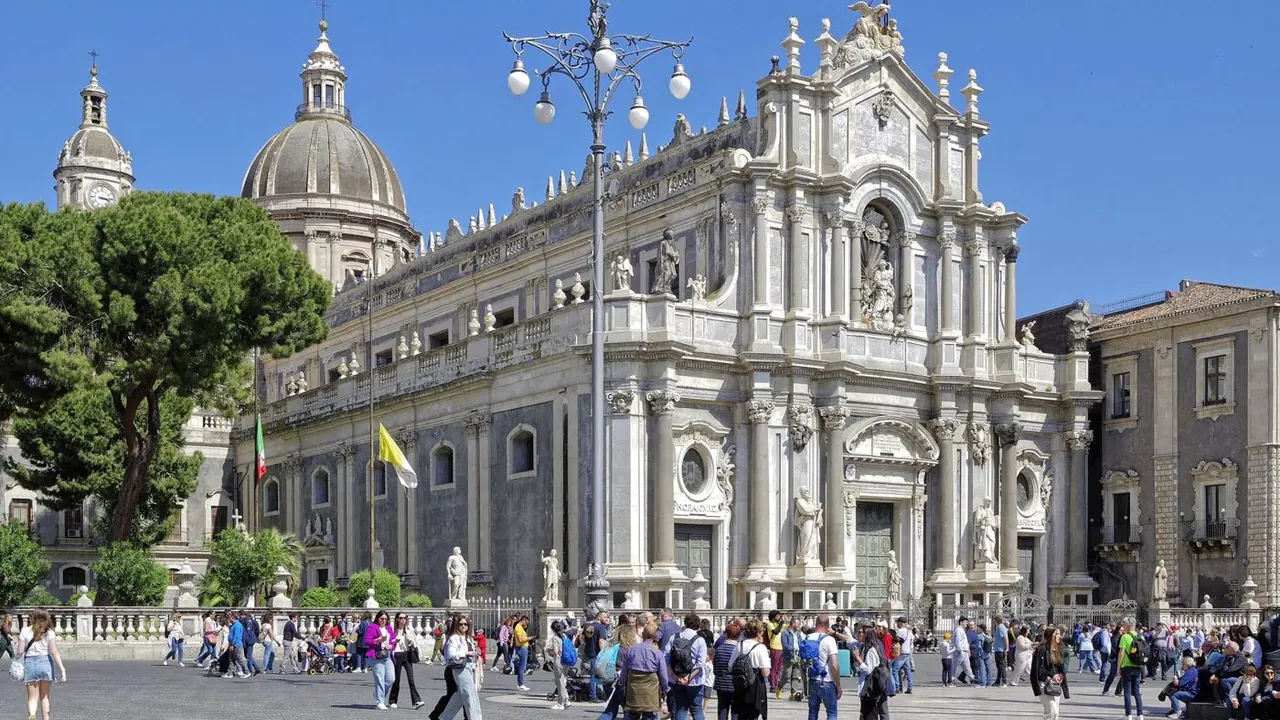
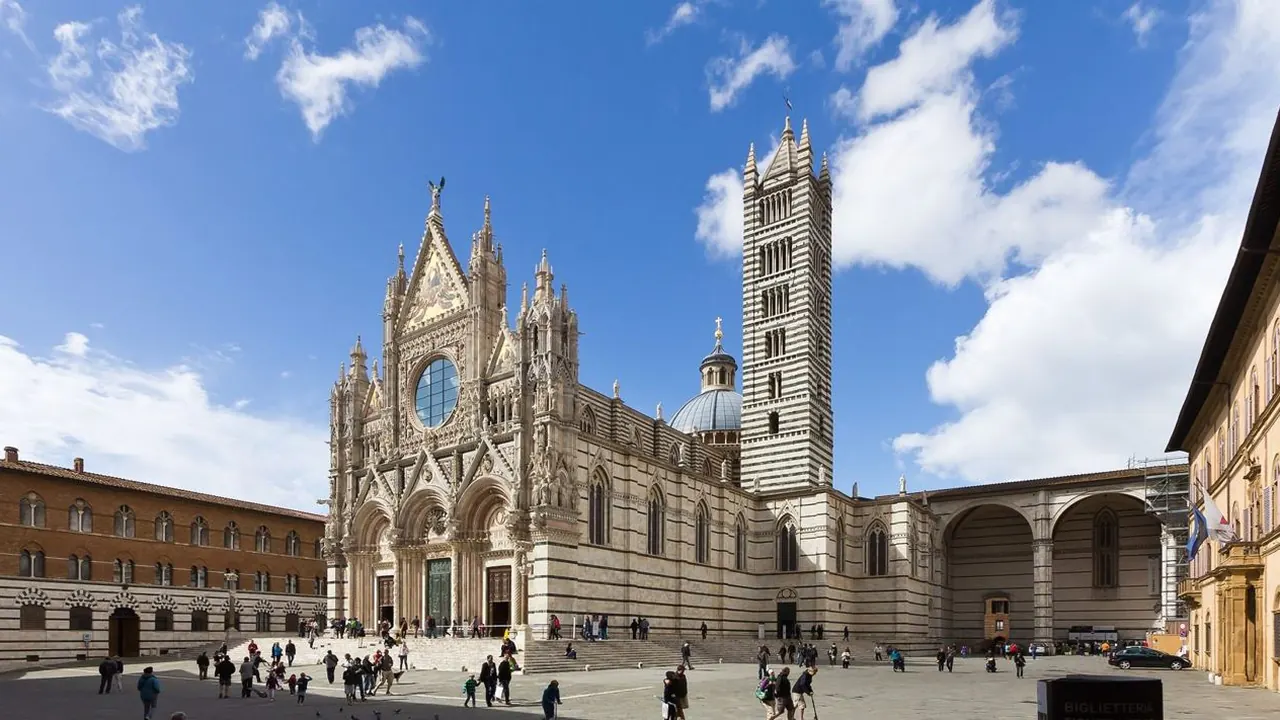
Photos: Catania by Berthold Werner, CC BY-SA 4.0, cropped; Siena by Raimond Spekking, CC BY-SA 4.0, cropped.
Catania or Siena?
Our verdict in twelve categories, each scored against the same fixed benchmark cities, and the climate month by month, so you can choose for your trip.
Choose Catania for
- beaches
- nightlife
- live music and the arts
Catania is the pick for travellers who want the sea, a volcano and a city that eats and drinks late into the night. In a single day you can swim off the lava rocks of the Riviera dei Ciclopi, spend a morning on Etna and eat street food around Piazza Bellini in the evening, and it costs less to do it here. It suits active couples, friends and families who want a mix of beach and adventure.
Choose Siena for
- wellness
- culture and sights
- getting around
Choose Siena for a slower trip built around medieval art, wine and the Tuscan hills. The Duomo, the Campo and the Lorenzetti frescoes reward close looking, and the centre is compact and mostly free of cars, so you walk everywhere. The thermal pools at Rapolano and Bagno Vignoni and the hill towns of Chianti and the Val d'Orcia are all close at hand. It is for travellers happy to give up beaches and nightlife in exchange for quiet evenings.
Scoreboard
Twelve categories on one fixed scale from 0 to 100. The shaded stretch is the gap between the two.
Your match
Pick a travel style or drag the sliders, and both match scores follow your weighting.
Wins on beaches and nightlife with your weighting.
Wins on wellness and culture and sights with your weighting.
What matters to you?
Category by category
What the scores mean for a trip.
Beaches & swimming
This is the widest gap between the two. Catania sits right on the sea. The sand of La Playa lies to the south, and to the north are the lava platforms and ladders of Aci Castello and Aci Trezza, where the water around the sea stacks is very clear.
Siena has no beach at all. The Maremma coast near Castiglione della Pescaia is well over an hour away by car, so a swim takes a whole day, and in town swimming means the pool at your hotel or agriturismo.
Food & drink
Both cities eat well, but Catania's food is more varied and more exciting. Its great strength is street food: ragù-filled arancini, fried crispelle, the horse-meat grills of Via Plebiscito and granita with brioche at breakfast. La Pescheria supplies the fish trattorias around the cathedral.
Siena's cooking is narrower and rooted in Tuscan tradition: pici, ribollita, cinta senese pork, and its panforte and almond biscuits. Wine is where Siena comes closest, with Chianti Classico, Brunello and Vino Nobile all poured in the town's enoteche, though Etna's volcanic reds and whites give Catania a strong answer.
Culture & sights
Siena is the richer city for sightseeing. Its whole medieval centre survives. The Duomo with its marble floor and Pisano pulpit, Duccio's Maestà and the Lorenzetti frescoes in the Palazzo Pubblico are major works of European art, and the contrade keep a civic tradition alive.
Catania appeals more for its buildings than its collections. It is a baroque city of black lava and pale limestone, with the vast monastery of San Nicolò l'Arena and Roman remains scattered through the streets. Its museums are modest, and the Feast of Sant'Agata in February is its great occasion.
Nightlife
Catania is clearly the city for going out. Its large student population fills the bars around Piazza Bellini and Via Gemmellaro until well after midnight, and in summer the beach clubs of La Playa turn into dance floors.
Siena winds down early. A usual evening is dinner, a glass of wine on the Campo and a stroll, and only on Palio nights do the streets stay full late.
Nature & outdoors
Etna gives Catania the more dramatic outdoors. A smoking volcano about 3,300m high is less than an hour away, with craters, old lava flows and beech woods to walk. There is also the Alcantara Gorge to wade through, and you can snorkel or kayak around the sea stacks off the lava coast.
Siena's countryside is gentler and more pastoral, with the bare clay hills of the Crete Senesi and the rolling Val d'Orcia, both at their best in spring and autumn. It is excellent cycling country, with the strade bianche starting at the edge of town, but there are no high peaks and no coast.
Day trips
Both make good bases, but Siena has more within reach. Florence, San Gimignano, Volterra, the Chianti villages, Montalcino, Pienza and the abbeys of Sant'Antimo and San Galgano are all easy outings, so a week of excursions never runs short.
From Catania the list is shorter but strong. Siracusa and Taormina are each about an hour away, and further out are the baroque towns of Noto and Ragusa Ibla and the Roman mosaics at Piazza Armerina. In both regions a car makes the smaller towns far easier.
Good for families
Neither city is built around children, but Catania gives families more to do. The gently shelving sand at La Playa, a walk on Etna's old craters and the Etnaland theme park and water park fill the days, even if the traffic, narrow pavements and summer heat are tiring.
Siena is safe and mostly free of cars, but it has no attractions made for children, and its steep lanes are hard going with a pushchair. Older children enjoy climbing the Torre del Mangia, and families often do better in a farmhouse with a pool outside town.
Getting around
Siena is the easier town to get around. Its centre is largely closed to cars and the sights are a few minutes' walk apart, though the climbs are steep. Escalators link the station to the upper town, and buses run to Florence.
Catania's compact centre along Via Etnea is easy on foot, but beyond it the single metro line, slow buses and heavy traffic make things harder. In both places the countryside really needs a hire car, and in Catania parking in the centre is a struggle too.
Shopping & style
Neither city is a shopping destination, and in both the best things to buy are edible. Catania has a little more to offer: the chains along Via Etnea, the noisy daily market of La Fiera, and Bronte pistachio cream, Etna wine and Caltagirone ceramics to take home.
Siena's shopping is quieter: clothing and leather shops on Banchi di Sopra, majolica, contrada scarves, panforte and pecorino, and a large weekly market by the Fortezza Medicea.
Affordability
Catania is the cheaper stay. Street food makes a full meal for little money, trattorias and guesthouses in the old town are reasonable for most of the year, and the churches are free to visit. Summer rooms, sunbeds and Etna summit tours do add up.
Siena costs more. There are few rooms inside the walls, and the cathedral complex and civic museums each charge for entry. A simple osteria lunch is good value, and staying in an agriturismo or a nearby town can bring the cost down.
Live music & performing arts
Catania has the bigger stage. Bellini's home city has a grand opera house with a full season of opera and concerts that visitors can attend, and small companies keep the Sicilian puppet theatre of knights and Saracens alive.
Siena's music is more specialised: summer concerts by the Accademia Chigiana in palaces and churches, performances by Siena Jazz, and drama at the Teatro dei Rinnovati and the Teatro dei Rozzi. For opera, you have to go to Florence.
Wellness & relaxation
Siena is far better for rest, thanks to the hot springs around it. Rapolano Terme is about half an hour away, and further south are the steaming medieval bath of Bagno Vignoni and the free limestone pools of Bagni San Filippo, which pair well with a farmhouse stay.
Catania has no tradition of thermal baths and a noisy centre, and its spas are mostly in hotels on the coast and on Etna. What it does offer is a slow daily rhythm of long lunches and the evening passeggiata.
When should you go?
Pick your month. The climate figures are measured averages, not a forecast.
Catania in July
Siena in July
Daytime high, °C
Rainfall in the month, mm
Where the figures come from
Catania's sunshine is measured 88 km from the centre, at Messina.
Siena's temperatures are measured 45 km from the centre, at Arezzo.
Siena has no rain gauge within 25 km of the centre, so its rainfall comes from a gridded climate dataset read at the city rather than from a gauge further away.
Temperature and rainfall are climate normals, averaged over the years shown. Catania: 1991-2020 normals, Catania / Fontanarossa (5.2 km from centre). Siena: 2006-2017 (rainfall 1991-2020) normals, Arezzo (45 km from centre).
Catania has the longer warm season. The sea is pleasant for swimming from June into October and reaches about 26°C in August. May and the weeks from late September into October are the comfortable months for walking the baroque streets. July and August are very hot, with highs near 32°C and little shade. The rain comes back in September and builds through autumn, and winter is the wettest and least sunny season, with December the dampest month at about 83mm. Even so, winter stays mild, with highs in the mid-teens, so sightseeing goes on between the showers.
Siena is cooler and wetter all year, with more rain than Catania in every month. Spring and early autumn are its best seasons, with pleasant days in May and September, though both months can be showery. High summer reaches about 28°C. That is hot work on the steep lanes but still milder than Sicily. Winter is properly chilly, with January highs around 9°C, and October and November are the wettest months.
Which traveller are you?
For a beach and sun trip, Catania is the only real choice. The sea is on its doorstep, with sand at La Playa and clear swimming off the lava rocks at Aci Trezza. From Siena the coast is more than an hour away, and in town you only have a pool.
On a food and nightlife trip, Catania again comes out ahead. Arancini, the fish market and the late crowds outside the bars around Piazza Bellini make for long evenings. Siena's nights usually end early, after a long dinner and a glass of Chianti.
On a relaxing and wellness trip, Siena suits better. The thermal pools of Rapolano, Bagno Vignoni and Bagni San Filippo are close by, the countryside is quiet, and a farmhouse in the hills is far calmer than noisy, traffic-filled Catania.
Before you go
| Measure | Catania | Siena |
|---|---|---|
| Official language | Italian | Italian |
| Currency | Euro (EUR) | Euro (EUR) |
| Sockets | CFL230 V, 50 Hz | CFL230 V, 50 Hz |
| Driving side | Right | Right |
| Time zone | UTC+1, UTC+2 in summer | UTC+1, UTC+2 in summer |
| Emergency number | 112 | 112 |
| Elevation | 7 m | 322 m |
| Main airport | Catania-Fontanarossa Airport (CTA)4 km from centre96 non-stop destinations | Florence Airport, Peretola (FLR)55 km from centre46 non-stop destinations |
| Public holidays this year | 13 days | 13 days |
By the numbers
| Measure | Catania | Siena |
|---|---|---|
| City population | 311,584 | 52,812 |
| People per km² | 1,704 | 446 |
| Museums within 10 km | 25 | 30 |
| UNESCO World Heritage sites within 50 km | 3 | 5 |
| Swim season, months above 21 °C | 5 months | - |
Where else could you go?
Every comparison below shares a destination with this one, so you can follow Catania or Siena somewhere new.