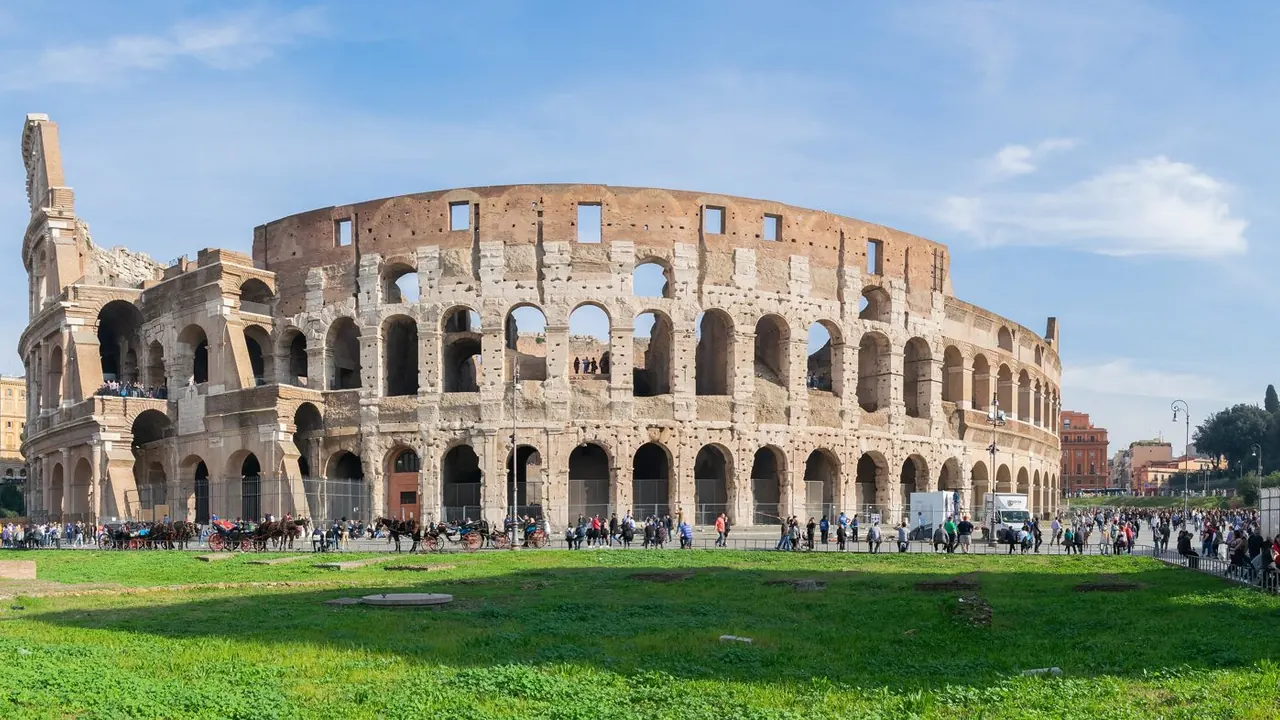
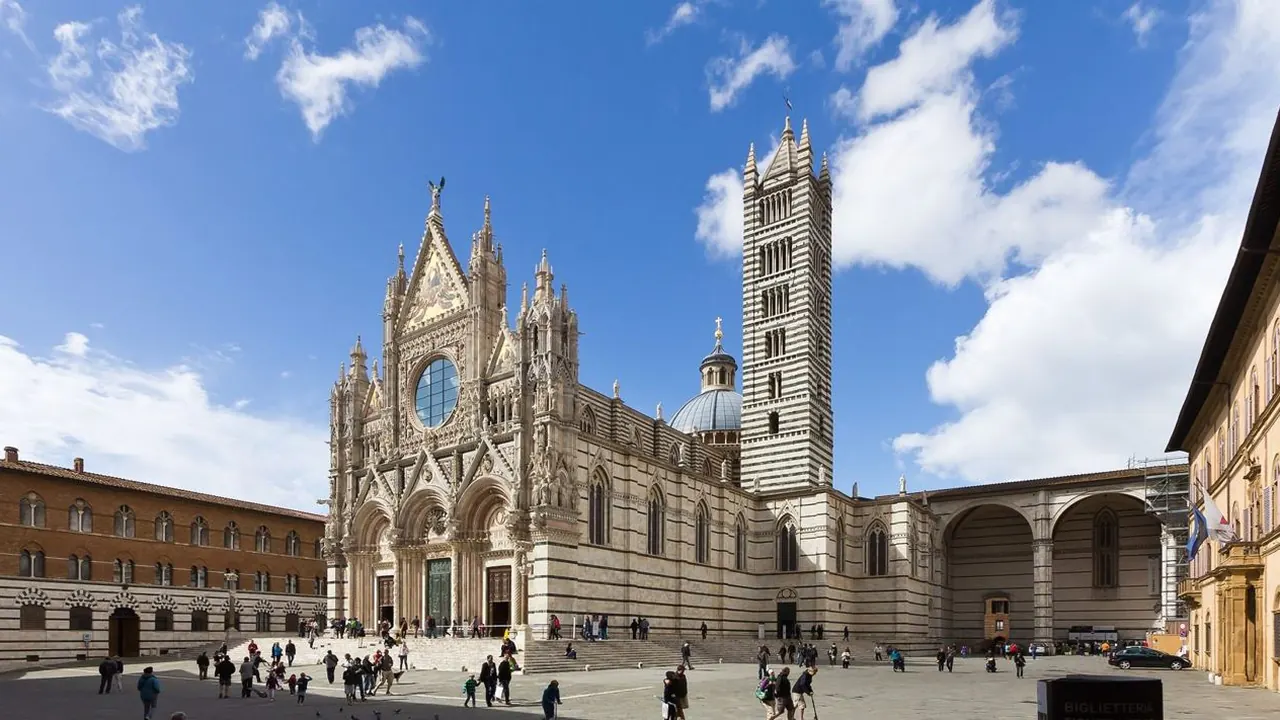
Photos: Rome by Tournasol7, CC BY-SA 4.0, cropped; Siena by Raimond Spekking, CC BY-SA 4.0, cropped.
Rome or Siena?
Our verdict in twelve categories, each scored against the same fixed benchmark cities, and the climate month by month, so you can choose for your trip.
Choose Rome for
- shopping
- beaches
- live music and the arts
Rome is the choice for a traveller who wants a great capital at full scale. Ancient ruins, the Vatican, Baroque piazzas and churches hung with Caravaggios fill a week without running dry, and the city adds things Siena cannot offer: its own trattoria cuisine, long evenings in Trastevere and Monti, opera among ancient ruins and serious fashion shopping. The price is noise, crowds and summer heat, so it suits people who enjoy a city's energy rather than retreat from it.
Choose Siena for
- wellness
- nature and the outdoors
- prices
Siena suits a slower trip with the countryside at its centre. The medieval town itself takes two or three days, after which it becomes a base for the Crete Senesi, the Val d'Orcia, Chianti and Brunello cellars, gravel cycling and hot springs in the hills. Wine lovers, cyclists and couples happy with quiet evenings and a hired car will get more from it than from Rome.
Scoreboard
Twelve categories on one fixed scale from 0 to 100. The shaded stretch is the gap between the two.
Your match
Pick a travel style or drag the sliders, and both match scores follow your weighting.
Wins on shopping and beaches with your weighting.
Wins on wellness and nature and the outdoors with your weighting.
What matters to you?
Category by category
What the scores mean for a trip.
Beaches & swimming
Rome at least has a sea within easy reach. Ostia is about half an hour by suburban train, with long beaches of dark volcanic sand, mostly paid lidos, and water around 25°C in summer, though it is rarely clear. For prettier coves you need to go further south to Sperlonga or Sabaudia.
From Siena the sea is a real expedition. The Maremma beaches near Castiglione della Pescaia are well over an hour by car, so a swim takes the whole day, and most visitors settle for an agriturismo pool instead.
Food & drink
Rome has the stronger and more varied table: carbonara, cacio e pepe, amatriciana and gricia, artichokes fried in the old Ghetto, Testaccio's offal dishes, and street food from pizza al taglio to supplì. The catch is the area around the big sights, so the good eating is in Trastevere, Monti and Testaccio.
Siena's Tuscan cooking is good but narrower: hand-rolled pici, ribollita, cinta senese pork and a fine baking tradition of panforte and ricciarelli. Where it beats Rome is wine. Chianti Classico, Brunello and Vino Nobile all grow close by, while Rome's local Frascati is modest.
Culture & sights
Rome holds almost three thousand years in one city: the Colosseum, Forum and Pantheon, early Christian mosaics, the Baroque of Bernini and Borromini, and the Vatican Museums, Sistine Chapel and Borghese Gallery. A week still leaves most of it unseen.
Siena offers something different, one era preserved almost whole. Its UNESCO-listed medieval centre, the shell-shaped Campo, Lorenzetti's Good and Bad Government frescoes, the striped Duomo and Duccio's Maestà make a rich and coherent visit, but two or three days cover it well.
Nightlife
Both cities centre the evening on a long dinner and a glass outdoors, but Rome keeps going much longer. Trastevere's lanes stay crowded until late, Monti has small cocktail and wine bars, San Lorenzo and Pigneto add student and arty crowds, and there is some clubbing around Testaccio and Ostiense.
Siena's centre is usually quiet before midnight, with a few student pubs and wine bars and almost no clubs. The nights around the Palio, when the contrade dine outdoors, are the one real exception.
Nature & outdoors
Siena has the better countryside, and it starts at the town walls. The bare clay hills of the Crete Senesi and the UNESCO-listed Val d'Orcia are classic Tuscan scenery, and the white gravel strade bianche make it a real destination for cyclists, with the Via Francigena and the Montagnola woods for walkers.
Rome's green is mostly inside the city: the villa parks of Borghese, Pamphili and Ada, and the Appian Way, a superb bike ride past tombs and aqueducts. Beyond that, the crater lakes of the Alban Hills are close and the Apennines are about ninety minutes away.
Day trips
Both are outstanding bases, and the difference is in how you travel. From Rome, trains do the work: Ostia Antica and Tivoli are close, Orvieto and the Etruscan tombs of Tarquinia lie north, and high-speed trains reach Florence and Naples in about ninety minutes.
Siena's trips are smaller in scale and denser: San Gimignano, Monteriggioni, the Chianti villages, Pienza, Montalcino and abbeys such as San Galgano and Sant'Antimo are all close. Most of these hill towns and wineries are far easier with a car, and Florence is the only big city in easy reach.
Good for families
Neither is built for children, but Rome has more to keep them busy. Villa Borghese has the Bioparco zoo, rowing boats and room to run, there is a children's museum near Piazza del Popolo, and gladiators, catacombs and the Mouth of Truth help with the ancient sights. Long queues, heat and cobbles still make it tiring.
Siena is safe, compact and largely car-free, and older children enjoy climbing the Torre del Mangia, but it has no zoo or attractions made for children, and its steep lanes are hard with a pushchair. Families often do better at a farmhouse with a pool, coming into town for half days.
Getting around
Both are best seen on foot, but the scale differs. Rome's walking centre is larger, and its metro has few lines and barely enters the core, so buses and trams stuck in traffic fill the gaps. A car only gets in the way.
Siena is small and mostly closed to traffic, though its three ridges mean steep climbs, and escalators link the station in the valley to the upper town. The catch comes beyond the walls: trains are slow and few, and the countryside really needs a hire car.
Shopping & style
Rome is a proper shopping city. The big Italian fashion houses line Via Condotti and the streets around the Spanish Steps, Via del Corso has the chains, Monti has independent designers and vintage, and the Sunday Porta Portese flea market is vast.
Siena is pleasant but modest: clothing, leather and stationery shops on Banchi di Sopra, hand-painted majolica, contrada scarves, and food to take home such as panforte, pecorino and wine. The weekly market around the Fortezza Medicea is the liveliest shopping it has.
Affordability
Both are fairly expensive for Italy, and in both cases rooms are the main cost. Rome's centre has small, costly rooms and steep entry fees at the big sights, but free drinking fountains, cheap standing espresso and churches full of masterpieces open to all soften it.
In Siena, rooms inside the walls are scarce and cost more in summer and around the Palio, and the cathedral and civic museums each charge. The best saving is to stay in an agriturismo or a nearby town, which suits a countryside trip anyway.
Live music & performing arts
Rome has the bigger stage. The Teatro dell'Opera runs opera and ballet through winter and moves to the Baths of Caracalla in summer, the Santa Cecilia orchestra plays at Renzo Piano's Auditorium Parco della Musica, and there are jazz clubs and frequent church concerts.
Siena's music is serious for a town its size, built around two schools: the Accademia Chigiana, with summer concerts in palaces and churches, and Siena Jazz. The Teatro dei Rinnovati and Teatro dei Rozzi fill the winter, but for opera or a major orchestra you go to Florence.
Wellness & relaxation
Siena is the better place to slow down, mainly because of the springs around it. Rapolano Terme's travertine pools are half an hour away, Bagno Vignoni has its steaming medieval bath, and Bagni San Filippo and Petriolo's hot river are free. Evenings in town are quiet once the day visitors leave.
Rome offers hotel spas and hammam-style day spas, the sulphur pools of Bagni di Tivoli and free hot springs near Viterbo about ninety minutes away. Its centre is loud, so the calm comes from long lunches, the villa gardens and the Aventine.
When should you go?
Pick your month. The climate figures are measured averages, not a forecast.
Rome in July
Siena in July
Daytime high, °C
Rainfall in the month, mm
Where the figures come from
Rome's sunshine is measured 31 km from the centre, at Vigna Di Valle.
Siena's temperatures are measured 45 km from the centre, at Arezzo.
Siena has no rain gauge within 25 km of the centre, so its rainfall comes from a gridded climate dataset read at the city rather than from a gauge further away.
Temperature and rainfall are climate normals, averaged over the years shown. Rome: 1991-2020 normals, Roma / Ciampino (15.1 km from centre). Siena: 2006-2017 (rainfall 1991-2020) normals, Arezzo (45 km from centre).
Rome has the gentler year. Winters are mild, around 12°C by day in January, and summers are long, dry and very sunny, with July and August reaching 31°C. That heat makes midday sightseeing a struggle, so May, early June and September into October are the best months for walking the centre. Beach weather runs from June to September, with the sea at about 25°C in high summer. The rain arrives in October and peaks in November and December.
Siena matches Rome's summer heat but is colder in winter, about 9°C in January, and wetter through most of the year, with no real dry season. March, May and September are all damp, and November is the wettest month at 136mm. April, May, September and early October suit both the town and the countryside best, while July and August are hot for walking its steep streets.
Which traveller are you?
On a food and nightlife trip, Rome is the clear pick. Every meal can be a good one, from a quick standing snack at noon to a late trattoria dinner, and afterwards the night carries on outdoors. In Siena most evenings wind down soon after dinner.
For a shopping trip, Rome wins easily. You could spend a morning with the big Italian fashion labels, an afternoon in small independent boutiques and a Sunday rummaging through a flea market. Siena is better for a few gifts and some food to carry home.
On a relaxing and wellness trip, Siena is the better base. The days settle into an easy rhythm of countryside, warm springs and quiet evenings, and nothing pushes you to hurry. Rome rewards energy rather than rest, and its noise rarely lets up.
Before you go
| Measure | Rome | Siena |
|---|---|---|
| Official language | Italian | Italian |
| Currency | Euro (EUR) | Euro (EUR) |
| Sockets | CFL230 V, 50 Hz | CFL230 V, 50 Hz |
| Driving side | Right | Right |
| Time zone | UTC+1, UTC+2 in summer | UTC+1, UTC+2 in summer |
| Emergency number | 112 | 112 |
| Elevation | 21 m | 322 m |
| Main airport | Rome–Fiumicino Leonardo da Vinci International Airport (FCO)23 km from centre242 non-stop destinations | Florence Airport, Peretola (FLR)55 km from centre46 non-stop destinations |
| Public holidays this year | 13 days | 13 days |
By the numbers
| Measure | Rome | Siena |
|---|---|---|
| City population | 2,748,109 | 52,812 |
| People per km² | 2,135 | 446 |
| Museums within 10 km | 178 | 30 |
| UNESCO World Heritage sites within 50 km | 7 | 5 |
| Swim season, months above 21 °C | 5 months | - |
Where else could you go?
Every comparison below shares a destination with this one, so you can follow Rome or Siena somewhere new.