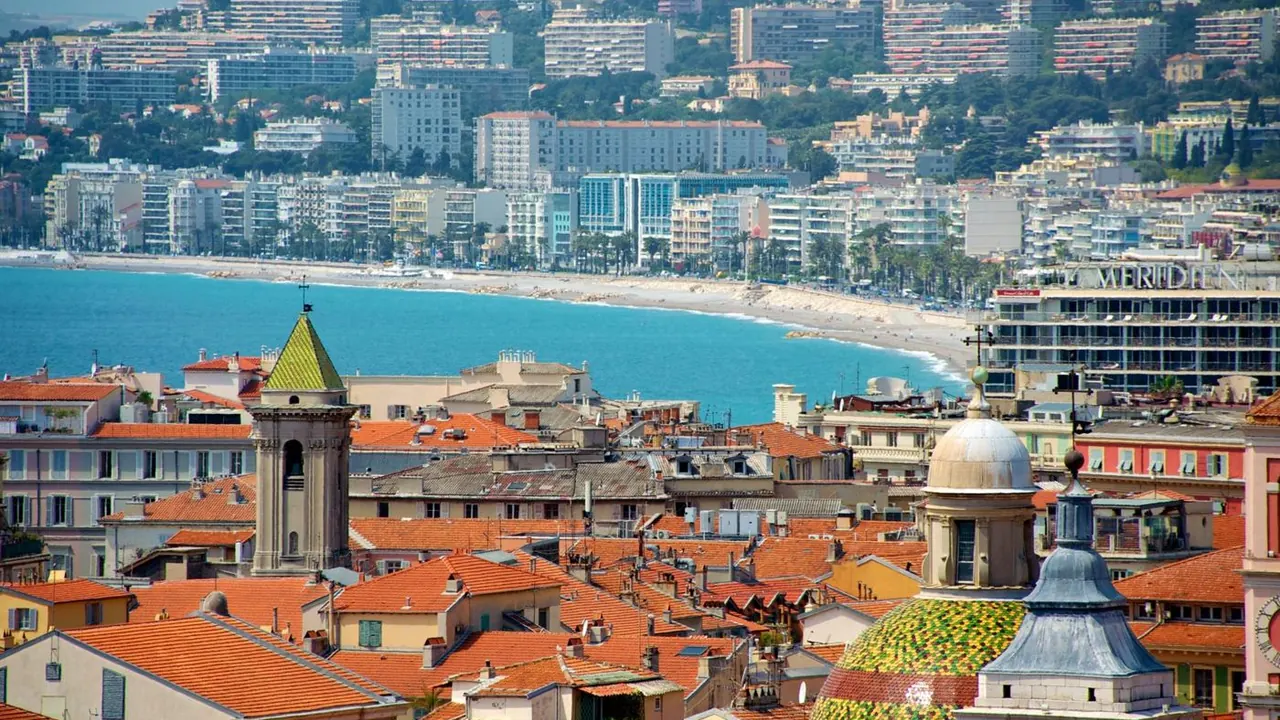
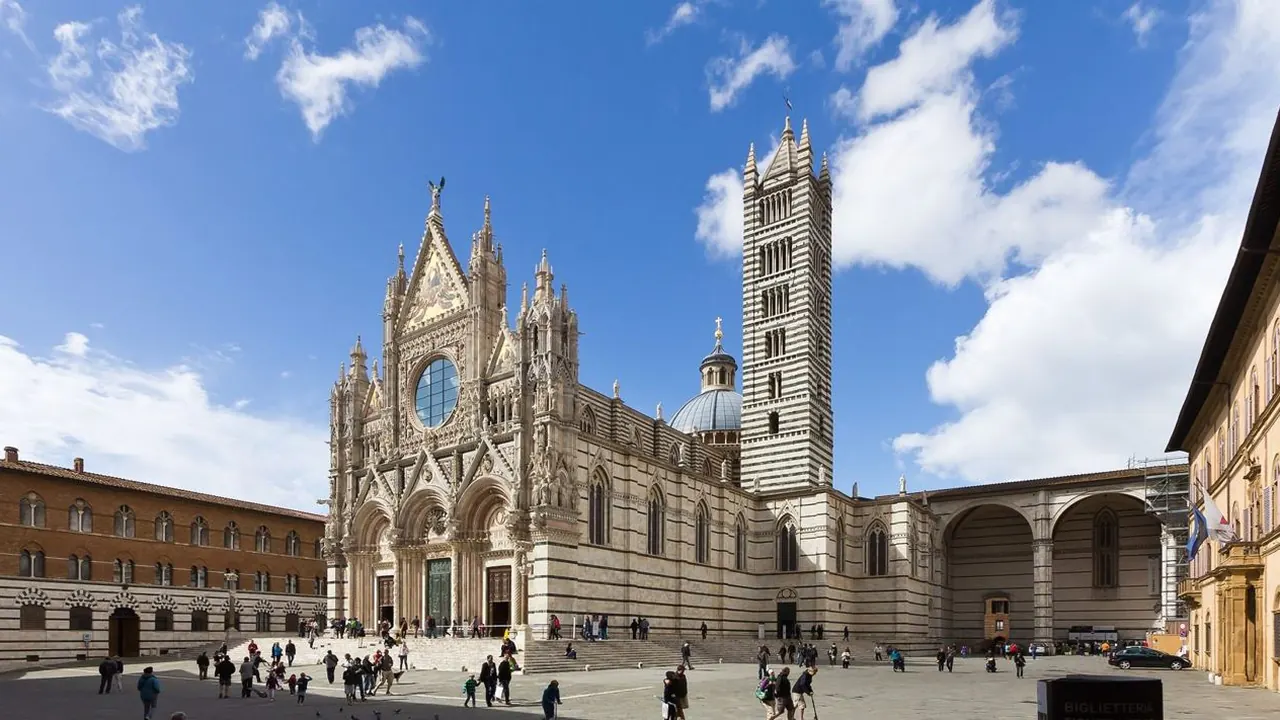
Photos: Nice by Daniel Stockman, CC BY-SA 2.0, cropped; Siena by Raimond Spekking, CC BY-SA 4.0, cropped.
Nice or Siena?
Our verdict in twelve categories, each scored against the same fixed benchmark cities, and the climate month by month, so you can choose for your trip.
Choose Nice for
- beaches
- nightlife
- shopping
Nice is for travellers who want the sea in every day of the trip: a morning swim from the city shore, coastal paths and Alpine valleys within reach, and a chain of Riviera towns along a railway line, all without a car. It is also the easier base with children, and the better one for anyone who likes a drink in the old town lanes after dinner.
Choose Siena for
- wellness
- culture and sights
- day trips
If medieval art and architecture are the reason for going, Siena wins. The Campo, the Duomo and the Sienese painters go deeper than Nice's modern art museums, and the countryside around it, from the Chianti villages to the Val d'Orcia and its hot springs, suits a slow trip. Go with a hire car, and don't expect a beach or late nights.
Scoreboard
Twelve categories on one fixed scale from 0 to 100. The shaded stretch is the gap between the two.
Your match
Pick a travel style or drag the sliders, and both match scores follow your weighting.
Wins on beaches and nightlife with your weighting.
Wins on wellness and culture and sights with your weighting.
What matters to you?
Category by category
What the scores mean for a trip.
Beaches & swimming
On beaches the two cities are worlds apart. Nice has about 7km of pebble shore directly below the promenade, with clear water from early summer to mid-autumn and loungers to rent on the private stretches. Sandier coves at Villefranche, Beaulieu and Juan-les-Pins are an easy train or bus ride away.
Siena is inland, and the sea plays no part in a stay there. The Maremma beaches are well over an hour's drive, so a swim takes a whole day, and in town swimming means a hotel or agriturismo pool.
Food & drink
Both cities eat well on their own regional cooking, and neither has the range of a big food capital. What differs is the kind of food. Nice cooks close to Liguria: socca hot from wood ovens, pissaladière, stuffed vegetables and a morning market on the Cours Saleya.
Siena is a place for pici, cinta senese pork, wild boar and its old baking tradition of panforte and ricciarelli. It also has the stronger wine, with Chianti Classico, Brunello and Vino Nobile poured in its enoteche, where Nice has only the small Bellet vineyards. In both cities, avoid the restaurants on the main square or the promenade.
Culture & sights
Siena offers the greater culture trip. Its whole walled centre is a UNESCO-listed medieval city, built around the Campo, the Palazzo Pubblico with Lorenzetti's Good and Bad Government, the Duomo, and Duccio's Maestà in the cathedral museum. The seventeen contrade, each with its own flag and fountain, give the streets a life that goes beyond the monuments.
Nice is stronger on modern art: the Matisse Museum in Cimiez, Chagall's biblical cycle and MAMAC. Around them are the Savoyard old town and the villas of the Belle Époque resort. It is enjoyable for two or three days but has nothing to match Siena's major works.
Nightlife
Neither is a clubbing city, but Nice has more to do after dark. The lanes of Vieux Nice fill with wine bars, pubs and cocktail bars, and in summer the beach clubs and the promenade keep people out late. Monaco and Cannes are close for a smarter night.
In Siena, an evening means dinner, a glass on the Campo and a walk home through quiet streets. The town only stays up late around the Palio, when the contrade hold their long street dinners.
Nature & outdoors
Nice has the wider range outdoors because the Alps meet the sea there. You can walk the coastal paths around Cap Ferrat in the morning and reach the larch forests and high lakes of the Mercantour in about two hours. In winter there is skiing at Isola 2000, and sailing, diving and kayaking are easy to arrange on the coast.
Siena's countryside is gentler and more pastoral: the bare clay hills of the Crete Senesi, the rolling Val d'Orcia and the white strade bianche gravel roads that draw cyclists. It has no high mountains and no coastline, though Monte Amiata adds beech forest and a little skiing.
Day trips
Both are excellent bases, and Siena has the richer choice. Florence, San Gimignano, Volterra, Montalcino, Pienza and Montepulciano are all near, along with the Chianti villages and the abbeys of Sant'Antimo and San Galgano. The catch is that many of the hill towns and wineries are much easier with a car.
Nice's day trips are fewer in kind but easier to reach. Monaco, Menton, Antibes and Cannes are on the coastal railway, buses climb to Èze and Saint-Paul-de-Vence, and Italy is a train ride away, so you don't need a car for any of them.
Good for families
Nice is the easier city with children. The flat promenade suits pushchairs and bikes, the Promenade du Paillon has playgrounds and water jets for hot days, and Parc Phoenix and Monaco's aquarium fill half days. The pebbles are hard on small feet, though.
Siena is safe and mostly free of cars, but it has no attractions made for children, and its steep streets are tiring with a pushchair. Older children enjoy climbing the Torre del Mangia and watching the contrada drummers. Many families stay at a countryside farmhouse with a pool and visit the town in half days.
Getting around
Nice is simpler to get around. The centre is flat and walkable, a tram runs straight from the airport to the port, and regional trains run the length of the coast. You only need a car for the mountains.
Siena's centre is small and largely closed to traffic, but it stands on three ridges, so short distances involve steep climbs, and escalators link the upper town to the station in the valley. Trains are slow and infrequent, buses cover Florence, and most visitors hire a car for the countryside.
Shopping & style
Nice has more to offer shoppers. Avenue Jean Médecin and its department store handle the high street, the streets around rue Paradis have the luxury fashion houses, and the Cours Saleya turns into an antiques and flea market on Mondays.
Siena is for small, local buys: hand-painted majolica, contrada scarves, panforte, pecorino and wine, plus a large weekly market by the Fortezza Medicea. There are no luxury streets and no department store worth the visit.
Affordability
Neither is cheap, but Siena is a little easier on the budget. Rooms inside its walls are scarce and cost more in summer and around the Palio, but osteria lunches with house wine are good value, and staying at an agriturismo or in a nearby town usually costs less. The cathedral and civic museum tickets add up over a visit.
Nice is dearer by southern European standards, especially for summer rooms near the sea and for beach loungers. Its cheap trams, coastal trains and low museum entry fees help, as do socca and market picnics away from the seafront.
Live music & performing arts
Nice has the fuller programme. The Opéra de Nice stages opera, ballet and philharmonic concerts, the Nice Jazz Festival is one of Europe's oldest and takes place each July, and the February Carnival is a long-standing tradition of parades and flower battles.
Siena's musical life is serious but small. The Accademia Chigiana puts on summer concerts in palaces and churches, Siena Jazz adds performances by its teachers and students, and two historic theatres run winter seasons. For opera or a major orchestra, you go to Florence.
Wellness & relaxation
Siena is better for a restful trip, because of the thermal water nearby. There are travertine pools at Rapolano Terme half an hour away, the steaming medieval bath at Bagno Vignoni, the free white limestone pools of Bagni San Filippo and the hot sulphur river at Petriolo.
Nice has no bathing tradition of its own, so spa time means hotel treatment rooms or thalassotherapy centres along the coast. Its kind of calm is an early swim and an evening walk on the promenade, and that works best outside high summer.
When should you go?
Pick your month. The climate figures are measured averages, not a forecast.
Nice in July
Siena in July
Daytime high, °C
Rainfall in the month, mm
Where the figures come from
Siena's temperatures are measured 45 km from the centre, at Arezzo.
Siena has no rain gauge within 25 km of the centre, so its rainfall comes from a gridded climate dataset read at the city rather than from a gauge further away.
Temperature and rainfall are climate normals, averaged over the years shown. Nice: 1991-2020 normals, Nice (8 km from centre). Siena: 2006-2017 (rainfall 1991-2020) normals, Arezzo (45 km from centre).
Nice has the gentler year. The sea is warm enough to swim from June into October and peaks at about 25°C in August, while July and August are dry and very sunny but crowded and hot at midday. The rain arrives with autumn: October and November are the wettest months, with about 138mm in November. Winters stay mild enough for walking the promenade, which makes Nice a reasonable choice for a winter break.
Siena has bigger swings. July and August reach about 31°C on its hills, which makes the steep streets hard going in the afternoon, and January highs of about 9°C make winter a quiet season. Late April, May and September are the best months for walking the town and the countryside, but rain is spread across much of the year, so pack for a few showers even in spring. November is the wettest month in both places.
Which traveller are you?
On a beach and sun trip, Nice is the obvious choice. You can swim from the city shore all summer, and there are sandy coves at Villefranche and Juan-les-Pins a short ride away. In Siena the nearest sea is a full day's outing.
For a culture and arts trip, Siena goes deeper. It is a whole medieval city, with Lorenzetti's frescoes, Duccio's Maestà and the Duomo's inlaid floor. Nice has Matisse and Chagall but nothing on that scale.
On a relaxing and wellness trip, Siena is the better choice. Rapolano, Bagno Vignoni and the free pools at Bagni San Filippo are all close, and a farmhouse stay among the hills completes the rest. Nice offers seafront hotel spas and an early swim instead.
Before you go
| Measure | Nice | Siena |
|---|---|---|
| Official language | French | Italian |
| Currency | Euro (EUR) | Euro (EUR) |
| Sockets | CE230 V, 50 Hz | CFL230 V, 50 Hz |
| Driving side | Right | Right |
| Time zone | UTC+1, UTC+2 in summer | UTC+1, UTC+2 in summer |
| Emergency number | 112 | 112 |
| Elevation | 0 m | 322 m |
| Main airport | Nice-Côte d'Azur Airport (NCE)6 km from centre130 non-stop destinations | Florence Airport, Peretola (FLR)55 km from centre46 non-stop destinations |
| Public holidays this year | 11 days | 13 days |
By the numbers
| Measure | Nice | Siena |
|---|---|---|
| City population | 357,737 | 52,812 |
| People per km² | 4,975 | 446 |
| Museums within 10 km | 17 | 30 |
| UNESCO World Heritage sites within 50 km | 2 | 5 |
| Swim season, months above 21 °C | 4 months | - |
Where else could you go?
Every comparison below shares a destination with this one, so you can follow Nice or Siena somewhere new.