Italy
Lucca
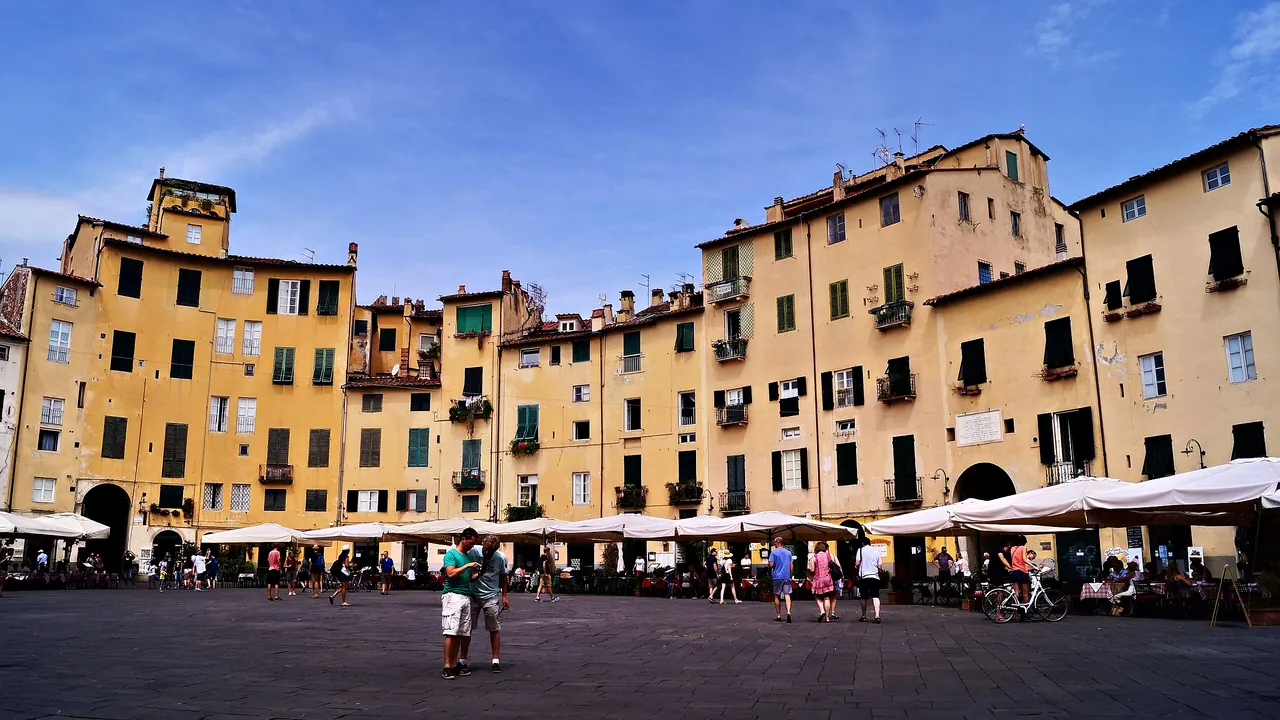
Piazza dell'Anfiteatro, the oval square built in the Roman amphitheatre
- Day trips91
- Getting around74
- Nature & outdoors68
Photo: Stefano Sansavini, CC BY-SA 4.0, cropped
Match
57
Every category weighted equally
- Beach & sun56
- Culture & arts60
- Food & nightlife53
- Family trip61
- Outdoors63
- Relax & unwind58
- Shopping & style55
- On a budget56
Lucca in twelve categories
Our verdict on each, scored 0 to 100 against the same fixed benchmark cities, so a score means the same thing on every page.
Beaches & swimming. Scores 55 out of 100.
Food & drink. Scores 58 out of 100.
Culture & sights. Scores 65 out of 100.
Nightlife. Scores 22 out of 100.
Nature & outdoors. Scores 68 out of 100.
Day trips. Scores 91 out of 100.
Good for families. Scores 57 out of 100.
Getting around. Scores 74 out of 100.
Shopping & style. Scores 42 out of 100.
Affordability. Scores 46 out of 100.
Live music & performing arts. Scores 54 out of 100.
Wellness & relaxation. Scores 51 out of 100.
Lucca category by category
Beaches & swimming
55Lucca is an inland city, but the Versilia coast starts about 25 minutes away by train at Viareggio. From there, long, wide sandy beaches run north past Lido di Camaiore and Marina di Pietrasanta to Forte dei Marmi. The shore shelves gently, the water reaches about 25°C in August and is good for swimming from June to September, and most of the sand is laid out in neat rows of umbrellas at beach clubs. For wilder free beaches, head to the dunes of the Lecciona, between Viareggio and Torre del Lago, where pine woods back the sand.
The beach makes an easy half day from Lucca, and in July and August the trains are full of locals doing the same. It suits travellers who want art and old streets in the morning and a swim in the afternoon. Anyone who wants to wake up by the sea should stay on the coast instead.
Food & drink
58Lucca eats in the style of its own province, which is plainer and more rustic than much of Tuscany. Look for zuppa di farro made with spelt from the Garfagnana, tordelli lucchesi (meat-filled pasta in a ragù), chestnut-flour dishes in autumn and winter, and slices of thin chickpea cecina from bakery counters. Buccellato, the anise and raisin sweet bread, is the city's own, and the hills around town produce a fine, mild olive oil along with the Colline Lucchesi and Montecarlo wines.
Most of the eating happens in family trattorias and osterie inside the walls, along with wine bars where aperitivo comes with local salumi. The quality is reliable and prices are fair for Tuscany. The range is narrow, though: international food and ambitious modern dining are thin on the ground, and after a few days the menus start to look alike.
Culture & sights
65Lucca's great sight is the city itself. Its Renaissance walls survive complete, broad and planted with trees, and they enclose a medieval grid of narrow streets, towers and dozens of churches. The Romanesque façades are the highlight: San Michele in Foro, stacked with tiers of carved arcades, San Frediano with its golden mosaic, and the Cathedral of San Martino, which holds Jacopo della Quercia's tomb of Ilaria del Carretto and the venerated Volto Santo crucifix. The oval Piazza dell'Anfiteatro follows the line of the Roman amphitheatre whose houses were built into it.
You can climb the Torre Guinigi, with oak trees growing on its top, or the clock tower. Palazzo Pfanner has a baroque garden, and Puccini's birthplace is a museum. The national museums at Villa Guinigi and Palazzo Mansi are good but modest. Two unhurried days cover the essentials.
Nightlife
22Evenings in Lucca mean an aperitivo in Piazza San Michele or Piazza dell'Anfiteatro, a long dinner, and a walk along the walls or down Via Fillungo. There are a few wine bars and pubs, some of them full of students, but the centre is calm by midnight for most of the year. In summer, younger visitors who want to dance head for the beach clubs and discos of the Versilia coast, which means driving or taking a taxi back late.
Nature & outdoors
68Within the city, the outdoors means the walls: a tree-lined ring about 4km long where locals walk, run and cycle. Cycle paths also follow the Serchio river out of town. Beyond that, the countryside is a gentle landscape of olive groves and villa gardens rising into the Lucchesi hills, with Monte Pisano to the south.
The drama lies to the north. The Apuan Alps rise steeply within about an hour, with sharp limestone peaks, white marble quarries and serious hiking routes. The Garfagnana valley and the Orecchiella park offer chestnut woods, beech forest and quiet trails. Toward the coast, Lake Massaciuccoli and the San Rossore park have reed beds, pine woods and good birdwatching. Spring and autumn are the best seasons, since high summer is hot in the plain.
Day trips
91Lucca makes a superb base for Tuscany and the coast. Pisa, with the Leaning Tower and the Campo dei Miracoli, is about half an hour away by train. Florence is a little over an hour. Pistoia's quiet medieval centre sits on the same line, and so do the old spa towns of Montecatini. Closer still are the great villas of the Lucca countryside, such as Villa Reale di Marlia and Villa Torrigiani with their formal gardens, and the hill village of Collodi with the baroque Villa Garzoni.
To the north are Viareggio, which holds a famous carnival with giant papier-mâché floats, the marble town of Pietrasanta with its sculptors' studios, and Carrara. Barga and the Garfagnana villages make a slower day. With an early start, the Cinque Terre and San Gimignano are both possible, at about two hours each.
Good for families
57Lucca is easy with children. The centre is small, flat and mostly free of traffic, and renting bikes or a family quadricycle to ride the walls is the classic outing. Children also enjoy climbing the Torre Guinigi to the trees on top and running around the oval piazza. Nearby, the Pinocchio Park at Collodi is about 20 minutes away and the Versilia beaches are under half an hour, which helps fill the days. In autumn, Lucca Comics & Games takes over the whole city with costumes and games, which delights older children and teenagers. Beyond that, the city has little made for children, and most sights are churches and palaces.
Getting around
74Inside the walls, Lucca is one of the easiest places in Italy to get around. It is compact and flat, and most of it is closed to ordinary traffic, so you walk or cycle everywhere. Bikes are the local way of moving, and rental shops are found near every gate. The railway station sits just outside the southern walls, with regular regional trains to Pisa, Viareggio, Pistoia and Florence. The countryside is another matter. Buses to the villas, the hill villages and the Garfagnana are sparse, so a car makes those days much simpler, but a car inside the walls is a burden.
Shopping & style
42Via Fillungo is the main street, a narrow, winding run of fashion and jewellery shops, some still behind old Liberty-style shopfronts and painted signs. The surrounding lanes add delicatessens selling local olive oil, wine, farro and buccellato, along with a few artisan workshops and paper shops. The city's real draw is its antiques market, one of the oldest in Italy, which fills the streets around the cathedral one weekend each month. Otherwise the shopping is pleasant but small-town, with no luxury depth.
Affordability
46Lucca costs about what you would expect in central Italy: noticeably less than Florence, but not cheap. Trattoria meals and regional trains are fairly priced, the walls and many churches are free, and the paid sights are modest. Accommodation is the main expense. There are few hotels inside the walls, and B&Bs and small hotels fill up in summer and during the big festivals, so staying just outside the walls is often better value.
Live music & performing arts
54Music in Lucca centres on Puccini, who was born here. For most of the year, short recitals of his arias are held in a church in the centre, so even a brief visit can include an evening of opera. The Teatro del Giglio, a nineteenth-century opera house, presents a season of opera, concerts and theatre. In July, the Lucca Summer Festival brings large outdoor concerts by international stars to Piazza Napoleone.
About half an hour away, the Puccini Festival stages open-air opera in summer beside the lake at Torre del Lago, where the composer lived. The city also has a long-established music conservatory, which adds student concerts. Outside these, the live music scene is small.
Wellness & relaxation
51Lucca has no thermal baths or bathing tradition of its own, and there are few hotel spas inside the walls. Here, relaxing comes from the pace of the place: quiet streets with no traffic, long lunches, and an evening walk on the shaded walls when the light turns gold.
For a proper soak you have to leave town. Montecatini Terme, with grand spa buildings from its belle époque heyday, is about half an hour away by train. Nearby Monsummano Terme has warm pools inside a natural cave. Bagni di Lucca is an old spa resort in the wooded Serchio valley, known for its natural steam grottoes, and is under an hour away by road. These make a good spa day out, but Lucca suits travellers who want a gentle rhythm more than those who plan a vacation around bathing.
When should you go?
Pick a month to see what it is like. The climate figures are measured averages, not a forecast.
Lucca in July
Daytime high, °C
Rainfall in the month, mm
The whole year
Shaded against this city’s own year: the deepest cell is its best month for that figure and the palest its weakest.
Temperature and rainfall are climate normals, averaged over the years shown. Lucca: 1991-2020 normals, Pisa / S. Giusto (21.4 km from centre).
Before you go
| Measure | Lucca |
|---|---|
| Official language | Italian |
| Currency | Euro (EUR) |
| Sockets | CFL230 V, 50 Hz |
| Driving side | Right |
| Time zone | UTC+1, UTC+2 in summer |
| Emergency number | 112 |
| Elevation | 19 m |
| Main airport | Pisa International Airport (PSA)21 km from centre82 non-stop destinations |
| Public holidays this year | 13 days |
By the numbers
| Measure | Lucca |
|---|---|
| City population | 88,798 |
| People per km² | 478 |
| Museums within 10 km | 20 |
| UNESCO World Heritage sites within 50 km | 4 |
| Swim season, months above 21 °C | 4 months |
Compare Lucca with
Every comparison with a written verdict behind it.
- Amalfi
- Annecy
- Antibes
- Avignon
- Bari
- Basel
- Bern
- Bled
- Bologna
- Cannes
- Catania
- Chamonix
- Como
- Cortina d'Ampezzo
- Florence
- Geneva
- Genoa
- Hallstatt
- Innsbruck
- Interlaken
- La Spezia
- Lausanne
- Lecce
- Ljubljana
- Lucerne
- Lyon
- Marseille
- Matera
- Milan
- Monaco
- Munich
- Naples
- Nice
- Palermo
- Pisa
- Portofino
- Positano
- Rome
- Rovinj
- Saint-Tropez
- Salerno
- Salzburg
- Siena
- Sorrento
- Split
- Trieste
- Turin
- Venice
- Verona
- Zadar
- Zagreb
- Zurich