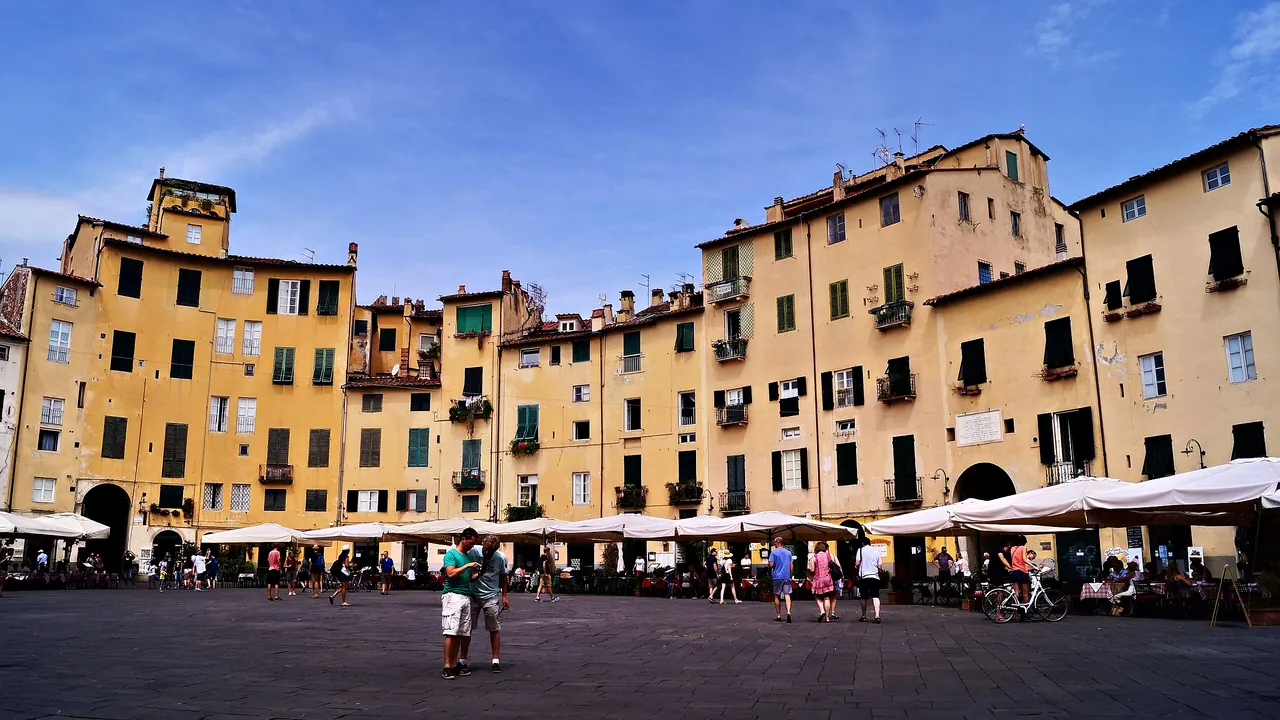
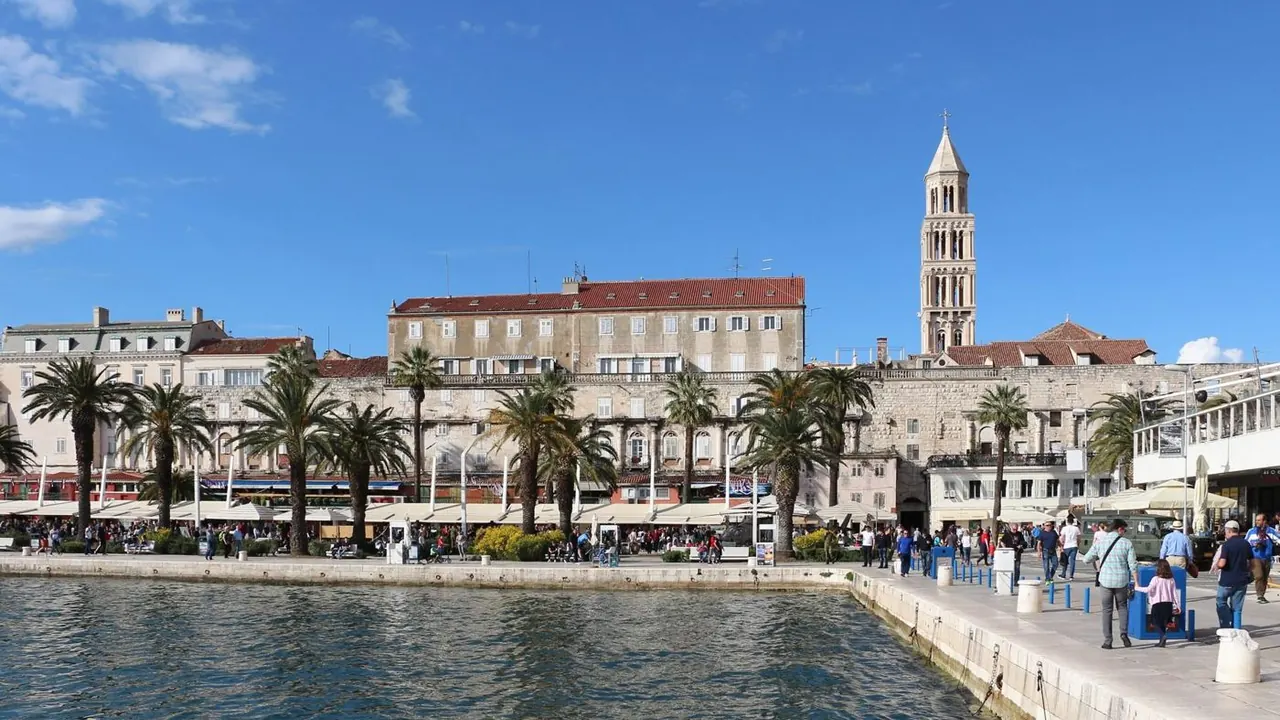
Photos: Lucca by Stefano Sansavini, CC BY-SA 4.0, cropped; Split by Bernard Gagnon, CC BY-SA 4.0, cropped.
Lucca or Split?
Our verdict in twelve categories, each scored against the same fixed benchmark cities, and the climate month by month, so you can choose for your trip.
Choose Lucca for
- live music and the arts
- day trips
- wellness
Lucca suits a traveller who wants a quiet, walkable base for seeing Tuscany. The walled centre is flat and almost free of cars, Puccini's music is on offer most evenings, and Pisa, Florence, Pistoia and the villa gardens are an easy train ride or short drive away. It is the better choice for a slower trip built around art, long lunches and excursions, with the Versilia sand as an afternoon extra.
Choose Split for
- nightlife
- beaches
- nature and the outdoors
If the sea and the outdoors come first, Split is the place to go. You can walk from Diocletian's Palace to a swim, ferries leave the harbour for Brač, Hvar and Šolta, and Marjan, the Cetina canyon and the Biokovo range give far more to do on foot or on the water. Summer evenings in the palace alleys and around Bačvice also run much later than anything inside Lucca's walls.
Scoreboard
Twelve categories on one fixed scale from 0 to 100. The shaded stretch is the gap between the two.
Your match
Pick a travel style or drag the sliders, and both match scores follow your weighting.
Too close to call, level with your weighting
Wins on live music and the arts and day trips with your weighting.
Wins on nightlife and beaches with your weighting.
What matters to you?
Category by category
What the scores mean for a trip.
Beaches & swimming
Split has the sea on its doorstep, and Lucca does not. Bačvice's shallow sandy bay is a short walk from the palace, the Marjan coves add pine shade and deeper water, and catamarans reach Brač and Hvar for longer beaches. The catch is that most of the city shore is pebble or concrete, and it gets crowded in high summer.
Lucca's beaches are a train ride away at Viareggio, but they are softer underfoot. Wide, gently shelving sand runs north to Forte dei Marmi, mostly laid out in rows of umbrellas, and the Lecciona dunes are there for something wilder. It works as an afternoon outing rather than a reason to stay.
Food & drink
The two are much the same on quality, and both kitchens are regional and offer little international food. What you eat is quite different, though. Lucca's food is rustic and inland: spelt soup, tordelli in ragù, chestnut flour and chickpea cecina, with the mild olive oil of the hills and Montecarlo wine.
Split cooks from the sea, with grilled fish, black risotto and peka, best eaten in the konobas of Varoš, and its fish market and the Pazar are better places to browse. Lucca's trattorias inside the walls are more consistent, while many menus inside Split's palace are aimed at the summer crowd.
Culture & sights
The two are evenly matched. In both, the city itself is the main sight, and two days cover it. Lucca's draw is a medieval street plan inside intact Renaissance walls, with the carved arcades of San Michele in Foro, the cathedral's tomb of Ilaria del Carretto and the oval Piazza dell'Anfiteatro.
Split has one larger and older monument instead. Diocletian's Palace is a Roman emperor's residence that people still live in, with a cathedral in his mausoleum and vaulted halls underneath. For museums, the Meštrović Gallery gives Split a slight edge over Lucca's modest national collections.
Nightlife
Split is far livelier after dark, at least in summer. Bars fill the stone stairways of the palace until late, and the clubs around Bačvice run into the early hours. From October to May, though, the scene shrinks to a few bars.
Lucca's evenings are an aperitivo in a piazza, a long dinner and a stroll on the walls, and the centre is quiet by midnight. Anyone who wants to dance has to go out to the Versilia coast and arrange a late ride back.
Nature & outdoors
Split has more right on its doorstep. The pine forest and cliffs of Marjan start at the edge of the old town, Mosor and Kozjak offer ridge hikes behind the city, and the sea adds kayaking, sailing and island-hopping. Rafting in the Cetina canyon and the waterfalls of Krka are easy day outings.
Lucca's own outdoors is gentler: the 4km tree-lined walls, cycle paths along the Serchio and hills covered in olive groves. The real scenery is about an hour away, in the marble peaks of the Apuan Alps and the chestnut woods of the Garfagnana. In both places, spring and autumn are better for walking than midsummer.
Day trips
Lucca is the stronger base, mostly because some of Italy's best-known towns are on its railway line. Pisa is about half an hour away and Florence a little over an hour. Pistoia, the Montecatini spas, the villa gardens at Marlia and Collodi, and the marble-carving town of Pietrasanta are all close by.
Split's excursions are good but fewer, and many depend on ferries or the coast road. The choice includes Trogir and Šibenik, the Roman ruins at Salona, Klis Fortress and the islands of Hvar and Brač. These trips are easy in summer but need more planning in winter.
Good for families
Neither city has much built for children, and both work best for simple days out. In Lucca the treat is riding the walls on a rented quadricycle and wandering streets free of traffic. Pinocchio Park at Collodi is nearby, and in autumn Lucca Comics & Games delights older children.
Split offers the sea instead. Bačvice is shallow enough for small children, Marjan gives shade and room to run, and a ferry to an island is often the best day. The polished steps of the palace and the summer crowds make it harder work with a pushchair.
Getting around
Inside Lucca's walls the streets are flat and mostly closed to ordinary traffic, so a bike from one of the rental shops by the gates takes you everywhere. The station just outside the southern walls has regular trains to Pisa, Florence and Viareggio. You only really need a car for the villas, the hill villages and the Garfagnana, where buses are sparse.
Split's centre is just as compact, but the palace lanes are polished stone and full of steps, which is hard going with heavy luggage. Local buses are basic and the coast road is slow in summer. Leaving the city is the easy part, because the ferries, intercity buses and trains all go from the same harbour.
Shopping & style
Lucca is the better place to shop, though you would not travel to either just for shopping. Via Fillungo has fashion and jewellery shops behind old Liberty-style shopfronts, the side streets have good delicatessens, and the monthly antiques market around the cathedral is a real draw.
Split's palace shops lean towards souvenirs, lavender and ties, and the fashion chains are on Marmontova. Its best browsing is the Pazar market, with dried figs, honey and local brandy.
Affordability
Overall costs are much the same, and neither city is cheap. In Lucca the main expense is rooms, since there are few hotels inside the walls. Staying just outside them saves money, and meals and trains are fairly priced.
In Split the cost depends far more on the season. Rooms near the old town are expensive in July and August and ferries to the islands add up, while May, June, late September and winter are much kinder to the budget.
Live music & performing arts
Lucca has the richer musical life, and it is built on Puccini. Recitals of his arias are held through most of the year and the Teatro del Giglio has an opera season. The summer festival brings big concerts to Piazza Napoleone, and Torre del Lago stages his operas outdoors beside the lake.
Split has the Croatian National Theatre, the open-air summer festival in the Peristyle and klapa singing in the palace vestibule. Outside summer, though, there is much less on.
Wellness & relaxation
Lucca has the edge for a restful trip, mainly because real thermal water is within easy reach. Montecatini's grand belle époque spa halls are half an hour away by train, Monsummano Terme has warm pools inside a natural cave, and the old resort of Bagni di Lucca has steam grottoes in the wooded Serchio valley. Lucca itself has few spas, but its car-free streets and a slow walk on the walls at dusk make the town restful.
Split has nothing like that. There are no thermal springs to visit, and a pampering day means a massage or a hotel spa at one of the resorts east of the centre. What it offers instead is fjaka, the Dalmatian habit of idling, which shows in coffees on the Riva that stretch across a whole morning. In high summer the old town stays noisy late into the night, so rest is easier to find in the shoulder months, among the pines of Marjan or out on an island.
When should you go?
Pick your month. The climate figures are measured averages, not a forecast.
Lucca in July
Split in July
Daytime high, °C
Rainfall in the month, mm
Temperature and rainfall are climate normals, averaged over the years shown. Lucca: 1991-2020 normals, Pisa / S. Giusto (21.4 km from centre). Split: 1991-2020 (sunshine 1971-2000, rainfall 1981-2010) normals, Split / Marjan (0.9 km from centre).
The two cities have a similar Mediterranean year. Both are warm enough for the beach from June to September, and in July and August they reach about 30°C, which is too hot for long walks through the streets at midday. Split is the sunnier and slightly drier of the two in summer, and its sea stays pleasant for swimming into early October. Lucca sits on a plain, so its high-summer afternoons can feel heavy, and its hill walks are better left for spring and autumn.
The biggest difference comes in autumn. Lucca turns wet from September, and October and November are its rainiest months at around 130mm, so May, June and early September are the safest months there. Split also gets wetter late in the year, but much less until November, so October is still a reasonable month for walking and hiking on the Dalmatian coast. In winter both sit at about 11°C to 12°C, which is mild enough for sightseeing but too cold for the sea.
Which traveller are you?
For a beach and sun trip, Split is the clear choice. You can swim at Bačvice or in the coves of Marjan without leaving the city, and the islands are a ferry ride away. From Lucca, every swim means a train to Viareggio and back.
On a culture and arts trip, Lucca has the edge. Its Romanesque churches and complete walls hold their own against Split's Roman palace, but Lucca also has Puccini recitals and the Teatro del Giglio for the evenings, and Pisa and Florence are easy train rides away.
For a food and nightlife trip, Split works better. Both cities serve honest regional cooking, but in Split the evenings carry on in the palace bars and the clubs near Bačvice. In Lucca the streets are mostly quiet by midnight.
Before you go
| Measure | Lucca | Split |
|---|---|---|
| Official language | Italian | Croatian |
| Currency | Euro (EUR) | Euro (EUR) |
| Sockets | CFL230 V, 50 Hz | CF230 V, 50 Hz |
| Driving side | Right | Right |
| Time zone | UTC+1, UTC+2 in summer | UTC+1, UTC+2 in summer |
| Emergency number | 112 | 112 |
| Elevation | 19 m | 0 m |
| Main airport | Pisa International Airport (PSA)21 km from centre82 non-stop destinations | Split Saint Jerome Airport (SPU)12 km from centre69 non-stop destinations |
| Public holidays this year | 13 days | 14 days |
By the numbers
| Measure | Lucca | Split |
|---|---|---|
| City population | 88,798 | 160,577 |
| People per km² | 478 | - |
| Museums within 10 km | 20 | 11 |
| UNESCO World Heritage sites within 50 km | 4 | 4 |
| Swim season, months above 21 °C | 4 months | 4 months |
Where else could you go?
Every comparison below shares a destination with this one, so you can follow Lucca or Split somewhere new.