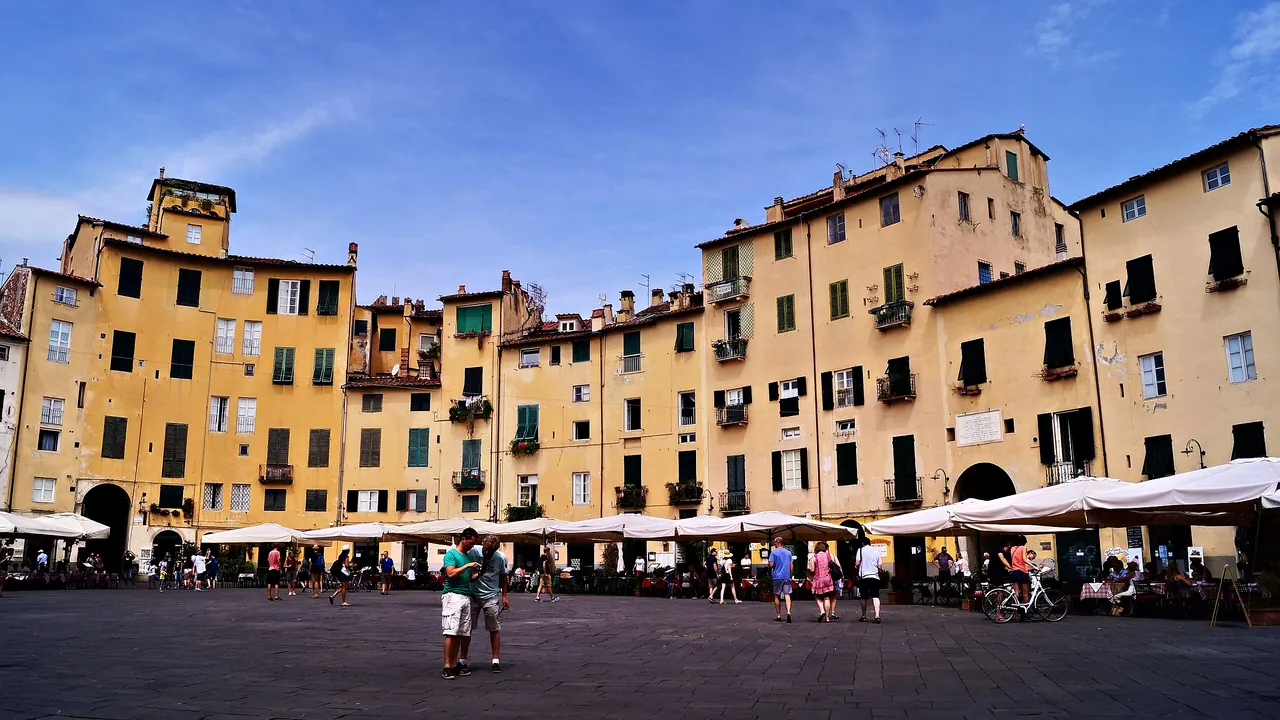
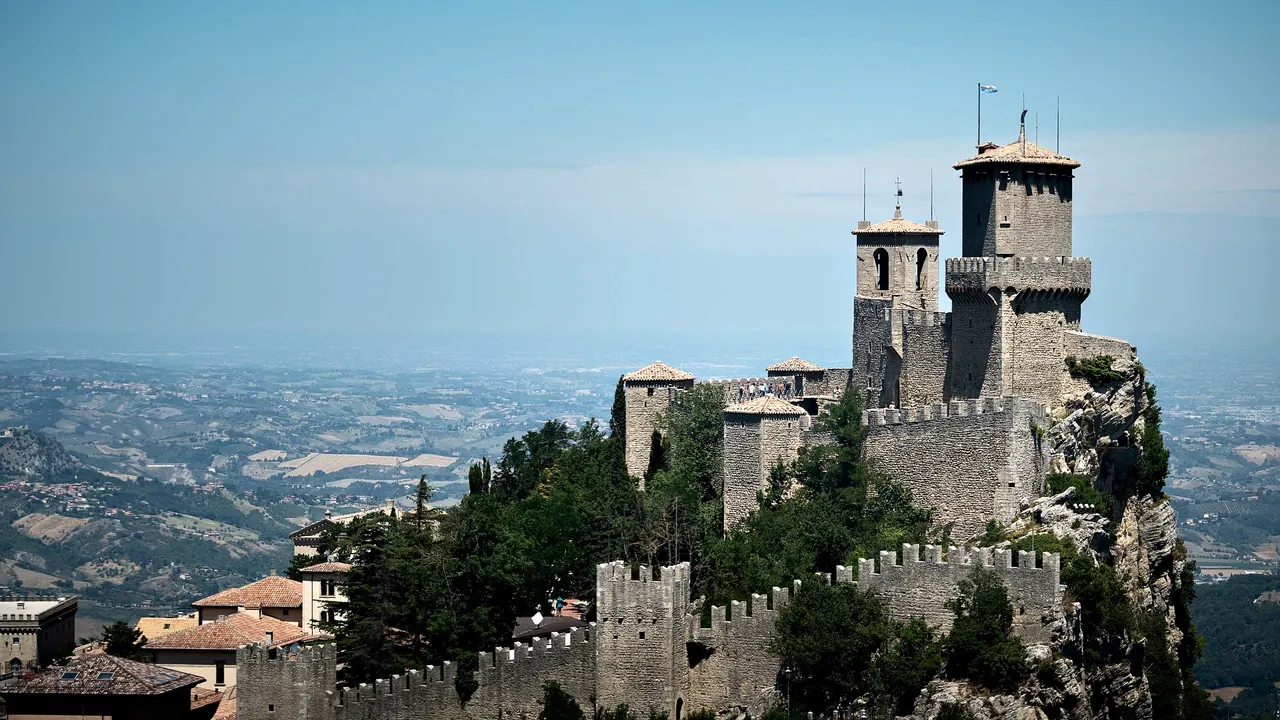
Photos: Lucca by Stefano Sansavini, CC BY-SA 4.0, cropped; San Marino by Tibor Szabo, Pexels License.
Lucca or San Marino?
Our verdict in twelve categories, each scored against the same fixed benchmark cities, and the climate month by month, so you can choose for your trip.
Choose Lucca for
- live music and the arts
- getting around
- nature and the outdoors
Lucca is the stronger choice for almost any trip longer than a day. Its complete walls enclose a flat, car-free town of Romanesque churches, Puccini fills the evenings, and the railway puts Pisa, Florence and the Versilia beaches within easy reach. It suits travellers who want to stay put in one place for several days, with slow mornings in town and afternoons spent on art, mountains or the sea.
Choose San Marino for
- prices
San Marino works better as a short, singular stop: a medieval town on a ridge that is also one of the world's oldest surviving republics, and you can see it well in half a day. It makes most sense for drivers touring the Romagna coast and the Montefeltro hills, or for families who want towers and battlements in the morning and Rimini's shallow beaches after lunch. Its prices also run a touch gentler.
Scoreboard
Twelve categories on one fixed scale from 0 to 100. The shaded stretch is the gap between the two.
Your match
Pick a travel style or drag the sliders, and both match scores follow your weighting.
Wins on live music and the arts and getting around with your weighting.
Wins on prices with your weighting.
What matters to you?
Category by category
What the scores mean for a trip.
Beaches & swimming
Neither city is on the sea, but Lucca gets you to the water more easily. Regional trains reach Viareggio in about 25 minutes, and the sandy Versilia shore runs north from there to Forte dei Marmi. If you tire of the rows of umbrellas, the dunes of the Lecciona are backed by pine woods.
San Marino looks down on the Adriatic, but getting to Rimini or Riccione means a car or a longer bus ride. The shore there is almost all beach clubs and shallow water, which is good for children but has very little wild coast.
Food & drink
Lucca eats noticeably better. Family trattorias inside the walls serve spelt soup, tordelli in ragù and chestnut dishes in the cold months, the bakeries sell cecina, and the hills supply mild olive oil and Montecarlo wines. The range is narrow but reliable.
San Marino cooks the hearty Romagna repertoire of piadina, passatelli and strozzapreti. The terraces on the summit sell the view more than the food, though, so a good meal means going down to Borgo Maggiore or over the border.
Culture & sights
In both places the town itself is the main sight, but Lucca has far more to fill the days. Inside its complete Renaissance walls are the arcaded façade of San Michele, the golden mosaic of San Frediano, the cathedral with Ilaria del Carretto's tomb, and the oval piazza built on a Roman amphitheatre. That is enough for two unhurried days.
San Marino offers a dramatic setting rather than depth: three towers on a cliff edge, the Palazzo Pubblico and the story of an ancient republic. You can see it all well in half a day.
Nightlife
Neither place is for a night out, but Lucca at least has an evening. An aperitivo in Piazza San Michele, a long dinner and a few wine bars and student pubs keep the centre going until around midnight. San Marino's summit goes quiet once the coaches leave and only a handful of terraces stay open above the lights of the coast, so dancing means a late drive down to the Rimini clubs, just as it means a trip to the Versilia from Lucca.
Nature & outdoors
Lucca has the bigger landscape on its doorstep. The Apuan Alps rise within about an hour, with sharp limestone peaks and serious hiking. The Garfagnana and the Orecchiella add beech and chestnut woods, and Lake Massaciuccoli has reed beds for birdwatching. Closer to home, the walls and the paths along the Serchio are good for running and cycling.
San Marino's nature is Monte Titano itself, a ridge of about 740m with cliff paths between the towers and views to the Adriatic. It suits a morning walk or a drive through the Montefeltro hills, not a hiking trip.
Day trips
Both make good bases, but Lucca's day trips are easier and there are more of them. Pisa is half an hour by train and Florence a little over an hour. Pistoia, Montecatini, the great villas, Pietrasanta and even the Cinque Terre can all be done in a day.
San Marino has strong destinations of its own, from San Leo's fortress on its rock to Urbino and the Byzantine mosaics of Ravenna. The only regular public transport, though, is the bus down to Rimini, so most of them need a car.
Good for families
Lucca is the easier choice with children. Its flat, traffic-free centre and a bike ride round the walls, perhaps on a family quadricycle, make for relaxed days. The Pinocchio Park at Collodi and the beaches are close by, and Lucca Comics & Games each autumn appeals to older children.
San Marino delights children with its battlements and the cable car, but the steep streets and steps are hard work with a pushchair. Most of the family attractions are down on the Rimini coast, which is easiest with a car.
Getting around
On a bike, Lucca is hard to beat. The town inside the walls is flat and compact, most of it is closed to ordinary traffic, and rental shops wait near every gate, so a lap of the ramparts or a ride across the centre takes minutes. Arriving is just as simple, because the station sits just outside the southern walls, with regular trains to Pisa, Viareggio and Florence. Only the villas and the Garfagnana really call for a car, and it is best left outside the walls.
San Marino's core is car-free too, but where Lucca is level ground, Monte Titano is all slopes and steps, so you go on foot rather than by bike and feel every climb. There is no railway on the mountain either. Lucca's trains stop at the foot of its walls, but here you change at Rimini for the bus up, and once you are on the summit the cable car down to Borgo Maggiore does the job a bike does in Lucca.
Shopping & style
Lucca's shops are small-town but have real character, while San Marino's are mostly souvenirs and lower-tax goods. Via Fillungo winds past fashion and jewellery shops, some behind old Liberty-style fronts and painted signs, and the side lanes sell local oil, farro and buccellato. One weekend a month, one of Italy's oldest antiques markets fills the streets around the cathedral.
On Monte Titano, the summit shops lean towards ceramics, decorative crossbows and the republic's stamps and coins, which collectors seek out. Italians come up for perfume, watches, leather and spirits, and an outlet centre in the valley adds fashion brands. There is little independent craft to find.
Affordability
The two cost about the same, and San Marino is slightly gentler on the wallet. Its hotels are moderate outside August, the sights are inexpensive and lower taxes make fuel and spirits cheaper, though the summit charges extra for its views.
In Lucca, meals, trains and the many free churches are fair value. Accommodation is the main expense because there are few rooms inside the walls, so staying just outside them often pays off.
Live music & performing arts
Lucca is far ahead here, thanks to Puccini. Recitals of his arias run through most of the year, and the Teatro del Giglio has a season of opera and concerts. Summer adds big-name concerts in Piazza Napoleone and open-air opera by the lake at Torre del Lago.
San Marino has a small theatre and occasional concerts by local ensembles. Its best-known event is the Medieval Days festival, with costumed musicians and crossbow contests, and for opera, people go to Pesaro or Bologna.
Wellness & relaxation
For a spa day, Lucca is much better placed. It has no baths of its own, but Montecatini's belle époque spa buildings are half an hour away by train, Monsummano Terme has warm pools inside a natural cave, and Bagni di Lucca's steam grottoes lie up the wooded Serchio valley. Back in town, the quiet, traffic-free streets and an evening on the shaded walls keep the pace easy.
San Marino has a few hotel spas and little else. It grows calm once the day visitors leave and the plain stretches out below the walls, but summer afternoons around the towers are crowded, and the thermal spas are well down the mountain.
When should you go?
Pick your month. The climate figures are measured averages, not a forecast.
Lucca in July
San Marino in July
Daytime high, °C
Rainfall in the month, mm
Where the figures come from
San Marino's temperatures are measured 52 km from the centre, at Frontone.
San Marino has no rain gauge within 25 km of the centre, so its rainfall comes from a gridded climate dataset read at the city rather than from a gauge further away.
Temperature and rainfall are climate normals, averaged over the years shown. Lucca: 1991-2020 normals, Pisa / S. Giusto (21.4 km from centre). San Marino: 1991-2020 normals, Frontone (51.5 km from centre).
Lucca is at its best in May, June and September, when the days are warm but not yet heavy. July and August reach about 30°C on the plain, so sightseeing works best early and late. The Versilia sea is warm enough for swimming from June to September, and July is the sunniest month. Rain arrives in earnest in autumn, and October and November are the wettest months at around 130mm. Winters are cool but fine for walking the streets.
San Marino has much the same summer heat, and the Adriatic below is warmest in August, at about 26°C. The mountain is colder in spring, autumn and winter, with January highs near 7°C, and spring warms more slowly, so late May to September suits it best. Its rain is spread more evenly through the year. Autumn is still the wettest season, but the downpours are lighter than in Lucca.
Which traveller are you?
For a culture and arts trip, Lucca is the clear pick. Its Romanesque churches need a couple of days, Puccini recitals and the Teatro del Giglio fill the evenings, and Florence and Pisa are a short train ride away. San Marino's sights fit into an afternoon.
On an outdoors trip, Lucca has the Apuan Alps about an hour to the north, with marble peaks and serious hiking, plus the forests of the Garfagnana. San Marino offers pleasant walks around Monte Titano but no high mountains or long trails.
On a trip on a tight budget, San Marino has a slight edge if you sleep in the lower villages rather than on the summit. Hotels there are moderate outside August and the sights cost little. Lucca is close behind, but its few rooms inside the walls fill quickly.
Before you go
| Measure | Lucca | San Marino |
|---|---|---|
| Official language | Italian | Italian |
| Currency | Euro (EUR) | Euro (EUR) |
| Sockets | CFL230 V, 50 Hz | CFL230 V, 50 Hz |
| Driving side | Right | Right |
| Time zone | UTC+1, UTC+2 in summer | UTC+1, UTC+2 in summer |
| Emergency number | 112 | 112 |
| Elevation | 19 m | 675 m |
| Main airport | Pisa International Airport (PSA)21 km from centre82 non-stop destinations | Bologna Guglielmo Marconi Airport (BLQ)114 km from centre98 non-stop destinations |
| Public holidays this year | 13 days | 18 days |
By the numbers
| Measure | Lucca | San Marino |
|---|---|---|
| City population | 88,798 | 4,040 |
| People per km² | 478 | 569 |
| Museums within 10 km | 20 | 19 |
| UNESCO World Heritage sites within 50 km | 4 | 2 |
| Swim season, months above 21 °C | 4 months | 4 months |
Where else could you go?
Every comparison below shares a destination with this one, so you can follow Lucca or San Marino somewhere new.