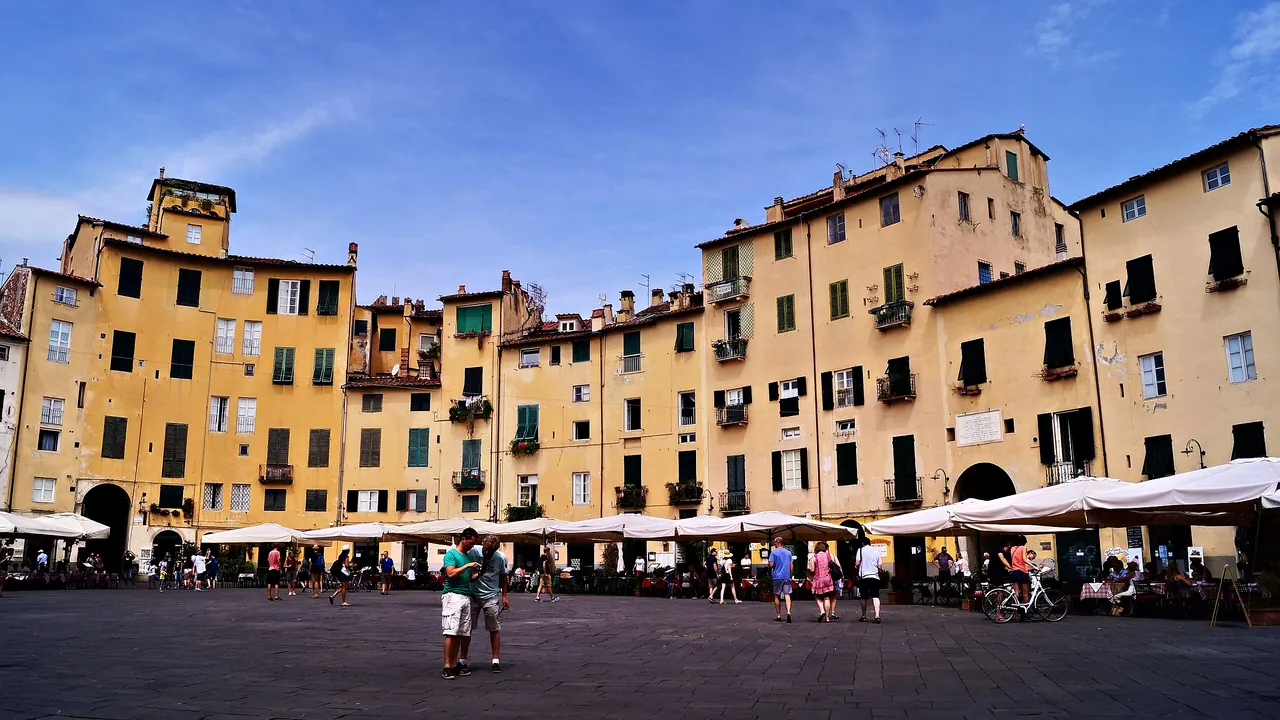
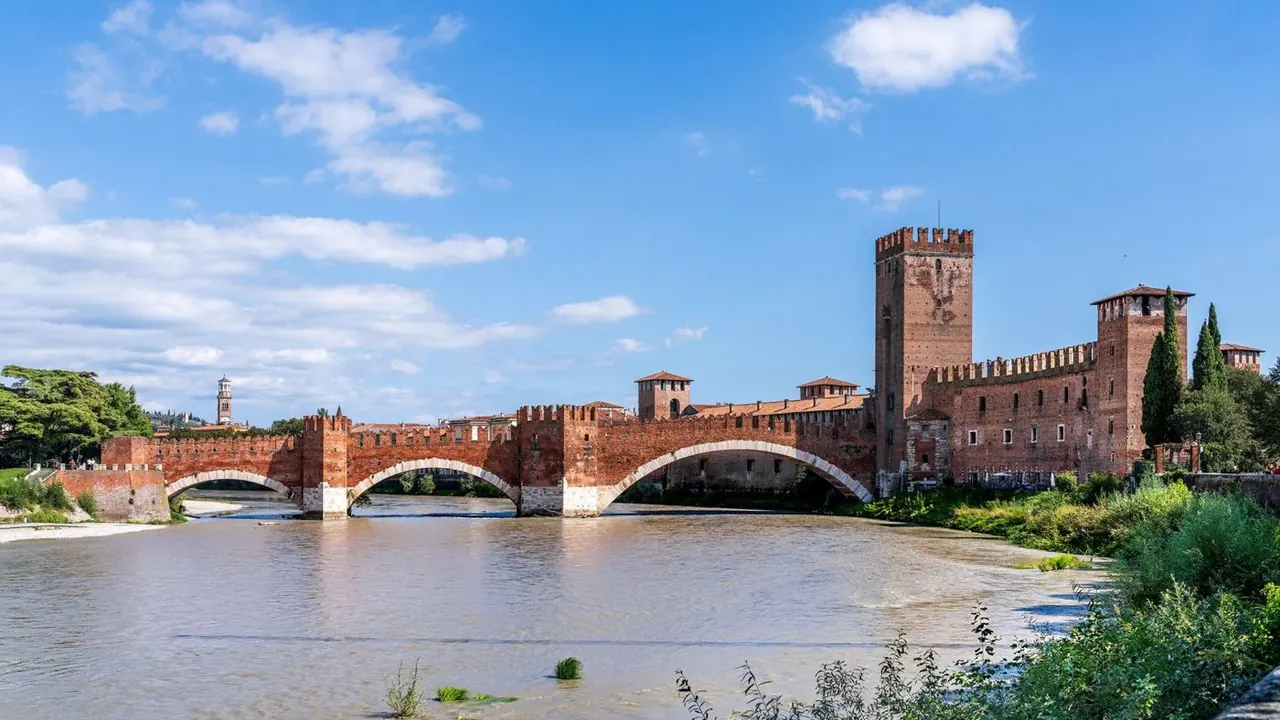
Photos: Lucca by Stefano Sansavini, CC BY-SA 4.0, cropped; Verona by NorbertNagel, CC BY-SA 4.0, cropped.
Lucca or Verona?
Our verdict in twelve categories, each scored against the same fixed benchmark cities, and the climate month by month, so you can choose for your trip.
Choose Lucca for
- beaches
- getting around
- nature and the outdoors
Lucca suits a slower, quieter trip. It is a walled town you cross by bike, with Romanesque churches, plain Tuscan cooking and calm evenings, and the sandy Versilia beaches are close enough for an afternoon swim. Choose it if you like the idea of mornings in old streets and afternoons by the sea, and you don't mind that the town itself is seen in a couple of days.
Choose Verona for
- nightlife
- live music and the arts
- culture and sights
Verona gives you more city for your days. It has a Roman arena, the Scaliger squares, Castelvecchio, and opera under the stars in summer. Amarone and Valpolicella give the table more depth, and the evenings go on a little later. Families also have Lake Garda and its theme parks nearby. It is the stronger choice for travellers who want history, music and wine more than sand.
Scoreboard
Twelve categories on one fixed scale from 0 to 100. The shaded stretch is the gap between the two.
Your match
Pick a travel style or drag the sliders, and both match scores follow your weighting.
Wins on beaches and getting around with your weighting.
Wins on nightlife and live music and the arts with your weighting.
What matters to you?
Category by category
What the scores mean for a trip.
Beaches & swimming
Neither city is on the water, but Lucca is better connected to it. Viareggio is about 25 minutes away by train, and from there the long, gently shelving Versilia sands run north in rows of beach-club umbrellas. For something wilder, the pine-backed dunes of the Lecciona are close by.
Verona's swimming is in the lake, on the southern shore of Garda. The water is calm and tideless, and you swim from lidos, lawns and small pebble beaches, with Sirmione's limestone shelves the favourite. It is pleasant, but the beaches are narrower and crowded at weekends, so it feels more like an outing than Lucca's easy afternoon at the sea.
Food & drink
Both cities cook rustic regional food rather than anything ambitious, but Verona's has more depth. In Lucca you eat spelt soup, meat-filled tordelli, cecina and autumn chestnut dishes in family trattorias inside the walls. It is reliable and fairly priced, though the menus start to repeat after a few days.
Verona offers Amarone risotto, bigoli with duck, bollito with peppery pearà and horse stewed in red wine. Its real strength is the wine: Valpolicella, Soave and Bardolino are all made a short drive away. The counters around Piazza delle Erbe and in Veronetta make an evening of tasting easy, as long as you avoid the tourist menus by the Arena.
Culture & sights
In Lucca the town is the sight. The Renaissance walls are complete, and inside them lies a medieval grid of towers and Romanesque façades such as San Michele in Foro and San Frediano. The oval Piazza dell'Anfiteatro follows the line of the Roman amphitheatre. The museums are modest, and two days are enough.
Verona has more to see. Its Roman arena is among the best preserved anywhere, and a Roman theatre climbs the hill across the river. Add the Scaliger tombs, San Zeno's bronze doors and Castelvecchio's art collection in Carlo Scarpa's setting. It deserves a third day and suits travellers who enjoy seeing Roman, medieval and Renaissance layers in one place.
Nightlife
Neither city has much nightlife, but Verona stays up later. Its aperitivo crowd fills Piazza delle Erbe and the riverside, and the student bars of Veronetta stay busy into the night. In summer, the audience leaving the Arena near midnight brings the centre back to life.
In Lucca the evening is an aperitivo in Piazza San Michele, a long dinner and a walk on the walls, and the centre is calm by midnight. Anyone who wants to dance has to go to the Versilia beach clubs and arrange a late ride back.
Nature & outdoors
The two are broadly level outdoors, but the landscapes are different. From Lucca, the Apuan Alps rise within about an hour, with sharp marble-scarred peaks and demanding hikes. The Garfagnana has chestnut woods, and the reed beds of Lake Massaciuccoli are good for birdwatching. Closer to home, the 4km ring of the walls is a daily circuit for walkers and cyclists.
Verona's countryside is gentler close to the city: vineyard walks in Valpolicella and a long cycle route up the Adige valley. Further out, Monte Baldo towers above Garda with ridge walks and paragliding, and the northern end of the lake is known for its reliable wind for sailing and windsurfing.
Day trips
Both cities are excellent bases, and the real difference is in what lies around them. From Lucca you reach Tuscany and its coast. Pisa is half an hour away, Florence a little over an hour, and the villa gardens of Marlia and the village of Collodi are close by. The marble town of Pietrasanta is also within reach, and with an early start so are the Cinque Terre.
Verona opens up the Veneto and the lakes. Venice is little more than an hour by train, Vicenza's Palladian buildings are under half an hour, and Padua and Mantua are close behind. The Garda harbours and the cellars of Valpolicella and Soave fill the gaps between the art cities.
Good for families
Verona has more to keep children busy, though most of it is outside the city. Gardaland and the water parks around southern Garda are about half an hour away, as is the drive-through safari at Parco Natura Viva, and the lake itself offers shallow swimming. In town, the Arena and Roman theatre tend to catch young imaginations, but you will usually need a car to reach the parks.
Lucca's best family outing is simpler: hiring a quadricycle and riding round the walls. Add the Pinocchio Park at Collodi, the beaches nearby and, in autumn, the costumes of Lucca Comics & Games, and you have several good days. After that, the town has little aimed at children.
Getting around
Both centres are flat, compact and largely closed to traffic, but Lucca is the easier of the two. Bikes are how locals get around inside the walls, there are rental shops at every gate, and the station sits just outside the southern walls.
Verona is just as walkable within its river loop, but Porta Nuova station is about twenty minutes on foot from Piazza Bra, so you need a bus or a walk to start the day. In both cities, the hill villages and countryside are poorly served by buses, and a car helps there.
Shopping & style
Verona is the better place to shop. Marble-paved Via Mazzini has Italian fashion labels, and Corso Porta Borsari adds jewellers and shoe shops. To take home, there is Amarone from the wine shops and the star-shaped pandoro. The feel is smart rather than grand, and serious shoppers still go to Milan.
Lucca's Via Fillungo is smaller and more old-fashioned, with Liberty shopfronts and delicatessens selling farro and buccellato. Its distinctive draw is the antiques market, which fills the streets around the cathedral one weekend each month.
Affordability
The two cost much the same, and in both cities the room is the biggest part of the bill. Lucca is noticeably cheaper than Florence. Its walls and many churches are free, but there are few hotels inside the walls, and they fill quickly in summer and at festival time.
Verona's centre hotels are expensive for a provincial city and become scarce on opera nights and during trade fairs. Restaurants near the Arena also charge for the view. In both places, staying just outside the historic core saves money, as does eating at Veronetta's student osterie in Verona.
Live music & performing arts
Verona has the bigger stage. Most evenings from June to early September, opera fills the Roman Arena, with Verdi and Puccini on vast sets in front of thousands of people, and the Roman theatre hosts Shakespeare, dance and jazz. Outside summer, the Teatro Filarmonico keeps up a modest season.
Lucca's music centres on Puccini, its native son. Short recitals of his arias run through most of the year, so even a brief off-season visit can include an evening of opera. In summer there are star concerts in Piazza Napoleone and the open-air Puccini Festival by the lake at Torre del Lago.
Wellness & relaxation
Neither city has baths of its own, and both rely on a slow pace and on spa towns nearby. From Lucca, the train takes you to the grand belle époque buildings of Montecatini Terme. Monsummano has warm pools inside a cave, and Bagni di Lucca has steam grottoes in a wooded valley.
Verona's soaks are by the lake. Sirmione's thermal pools look out over Garda, and near Lazise a warm spring-fed lake sits in an old villa garden. Back in town, the terraces of the Giardino Giusti offer a quiet hour.
When should you go?
Pick your month. The climate figures are measured averages, not a forecast.
Lucca in July
Verona in July
Daytime high, °C
Rainfall in the month, mm
Temperature and rainfall are climate normals, averaged over the years shown. Lucca: 1991-2020 normals, Pisa / S. Giusto (21.4 km from centre). Verona: 1991-2020 normals, Verona / Villafranca (11.6 km from centre).
Both cities reach about 30°C in July and August, so summer afternoons are better spent by the water or in the shade than in the streets. Lucca has the drier summer and more sunshine. From June to September the Versilia sea is warm enough to swim, peaking around 25°C. Rain arrives in autumn, with October and November the wettest months at up to 132mm. Its winters are mild, around 11°C in January.
Verona has colder winters, near 7°C in January, and grey, short days. Its rain is spread more evenly through the year, so summer brings more wet days than in Lucca. For walking and sightseeing, May, early June and late September are the best months in both cities. Lucca also stays pleasant through October, though it is wetter then.
Which traveller are you?
On a beach and sun trip, Lucca is the better choice. Trains reach the long sandy Versilia shore in under half an hour, and the sea there is gentle and warm. Verona's swimming means narrow, busy lake beaches on Garda.
For a culture and arts trip, Verona gives more. It has a Roman arena and theatre, San Zeno, Castelvecchio's collection, and summer opera on the ancient tiers. Lucca's walls and church façades are lovely, but they are seen in less time.
For a food and nightlife trip, Verona has more to offer. Valpolicella and Amarone are poured at counters across the centre, Veronetta's student bars stay busy later, and the Arena crowd keeps summer nights going. Lucca's evenings are calm by midnight.
Before you go
| Measure | Lucca | Verona |
|---|---|---|
| Official language | Italian | Italian |
| Currency | Euro (EUR) | Euro (EUR) |
| Sockets | CFL230 V, 50 Hz | CFL230 V, 50 Hz |
| Driving side | Right | Right |
| Time zone | UTC+1, UTC+2 in summer | UTC+1, UTC+2 in summer |
| Emergency number | 112 | 112 |
| Elevation | 19 m | 59 m |
| Main airport | Pisa International Airport (PSA)21 km from centre82 non-stop destinations | Verona Villafranca Valerio Catullo Airport (VRN)10 km from centre96 non-stop destinations |
| Public holidays this year | 13 days | 13 days |
By the numbers
| Measure | Lucca | Verona |
|---|---|---|
| City population | 88,798 | 255,588 |
| People per km² | 478 | 1,285 |
| Museums within 10 km | 20 | 18 |
| UNESCO World Heritage sites within 50 km | 4 | 5 |
| Swim season, months above 21 °C | 4 months | - |
Where else could you go?
Every comparison below shares a destination with this one, so you can follow Lucca or Verona somewhere new.