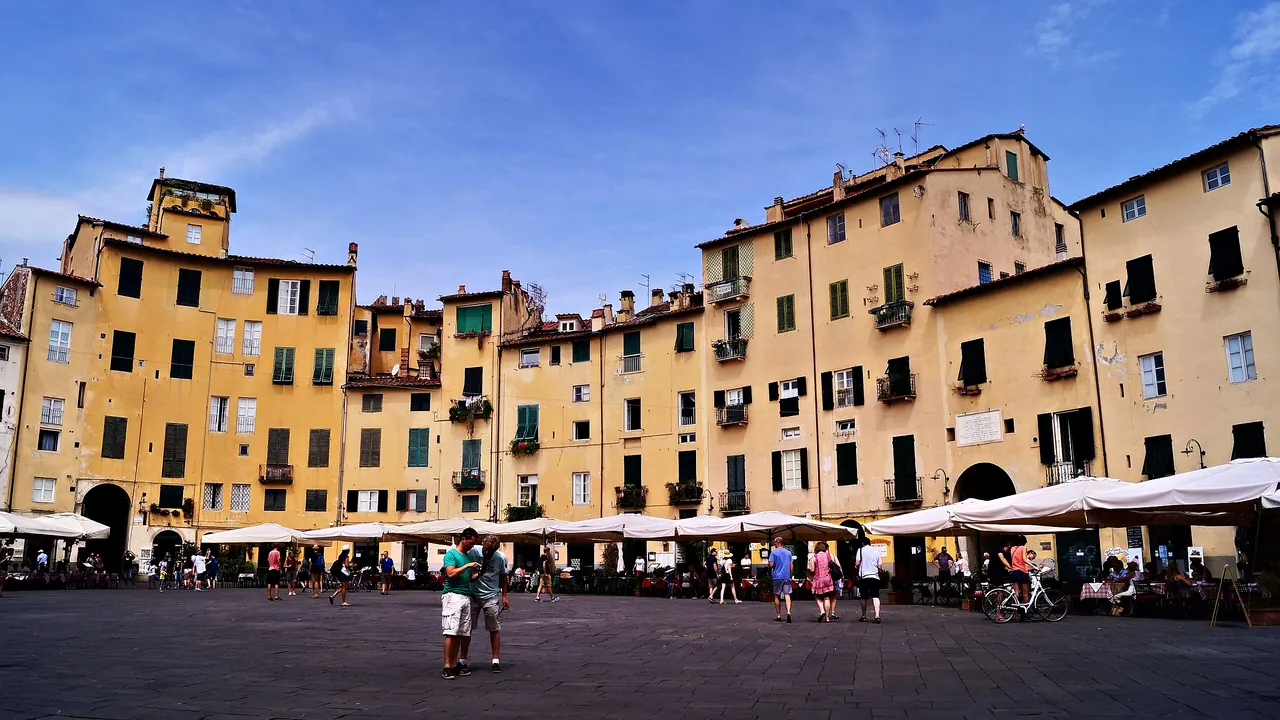
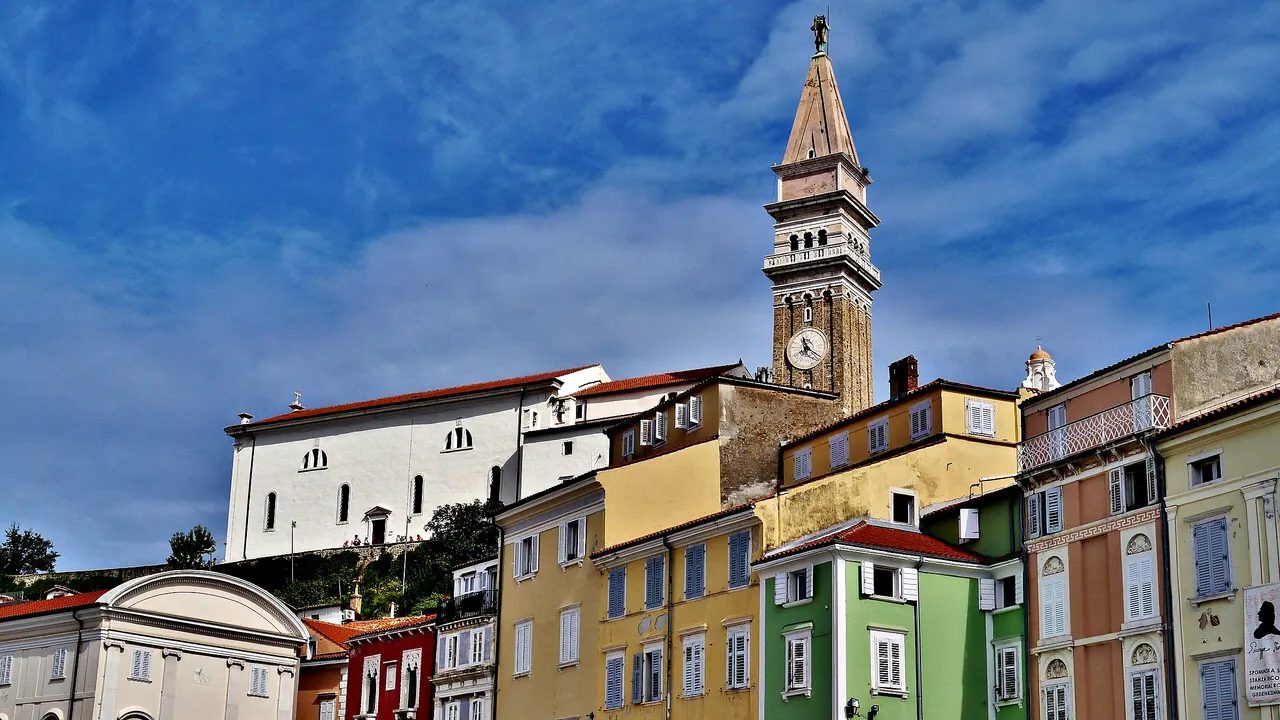
Photos: Lucca by Stefano Sansavini, CC BY-SA 4.0, cropped; Piran by Zairon, CC BY-SA 4.0, cropped.
Lucca or Piran?
Our verdict in twelve categories, each scored against the same fixed benchmark cities, and the climate month by month, so you can choose for your trip.
Choose Lucca for
- live music and the arts
- shopping
- culture and sights
Lucca suits travellers who want Tuscany at walking pace: Romanesque churches, Renaissance walls you can cycle round, Puccini sung in a church in the evening, and plain, honest Lucchese cooking. Its real advantage is position. Pisa and Florence are an easy train ride away, the Apuan Alps rise to the north, and the sandy Versilia beaches are close enough for an afternoon swim.
Choose Piran for
- wellness
- beaches
Piran is the better pick for a slower trip built around the sea. You swim off the rocks below the old walls, watch the sunset from the Punta and spend an afternoon in brine and salt mud at the pans. There is less to see, eat and buy than in Lucca, but the water is right there, and Trieste and the Istrian hill towns are close if you have a car.
Scoreboard
Twelve categories on one fixed scale from 0 to 100. The shaded stretch is the gap between the two.
Your match
Pick a travel style or drag the sliders, and both match scores follow your weighting.
Wins on live music and the arts and shopping with your weighting.
Wins on wellness and beaches with your weighting.
What matters to you?
Category by category
What the scores mean for a trip.
Beaches & swimming
These two are about level for swimming, but the experience is quite different. From Lucca you take a short train ride to the Versilia coast, where long, gently shelving sandy beaches are lined with rows of umbrellas, and the pine-backed dunes of the Lecciona offer something wilder. It makes a good half day, but you don't wake up by the sea.
In Piran you do. You get in from concrete platforms, rocks and ladders right below the old town, and the water is clear. Sand is scarce, though: Fiesa is a small pebble cove, and Portoroz's beach is small and artificial.
Food & drink
Lucca has the deeper kitchen. Its rustic provincial cooking runs from spelt soup and meat-filled tordelli to chestnut-flour dishes in the colder months, cecina from bakery counters and buccellato, with Colline Lucchesi and Montecarlo wines in family trattorias inside the walls.
Piran keeps it simple: grilled fish, squid and scampi buzara in konobas, with Malvazija, Refosk and salt from the pans. The harbour menus soon repeat, and for more ambitious cooking you have to drive into the Istrian hinterland.
Culture & sights
Lucca has far more to see. Its Renaissance walls survive complete, and inside them are San Michele in Foro with its tiers of arcades, the gold mosaic of San Frediano, Ilaria del Carretto's tomb in the cathedral and the oval Piazza dell'Anfiteatro. That fills two full days.
Piran's appeal is the whole scene rather than its monuments: Venetian Gothic houses on a narrow peninsula, Tartini Square, and St George's campanile above the bay. Its maritime museum and cloister are modest, and one day covers them.
Nightlife
Both go quiet early, so neither suits a big night out. In Lucca the evening is an aperitivo in Piazza San Michele, a stroll down Via Fillungo and perhaps a student wine bar. Dancing means the Versilia discos and a late drive back.
Piran's evenings centre on a glass of wine at sunset on the Punta. Its fallback, Portoroz with a casino and a few summer clubs, is only minutes away, which is closer than Lucca's coast.
Nature & outdoors
Lucca has the more varied outdoors, and some of it is genuinely dramatic. The tree-lined walls and the Serchio cycle paths cover the gentle side. Within about an hour you reach the marble-scarred peaks of the Apuan Alps, with serious hiking, the chestnut and beech woods of the Garfagnana, and the reed beds of Lake Massaciuccoli.
Piran's landscape is smaller and gentler: the flysch cliffs of Strunjan to kayak beneath, the wading birds of the Secovlje salt pans, the Parenzana cycle route through the vineyards, and the Skocjan caves on the Karst. There are no high mountains nearby.
Day trips
Lucca is one of the best bases in central Italy, and most trips need only a train. Pisa is about half an hour away and Florence about an hour, and Pistoia and Montecatini are on the same line. Closer to home are the villa gardens at Marlia and Collodi, and the sculptors' studios of Pietrasanta.
Piran's advantage is variety, with three countries in reach: Trieste's coffee houses, Rovinj and Motovun in Croatian Istria, Predjama Castle and Ljubljana, plus a summer boat to Venice. Most of it, though, needs a hire car.
Good for families
Both are broadly level and safe for children, with car-free centres, but each suits families in its own way. Lucca is flat, so a family quadricycle on the walls is the classic outing. Pinocchio Park and sandy beaches are both close, and Lucca Comics & Games wins over teenagers in autumn.
Piran offers calm, warm sea and a harbour aquarium for small children. On the downside, swimming is from concrete ledges and the lanes up to the church are steep, so families wanting sand head to Portoroz.
Getting around
Lucca is easier to move around, both in town and beyond. The walled centre is flat and almost traffic-free, there are bike rentals at every gate, and the station just outside the southern walls has regular trains to Pisa, Viareggio and Florence. Only the villas and the Garfagnana really need a car.
You can cross Piran on foot in a quarter of an hour, and a shuttle runs to Portoroz. However, there is no railway and the regional buses are slow, so seeing Istria or the Karst usually means hiring a car.
Shopping & style
Lucca is a more rewarding place to shop. Via Fillungo has fashion and jewellery behind Liberty-style shopfronts, the lanes have delicatessens and paper shops, and one weekend each month an antiques market fills the streets around the cathedral.
Piran has a few galleries and harbour souvenir stalls. The best things to take home are edible: salt flower from Secovlje, Istrian olive oil and coastal wine.
Affordability
Costs are much the same in both, and in each the room is the main expense. In Lucca, hotels inside the walls are few and fill up in summer and at festival time, so staying just outside the gates saves money. Meals and trains are fairly priced, and the walls and many churches are free.
Piran's premium is seasonal. Old-town rooms are scarce in July and August and waterfront restaurants charge for the view, so staying in Portoroz or visiting outside the peak months keeps the trip reasonable. Swimming here costs nothing.
Live music & performing arts
Puccini was born in Lucca, and his music runs through the city all year. Even on a short visit you can hear his arias at an evening recital in a central church, the nineteenth-century Teatro del Giglio has a season of opera, concerts and theatre, and the conservatory adds student concerts. In July, international stars play outdoors in Piazza Napoleone, and in summer the Puccini Festival stages open-air opera beside the lake at Torre del Lago, where he lived.
Piran's composer is the violinist Tartini, who is honoured with classical concerts in churches, the monastery cloister and on the square named after him. These are mostly summer events, and outside the warm months the small Tartini Theatre offers only the occasional play or recital.
Wellness & relaxation
Piran does better here because its treatments are on the doorstep and come from the sea itself. Portoroz has seawater pools, brine baths and mud from the salt pans. Out among the lagoons, an outdoor thalasso spa lets you lie in salt mud, and Strunjan has a seawater health resort.
Lucca has no baths of its own, so relaxing there means quiet streets and evening walks on the walls. A proper soak is a day out: by train to the belle époque spas of Montecatini, to the warm cave at Monsummano, or up to the steam grottoes of Bagni di Lucca.
When should you go?
Pick your month. The climate figures are measured averages, not a forecast.
Lucca in July
Piran in July
Daytime high, °C
Rainfall in the month, mm
Temperature and rainfall are climate normals, averaged over the years shown. Lucca: 1991-2020 normals, Pisa / S. Giusto (21.4 km from centre). Piran: 2005-2020 (sunshine 1991-2020, rainfall 1991-2020) normals, Portoroz (1.2 km from centre).
The two follow almost the same curve of heat. Both are pleasant for walking from April to early June and again in September and October. Both reach about 30°C in July and August, which is hot for sightseeing in Lucca's inland streets, while in Piran the sea is never more than a few steps away. The sea warms to about 25°C off both coasts in high summer, and swimming works from June to September.
They differ most in summer rain. Lucca's July and August are very dry, around 35mm, and sunnier than Piran's, whereas Piran gets showers right through the season, about 78mm in August, and a fairly wet May. Autumn is wet in both, with Lucca peaking at about 132mm in November. Winters are cool and grey, a degree or two milder in Lucca, and neither is a winter sun destination.
Which traveller are you?
On a culture and arts trip, Lucca is the stronger choice. Its complete walls, carved church façades and amphitheatre piazza fill two days, Puccini recitals and the Teatro del Giglio cover the evenings, and Pisa and Florence are close by train.
For a relaxing and wellness trip, Piran has the edge. Portoroz and the Secovlje salt pans offer seawater pools, brine baths and salt-mud treatments by the lagoons, and the car-free lanes and evening swims set a slow rhythm without a day out to a spa town.
On a food and nightlife trip, Lucca does better, mainly because of the food. Tordelli, farro soup, cecina and Montecarlo wines give more to explore than Piran's repeated harbour menus. Evenings are quiet in both, so plan on long dinners rather than dancing.
Before you go
| Measure | Lucca | Piran |
|---|---|---|
| Official language | Italian | Slovene |
| Currency | Euro (EUR) | Euro (EUR) |
| Sockets | CFL230 V, 50 Hz | CF230 V, 50 Hz |
| Driving side | Right | Right |
| Time zone | UTC+1, UTC+2 in summer | UTC+1, UTC+2 in summer |
| Emergency number | 112 | 112 |
| Elevation | 19 m | 7 m |
| Main airport | Pisa International Airport (PSA)21 km from centre82 non-stop destinations | Trieste Airport (TRS)34 km from centre32 non-stop destinations |
| Public holidays this year | 13 days | 21 days |
By the numbers
| Measure | Lucca | Piran |
|---|---|---|
| City population | 88,798 | 3,787 |
| People per km² | 478 | 85 |
| Museums within 10 km | 20 | 5 |
| UNESCO World Heritage sites within 50 km | 4 | 4 |
| Swim season, months above 21 °C | 4 months | 4 months |
Where else could you go?
Every comparison below shares a destination with this one, so you can follow Lucca or Piran somewhere new.