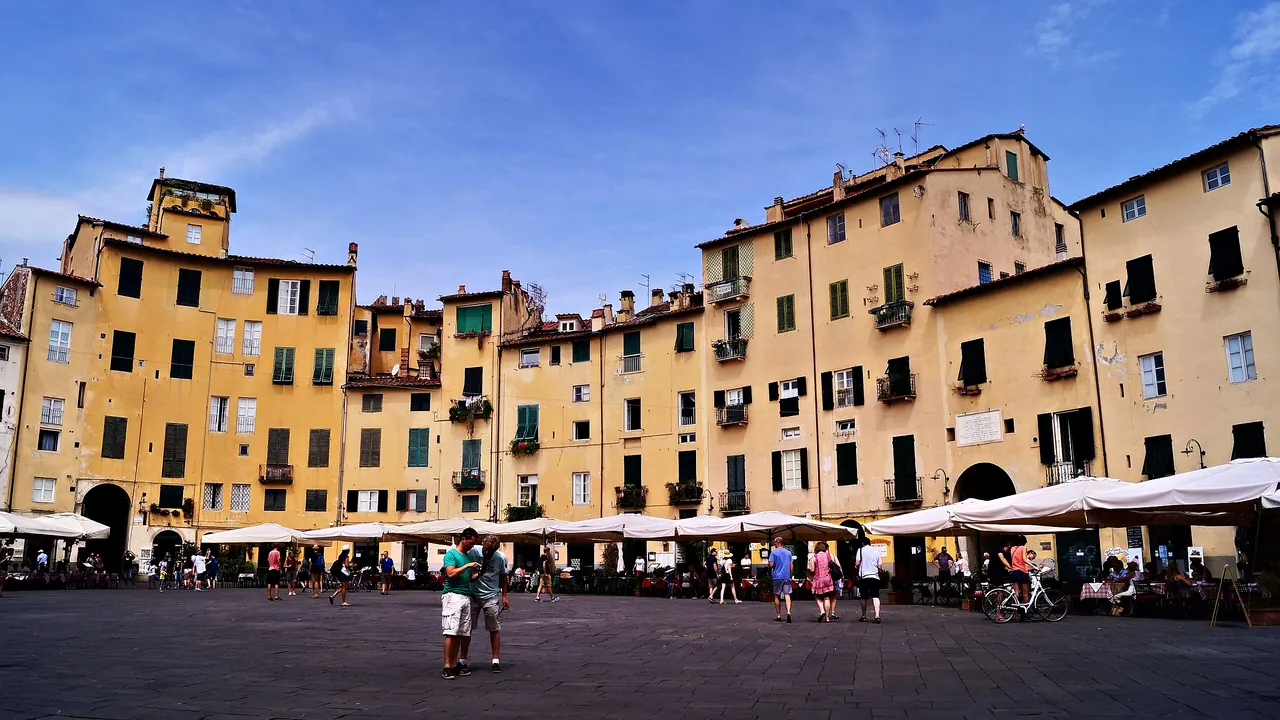
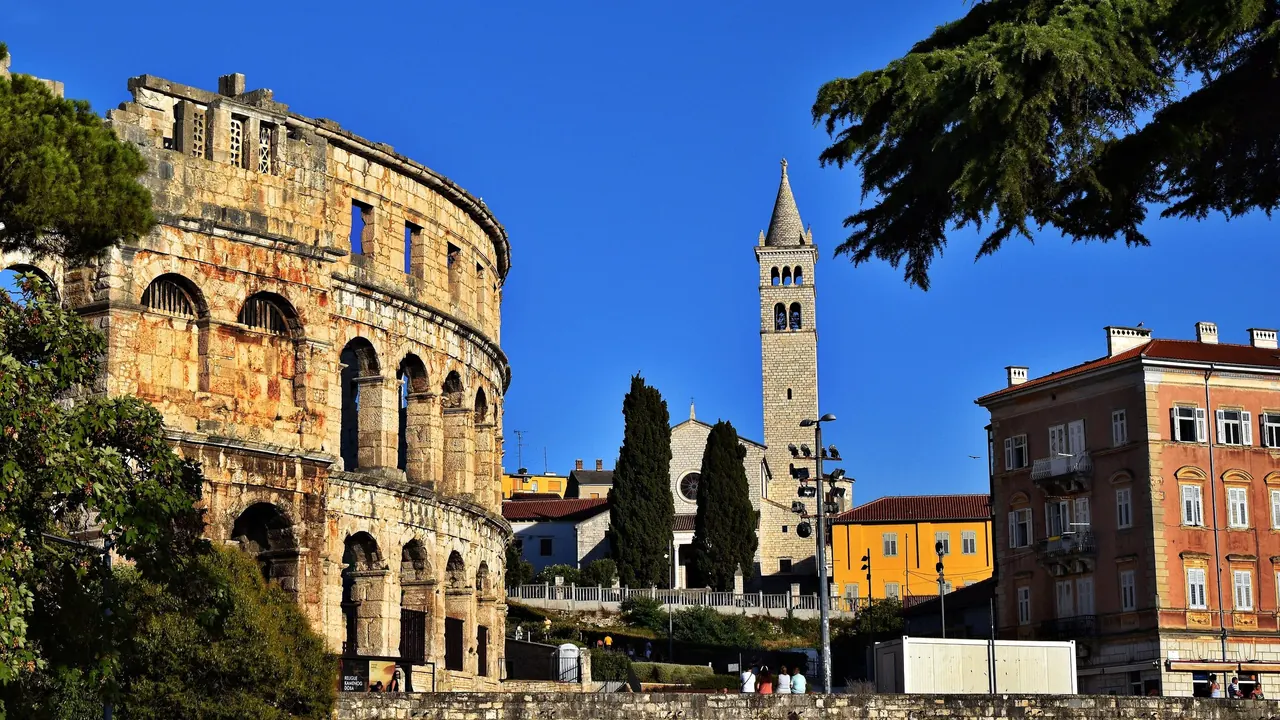
Photos: Lucca by Stefano Sansavini, CC BY-SA 4.0, cropped; Pula by Miroslav.vajdic, CC BY-SA 4.0, cropped.
Lucca or Pula?
Our verdict in twelve categories, each scored against the same fixed benchmark cities, and the climate month by month, so you can choose for your trip.
Choose Lucca for
- getting around
- wellness
- live music and the arts
Lucca suits travellers who want a walkable walled town as a base for Tuscany. Pisa and Florence are on the regional rail line, Puccini recitals and the Teatro del Giglio fill the evenings, and the old spa towns are close by. You can manage most of the stay without a car, and the Versilia sand is a half day out rather than the reason for coming.
Choose Pula for
- beaches
- nightlife
- prices
If the sea comes first, Pula is the better pick. Clear water off rocks and pine-shaded coves, the wild headland of Kamenjak and a Roman arena above the harbour make it the stronger summer base for swimmers, and its evenings run a little later. Plan on hiring a car, though, because the hill towns of Istria and the best coves lie beyond the buses.
Scoreboard
Twelve categories on one fixed scale from 0 to 100. The shaded stretch is the gap between the two.
Your match
Pick a travel style or drag the sliders, and both match scores follow your weighting.
Wins on getting around and wellness with your weighting.
Wins on beaches and nightlife with your weighting.
What matters to you?
Category by category
What the scores mean for a trip.
Beaches & swimming
Lucca has no sea of its own. Its swimming is at Viareggio, a short train ride away, where wide sand shelves gently into the water and is mostly laid out in rows of umbrellas, with wilder dunes at the Lecciona. That works well if you want art in the morning and a swim in the afternoon.
Pula is the better place for swimmers, though not for anyone who wants sand. The sea is right at the edge of town, very clear and entered from rocks, platforms and pebble coves on Verudela and Stoja. Cape Kamenjak adds dozens of wild inlets. Bring water shoes, and head to Medulin's bays for shallow water.
Food & drink
The two kitchens are about equally rewarding, and both are rustic and regional, but they come from different places. Lucca cooks plain Tuscan food from the province: farro soup, meat-filled tordelli, chestnut dishes in the cooler months and cecina from bakery counters. The good trattorias are right inside the walls, though the menus start to repeat after a few days.
Pula looks to the sea and to Istria. Truffle-dressed fuži, scampi buzara, pršut and glasses of Malvazija or Teran are the things to order. The catch is that the best meals tend to be out in hinterland villages or at harbours along the coast, while the tables near the Arena lean towards tourist menus.
Culture & sights
Both reward a day or two of sightseeing, and they show different eras. Lucca is a complete medieval town inside intact Renaissance walls, and its highlights are the carved Romanesque façades of San Michele and San Frediano and the cathedral with Ilaria del Carretto's tomb. Its museums are modest.
Pula is a Roman city first. The three-storey Arena, the Temple of Augustus on the Forum and the Arch of the Sergii are the main sights, with Venetian and Habsburg naval layers on top. Lucca is the better choice for churches and streetscape, Pula for antiquity.
Nightlife
Neither town is a place to go out, but Pula offers a little more after dark. Evenings in Lucca come down to aperitivo in Piazza San Michele, dinner and a stroll on the walls, and the centre is calm by midnight. Dancing means the Versilia coast and a late taxi back.
In summer, Pula's evenings carry on from the Forum terraces to cocktail and beach bars on Verudela and around Medulin, some of which stay open late, and a few small clubs fill up at weekends. Out of season, both go quiet.
Nature & outdoors
The two are broadly level outdoors, but the landscapes differ in kind. Lucca looks to the mountains. The sharp limestone peaks, marble quarries and serious hiking routes of the Apuan Alps are about an hour north, the Garfagnana has chestnut and beech woods, and the reed beds of Lake Massaciuccoli are good for birdwatching. Closer in, the tree-lined walls make a daily loop for running or cycling.
Pula's outdoors is low and coastal, and it starts close to town. Kamenjak's car-free cliffs and islets suit walking and cycling. Sea kayaking around the islets, windsurfing in Premantura bay and diving on wrecks from the naval era are all a short ride away, while from Lucca the water means an outing to the coast or the lake. The nearest high ground, the Učka range, is about an hour and a half away, a longer drive than the Apuan Alps are from Lucca.
Day trips
Lucca is the stronger base by some distance, mainly because so much lies on the railway. Pisa is half an hour away and Florence a little over an hour, with Pistoia and Montecatini on the same line. The Marlia and Torrigiani villas, Collodi, Pietrasanta and the Garfagnana are all close, and with an early start you can reach the Cinque Terre.
Pula has fine Istrian outings, including Rovinj, Poreč's Byzantine mosaics, the hill towns of Motovun and Hum, and the Brijuni islands. Most of them need a car, though, and Trieste or Piran is a long drive.
Good for families
The two are about equally good with children, in different ways. Lucca's appeal is a flat, traffic-free town: a family quadricycle on the walls, trees on top of the Torre Guinigi, Pinocchio Park at Collodi and Lucca Comics & Games in autumn for older children.
Pula's family days revolve around the sea. There are shallow bays at Medulin and Premantura, an aquarium inside an old fort and underground passages to explore at the Arena. On the other hand, rocky shores near town and the need for a car make it more work.
Getting around
Lucca is far easier without a car. The walled centre is flat and mostly closed to traffic, there are bikes for hire at every gate, and the station just outside the southern walls has regular trains to Pisa, Florence and the coast. Only the hill villages and the Garfagnana really call for driving.
Pula's centre is just as easy on foot, and buses reach Verudela. Beyond that the slow rail line and sparse regional buses leave you dependent on a car or scooter, and parking near the centre is tight in summer.
Shopping & style
Neither has luxury shopping, but Lucca gives you more to browse. Via Fillungo mixes fashion and jewellery behind old Liberty-style shopfronts, the side lanes have delicatessens and paper workshops, and one weekend a month one of Italy's oldest antiques markets spreads around the cathedral.
In Pula, the best things to take home are edible: olive oil, truffles, rakija and pršut from the market hall or straight from producers. The main street offers little beyond chain stores and souvenirs.
Affordability
Overall costs are similar, but you save money in different ways. In Lucca, rooms are the main expense, especially inside the walls during festivals, while trains, trattorias and the free walls and churches keep the rest of the trip modest.
Pula is cheap in spring and autumn but expensive in July and August. Car hire and boat trips, which you will probably need there, add up quickly.
Live music & performing arts
Lucca has much more on stage for most of the year. Short Puccini recitals in a central church run through most seasons, the nineteenth-century Teatro del Giglio has an opera and concert season, and in summer there is open-air opera by the lake at Torre del Lago along with big concerts in Piazza Napoleone.
Pula has one great setting, the Arena on a summer night, with touring concerts and the film festival under Roman arches. For the rest of the year there is little beyond Croatian-language theatre.
Wellness & relaxation
Lucca is better placed for a proper soak, although there is none in town. Montecatini's belle époque spa halls are half an hour away by train, Monsummano has warm pools inside a cave, and Bagni di Lucca has its steam grottoes in the Serchio valley.
Pula has no such tradition. Wellness there means resort-hotel spas on Verudela and in Medulin, so the relaxation comes from slow coffees on the Forum and walks on the pine-shaded coastal paths.
When should you go?
Pick your month. The climate figures are measured averages, not a forecast.
Lucca in July
Pula in July
Daytime high, °C
Rainfall in the month, mm
Where the figures come from
Pula's temperatures are measured 87 km from the centre, at Trieste.
Pula has no rain gauge within 25 km of the centre, so its rainfall comes from a gridded climate dataset read at the city rather than from a gauge further away.
Temperature and rainfall are climate normals, averaged over the years shown. Lucca: 1991-2020 normals, Pisa / S. Giusto (21.4 km from centre). Pula: 1991-2020 normals, Trieste (87 km from centre).
Through the year the two follow a similar pattern, but Lucca runs hotter and wetter. On its inland plain Lucca reaches about 30°C in July and August, which makes midday sightseeing hard going, while Pula's coast stays a degree or so cooler. The sea off both is warm enough for easy swimming from June to September and peaks at around 25°C in August. Lucca also gets a little more sunshine through the summer.
The bigger difference comes with the autumn rain. Lucca turns wet from September, and October and November are its wettest months at about 125mm or more. Pula's rain builds more gradually and only peaks in November. May, June and late September are the best months for walking the streets in either town. Winters are cool in both, slightly colder in Pula.
Which traveller are you?
On a beach and sun trip, Pula is the clear choice. You can swim from the edge of town in very clear water around Verudela and Stoja, and Kamenjak's coves are close by. From Lucca the sea is a train ride away.
For a relaxing and wellness trip, Lucca wins. Its traffic-free lanes and shaded walls set a slow pace, and the thermal resorts of Montecatini, the cave pools at Monsummano and Bagni di Lucca all make easy spa days. Pula offers little beyond hotel spas.
For a short city break, Lucca works better. You walk or cycle everything inside the walls, the station sits just outside them, and Romanesque churches, Puccini recitals and Pisa half an hour away fill a few days without a car.
Before you go
| Measure | Lucca | Pula |
|---|---|---|
| Official language | Italian | Croatian |
| Currency | Euro (EUR) | Euro (EUR) |
| Sockets | CFL230 V, 50 Hz | CF230 V, 50 Hz |
| Driving side | Right | Right |
| Time zone | UTC+1, UTC+2 in summer | UTC+1, UTC+2 in summer |
| Emergency number | 112 | 112 |
| Elevation | 19 m | 5 m |
| Main airport | Pisa International Airport (PSA)21 km from centre82 non-stop destinations | Pula Airport (PUY)7 km from centre34 non-stop destinations |
| Public holidays this year | 13 days | 14 days |
By the numbers
| Measure | Lucca | Pula |
|---|---|---|
| City population | 88,798 | 52,220 |
| People per km² | 478 | 971 |
| Museums within 10 km | 20 | 4 |
| UNESCO World Heritage sites within 50 km | 4 | 1 |
| Swim season, months above 21 °C | 4 months | 4 months |
Where else could you go?
Every comparison below shares a destination with this one, so you can follow Lucca or Pula somewhere new.