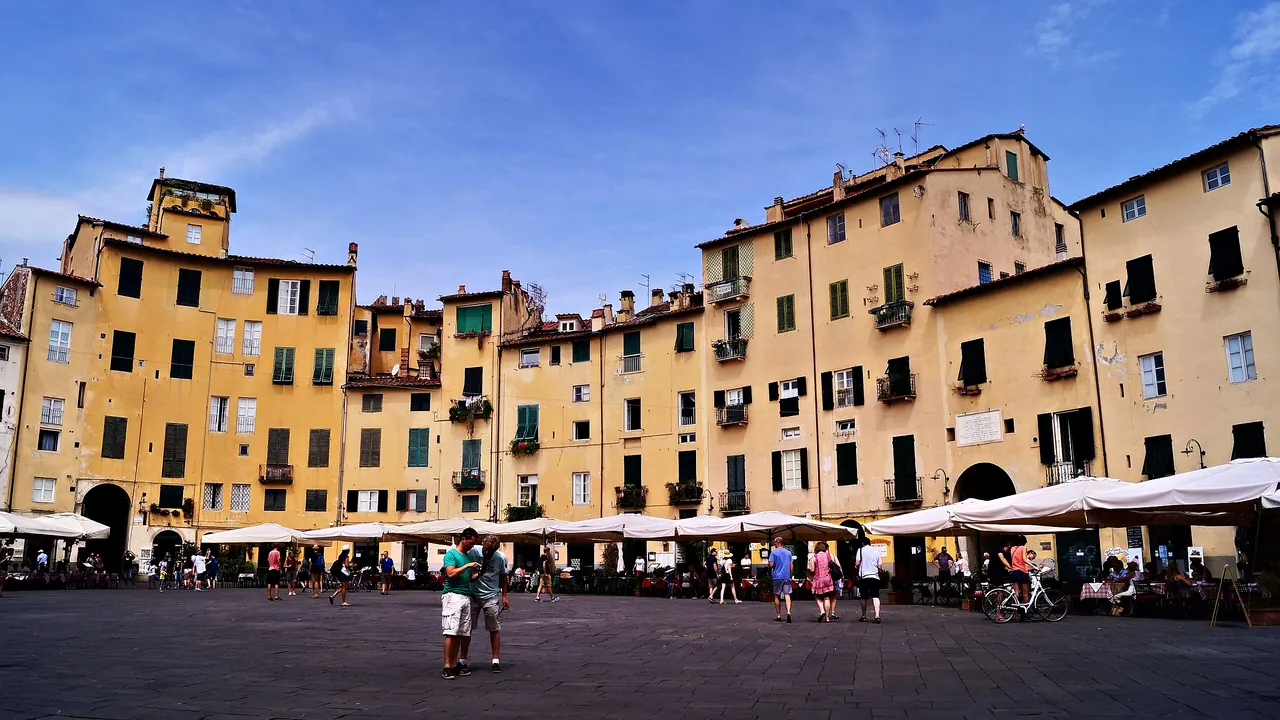
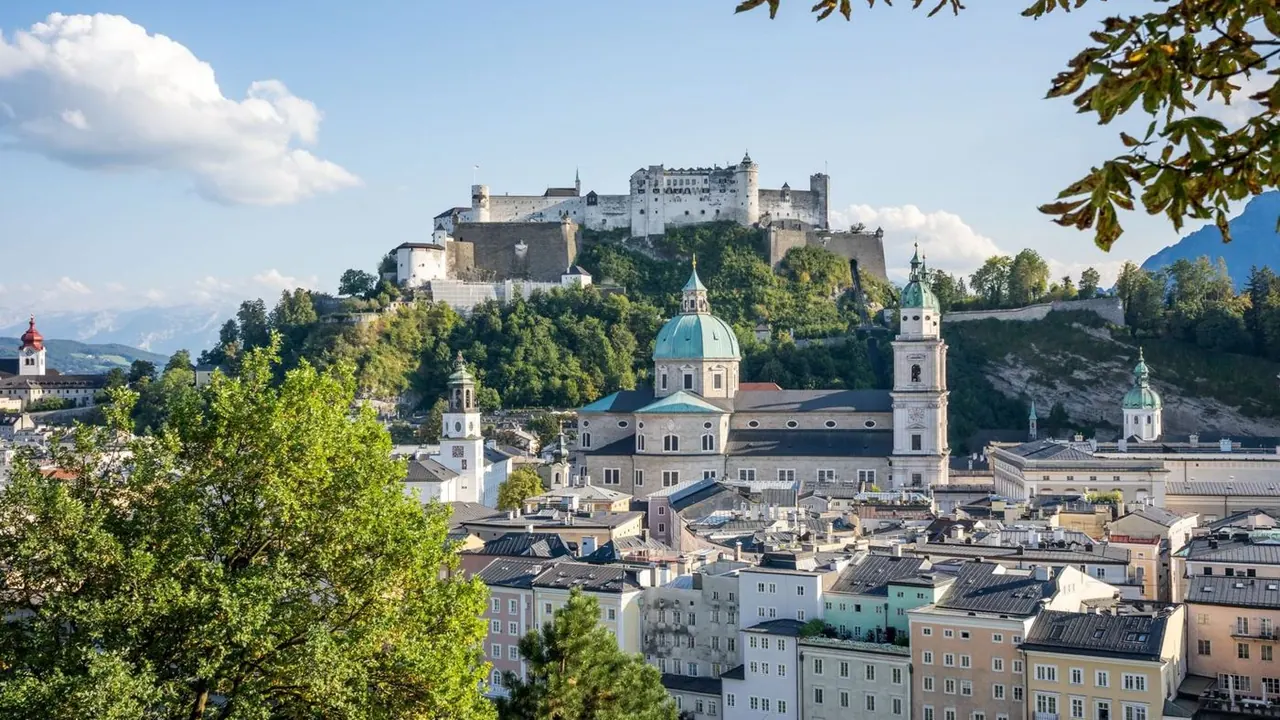
Photos: Lucca by Stefano Sansavini, CC BY-SA 4.0, cropped; Salzburg by Leonhard Niederwimmer, Pexels License.
Lucca or Salzburg?
Our verdict in twelve categories, each scored against the same fixed benchmark cities, and the climate month by month, so you can choose for your trip.
Choose Lucca for
- beaches
- prices
- food and drink
Lucca suits travellers who want Tuscany at an easy pace and a fair price. The walled town is calm and flat enough to cross by bike. Pisa, Florence and the sandy Versilia beaches are a short train ride away, so it works well as a base for a week of varied days. The rustic local cooking is a quiet bonus.
Choose Salzburg for
- live music and the arts
- nature and the outdoors
- families
Pick Salzburg if music and mountains matter more than sea and wine. Its Baroque old town and clifftop fortress make a grander set piece, and the festival seasons draw opera and orchestral performers that Lucca cannot match. The Alps, the Salzkammergut lakes and the salt mines start almost at the city edge, which also makes it the stronger choice for families and walkers, though staying there costs more.
Scoreboard
Twelve categories on one fixed scale from 0 to 100. The shaded stretch is the gap between the two.
Your match
Pick a travel style or drag the sliders, and both match scores follow your weighting.
Too close to call, 1 point apart
Wins on beaches and prices with your weighting.
Wins on live music and the arts and nature and the outdoors with your weighting.
What matters to you?
Category by category
What the scores mean for a trip.
Beaches & swimming
Lucca has a genuine seaside within reach. The Versilia coast begins at Viareggio, about 25 minutes away by train, with wide, gently shelving sand lined with beach-club umbrellas, and wilder dunes at the Lecciona backed by pine woods. Spending a morning on the old streets and an afternoon in warm sea is an easy and natural pairing.
Salzburg has no sea and no sand. Swimming means the clear green lakes of the Salzkammergut, entered from lawns, jetties and pebbles. The water is cooler and the season shorter, which makes it a pleasant hot-day escape rather than a beach trip.
Food & drink
Lucca eats better and more cheaply. Its plain country cooking of farro soup, tordelli in ragù, chestnut-flour dishes and street slices of cecina is served in family trattorias inside the walls, with good local olive oil and Montecarlo wines alongside. The range is narrow, but the quality holds up.
Salzburg's strengths lie in coffee and cake in its historic coffee houses and in beer from wooden barrels at the monastery brewery in Mülln. Its menus of schnitzel, dumplings and Salzburger Nockerl are hearty, but in the old town they are often pricey and aimed at tour groups, so the better meals are out in the suburbs and hill inns.
Culture & sights
Salzburg has the richer set of sights. The prince-archbishops' Baroque cathedral, Residenz and arcaded squares form a UNESCO-listed whole, with one of Europe's largest intact medieval fortresses above them. Add Mozart's two houses, the St Peter catacombs, Mirabell and a modern art museum on the Mönchsberg, and you have a fuller two or three days.
Lucca's appeal is quieter and more architectural. Its Renaissance walls survive complete, and it has the carved Romanesque façades of San Michele and San Frediano and the oval Piazza dell'Anfiteatro. Its museums are modest, so the pleasure lies in the streets themselves.
Nightlife
Neither city is a place for late nights, and both centres are quiet by midnight. What differs is the style of the evening. Lucca means an aperitivo in a piazza followed by a stroll on the walls, while Salzburg means a concert and then litre mugs at long tables in a beer hall.
For dancing, Lucca's young crowd heads to the Versilia beach discos in summer, a drive or taxi away. Salzburg's goes to Munich, about an hour and a half away by train.
Nature & outdoors
Salzburg sits right against the Alps. Wooded ridges with walking paths rise inside the city, a cable car climbs the Untersberg to about 1,800m, and the Gaisberg is used for paragliding. Within the hour you can reach the Salzkammergut lakes, the Königssee in Berchtesgaden National Park and the ski areas.
Lucca's own outdoors is gentler: the tree-lined ring of the walls, cycle paths along the Serchio and olive-clad hills. The Apuan Alps and the Garfagnana woods offer serious hiking, but they mean a day out rather than a walk from the hotel.
Day trips
Lucca has the better spread of day trips, many of them on one railway line. Pisa is half an hour away and Florence a little over an hour, with Pistoia and Montecatini on the way. The villa gardens at Marlia and Collodi, Pietrasanta's sculpture studios and the Carrara quarries are all close, and the Cinque Terre and San Gimignano are possible with an early start.
Salzburg's excursions are strong but more scattered. They include Hallstatt and the Wolfgangsee villages, salt mines at Hallein and Berchtesgaden, the Werfen fortress and Munich by train. Several of the lake villages are hard to reach without a car.
Good for families
Salzburg gives children more to do. The trick fountains at Hellbrunn, the zoo next door, the hands-on Haus der Natur and the marionette theatre fill the city days. The salt mines add wooden miners' slides and underground boat rides, though cobbles and steep lanes make pushchairs hard work.
Lucca is flat, so it is easy with small children, and riding a family quadricycle round the walls is a highlight. Pinocchio Park and the beach are nearby, but within the walls there is little aimed at children beyond churches and palaces.
Getting around
Both centres are compact, largely car-free and walkable, and in both a car only earns its keep for the countryside. In Lucca you move by bike. The town is flat and rental shops sit at every gate, but buses to the villas and villages are sparse.
Salzburg is hillier on foot. It makes up for this with a dense trolleybus network reaching Hellbrunn and the Untersberg cable car, and it has mainline trains to Munich and Vienna.
Shopping & style
Salzburg has the slightly more distinctive shopping. It has made-to-measure Tracht workshops selling dirndls and loden, a farmers' market and one of the region's best-known Advent markets on Domplatz, although Getreidegasse is mostly chains and souvenirs.
Lucca's Via Fillungo keeps old Liberty-style shopfronts and delicatessens for oil and buccellato. Its real draw is the monthly antiques market around the cathedral. Neither city offers luxury depth.
Affordability
Lucca is the easier city on the wallet. Trattoria meals and regional trains are fairly priced, the walls and many churches cost nothing, and sleeping just outside the gates cuts the main expense.
Salzburg is expensive for its size all year, with hotels and old-town restaurants priced well above the Austrian norm and costs climbing further during the summer festival and Advent. A city card and a room across the river or in the suburbs help.
Live music & performing arts
Salzburg is in a different league. The Salzburg Festival fills the Festspielhaus and the cliff-cut Felsenreitschule with leading opera and orchestral performers, Jedermann is staged before the cathedral, and Mozart Week and the Easter Festival add further seasons. Outside these, the Mozarteum, the Landestheater and nightly palace concerts keep music going all year.
Lucca's music is built around Puccini: church recitals of his arias, a season at the Teatro del Giglio and open-air opera by the lake at Torre del Lago in summer. It is charming, but much smaller in scale.
Wellness & relaxation
Neither city has its own hot springs, and both relax you mainly through their slow pace. Salzburg does have the Paracelsus Bad, a public pool and sauna in the city park. Its spa excursions lean towards brine at Bad Reichenhall and radon springs in the Gastein valley.
Lucca's calm comes from traffic-free streets, long lunches and evening walks on the shaded walls. For a soak you take the train to Montecatini's belle époque spas, the cave pools at Monsummano or the steam grottoes of Bagni di Lucca.
When should you go?
Pick your month. The climate figures are measured averages, not a forecast.
Lucca in July
Salzburg in July
Daytime high, °C
Rainfall in the month, mm
Temperature and rainfall are climate normals, averaged over the years shown. Lucca: 1991-2020 normals, Pisa / S. Giusto (21.4 km from centre). Salzburg: 1991-2020 normals, Salzburg (3.4 km from centre).
Lucca is a warm-weather destination. The Versilia sea is warm enough for swimming from June to September, reaching about 25°C in July and August, which are also the sunniest and driest months. They are hot on the plain, though, around 30°C, so sightseeing works best early or late in the day, and May and early June are more comfortable for walking the walls. The rain sets in from September and peaks in November at about 132mm, and winters are mild but grey.
Salzburg is cooler, and its rain falls at the opposite time of year. Summer highs in the mid-twenties are pleasant for walking, but May to August is its wettest stretch, with around 168mm in June, so expect showers on mountain days. October is drier than summer and still mild enough for the streets. The driest months are December to February, but highs then fall to about 3°C and snow often reaches the town. Lucca is the sunnier city for most of the year, and the gap is widest in summer. In April the two are close.
Which traveller are you?
For a beach and sun trip, Lucca is the clear pick. The long sandy shore at Viareggio and Forte dei Marmi is under half an hour by train, with warm sea through summer. Salzburg only offers cool lake swimming from lawns and jetties.
On a culture and arts trip, Salzburg comes out ahead. A UNESCO-listed Baroque old town and Hohensalzburg fortress sit alongside a year-round programme of opera and concerts, peaking at the summer festival. Lucca's Romanesque churches and Puccini recitals are lovely but smaller in scale.
For an outdoors trip, choose Salzburg. You can walk ridges straight from the old town, take a cable car up the Untersberg, or reach Berchtesgaden and the Salzkammergut lakes within the hour. Lucca's gentle hills and the Apuan Alps further north are good, but less immediate.
Before you go
| Measure | Lucca | Salzburg |
|---|---|---|
| Official language | Italian | German, Austrian Sign Language |
| Currency | Euro (EUR) | Euro (EUR) |
| Sockets | CFL230 V, 50 Hz | CF230 V, 50 Hz |
| Driving side | Right | Right |
| Time zone | UTC+1, UTC+2 in summer | UTC+1, UTC+2 in summer |
| Emergency number | 112 | 112 |
| Elevation | 19 m | 424 m |
| Main airport | Pisa International Airport (PSA)21 km from centre82 non-stop destinations | Salzburg Airport (SZG)3 km from centre64 non-stop destinations |
| Public holidays this year | 13 days | 16 days |
By the numbers
| Measure | Lucca | Salzburg |
|---|---|---|
| City population | 88,798 | 155,021 |
| People per km² | 478 | 2,360 |
| Museums within 10 km | 20 | 38 |
| UNESCO World Heritage sites within 50 km | 4 | 3 |
| Swim season, months above 21 °C | 4 months | - |
Where else could you go?
Every comparison below shares a destination with this one, so you can follow Lucca or Salzburg somewhere new.