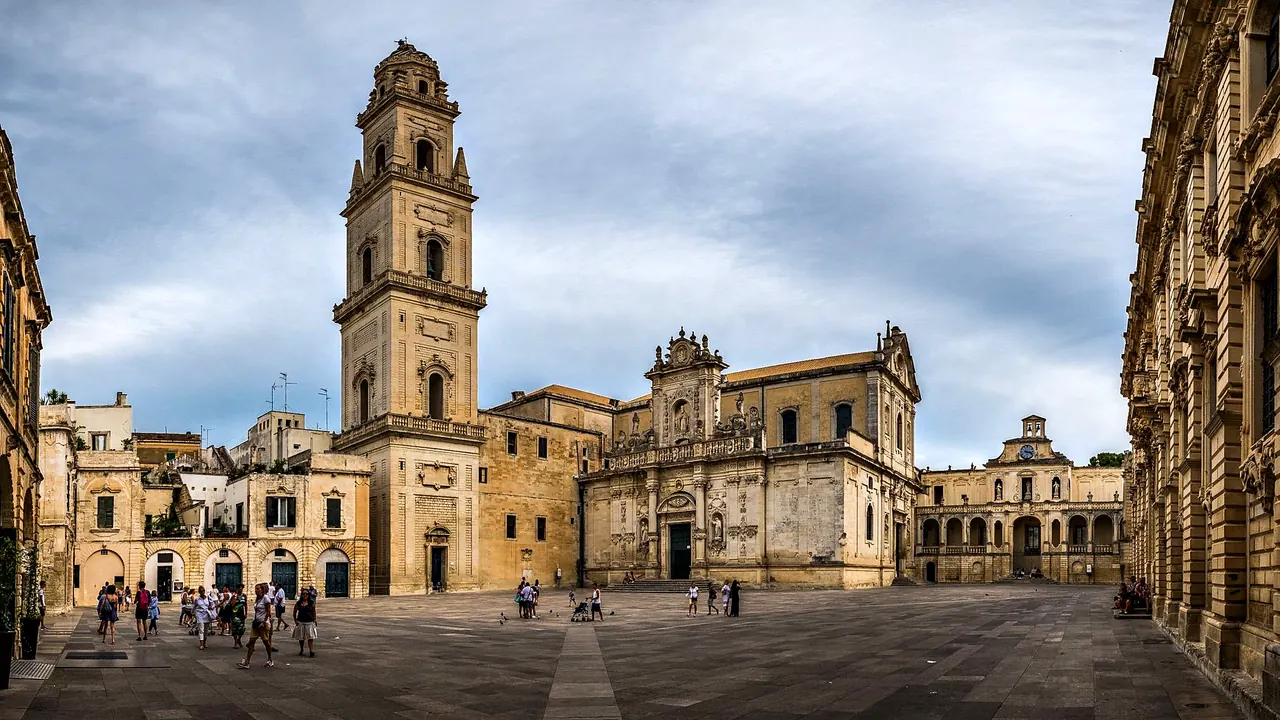
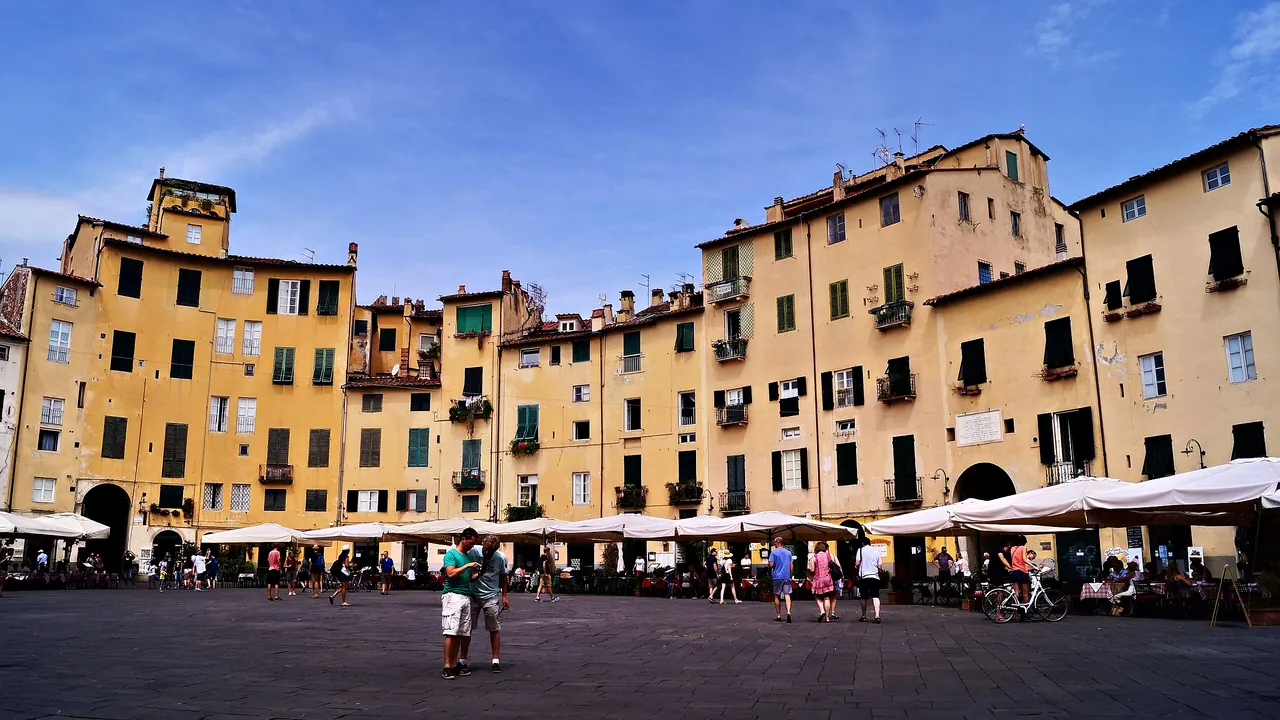
Photos: Lecce by Giuseppe Milo, CC BY 3.0, cropped; Lucca by Stefano Sansavini, CC BY-SA 4.0, cropped.
Lecce or Lucca?
Our verdict in twelve categories, each scored against the same fixed benchmark cities, and the climate month by month, so you can choose for your trip.
Choose Lecce for
- nightlife
- beaches
- prices
Lecce suits a summer trip where the sea matters as much as the sights. Two coasts lie within easy driving distance, from the cliffs and coves around Torre dell'Orso to the shallow Ionian water at Porto Cesareo. The Baroque old town fills the evenings, food and rooms cost less outside August, and the nights out last a little longer. In return you will need a hire car and some patience with the heat.
Choose Lucca for
- getting around
- day trips
- live music and the arts
Travellers who would rather see a whole region without driving should look at Lucca. Pisa, Florence and the Versilia beaches are all a short train ride away, and inside the walls you walk or cycle everywhere. It also has Puccini's music, the marble peaks of the Apuan Alps for walkers, and a calm that suits slow days, though the evenings end early.
Scoreboard
Twelve categories on one fixed scale from 0 to 100. The shaded stretch is the gap between the two.
Your match
Pick a travel style or drag the sliders, and both match scores follow your weighting.
Wins on nightlife and beaches with your weighting.
Wins on getting around and day trips with your weighting.
What matters to you?
Category by category
What the scores mean for a trip.
Beaches & swimming
Both cities sit inland, but Lecce's coast is the bigger prize. Within an hour's drive it reaches two different seas: the pale coves and sea stacks of Torre dell'Orso on the Adriatic, and the long, shallow, very clear water of Porto Cesareo and Punta Prosciutto on the Ionian. The swimming season also runs longer, so in summer the beach can shape the whole stay.
Lucca's Versilia shore is easier to reach, a short train ride to Viareggio with no car needed. It is one long run of wide sand, though, mostly laid out in rows of beach-club umbrellas, with the pine-backed dunes of the Lecciona as the wilder choice. It makes a fine afternoon after sightseeing rather than the focus of a trip.
Food & drink
Both cities cook plain, rustic regional food with little beyond it, but Lecce's has the stronger character. Its day has a rhythm you will not find elsewhere: a warm pasticciotto and almond-sweetened iced espresso in the morning, a rustico mid-morning, then ciceri e tria or fava purée with chicory, with dark Negroamaro and Primitivo at dinner. The simple osterie are also cheap.
Lucca's table is more modest Tuscan country fare: spelt soup from the Garfagnana, tordelli in ragù, chestnut dishes in the cooler months and cecina from the bakery counter, with fine local olive oil and Montecarlo wines. It is reliable, but the menus repeat themselves sooner.
Culture & sights
The two are close, and the difference lies in style. Lecce is a Baroque city, with honey-coloured limestone carved into fruit, beasts and cherubs on Santa Croce and around the enclosed Piazza del Duomo. Half a Roman amphitheatre lies exposed below Piazza Sant'Oronzo, and Messapian layers run underground.
Lucca is medieval and Romanesque, held inside complete Renaissance walls. San Michele's tiered arcades, the Ilaria del Carretto tomb in San Martino and the oval piazza built into a Roman amphitheatre are its highlights, along with towers you can climb. Neither has major museums. Both are cities for walking, ornate in Lecce and austere in Lucca.
Nightlife
Lecce has the livelier evenings, though neither is a reason to come. After the aperitivo, the old town's lanes keep wine bars and small cocktail bars busy, and students stretch weekends late for much of the year.
Lucca usually winds down after dinner and a walk along the walls or Via Fillungo, and the centre is quiet by midnight. In both cities, summer dancing means a drive to the coast, to Gallipoli from Lecce and to the Versilia clubs from Lucca.
Nature & outdoors
Lucca has the more varied landscape. The Apuan Alps rise within an hour, with sharp peaks, marble quarries and serious hiking routes. The Garfagnana and the Orecchiella park add beech and chestnut forest, and closer in there are the walls, the Serchio cycle paths and birdwatching at Lake Massaciuccoli.
Lecce sits on a flat plain of olive groves, so its outdoors is the sea. Clifftop paths and sea caves run from Roca Vecchia to Santa Maria di Leuca, with good kayaking, snorkelling and diving, plus wetlands at Le Cesine and the Alimini lakes. Choose it for life on the water rather than in the hills.
Day trips
Lucca is one of the best bases in Tuscany. Pisa is half an hour away by train, Florence a little over an hour, and Pistoia and Montecatini are on the same line. Add the villas of Marlia and Collodi, marble towns such as Pietrasanta and Carrara, and long days to the Cinque Terre or San Gimignano.
Lecce's list is good too: walled Otranto and its great floor mosaic, Gallipoli's island old town, Galatina's frescoes, and the trulli of Alberobello and white Ostuni further north. Most of these places are far apart and slow to reach without a car, which is where Lucca's rail links make the difference.
Good for families
Lecce suits small children in a simple way: a car-free old town, piazzas where local families linger after dark, and gentle, sandy shallows at Porto Cesareo. Unlike Lucca, though, it has little laid on beyond the beach and the gelato, and in July and August the heat limits time outdoors to the mornings and evenings.
Lucca gives children more to do. Pedalling a family quadricycle round the walls is the classic outing, and the oak trees on top of the Torre Guinigi make a rewarding climb. Pinocchio Park at Collodi and the Versilia sand are both less than half an hour away. In autumn, Lucca Comics & Games turns the whole city into a costume party that older children love.
Getting around
Lucca is much easier to manage. It is flat and compact and mostly closed to traffic, bikes are rented at every gate, and the station just outside the walls has regular trains to Pisa, Viareggio and Florence. A car only matters for the hill villages and the Garfagnana.
Lecce's old town is just as easy on foot, but beyond it the Salento's slow local railways and summer-only beach buses leave most visitors depending on a hire car, parked outside the walls.
Shopping & style
Neither city is made for a shopping trip, but Lucca has the edge. Via Fillungo pairs fashion and jewellery with old Liberty shopfronts, and once a month one of Italy's oldest antiques markets fills the streets around the cathedral.
Lecce's best buys are local crafts: cartapesta saints and nativity figures from old-town workshops, small carvings in the local limestone and ceramics from Grottaglie. Beyond those, it is mostly food shops and souvenirs.
Affordability
Lecce is the cheaper stay. Pastries, osteria meals and local wine cost little, and B&Bs in old palazzi are fairly priced for most of the year. Two things push costs up: August, when the whole Salento fills and prices rise, and the hire car most trips need.
Lucca costs what you would expect in central Italy, less than Florence but not cheap. The walls and many churches are free, and you can get by on the trains without a car. Rooms inside the walls are few and fill up fast, so staying just outside often saves money.
Live music & performing arts
Lucca has far more to offer here, thanks to Puccini. Recitals of his arias run in a central church for most of the year, the nineteenth-century Teatro del Giglio has a full season, and in summer there is open-air opera by the lake at Torre del Lago and big concerts in Piazza Napoleone.
Lecce's theatres have a modest programme. Its real draw is pizzica, the tambourine dance heard at village festivals all summer, which peaks with the Notte della Taranta at Melpignano in August. Outside summer, there is little on.
Wellness & relaxation
Lucca is the better base for taking the waters, with three spa towns within reach and no car needed for the grandest of them. Lecce has one thermal spring, though an unusual one: Santa Cesarea Terme, where sulphur water fills grottoes and pools on the cliffs above the sea, under an hour's drive away. Its other option is a quiet stay at one of the old masserie on the olive plain that now have spas.
From Lucca, the belle époque halls of Montecatini Terme are about half an hour away by train. Monsummano has warm pools inside a natural cave, and Bagni di Lucca has steam grottoes in the wooded Serchio valley. Back in town, the traffic-free streets and an evening walk on the shaded walls are restful in themselves.
When should you go?
Pick your month. The climate figures are measured averages, not a forecast.
Lecce in July
Lucca in July
Daytime high, °C
Rainfall in the month, mm
Where the figures come from
Lecce's temperatures are measured 38 km from the centre, at Brindisi.
Lecce has no rain gauge within 25 km of the centre, so its rainfall comes from a gridded climate dataset read at the city rather than from a gauge further away.
Temperature and rainfall are climate normals, averaged over the years shown. Lecce: 1991-2020 (sunshine 1981-2010) normals, Brindisi (38 km from centre). Lucca: 1991-2020 normals, Pisa / S. Giusto (21.4 km from centre).
Through the summer the two cities are almost twins, with highs of about 30°C in July and August, too hot for long midday walks in either. Lecce is the drier and sunnier of the pair. Its summer is close to rainless at around 15mm in July, and its sea warms to 26°C in August and stays fit for swimming into October. Lucca's coast is good for bathing from June to September, but it has fewer sunny hours all year and noticeably more rain in spring.
The main split comes in autumn. Lucca turns wet from September, and October and November bring around 125mm or more, so late spring is its best time for walking the walls and the hills. Lecce stays warm and fairly dry through September, which makes that month and May to June its sweet spot, before its own rains arrive in October and November. Lucca's winters are a touch colder, though neither city is ever harsh.
Which traveller are you?
On a beach and sun trip, Lecce is the clear pick. It has sandy and rocky coast on two seas, a drier and sunnier summer, and swimming that lasts into October, which suits mornings by the water and evenings among the Baroque piazzas.
For an outdoors trip, Lucca has more to offer. You can cycle the tree-lined walls and the Serchio paths, and within an hour you reach the steep limestone and marble of the Apuan Alps and the chestnut woods of the Garfagnana. Lecce's outdoors is mostly coastline and flat olive country.
For a short city break, Lucca works better. You arrive by train next to the walls and walk or cycle everything, there is a Puccini recital most evenings, and Pisa is half an hour away. Lecce's best days start once you have a car.
Before you go
| Measure | Lecce | Lucca |
|---|---|---|
| Official language | Italian | Italian |
| Currency | Euro (EUR) | Euro (EUR) |
| Sockets | CFL230 V, 50 Hz | CFL230 V, 50 Hz |
| Driving side | Right | Right |
| Time zone | UTC+1, UTC+2 in summer | UTC+1, UTC+2 in summer |
| Emergency number | 112 | 112 |
| Elevation | 49 m | 19 m |
| Main airport | Brindisi Airport (BDS)39 km from centre49 non-stop destinations | Pisa International Airport (PSA)21 km from centre82 non-stop destinations |
| Public holidays this year | 13 days | 13 days |
By the numbers
| Measure | Lecce | Lucca |
|---|---|---|
| City population | 94,783 | 88,798 |
| People per km² | 393 | 478 |
| Museums within 10 km | 11 | 20 |
| UNESCO World Heritage sites within 50 km | 0 | 4 |
| Swim season, months above 21 °C | 4 months | 4 months |
Where else could you go?
Every comparison below shares a destination with this one, so you can follow Lecce or Lucca somewhere new.