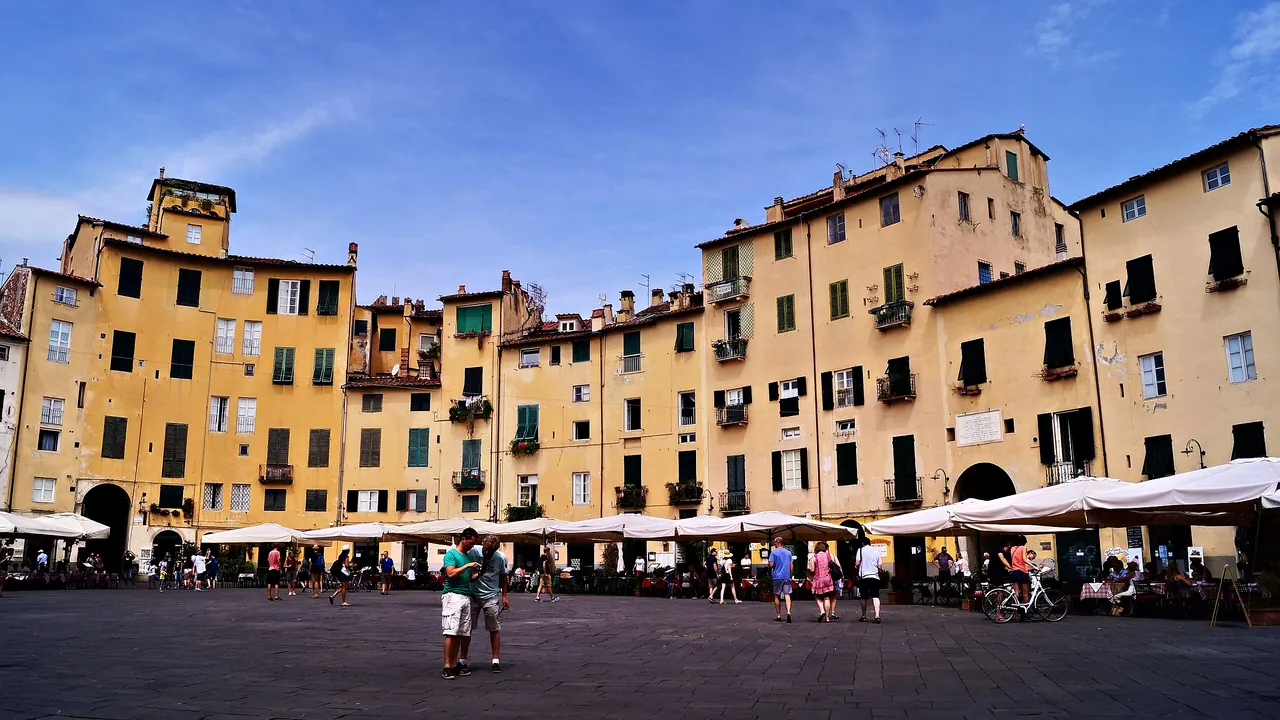
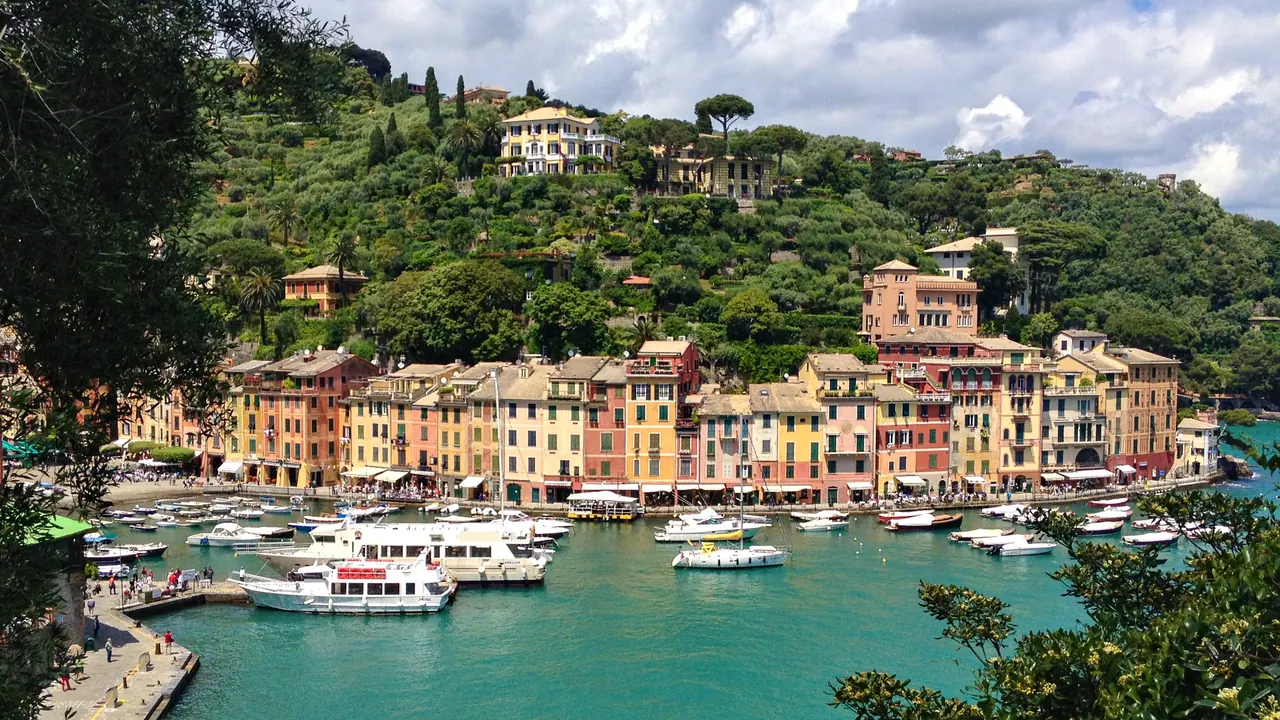
Photos: Lucca by Stefano Sansavini, CC BY-SA 4.0, cropped; Portofino by Michal Osmenda, CC BY 2.0, cropped.
Lucca or Portofino?
Our verdict in twelve categories, each scored against the same fixed benchmark cities, and the climate month by month, so you can choose for your trip.
Choose Lucca for
- live music and the arts
- culture and sights
- prices
Lucca suits travellers who want a base rather than a backdrop. It is a walled town of churches and towers to explore on foot or by bike, with honest Tuscan cooking and Puccini in the evenings. Trains to Florence, Pisa or the Versilia sand leave whenever you like. It is also the sensible pick for families and for anyone watching costs.
Choose Portofino for
- nature and the outdoors
- beaches
Choose Portofino for a short, indulgent stay built around the sea and the headland: rock swimming in clear water, the cliff path to San Fruttuoso, diving in the marine reserve and a long aperitivo beside the yachts. It rewards people with a generous budget and few plans, and it will frustrate anyone looking for sights, nightlife or value.
Scoreboard
Twelve categories on one fixed scale from 0 to 100. The shaded stretch is the gap between the two.
Your match
Pick a travel style or drag the sliders, and both match scores follow your weighting.
Wins on live music and the arts and culture and sights with your weighting.
Wins on nature and the outdoors and beaches with your weighting.
What matters to you?
Category by category
What the scores mean for a trip.
Beaches & swimming
Neither town has a beach at its door. The swimming at the two is about equally good, but quite different in kind. From Lucca you take the train to Viareggio for the long, gently shelving sand of the Versilia coast. Most of it is laid out in neat beach clubs, and the pine-backed dunes of the Lecciona are there if you want something wilder.
Portofino offers rock swimming in deep, clear water off the platforms towards the lighthouse, the small sheltered bay at Paraggi and the pebble cove at San Fruttuoso. The sea is right beside where you sleep, but the spots are small and crowded in summer. Lucca's beaches have plenty of room but are a train ride away.
Food & drink
Lucca eats better and for less. Its trattorias inside the walls serve spelt soup, tordelli in ragù and buccellato, bakery counters sell cecina, and the hills supply mild olive oil and local wine. The range is narrow, but the cooking is rooted in the province and fairly priced.
Portofino's Ligurian dishes, such as pesto, pansoti and Recco focaccia, sound tempting, but the harbour terraces charge you for the yachts in view more than for what is on the plate. There is no market and no street food, so people who care about eating go to Camogli or the trattorias in the hills.
Culture & sights
This is one of the widest gaps between the two. Lucca has complete Renaissance walls around a medieval grid of towers and Romanesque churches. Highlights include San Michele in Foro and the cathedral with the tomb of Ilaria del Carretto, plus the oval Piazza dell'Anfiteatro, and the essentials need about two days.
Portofino's culture is the painted harbour itself, along with San Giorgio, Castello Brown and the abbey at San Fruttuoso. You can see all of it in about a day, and there is no museum of any real size. You come here for the setting, not for the sightseeing.
Nightlife
Neither suits a big night out, though Lucca has a little more going on: wine bars, pubs full of students, and aperitivo in Piazza San Michele before the centre goes quiet. Portofino's evenings mean a dressed-up drink facing the yachts and then very little, with no clubs at all. To go dancing you leave both towns, for the Versilia beach discos from Lucca or for Santa Margherita, Rapallo or Genoa from Portofino.
Nature & outdoors
Portofino puts you inside protected landscape, with a regional park on the headland and a marine reserve offshore. Trails cross Monte di Portofino to San Fruttuoso and Punta Chiappa, and divers explore red coral walls and visit the Christ of the Abyss statue.
Lucca's own outdoors is gentler: the tree-lined walls and the cycle paths along the Serchio. The steep Apuan Alps, the Garfagnana woods and the reed beds of Massaciuccoli are all within reach for a day out. The difference is that Portofino's best walking and swimming start at your door.
Day trips
Lucca is the stronger base. Its railway line puts Pisa about half an hour away and Florence just over an hour, with Pistoia on the same line. The villas at Marlia, Collodi, the marble workshops of Pietrasanta and the Garfagnana villages fill more days.
Portofino's outings follow one stretch of coast: Camogli, Santa Margherita, Sestri Levante and Genoa, plus summer ferries to the Cinque Terre and Portovenere. Arriving by boat is part of the pleasure, but outside the ferry season the choice gets smaller.
Good for families
Lucca works far better with children. The centre is flat and largely free of cars, and you can ride bikes or a family quadricycle along the walls. Children also like the trees on top of the Torre Guinigi, and Pinocchio Park and sandy beaches are both close by.
Portofino is safe, and children enjoy the boats and the walk up to the castle, but the place is built for adults. Steep steps defeat a pushchair, most of the sand is in paid beach clubs, and nothing is aimed at the young. Families who want this coast usually stay in Santa Margherita or Rapallo.
Getting around
Lucca is much the easier of the two. Inside the walls it is flat, compact and mostly closed to cars, there is bike hire at every gate, and the station just outside the southern walls has regular trains to Pisa, Florence and the coast. The villas, hill villages and the Garfagnana are another matter, because buses there are sparse and a car makes those days far simpler.
Portofino is tiny on foot, but the paths up to the church, castle and lighthouse are steep. Getting in and out depends on one narrow coast road from Santa Margherita, a bus that is crowded in summer, and ferries that run only from spring to autumn. Parking is very limited and the road jams in high season, so in Portofino a car is more trouble than it is worth.
Shopping & style
Lucca is better for a proper browse. Via Fillungo has fashion and jewellery shops, some behind old Liberty shopfronts, the side lanes have delicatessens selling oil and buccellato, and one of Italy's oldest antiques markets is held one weekend a month. Portofino has more big fashion labels than its size suggests, plus resort wear, but they fit into a few lanes behind the piazzetta and take less than an hour. For markets or a longer day of shopping, people go to Chiavari or Genoa.
Affordability
On cost, the two towns are far apart. Lucca is priced like an ordinary town in central Italy and comes in below Florence, while Portofino is among the most expensive places in the country to spend a night. In Lucca, money is mostly a question of where you sleep. Rooms inside the walls are few and go quickly in summer and at festival time, so booking early or staying just beyond the gates keeps even a week affordable, and daily spending stays modest.
Portofino works the other way round. Nearly everything that fills a day there costs a premium, from a table facing the harbour to an afternoon on the water, so the price shapes the whole trip. Most people either keep a night or two in the village as a treat, or stay in a cheaper town along the coast and come in by bus or ferry for the day.
Live music & performing arts
Puccini was born in Lucca, and the town makes the most of it. For most of the year a central church holds short recitals of his arias, and the Teatro del Giglio has a season of opera and concerts. In July, big outdoor concerts fill Piazza Napoleone, and open-air opera at Torre del Lago is close by.
Portofino has almost nothing beyond the occasional summer concert in the piazzetta or at the castle. To see an opera or a play from there, you spend the evening at the Teatro Carlo Felice in Genoa.
Wellness & relaxation
Neither town has a bathing tradition of its own, and in both the calm comes mostly from the slow pace. Lucca has the edge because real thermal water is close. The belle époque spas of Montecatini are a short train ride away, and there are cave pools at Monsummano and steam grottoes at Bagni di Lucca. At home, the traffic-free streets and shaded walls do the rest.
In Portofino, wellness means the spas and pools of the luxury hotels. The peace is real early in the morning, in the evening and outside summer, but at midday in high summer the tour-boat crowds break it.
When should you go?
Pick your month. The climate figures are measured averages, not a forecast.
Lucca in July
Portofino in July
Daytime high, °C
Rainfall in the month, mm
Where the figures come from
Portofino's temperatures are measured 31 km from the centre, at Genova / Sestri.
Portofino has no rain gauge within 25 km of the centre, so its rainfall comes from a gridded climate dataset read at the city rather than from a gauge further away.
Temperature and rainfall are climate normals, averaged over the years shown. Lucca: 1991-2020 normals, Pisa / S. Giusto (21.4 km from centre). Portofino: 1991-2020 normals, Genova / Sestri (31 km from centre).
Lucca sits inland on its plain and gets hotter. July and August reach about 30°C, which makes afternoon sightseeing hard work, so May, June and September are the comfortable months for the streets and the walls. Portofino stays slightly milder beside the water. At both, the sea is warm enough to swim from June to September and reaches about 25°C in August. Lucca's summers are also long and very sunny.
Autumn is the wet season at both, but much more so on the Ligurian coast. Portofino's October brings around 225mm of rain, almost twice as much as Lucca's, and its winters are wetter as well. Lucca's mild, fairly dry spring makes it the safer choice outside summer. Portofino is at its best from late May to mid-September.
Which traveller are you?
For a culture and arts trip, Lucca is the clear choice. Its complete walls, Romanesque churches and Puccini recitals fill several days, and Florence and Pisa are easy train rides away. Portofino's sights take about a day.
On a tight budget, go to Lucca. Trattorias and regional trains are fairly priced and the walls and churches are free. Portofino is among the most expensive places in Italy to sleep and eat, and even a lounger at Paraggi costs a lot.
For an outdoors trip, Portofino wins. Trails over the protected headland drop to San Fruttuoso with the sea beside you, and the marine reserve offers coral diving and kayaking. You start all of this from the village itself, not after a drive.
Before you go
| Measure | Lucca | Portofino |
|---|---|---|
| Official language | Italian | Italian |
| Currency | Euro (EUR) | Euro (EUR) |
| Sockets | CFL230 V, 50 Hz | CFL230 V, 50 Hz |
| Driving side | Right | Right |
| Time zone | UTC+1, UTC+2 in summer | UTC+1, UTC+2 in summer |
| Emergency number | 112 | 112 |
| Elevation | 19 m | 20 m |
| Main airport | Pisa International Airport (PSA)21 km from centre82 non-stop destinations | Genoa Cristoforo Colombo Airport (GOA)32 km from centre25 non-stop destinations |
| Public holidays this year | 13 days | 13 days |
By the numbers
| Measure | Lucca | Portofino |
|---|---|---|
| City population | 88,798 | 355 |
| People per km² | 478 | 142 |
| Museums within 10 km | 20 | 14 |
| UNESCO World Heritage sites within 50 km | 4 | 2 |
| Swim season, months above 21 °C | 4 months | 4 months |
Where else could you go?
Every comparison below shares a destination with this one, so you can follow Lucca or Portofino somewhere new.