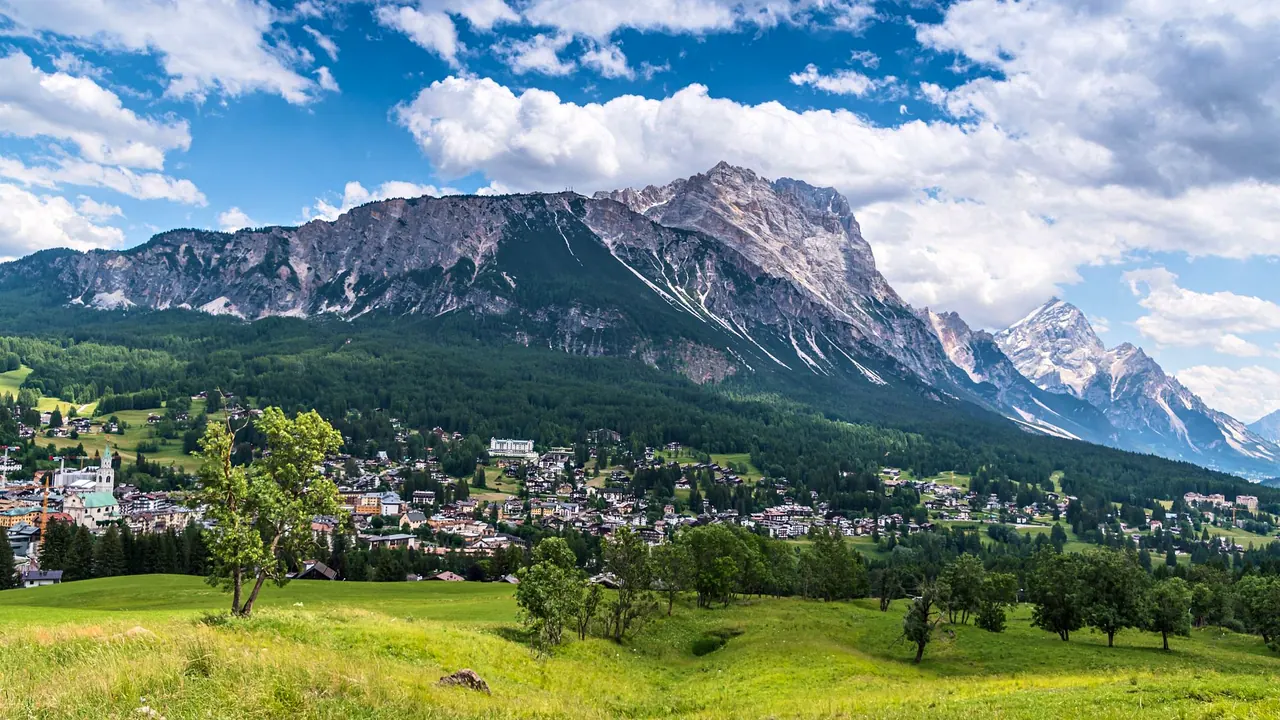
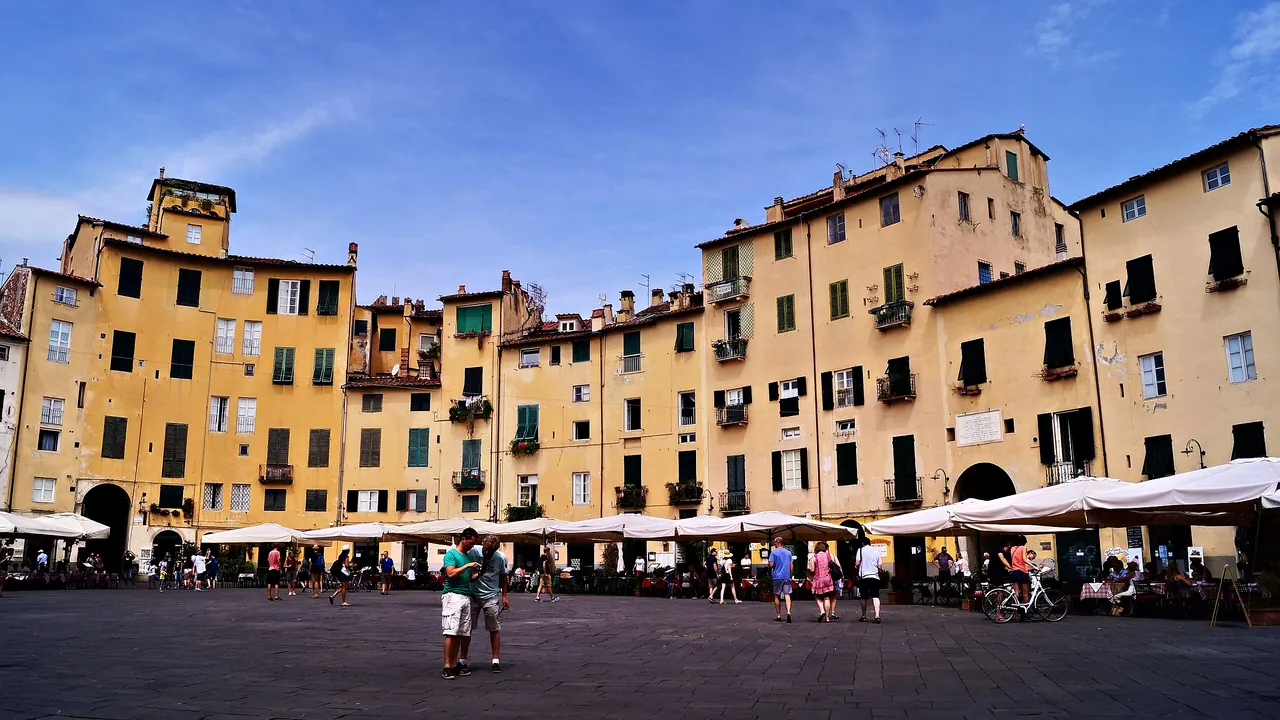
Photos: Cortina d'Ampezzo by Andreas Neubauer, Pexels License; Lucca by Stefano Sansavini, CC BY-SA 4.0, cropped.
Cortina d'Ampezzo or Lucca?
Our verdict in twelve categories, each scored against the same fixed benchmark cities, and the climate month by month, so you can choose for your trip.
Choose Cortina d'Ampezzo for
- nature and the outdoors
Cortina d'Ampezzo is the choice when the mountains are the whole point. Lifts rise straight from town into the Dolomites, so skiing the Dolomiti Superski in winter and hut-to-hut hiking or via ferrata in summer both start from your door. Expect to pay resort prices, and to spend quiet evenings in a small town with few sights of its own.
Choose Lucca for
- beaches
- day trips
- culture and sights
Travellers who want a city to explore will find more in Lucca. Inside its intact walls are Romanesque churches, Puccini recitals and a calm street plan you can cycle, and Pisa, Florence and the Versilia beaches are all an easy train ride away. Costs are fair for Tuscany, and the hills are gentler than Cortina's, though the Apuan Alps are within reach.
Scoreboard
Twelve categories on one fixed scale from 0 to 100. The shaded stretch is the gap between the two.
Your match
Pick a travel style or drag the sliders, and both match scores follow your weighting.
Wins on nature and the outdoors with your weighting.
Wins on beaches and day trips with your weighting.
What matters to you?
Category by category
What the scores mean for a trip.
Beaches & swimming
Cortina has no beach at all. The Adriatic is over two hours away, and its pretty lakes such as Ghedina are for walking round, not swimming, so a hotel pool is the realistic option.
Lucca, though inland, has the Versilia coast a short train ride away. Long, gently shelving sands run from Viareggio to Forte dei Marmi, with tidy rows of beach-club umbrellas, while the pine-backed dunes of the Lecciona are wilder. It makes a natural afternoon after a morning in town.
Food & drink
Lucca eats better day to day. Spelt soup from the Garfagnana, tordelli in ragù, cecina from bakery counters and buccellato come from family trattorias at prices that feel fair for Tuscany, with Montecarlo wines and local olive oil alongside.
Cortina's cooking has its own Ampezzan character, with beetroot casunziei and polenta with game, and its best meals are on rifugio terraces among the peaks. In the valley the choice is small and almost nothing is cheap. Neither town has much international cooking.
Culture & sights
Here Lucca is far ahead. Its complete Renaissance walls enclose a medieval town of towers and Romanesque façades, from the carved arcades of San Michele in Foro to San Frediano's golden mosaic, plus the oval Piazza dell'Anfiteatro and the oak-crowned Torre Guinigi.
Cortina's centre is pleasant, with its basilica bell tower, painted houses and the 1956 Olympic ice stadium, and the Rimoldi art collection will fill a rainy afternoon. Its most moving history is the First World War front on Lagazuoi and the Cinque Torri, which is a mountain outing rather than a sight in town.
Nightlife
Neither town is built for late nights, but the evenings feel different. Cortina's are about après-ski and a stroll on the Corso Italia, with a few smart bars and a club staying open late only in the peak winter weeks.
Lucca's evenings are an aperitivo in Piazza San Michele, dinner and a walk on the walls, with some student pubs. In summer, dancing means a late trip to the Versilia beach discos.
Nature & outdoors
Cortina's setting is among the finest anywhere. The pale Dolomites ring the valley, the Fanes-Sennes-Braies park begins at its edge, and lifts lead straight to ski runs, via ferrata and the Alta Via 1. Nothing near Lucca matches it.
Lucca's outdoors is gentler: the tree-lined walls, Serchio cycle paths and olive-clad hills. For real mountains, the marble-scarred Apuan Alps are about an hour north, and Lake Massaciuccoli adds birdwatching.
Day trips
Lucca is a superb base. Pisa is half an hour by train and Florence little more than an hour, with Pistoia and Montecatini on the same line. The Marlia and Torrigiani villas, Collodi, Pietrasanta and Carrara are close, and the Cinque Terre is possible with an early start.
Cortina's outings are mostly mountain days. South Tyrol's San Candido, Brunico and Bolzano with its Iceman are pleasant, but Venice is a long coach ride each way.
Good for families
Lucca is slightly easier with children. Riding a family quadricycle round the walls, climbing to the trees on the Torre Guinigi, Pinocchio Park at Collodi and the nearby beaches make the days easy to fill.
Cortina suits families who ski or hike, with ski schools at Socrepes, public skating and gentle trails to huts. A wet day with little ones is harder there, and the bills grow quickly.
Getting around
Lucca is far easier to reach and to get around than Cortina, and the gap shows from the day you arrive. Cortina has had no railway since 1964, so the journey in is by coach or by road. Its small centre takes minutes to cross on foot, but buses up to Misurina and the Tre Cime are too infrequent to plan a day around, and for the wider Dolomites a car is close to essential.
In Lucca the train pulls in just below the southern walls, with frequent links to Pisa, Florence and Viareggio for day trips. Inside the walls, the flat, largely car-free streets are covered on foot or by bike. Only the villas and the Garfagnana make a car worth having.
Shopping & style
The two are evenly matched but cater to different shoppers. Cortina's Corso Italia sells luxury fashion, furs and upmarket ski wear, anchored by the old Cooperativa department store.
Lucca's Via Fillungo is plainer, with Liberty-era shopfronts and delicatessens selling farro and buccellato. Its real draw is the monthly antiques market around the cathedral.
Affordability
Lucca is much kinder to the wallet. Trattoria meals and regional trains are fairly priced, the walls and many churches are free, and staying just outside the walls keeps rooms reasonable.
Cortina is among Italy's most expensive resorts, with costly hotels and restaurants in the peak seasons and lift passes and hire on top. Rifugio meals and the quieter June and late-September weeks soften the cost a little, and many budget travellers sleep in cheaper valleys nearby.
Live music & performing arts
Lucca has a real musical life, built around Puccini. Church recitals of his arias run through most of the year, the Teatro del Giglio holds an opera and theatre season, and summer brings the Lucca Summer Festival and open-air opera by the lake at Torre del Lago.
Cortina has no theatre or regular venue. Its summer chamber concerts, some held in mountain settings, are pleasant but occasional.
Wellness & relaxation
Neither town has spa baths of its own, so the difference is in style. Cortina's wellness is inside its hotels, with Alpine saunas, hay baths and indoor pools after a day outdoors, though the peak weeks bring traffic and crowds.
Lucca relaxes through its traffic-free streets and evening walks on the walls. For a proper soak there are Montecatini Terme, the cave pools at Monsummano and the steam grottoes of Bagni di Lucca, all an easy trip away.
When should you go?
Pick your month. The climate figures are measured averages, not a forecast.
Cortina d'Ampezzo in July
Lucca in July
Daytime high, °C
Rainfall in the month, mm
Temperature and rainfall are climate normals, averaged over the years shown. Cortina d'Ampezzo: 1991-2020 normals, Dobbiaco (22.5 km from centre). Lucca: 1991-2020 normals, Pisa / S. Giusto (21.4 km from centre).
Cortina has two seasons. December and January are the coldest months, with daytime highs near 0°C, and February and March stay cold but brighten towards spring, which makes the whole stretch good for skiing. June to September is the hiking season, mild rather than warm at around 22°C in July and August, though this is also when most of the year's rain falls, with July the wettest month. June and September are the gentlest compromise. April, May, October and November fall between the two seasons and suit neither skiing nor high trails.
Lucca runs almost the other way. July and August reach about 30°C, which is sticky for sightseeing on the plain but right for the coast, where the sea warms to 25°C and the sunshine is long and steady from June to August. For walking the streets and the walls, May, June and late September are kinder. Heavy rain arrives in autumn and peaks at around 132mm in November. Winters stay mild, far warmer than Cortina's, but they are wetter and greyer.
Which traveller are you?
For an outdoors trip, Cortina is in a different league. The Tofane, Cinque Torri and Tre Cime are right there, with skiing in winter and the Alta Via 1, historic via ferrata and mountain biking in summer, all reached by lifts from town.
On a culture and arts trip, Lucca is far richer. San Michele in Foro, the cathedral's Ilaria del Carretto tomb and the walled medieval grid fill the days, and Puccini recitals or the Teatro del Giglio fill evenings that are quiet in Cortina.
For a beach and sun trip, only Lucca works. The wide sands of Viareggio and Forte dei Marmi are under half an hour by train, and the summer sea is warm. Cortina's alpine lakes are fed by snowmelt and stay cold.
Before you go
| Measure | Cortina d'Ampezzo | Lucca |
|---|---|---|
| Official language | Italian | Italian |
| Currency | Euro (EUR) | Euro (EUR) |
| Sockets | CFL230 V, 50 Hz | CFL230 V, 50 Hz |
| Driving side | Right | Right |
| Time zone | UTC+1, UTC+2 in summer | UTC+1, UTC+2 in summer |
| Emergency number | 112 | 112 |
| Elevation | 1,224 m | 19 m |
| Main airport | Venice Marco Polo Airport (VCE)116 km from centre103 non-stop destinations | Pisa International Airport (PSA)21 km from centre82 non-stop destinations |
| Public holidays this year | 13 days | 13 days |
By the numbers
| Measure | Cortina d'Ampezzo | Lucca |
|---|---|---|
| City population | 5,546 | 88,798 |
| People per km² | 22 | 478 |
| Museums within 10 km | 3 | 20 |
| UNESCO World Heritage sites within 50 km | 1 | 4 |
| Swim season, months above 21 °C | - | 4 months |
Where else could you go?
Every comparison below shares a destination with this one, so you can follow Cortina d'Ampezzo or Lucca somewhere new.
- Pisavs Lucca
- Florencevs Lucca
- La Speziavs Lucca
- Sienavs Lucca
- Bolognavs Lucca
- Innsbruckvs Cortina d'Ampezzo