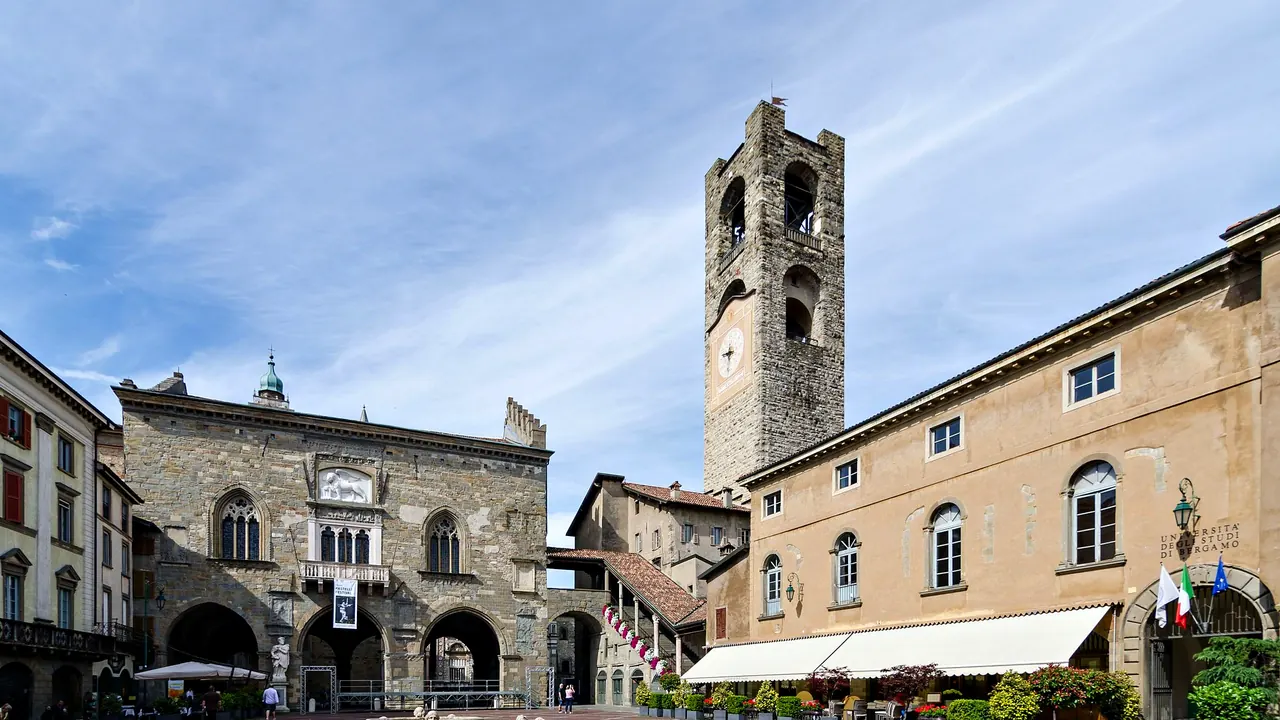
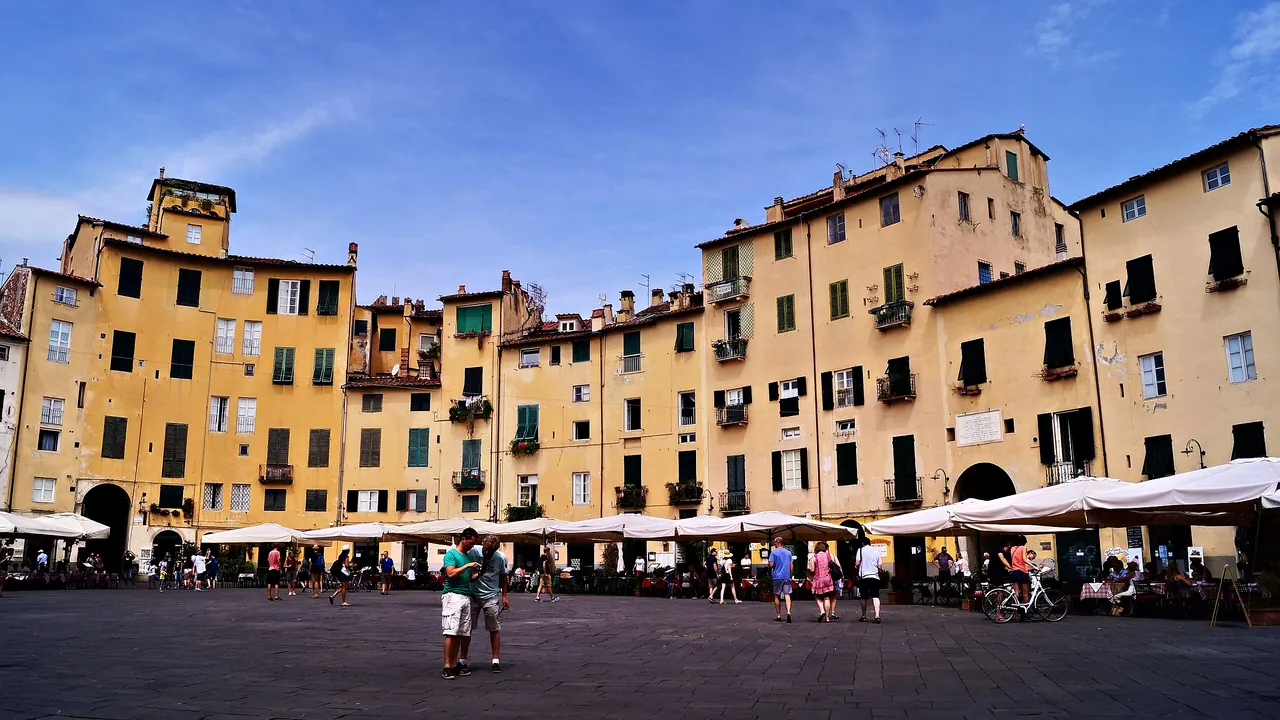
Photos: Bergamo by Steffen Schmitz, CC BY-SA 4.0, cropped; Lucca by Stefano Sansavini, CC BY-SA 4.0, cropped.
Bergamo or Lucca?
Our verdict in twelve categories, each scored against the same fixed benchmark cities, and the climate month by month, so you can choose for your trip.
Choose Bergamo for
- nightlife
- prices
- nature and the outdoors
Bergamo suits travellers who want mountains and lakes on the doorstep of a fine old town. The Orobie valleys start just beyond the walls, Lake Iseo and Lake Como are close, and Milan is near enough for an evening at La Scala or a proper night out. Your money goes a little further here than in Lucca, and the evenings are a touch livelier, which makes it a practical base for a week of rail trips around Lombardy.
Choose Lucca for
- beaches
- live music and the arts
- getting around
Choose Lucca if you want sandy beaches and Tuscan towns within reach of a city you can cycle across. The Versilia coast is under half an hour away, Pisa and Florence are on the same railway line, and the flat, traffic-free centre inside the walls is easy to get around. Puccini's music runs through the place, from short recitals of his arias to summer opera by the lake at Torre del Lago. It is the better pick for slow days that end with an afternoon swim.
Scoreboard
Twelve categories on one fixed scale from 0 to 100. The shaded stretch is the gap between the two.
Your match
Pick a travel style or drag the sliders, and both match scores follow your weighting.
Too close to call, 2 points apart
Wins on nightlife and prices with your weighting.
Wins on beaches and live music and the arts with your weighting.
What matters to you?
Category by category
What the scores mean for a trip.
Beaches & swimming
Neither city is on the water, but Lucca is much better for swimming. Viareggio is about 25 minutes away by train, and the gently shelving sandy beaches run from there to Forte dei Marmi, with the wilder pine-backed dunes of the Lecciona for anyone who wants to avoid the rows of umbrellas.
From Bergamo, swimming means a lake: the lidos and grassy shores of Lake Iseo or the Lecco arm of Como, usually reached from pebble beaches or concrete platforms. They make a pleasant hot day out, not a beach vacation.
Food & drink
The food is equally good in both, but quite different. Bergamo cooks Lombard mountain food, with polenta, braised meats, game and butter-and-sage casoncelli. Its real strength is cheese, with Taleggio, Branzi and Strachitunt sold over the counters of the Città Alta, and Franciacorta sparkling wine is made nearby.
Lucca's food is plainer and Tuscan: farro soup, tordelli in ragù, chickpea cecina, chestnut flour in the colder months, all with mild local olive oil. Bergamo has the stronger fine-dining tier, while Lucca relies more on family osterie. Neither offers much beyond Italian food.
Culture & sights
Both are walled towns of real quality, and both need about two days. In Bergamo, the main sight is the hilltop Città Alta inside its UNESCO-listed Venetian walls, with Piazza Vecchia, Santa Maria Maggiore and the marble front of the Cappella Colleoni. Bergamo also has the stronger art collection: the Accademia Carrara, with Raphael, Bellini and Mantegna.
Lucca's appeal is more the townscape as a whole. Its complete tree-lined walls enclose a flat medieval grid of towers and churches, with the carved arcades of San Michele in Foro, the oval Piazza dell'Anfiteatro and the Torre Guinigi. Its museums are more modest.
Nightlife
Both are quiet places at night, but Bergamo has a little more to offer. Aperitivo turns into wine bars and pubs around Via XX Settembre and Borgo Santa Caterina, students keep some bars busy, and on summer evenings people drink in the squares of the upper town. Milan is close enough for a proper night out.
Lucca winds down earlier. Its evening is an aperitivo in Piazza San Michele, dinner and a stroll on the walls, and dancing in summer means a late taxi back from the Versilia clubs.
Nature & outdoors
Bergamo has the mountains right on its doorstep. The Colli park climbs straight from the upper town to San Vigilio, and Val Brembana and Val Seriana lead deep into the Orobie Alps, with rifugi, high lakes, serious summer hiking and small ski areas such as Foppolo in winter. Lake Iseo and Lake Como add sailing and cycling along the shore.
Around Lucca the land is gentler, with olive groves and villa gardens in the Lucchesi hills, cycle paths along the Serchio and the 4km ring of the walls for a run. For real mountains you go about an hour north to the sharp marble peaks of the Apuan Alps. Closer to the coast, the reed beds of Lake Massaciuccoli and the pine woods of San Rossore are good for birdwatching.
Day trips
Both are excellent bases and much of their appeal lies outside town. Bergamo covers Lombardy: Milan in under an hour, Lake Como and Lake Iseo with car-free Monte Isola, Crespi d'Adda, Brescia, and Verona or Cremona for a longer day.
Lucca has a slight edge because of the range it offers. Pisa is half an hour away, Florence a little over an hour, and the coast, the marble town of Pietrasanta, the villa gardens at Marlia and the Garfagnana villages are all close. With an early start you can also reach the Cinque Terre.
Good for families
Both are calm, manageable places with children, but the day goes differently in each. In Bergamo the fun is in going up: the funiculars to the Città Alta and on to San Vigilio feel like an outing in themselves, though the upper town's steep cobbles make heavy going with a buggy. Its bigger attractions lie outside town, with rides for younger children at Leolandia and animals at Le Cornelle. That suits families with a car who like to plan a full day out.
Lucca is easier for families who want to stay put and get about on foot or by bike. The level, mostly car-free streets inside the walls let small children roam, and a quadricycle ride round the ring keeps everyone busy. In place of Leolandia's rides, Collodi has the gentler Pinocchio Park, and the sandy Versilia shore is easier for paddling than Bergamo's lake platforms. In autumn, Lucca Comics & Games makes it the better pick for teenagers.
Getting around
Lucca is the easier of the two. Inside the walls it is compact, flat and largely closed to traffic, bikes can be hired at every gate, and the station sits just outside the southern walls.
Bergamo's two levels add some effort. The funicular solves the climb to the Città Alta, buses and the airport link are good, and a light-rail line runs up Val Seriana. In both cities, the countryside is much easier with a car.
Shopping & style
Neither city is a shopping destination, and what is worth buying is mostly food. Bergamo's Città Alta lane is lined with cheese shops, delicatessens and wine sellers, while the arcades of the lower town have mid-range chains, and Milan's fashion is under an hour away.
Lucca's Via Fillungo has more character, with jewellers behind old Liberty shopfronts, and its monthly antiques market around the cathedral is one of the oldest in Italy and worth planning a visit around.
Affordability
Bergamo is somewhat easier on the budget. Lower-town hotels are fairly priced for a city with this much to see, and local transport costs little, although rooms inside the Città Alta cost more.
Lucca is cheaper than Florence but tighter than Bergamo, mainly because there are few rooms inside the walls and they fill up in summer and at festival time. On the other hand, the walls and many churches are free, and staying just outside the gates saves money.
Live music & performing arts
Both cities are built around a composer, and Lucca makes more of it. Short recitals of Puccini arias are held most of the year, the Teatro del Giglio has a full season, Piazza Napoleone hosts big outdoor concerts in July, and Torre del Lago stages open-air opera by the lake in summer.
Bergamo's stage life centres on Donizetti, with an autumn festival at the Teatro Donizetti and the long-running Bergamo Jazz in spring. For the rest of the year the programme is more provincial, although La Scala is within reach.
Wellness & relaxation
Neither city has baths of its own, so a spa means a day out from either. From Bergamo, San Pellegrino Terme up Val Brembana offers grand Belle Époque bathing, and Trescore Balneario has sulphur springs. From Lucca you can reach Montecatini by train, the warm cave pools at Monsummano or the steam grottoes of Bagni di Lucca.
The main difference is the setting. Bergamo's calm is found in the early-morning quiet of the upper town, while Lucca's comes from its flat streets without cars and evening walks on the shaded walls.
When should you go?
Pick your month. The climate figures are measured averages, not a forecast.
Bergamo in July
Lucca in July
Daytime high, °C
Rainfall in the month, mm
Where the figures come from
Bergamo has no rain gauge within 25 km of the centre, so its rainfall comes from a gridded climate dataset read at the city rather than from a gauge further away.
Bergamo's sunshine is measured 64 km from the centre, at Lugano.
Temperature and rainfall are climate normals, averaged over the years shown. Bergamo: 1991-2020 normals, Bergamo / Orio Al Serio (3.9 km from centre). Lucca: 1991-2020 normals, Pisa / S. Giusto (21.4 km from centre).
Bergamo is the cooler and wetter of the two for most of the year. Winter days are chilly, around 7°C in January against 11°C in Lucca, although these are Bergamo's driest months. Rain picks up in May and stays fairly steady through the summer, so a warm afternoon at the lake in July or August can turn showery. From September to November it is wettest. Late May and June are the best months for walking the streets, as long as you pack an umbrella.
Lucca has the drier, sunnier summer. June to August bring little rain. The sea is warm enough for swimming from June to September and reaches 25°C at its peak, but the plain is hot for sightseeing in July and August. Lucca's rain falls mostly between September and December. November is the wettest month at 132mm, more than any month in Bergamo. April, May and early June are the best months for exploring the town on foot.
Which traveller are you?
On a beach and sun trip, Lucca is the obvious choice. The wide sands of Versilia are a short train ride away, the summers are dry and bright, and you can see the Romanesque churches in the morning before an afternoon by the sea.
For a trip on a tight budget, Bergamo stretches your money further. Hotels in the lower town are fairly priced, buses and the funicular cost little, and trains to Milan, Brescia and the lakes make cheap day trips easy without paying for a hotel elsewhere.
On a food and nightlife trip, Bergamo has the edge. The cooking is as good as Lucca's, with casoncelli and the valley cheeses, and the lower town keeps going a little later. When you want more, Milan's bars and clubs are under an hour away.
Before you go
| Measure | Bergamo | Lucca |
|---|---|---|
| Official language | Italian | Italian |
| Currency | Euro (EUR) | Euro (EUR) |
| Sockets | CFL230 V, 50 Hz | CFL230 V, 50 Hz |
| Driving side | Right | Right |
| Time zone | UTC+1, UTC+2 in summer | UTC+1, UTC+2 in summer |
| Emergency number | 112 | 112 |
| Elevation | 249 m | 19 m |
| Main airport | Il Caravaggio International Airport (BGY)4 km from centre146 non-stop destinations | Pisa International Airport (PSA)21 km from centre82 non-stop destinations |
| Public holidays this year | 13 days | 13 days |
By the numbers
| Measure | Bergamo | Lucca |
|---|---|---|
| City population | 119,534 | 88,798 |
| People per km² | 2,973 | 478 |
| Museums within 10 km | 21 | 20 |
| UNESCO World Heritage sites within 50 km | 6 | 4 |
| Swim season, months above 21 °C | - | 4 months |
Where else could you go?
Every comparison below shares a destination with this one, so you can follow Bergamo or Lucca somewhere new.