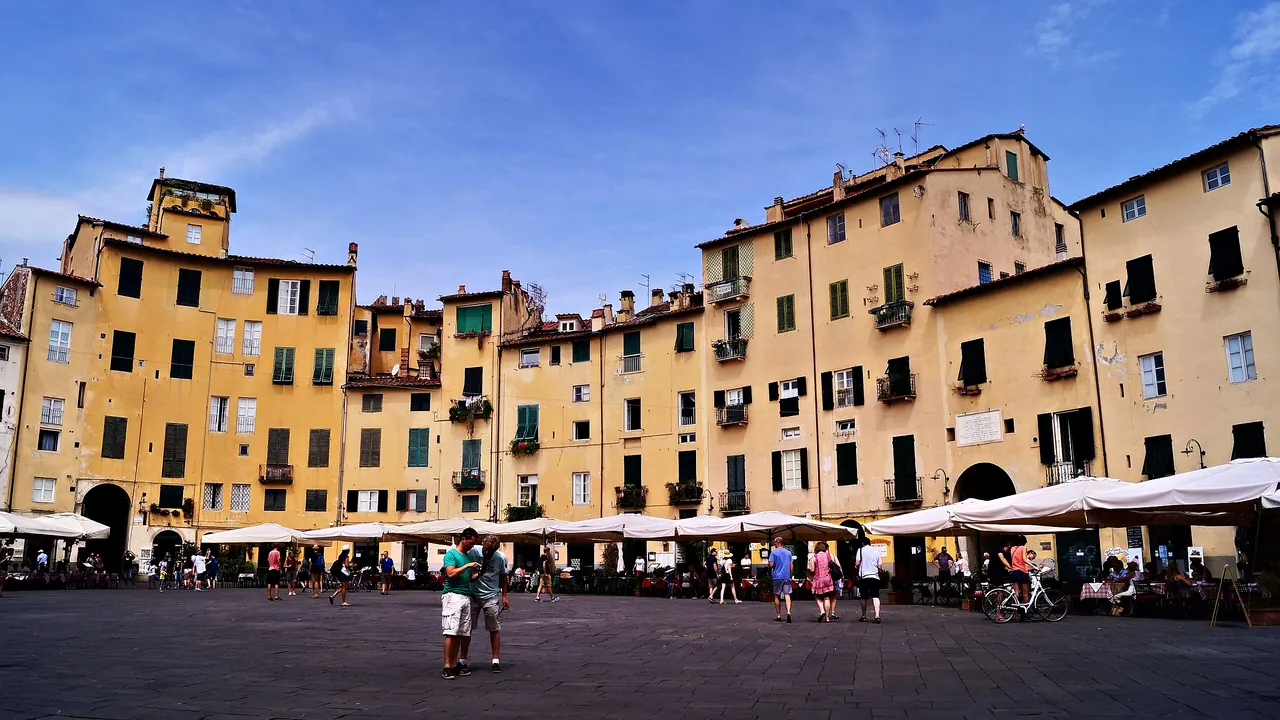
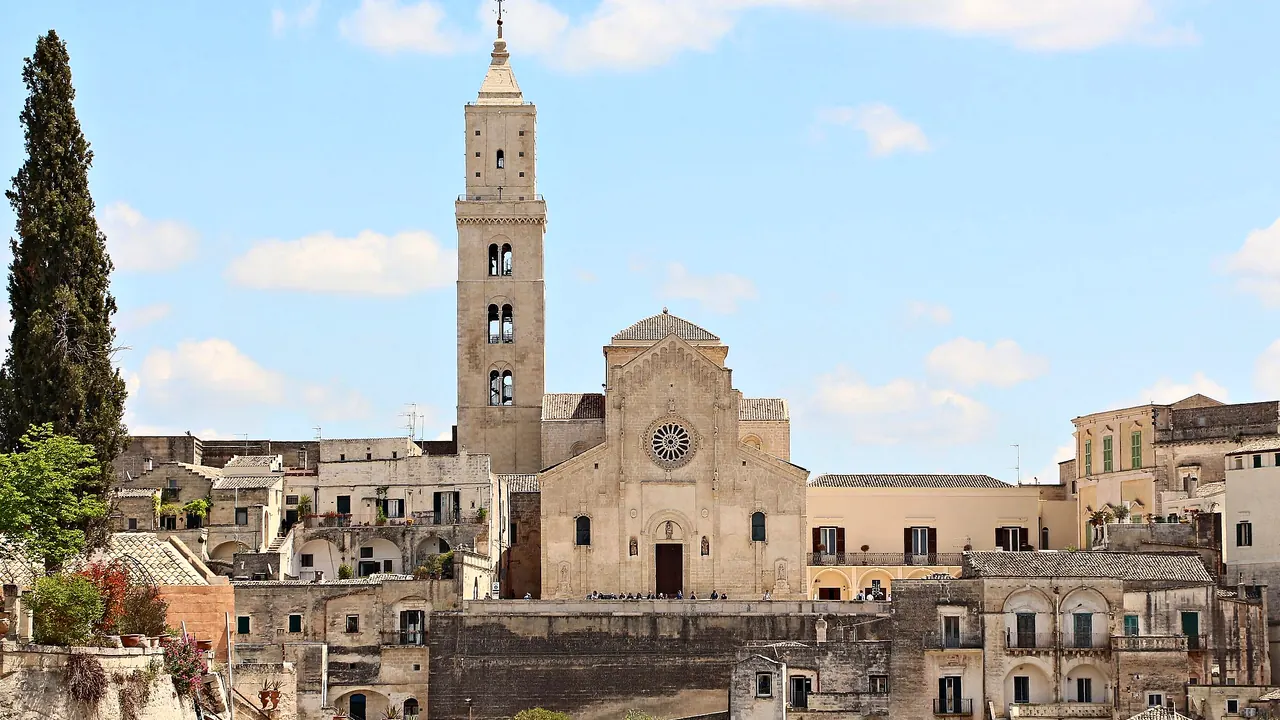
Photos: Lucca by Stefano Sansavini, CC BY-SA 4.0, cropped; Matera by Bernard Gagnon, CC BY 4.0, cropped.
Lucca or Matera?
Our verdict in twelve categories, each scored against the same fixed benchmark cities, and the climate month by month, so you can choose for your trip.
Choose Lucca for
- live music and the arts
- getting around
- families
Lucca suits travellers who want an easy, well-connected base in Tuscany. Its flat, traffic-free centre is a pleasure to walk or cycle, trains run straight to Pisa, Florence and the Versilia beaches, and Puccini's music fills its evenings. Families, first-time visitors to Italy and anyone who wants a different outing every day will find it the simpler and fuller choice.
Choose Matera for
- prices
- culture and sights
Matera is for the traveller who wants one extraordinary place. The cave districts of the Sassi, cut into the side of a gorge and lived in since prehistoric times, look like nowhere else in Italy. Food and rooms in the upper town also cost a little less. It rewards couples and curious adults with a hire car who don't mind steep steps, quiet nights and some effort to get there.
Scoreboard
Twelve categories on one fixed scale from 0 to 100. The shaded stretch is the gap between the two.
Your match
Pick a travel style or drag the sliders, and both match scores follow your weighting.
Wins on live music and the arts and getting around with your weighting.
Wins on prices and culture and sights with your weighting.
What matters to you?
Category by category
What the scores mean for a trip.
Beaches & swimming
Neither city is on the sea, but Lucca is much closer to it. Trains reach Viareggio in under half an hour, and the Versilia's wide sands, lined with beach clubs, run on to Forte dei Marmi. That makes a swim an easy afternoon add-on, without a car.
From Matera, the pine-backed Ionian beaches at Metaponto and Policoro are about 45 minutes by road. They are shallow and calm, which suits children well, but without a car they are hard to reach, so most visitors skip the sea entirely.
Food & drink
Both cook plain regional food, but Lucca's table has a little more to it. There is spelt soup from the Garfagnana, meat-filled tordelli, chickpea cecina from bakery counters and buccellato bread, plus local olive oil and Montecarlo wines to go with aperitivo in its wine bars.
Matera's cooking is the peasant food of Basilicata: crusty durum-wheat bread, fave e cicoria, crackling dried peppers and Aglianico wine. Eating in a cave room is part of the appeal, but the range is narrow and there is no street food to fill the gaps.
Culture & sights
The two are close in strength but very different in what they offer. Lucca is a finished Renaissance town inside complete walls. Its highlights are the carved Romanesque façades of San Michele and San Frediano, the cathedral's tomb of Ilaria del Carretto, and the oval Piazza dell'Anfiteatro.
Matera is stranger and older. You walk through cave dwellings and rock churches with Byzantine frescoes, and under the main square through the Palombaro Lungo cistern. Its set of sights is smaller, but the Sassi at dusk stay in the memory longer than any single building in Lucca.
Nightlife
Both are quiet after dinner, and neither has a real club. Lucca's evenings are an aperitivo in Piazza San Michele and a stroll on the walls, and in summer the Versilia discos are within reach for anyone who wants to dance. In Matera, a late drink means a cave wine bar or a terrace above the lit Sassi, a lovely setting for couples but nowhere to go out dancing.
Nature & outdoors
Lucca has more variety close at hand. Within an hour you can reach the sharp marble peaks of the Apuan Alps, the chestnut woods of the Garfagnana, and the reed beds of Lake Massaciuccoli. In town, the 4km ring of the walls gives you a shaded place to run or cycle.
Matera's strength is the wild ground right on its doorstep. A path drops from Sasso Caveoso into the Gravina gorge and climbs to the Murgia plateau, past abandoned rock churches and Neolithic sites. The Lucanian Dolomites and Pollino need a long drive.
Day trips
Lucca is one of the best bases in Tuscany. Pisa is half an hour by train and Florence little more than an hour, with Pistoia, the Montecatini spas, the gardens of the great villas and the marble town of Pietrasanta all close by.
Matera also has a strong spread, from the trulli of Alberobello and the white towns of the Valle d'Itria to Castel del Monte and the abandoned village of Craco. The difference is that almost every one of these needs a car.
Good for families
Lucca is far easier with children. The flat streets are mostly free of cars, and riding a family quadricycle round the walls is a ready-made outing. Collodi's Pinocchio Park and the beaches are each a short trip away.
In Matera, older children enjoy the caves and the underground cistern. But the Sassi are steep stone stairways with little shade, a pushchair is useless, and there is nothing built for children, so a short stay with a baby carrier works best.
Getting around
Both old centres are best on foot, but Lucca's is flat and Matera's Sassi are a climb of stairs and steep lanes. Lucca also has bikes for hire at every gate, and its station is just outside the walls, with regular trains along the Tuscan lines.
Matera is off the national rail network. A slow narrow-gauge line runs to Bari and buses are sparse, so a hire car decides how much of the region you see. In Lucca you only need one for the hill villages.
Shopping & style
Lucca's antiques market is the reason to shop here. It is one of the oldest in Italy and fills the streets around the cathedral one weekend each month. Via Fillungo adds fashion and jewellery shops behind old Liberty-style shopfronts, so Lucca has more to browse than Matera, though nothing in the luxury range.
Matera's shopping is mostly souvenirs: painted cuccù whistles and carved tufa models from the Sassi workshops, plus ordinary high-street shops along Via del Corso. The best things to take home are edible, such as dried peppers and Aglianico.
Affordability
Matera is somewhat cheaper day to day, especially at the simple trattorias of the upper town and in the guesthouses a short walk from the Sassi. Just avoid the cave hotels, which are its pricey speciality. Lucca costs less than Florence, but rooms inside the walls are few and fill up in summer and at festival times, so the savings come from staying outside the gates.
Live music & performing arts
Lucca has the much richer musical life, thanks to Puccini. Short recitals of his arias run through most of the year, and the Teatro del Giglio has an opera season. In summer you also get open-air opera at Torre del Lago and the big July concerts in Piazza Napoleone.
Matera has a conservatory, a summer jazz festival and a few outdoor events against the Sassi. Its one big night is the Festa della Bruna, a feast rather than a performance.
Wellness & relaxation
Montecatini's belle époque spa buildings are half an hour from Lucca by train. The warm cave pools of Monsummano and the steam grottoes of Bagni di Lucca are close as well, so a proper day of bathing is easy to arrange even though the city has no baths of its own.
Matera's wellness stays inside its hotels, some of which have candlelit pools cut into the rock. They make a memorable soak, but there is little beyond them, and the town's calm comes mostly from its slow pace and the quiet months between autumn and spring.
When should you go?
Pick your month. The climate figures are measured averages, not a forecast.
Lucca in July
Matera in July
Daytime high, °C
Rainfall in the month, mm
Where the figures come from
Matera has no rain gauge within 25 km of the centre, so its rainfall comes from a gridded climate dataset read at the city rather than from a gauge further away.
Temperature and rainfall are climate normals, averaged over the years shown. Lucca: 1991-2020 normals, Pisa / S. Giusto (21.4 km from centre). Matera: 2005-2025, 10 years observed (rainfall 1991-2020) normals, Matera / Martella (4.8 km from centre).
Lucca is at its best in May and June, when the days are warm and long and the sun is out most of the time, and again in early September, before the rain sets in. July and August reach about 30°C on the plain, which is hot for walking the streets but good for the Versilia beaches. The sea there is warm enough to swim from June to September. From late September the weather turns. October and November are the wettest months, with around 132mm in November, and the winter days are short and grey.
Matera gets hotter in high summer, about 32°C on the bare plateau, so in July and August sightseeing in the Sassi is for early mornings and evenings. Its rain is lighter and spread more evenly through the year, so late September and October stay pleasant for walking the gorge after Lucca has turned wet. The Ionian sea is still about 25°C in September, which makes it the better place for a swim at the end of summer. Winters are cool and much the same in both.
Which traveller are you?
On a family trip with children, Lucca is the clear choice. The flat, car-free centre, bike rides on the walls, Pinocchio Park at Collodi and sandy beaches by train keep children busy. In Matera, steep stone steps rule out pushchairs.
For a trip on a tight budget, Matera stretches money a little further. Trattorias in the upper town are cheap, guesthouses outside the Sassi cost much less than the cave hotels, and walking the old districts and the Murgia is free.
On a culture and arts trip, pick Matera if you want sights unlike anywhere else: frescoed rock churches, furnished cave houses and the gorge at dusk. Choose Lucca if you care more about Romanesque façades and evenings of Puccini opera.
Before you go
| Measure | Lucca | Matera |
|---|---|---|
| Official language | Italian | Italian |
| Currency | Euro (EUR) | Euro (EUR) |
| Sockets | CFL230 V, 50 Hz | CFL230 V, 50 Hz |
| Driving side | Right | Right |
| Time zone | UTC+1, UTC+2 in summer | UTC+1, UTC+2 in summer |
| Emergency number | 112 | 112 |
| Elevation | 19 m | 401 m |
| Main airport | Pisa International Airport (PSA)21 km from centre82 non-stop destinations | Bari Karol Wojtyła International Airport (BRI)54 km from centre104 non-stop destinations |
| Public holidays this year | 13 days | 13 days |
By the numbers
| Measure | Lucca | Matera |
|---|---|---|
| City population | 88,798 | 59,685 |
| People per km² | 478 | 152 |
| Museums within 10 km | 20 | 8 |
| UNESCO World Heritage sites within 50 km | 4 | 1 |
| Swim season, months above 21 °C | 4 months | 5 months |
Where else could you go?
Every comparison below shares a destination with this one, so you can follow Lucca or Matera somewhere new.