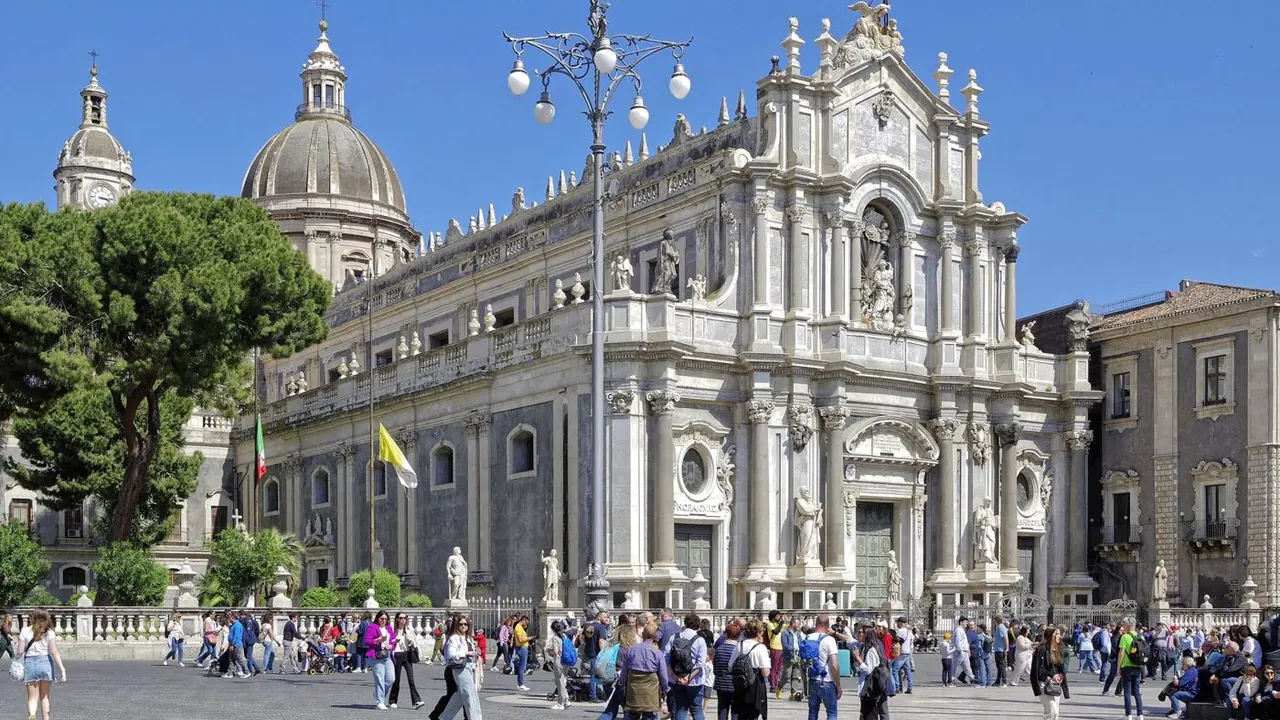
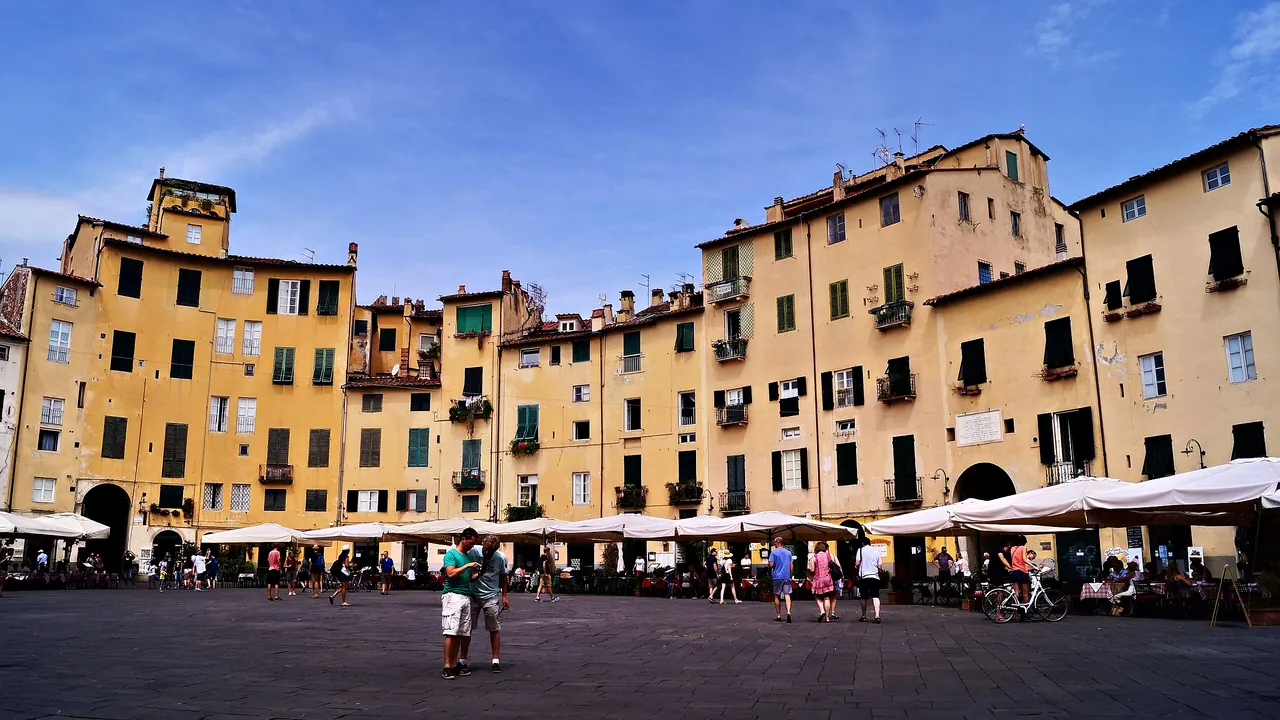
Photos: Catania by Berthold Werner, CC BY-SA 4.0, cropped; Lucca by Stefano Sansavini, CC BY-SA 4.0, cropped.
Catania or Lucca?
Our verdict in twelve categories, each scored against the same fixed benchmark cities, and the climate month by month, so you can choose for your trip.
Choose Catania for
- nightlife
- food and drink
- beaches
Catania is the better pick for travellers who want heat, appetite and drama. Etna is smoking on the skyline, the sea is on the doorstep with both a sandy strip and a black lava shore, the street food and fish market are among the best in southern Italy, and the old centre stays out late. It is also kinder to the budget. The trade-off is a noisy, traffic-heavy city that rewards energy more than calm, and a car makes the most of it.
Choose Lucca for
- getting around
- wellness
- day trips
Lucca is for those who want an easy, gentle base where the car can stay parked. Inside its complete Renaissance walls you walk or cycle everywhere, the evenings are quiet, and trains run straight to Pisa, Florence and the Versilia beaches. It suits couples, families with young children and anyone touring Tuscany by rail, though nights out are tame and the food is plainer than Sicily's.
Scoreboard
Twelve categories on one fixed scale from 0 to 100. The shaded stretch is the gap between the two.
Your match
Pick a travel style or drag the sliders, and both match scores follow your weighting.
Wins on nightlife and food and drink with your weighting.
Wins on getting around and wellness with your weighting.
What matters to you?
Category by category
What the scores mean for a trip.
Beaches & swimming
Catania has the sea right at its edge, and two quite different kinds of it. La Playa to the south is a long sandy strip of beach clubs, while the lava coast north at Aci Castello and Aci Trezza means swimming off rocks and ladders into very clear water beside the basalt stacks.
Lucca is inland, so a swim means a train of about 25 minutes to Viareggio and the tidy rows of umbrellas along the Versilia sand, or the pine-backed dunes of the Lecciona for something wilder. It works well as a half day after sightseeing, but Catania lets you make the sea part of every day.
Food & drink
Catania is the stronger eating city by some way. Its tavola calda counters, cone-shaped arancini, fried crispelle and summer granita make casual eating a highlight, the Pescheria behind the cathedral supplies trattorias with the morning's swordfish, and Etna's volcanic vineyards add serious wines.
Lucca's cooking is honest and rustic: farro soup, tordelli in ragù, chestnut dishes in the cooler months and buccellato from the bakeries, with good local olive oil. It is reliable and fairly priced, but the menus repeat after a few days, and there is nothing like Catania's street-food culture.
Culture & sights
The two are broadly level, but they show off very different pasts. Catania is a late-baroque city rebuilt after the 1693 earthquake in black lava and pale limestone, with the elephant fountain, Via dei Crociferi's churches and the vast San Nicolò l'Arena monastery, plus Roman theatres and an amphitheatre showing through underneath.
Lucca is older in feel: complete Renaissance walls around a medieval grid, carved Romanesque façades at San Michele and San Frediano, and houses built into the oval of a Roman amphitheatre. Neither has great museums. Lucca is the more coherent and peaceful to wander, Catania the grittier and more theatrical, especially during the February feast of Sant'Agata.
Nightlife
Catania is much the livelier choice after dark. A large university keeps the bars around Piazza Bellini, the Teatro Massimo and Via Gemmellaro full of people drinking outside late, and in summer the La Playa beach clubs turn into open-air dance floors.
Lucca's evenings are an aperitivo in Piazza San Michele, dinner and a stroll on the walls, with the streets quiet by midnight. Anyone wanting to dance has to head out to the Versilia discos and arrange a late ride back.
Nature & outdoors
Etna gives Catania the edge. A smoking volcano of about 3,300m within an hour's reach, with a cable car from Rifugio Sapienza, walks across lava fields and old craters, and even small winter ski areas, is hard to match. Add the Alcantara Gorge and snorkelling off the lava coast, and the range is wide.
Lucca's outdoors is gentler: the tree-lined walls for running and cycling, olive-clad hills, and the Serchio cycle paths. The Apuan Alps, about an hour north, do offer marble-scarred peaks and serious hiking, and the Garfagnana chestnut woods are lovely in spring and autumn.
Day trips
Both are excellent bases, but Lucca has the edge because so much lies on the railway. Pisa is half an hour by train, Florence a little over an hour, Pistoia and Montecatini are on the same line, and the Lucchesi villas, Collodi, Pietrasanta and even the Cinque Terre are within a day.
Catania's list is just as tempting, with Ortigia in Siracusa, Taormina's theatre, the baroque towns of Noto, Modica and Ragusa Ibla, and the Piazza Armerina mosaics. The difference is effort: buses cover the main towns, but the baroque circuit and inland sights really need a hire car.
Good for families
Lucca is the easier city with children. Its centre is flat and mostly traffic-free, a family quadricycle ride round the walls is the classic outing, the oak trees on top of the Torre Guinigi delight younger ones, and the Pinocchio Park at Collodi and the Versilia sand are both close.
Catania has good days out, from the gently shelving sand at La Playa to walking on Etna's craters and the Etnaland water park. The city itself is harder going, with heavy traffic, narrow pavements and little shade in the fierce summer afternoons.
Getting around
Lucca is far simpler. Inside the walls everything is a short walk or bike ride, with rental bikes at every gate, and the station just outside the southern walls links you to Pisa, Florence and the coast. Only the villas and hill villages call for a car.
Catania's historic core around Via Etnea and Piazza del Duomo is walkable too, but beyond it the single metro line, slow buses and impatient drivers make life harder. Most visitors end up hiring a car for Etna and the baroque towns, then struggle to park it in the centre.
Shopping & style
Neither is a shopping destination, and both have their best buys in food and local craft. Catania's appeal lies in its markets: the big daily La Fiera and the theatre of the Pescheria, plus Bronte pistachio creams, Etna wines and Caltagirone ceramics, while Via Etnea is mostly chains.
Lucca is more charming to browse, with Via Fillungo's old Liberty shopfronts, delicatessens selling olive oil and buccellato, and one of Italy's oldest antiques markets filling the streets around the cathedral one weekend a month.
Affordability
Catania goes further on a modest budget. Street food makes a full meal for little, market-side trattorias are fairly priced and old-centre apartments are reasonable for most of the year, though Etna summit tours, a hire car and La Playa sunbeds add up.
Lucca is cheaper than Florence but not cheap. Meals and regional trains are fair, yet rooms inside the walls are few and fill up in summer and at festival time, so accommodation takes the biggest bite and staying outside the walls is often smarter.
Live music & performing arts
Each is the birthplace of a great opera composer, and they are evenly matched. Catania has Bellini, with the grand Teatro Massimo Bellini and its opera and symphonic season, plus the Sicilian marionette theatre of the opera dei pupi, which Lucca has nothing like.
Lucca has Puccini, and makes him easy to hear: short aria recitals in a central church through most of the year, the Teatro del Giglio's season, and in summer the lakeside Puccini Festival at Torre del Lago and big outdoor concerts in Piazza Napoleone.
Wellness & relaxation
Lucca is clearly the more restful of the two. Traffic-free streets and shaded evening walks on the walls set a slow pace, and genuine spa days are close by at the belle époque baths of Montecatini, the cave pools of Monsummano and the steam grottoes of Bagni di Lucca.
Catania is noisy and traffic-bound, with no bathing tradition and spas mostly limited to coastal or Etna hotels. Long lunches and the evening passeggiata help, but rest-seekers do better staying in a quiet village on the volcano.
When should you go?
Pick your month. The climate figures are measured averages, not a forecast.
Catania in July
Lucca in July
Daytime high, °C
Rainfall in the month, mm
Temperature and rainfall are climate normals, averaged over the years shown. Catania: 1991-2020 (sunshine 1961-1990, rainfall 1971-2000) normals, Catania / Fontanarossa (5.2 km from centre). Lucca: 1991-2020 normals, Pisa / S. Giusto (21.4 km from centre).
Catania is the warmer and drier of the two all year. Its summers are long and fierce, peaking around 32°C in August, with almost no rain from May to August, and the sea is warm enough to swim from June into October, reaching about 26°C at its warmest. Midsummer afternoons are too hot for walking the streets, so May and late September into October are the best months for combining sightseeing with swimming. Winters are mild, around 15°C in January, though December and November are the wettest months.
Lucca is cooler in winter, with January highs near 11°C, and its summers are hot in the plain too, if a touch less extreme than Sicily's. The real difference is autumn: from September the rain sets in heavily, with November bringing about 132mm, far wetter than Catania. Late spring and early summer are Lucca's sweet spot, warm and fairly dry, with the Versilia sea good for swimming from June to September.
Which traveller are you?
For a food and nightlife trip, Catania wins clearly. Arancini, granita with brioche, Via Plebiscito's grills and the Pescheria fill the days, Etna wines fill the glasses, and the student crowd keeps the lanes around Piazza Bellini busy well past midnight, while Lucca is calm by then.
For a short city break, Lucca is the easier choice. It is compact, flat and largely closed to traffic, the station sits just outside the walls, and two unhurried days take in the towers, Romanesque churches and a bike ride round the ramparts with no transport worries.
On an outdoors trip, Catania has the bigger landscape. Etna's craters, lava fields and beech woods are less than an hour away, the Alcantara Gorge can be waded, and the Riviera dei Ciclopi suits snorkelling and kayaking. Lucca's Apuan Alps are fine but less dramatic.
Before you go
| Measure | Catania | Lucca |
|---|---|---|
| Official language | Italian | Italian |
| Currency | Euro (EUR) | Euro (EUR) |
| Sockets | CFL230 V, 50 Hz | CFL230 V, 50 Hz |
| Driving side | Right | Right |
| Time zone | UTC+1, UTC+2 in summer | UTC+1, UTC+2 in summer |
| Emergency number | 112 | 112 |
| Elevation | 7 m | 19 m |
| Main airport | Catania-Fontanarossa Airport (CTA)4 km from centre96 non-stop destinations | Pisa International Airport (PSA)21 km from centre82 non-stop destinations |
| Public holidays this year | 13 days | 13 days |
By the numbers
| Measure | Catania | Lucca |
|---|---|---|
| City population | 311,584 | 88,798 |
| People per km² | 1,704 | 478 |
| Museums within 10 km | 25 | 20 |
| UNESCO World Heritage sites within 50 km | 3 | 4 |
| Swim season, months above 21 °C | 5 months | 4 months |
Where else could you go?
Every comparison below shares a destination with this one, so you can follow Catania or Lucca somewhere new.