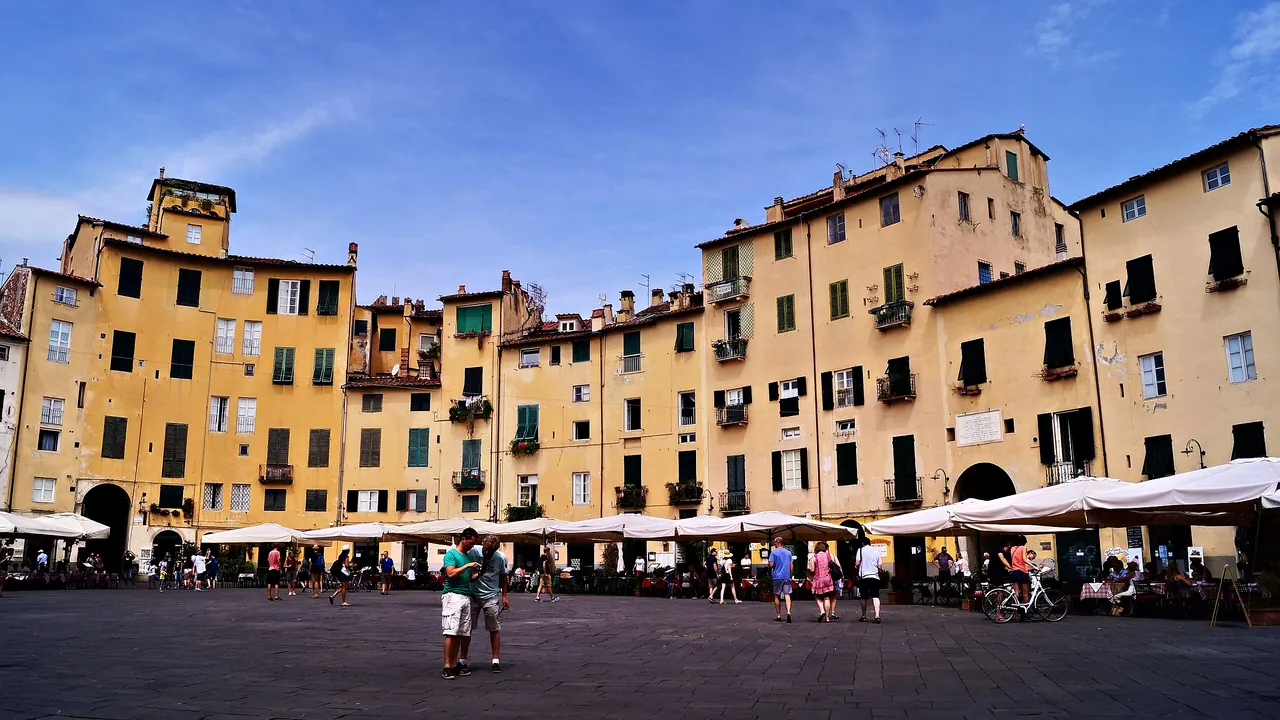
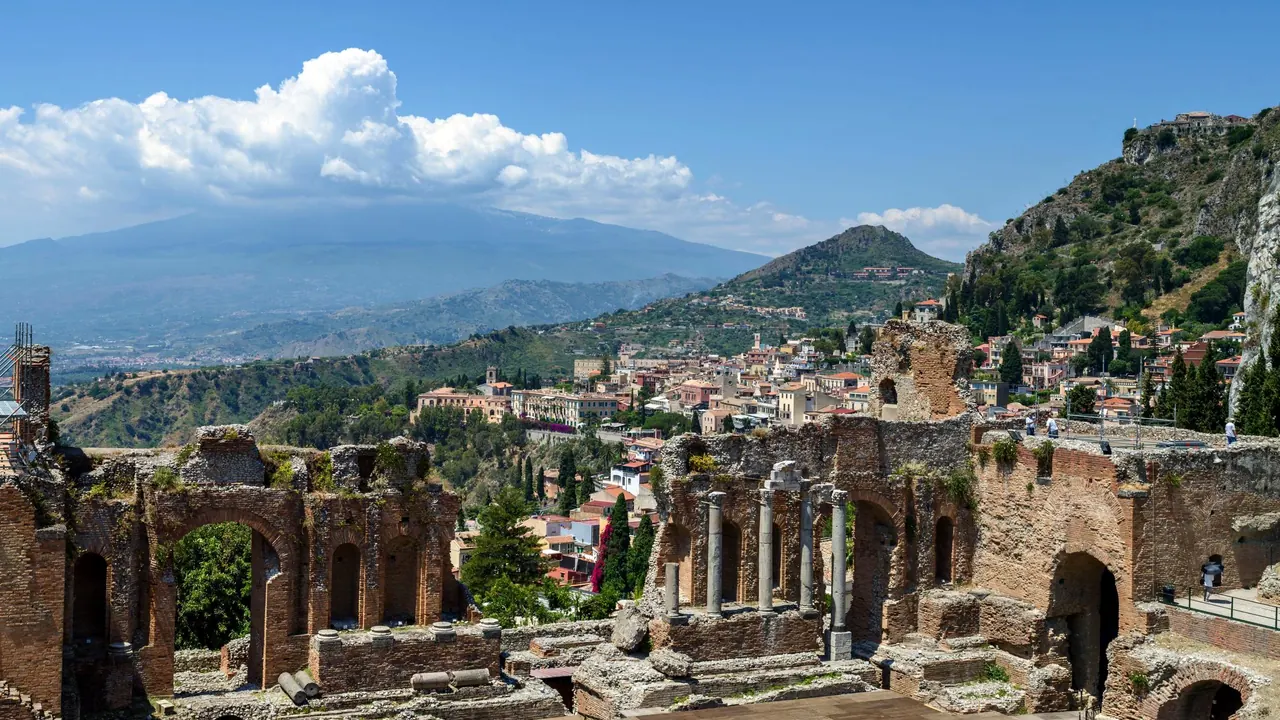
Photos: Lucca by Stefano Sansavini, CC BY-SA 4.0, cropped; Taormina by Reinhard Bruckner, Pexels License.
Lucca or Taormina?
Our verdict in twelve categories, each scored against the same fixed benchmark cities, and the climate month by month, so you can choose for your trip.
Choose Lucca for
- live music and the arts
- culture and sights
- getting around
Lucca is the better choice for a trip built around Tuscan towns and old streets. Its complete walls, Romanesque churches and car-free centre reward slow walking and cycling, and the railway puts Pisa, Florence, Pistoia and the Versilia coast within easy reach. It also costs less, works well with children, and offers Puccini recitals most evenings. The trade-off is a quiet night scene and a beach that means a train ride.
Choose Taormina for
- beaches
- nature and the outdoors
- nightlife
Taormina is for travellers who want the sea and a volcano in view. Below the terraced town there are clear coves for snorkelling, Etna's craters and the Alcantara gorges are close by, and the Greek theatre frames one of the great Mediterranean views. Expect to pay resort prices and climb a lot of steps, and know that the old town can be seen in a day. As a base for swimming, walking and eastern Sicily, it beats Lucca.
Scoreboard
Twelve categories on one fixed scale from 0 to 100. The shaded stretch is the gap between the two.
Your match
Pick a travel style or drag the sliders, and both match scores follow your weighting.
Wins on live music and the arts and culture and sights with your weighting.
Wins on beaches and nature and the outdoors with your weighting.
What matters to you?
Category by category
What the scores mean for a trip.
Beaches & swimming
Taormina is the stronger beach town, because the sea is right below it. A cable car or a steep path drops to Mazzarò and the cove at Isola Bella, where the water is clear and good for snorkelling. The catch is that these are narrow pebble strips that fill up in summer. For longer stretches of sand, go to Giardini Naxos or Letojanni.
Lucca has no sea of its own. The Versilia coast begins at Viareggio, a short train ride away, and offers broad, gently shelving sand that is better for small swimmers than Taormina's pebbles. Most of it is lined with beach-club umbrellas, apart from the dunes of the Lecciona. It works as an afternoon swim, not as waking up by the water.
Food & drink
The two eat about equally well, but in very different ways. Lucca's cooking is plain and inland: spelt soup from the Garfagnana, meat-filled tordelli, chestnut flour and chickpea cecina, eaten in family trattorias at fair prices. After a few days the menus start to look alike.
Taormina cooks with the sea and with Sicily's sweeter, bolder flavours: swordfish, raw prawns, pasta alla Norma, and granita with brioche for breakfast. It also has a refined top tier of restaurants with sea views and the volcanic Etna wines. Along Corso Umberto, though, you pay resort prices for tourist menus.
Culture & sights
Lucca has much more for a sightseer. The walls survive whole and enclose a medieval town of towers and churches. San Michele's arcaded façade, the mosaic at San Frediano and Ilaria del Carretto's tomb in the cathedral each repay time, and the oval piazza still traces the Roman amphitheatre. It takes two full days to see properly.
Taormina has one world-class sight, the Greek theatre with Etna framed behind its stage. Around it are a short run of Arab-Norman palazzi and gates. A slow day covers it all, and with no major museums, deeper sightseeing means Syracuse or Catania.
Nightlife
Neither town is for clubbing, though Taormina's summer evenings run a little later. Its piano bars and sea-view terraces, and the lounge bars down at Mazzarò and Giardini Naxos, draw couples rather than dancers. In Lucca the evening is an aperitivo in Piazza San Michele, dinner and a stroll on the walls, with student wine bars as the only late option. Anyone wanting to dance has to go to the Versilia discos and take a taxi back.
Nature & outdoors
Taormina has the more dramatic outdoors. Etna is about an hour away, with lava fields, the Silvestri craters, guided trips towards the summit and even winter skiing. The Alcantara gorges are closer still, and the marine reserve at Isola Bella adds diving and kayaking.
Lucca's countryside is gentler, with olive groves, villa gardens and a cycling ring on the walls. The real walking lies an hour north in the marble peaks of the Apuan Alps and the beech woods of the Garfagnana. Lake Massaciuccoli adds birdwatching.
Day trips
Lucca is the richer base for days out. Pisa is half an hour away by train and Florence a little over an hour, with Pistoia and the old spa towns of Montecatini on the same line. Nearer than any of them are the villas of the Lucca countryside, such as Marlia and Torrigiani with their formal gardens, and the hill village of Collodi with Villa Garzoni. Further away, up the coast to the north, are Viareggio with its carnival floats, the sculptors' studios of Pietrasanta and the marble town of Carrara, and with an early start you can even reach the Cinque Terre or San Gimignano.
Taormina's day trips are fewer and longer, though some are superb. Catania is about an hour away, and Syracuse, with Ortigia and the Greek quarries of Neapolis, is about two hours south. Closer to home, Castelmola sits on the crag above town. The film villages of Savoca and Forza d'Agrò and the Etna wine villages make slower days, and Noto is possible if you set off early.
Good for families
Lucca is the easier town with children. The flat, car-free centre lets a family ride the walls on a rented quadricycle. Pinocchio Park at Collodi and the sandy Versilia shore are both close, and the autumn comics festival delights teenagers.
Taormina welcomes children but asks more of them. It is built on a steep slope of steps, its beaches are pebbly, and many hotels are aimed at couples. Snorkelling and the Etna craters suit school-age children, and families with toddlers often stay down in Giardini Naxos instead.
Getting around
Lucca is simpler to get around. Inside the walls it is flat and mostly closed to traffic, there are bikes for rent at every gate, and the station just outside the walls has frequent trains across northern Tuscany. Only the villas and hill villages really need a car.
Taormina's centre is also walkable, but every outing involves stairs and steep lanes. The station is down by the sea, and you rely on the cable car and local buses. Etna and the inland villages realistically need a tour or a hire car.
Shopping & style
Neither town is a place for serious shopping, so the difference lies in what you bring home. Lucca's Via Fillungo has fashion and jewellery behind old Liberty shopfronts, delicatessens sell olive oil and buccellato, and the monthly antiques market around the cathedral is a real reason to time a visit.
Taormina's Corso Umberto is more of a souvenir street, with coral, cameos, lace and painted Sicilian ceramics, plus pistachio cream and Etna wine to pack. Much of it is aimed at visitors, and for real fashion you have to go to Catania.
Affordability
Lucca is the cheaper of the two. It is not a bargain by central Italian standards, but it costs well under Florence. Trattoria meals and trains are fairly priced, and the walls and many churches are free. Rooms inside the walls are the main cost, and staying just outside them saves money.
Taormina is the priciest place to stay in eastern Sicily. Grand sea-view hotels set the tone and restaurants on the Corso charge resort rates. Granita and buses stay cheap, and staying in Giardini Naxos or coming in spring or autumn makes a real difference.
Live music & performing arts
Lucca has the fuller music life, thanks to Puccini. Recitals of his arias run in a central church for most of the year, and the Teatro del Giglio offers an opera and concert season. In July the summer festival fills Piazza Napoleone, and open-air opera plays by the lake at Torre del Lago.
Taormina has one unforgettable stage: concerts, ballet and opera in the Greek theatre on summer nights, with Etna behind the performers. Outside summer there is little beyond piano bars, and serious opera means a trip to Catania.
Wellness & relaxation
Lucca is the better choice for a proper spa day, although it has no baths of its own. Montecatini's belle époque spa halls are half an hour away by train, and the warm cave pools at Monsummano and the steam grottoes of Bagni di Lucca are close by.
In Taormina, pampering stays inside the big hotels, with terrace pools above the sea and treatments using volcanic mud and citrus. Its calm also depends on the season: gentle in May and June, but crowded along the Corso in August.
When should you go?
Pick your month. The climate figures are measured averages, not a forecast.
Lucca in July
Taormina in July
Daytime high, °C
Rainfall in the month, mm
Where the figures come from
Taormina's temperatures are measured 45 km from the centre, at Messina.
Taormina has no rain gauge within 25 km of the centre, so its rainfall comes from a gridded climate dataset read at the city rather than from a gauge further away.
Temperature and rainfall are climate normals, averaged over the years shown. Lucca: 1991-2020 normals, Pisa / S. Giusto (21.4 km from centre). Taormina: 1991-2020 normals, Messina (45.1 km from centre).
Both towns are at their best from late May to June and again in September, when it is warm enough to swim but comfortable for walking. High summer is hot in both, with highs around 30°C in July and August, which makes the walls of Lucca and the stairways of Taormina tiring at midday. Taormina is drier and sunnier through the summer, with almost no rain in July, while Lucca's plain feels more humid and the town sits a train ride from the sea.
The two part ways in autumn. Lucca turns wet from September, and October and November are its rainiest months at well over 100mm, so it suits a spring visit better. Taormina's sea stays warm enough to swim through October, at around 23°C, and its winters are milder, so a sunny walk is still possible in January. That makes Sicily the better choice for an off-season escape.
Which traveller are you?
On a beach and sun trip, Taormina is the clear pick. The coves at Mazzarò and Isola Bella are a cable-car ride below the town, the water is clear enough to snorkel, and the summers are drier. From Lucca, the Versilia sand is a train ride away every day.
For a culture and arts trip, Lucca has more to offer. Its intact walls, carved Romanesque façades and Puccini's opera house fill several days. Pisa and Florence are an easy train ride away. Taormina has its Greek theatre and one street of palazzi.
For a trip on a tight budget, Lucca stretches the money further. You get around on foot and by bike, many churches and the walls are free, and regional trains are fair value. Taormina charges resort prices unless you sleep down in Giardini Naxos.
Before you go
| Measure | Lucca | Taormina |
|---|---|---|
| Official language | Italian | Italian |
| Currency | Euro (EUR) | Euro (EUR) |
| Sockets | CFL230 V, 50 Hz | CFL230 V, 50 Hz |
| Driving side | Right | Right |
| Time zone | UTC+1, UTC+2 in summer | UTC+1, UTC+2 in summer |
| Emergency number | 112 | 112 |
| Elevation | 19 m | 204 m |
| Main airport | Pisa International Airport (PSA)21 km from centre82 non-stop destinations | Catania-Fontanarossa Airport (CTA)47 km from centre96 non-stop destinations |
| Public holidays this year | 13 days | 13 days |
By the numbers
| Measure | Lucca | Taormina |
|---|---|---|
| City population | 88,798 | 10,471 |
| People per km² | 478 | 799 |
| Museums within 10 km | 20 | 5 |
| UNESCO World Heritage sites within 50 km | 4 | 2 |
| Swim season, months above 21 °C | 4 months | 5 months |
Where else could you go?
Every comparison below shares a destination with this one, so you can follow Lucca or Taormina somewhere new.
- Pisavs Lucca
- Cataniavs Taormina
- Florencevs Lucca
- La Speziavs Lucca
- Syracuse, Sicilyvs Taormina
- Sienavs Lucca