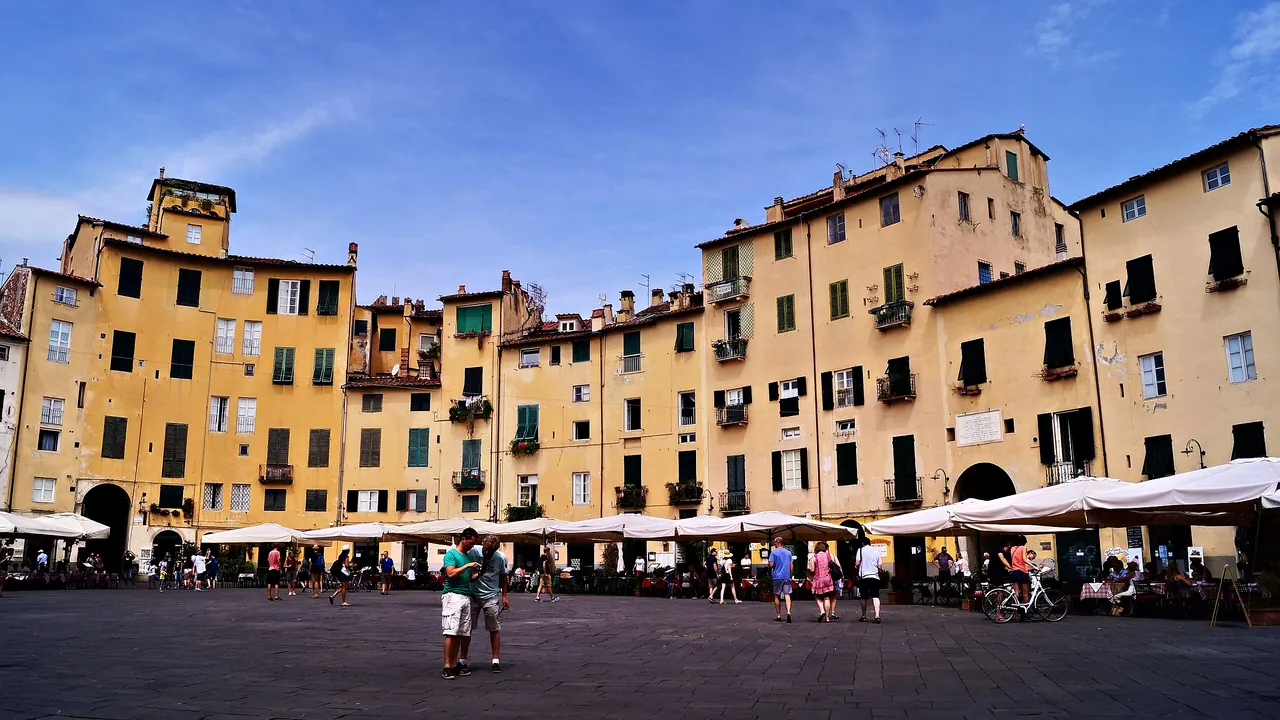
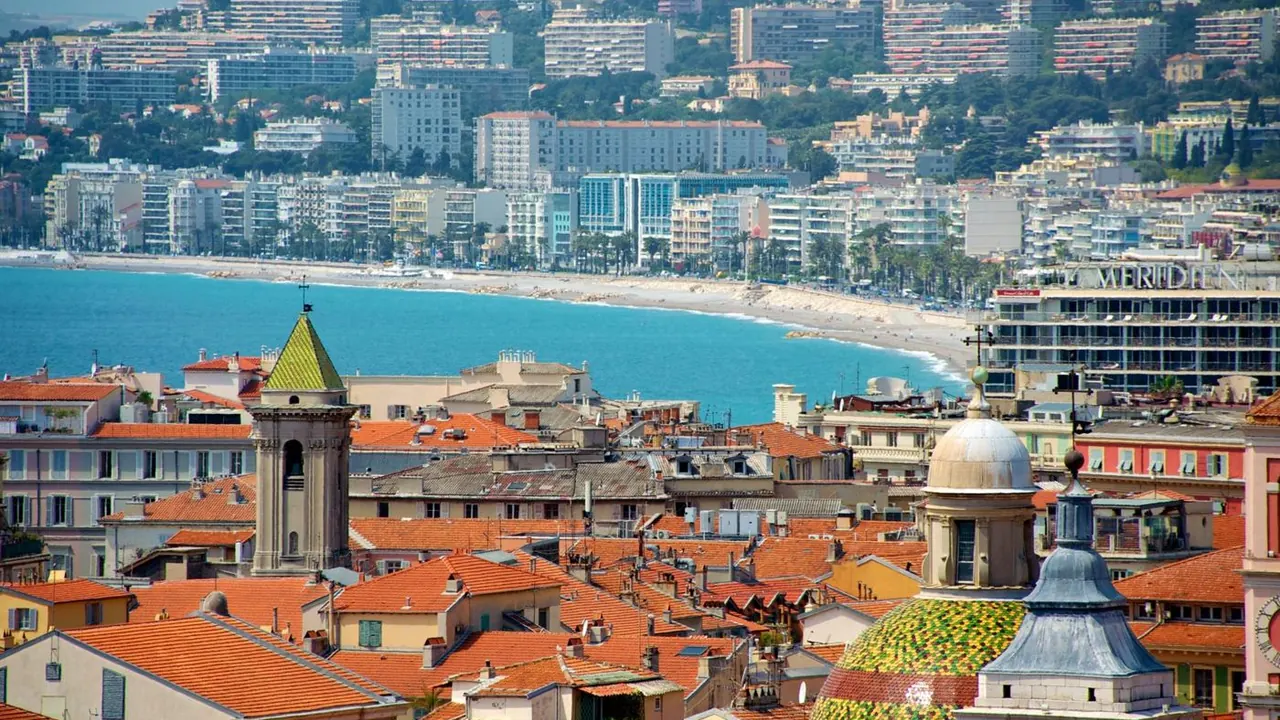
Photos: Lucca by Stefano Sansavini, CC BY-SA 4.0, cropped; Nice by Daniel Stockman, CC BY-SA 2.0, cropped.
Lucca or Nice?
Our verdict in twelve categories, each scored against the same fixed benchmark cities, and the climate month by month, so you can choose for your trip.
Choose Lucca for
- prices
- wellness
- live music and the arts
Lucca suits travellers who want a slower, quieter Italian stay built around old streets, church façades and trips into Tuscany. Its car-free centre inside complete walls, Puccini's music, the spa towns nearby and somewhat lower costs make it a calm base for a couple who like a long lunch, an evening of arias and a day in Pisa or Florence. The sea is a train ride away rather than outside the door.
Choose Nice for
- nightlife
- beaches
- shopping
Choose Nice if the Mediterranean is the point of the trip. The swimming starts below the promenade, the outdoors reaches from coastal paths to the high Alps, and the evenings have more to them, with bar-lined lanes in the old town. It also has the stronger food of the two and modern art in the Matisse and Chagall museums. Expect to pay more, especially in summer, and expect more people around you.
Scoreboard
Twelve categories on one fixed scale from 0 to 100. The shaded stretch is the gap between the two.
Your match
Pick a travel style or drag the sliders, and both match scores follow your weighting.
Wins on prices and wellness with your weighting.
Wins on nightlife and beaches with your weighting.
What matters to you?
Category by category
What the scores mean for a trip.
Beaches & swimming
In Nice you swim from the city itself. About 7km of pebble shore runs below the Promenade des Anglais, the water is clear, and sandy coves at Villefranche and Cap Ferrat are a short ride east. The stones are the drawback, so a beach-club lounger or water shoes help.
Lucca is inland, and going to the beach is an outing. The train reaches Viareggio in under half an hour, and the Versilia shore offers long, gently shelving sand that is easier for paddling than Nice's pebbles. Most of it is lined with umbrellas at beach clubs, with wilder dunes at the Lecciona.
Food & drink
Both cities make something from chickpea flour, cecina in Lucca and socca in Nice, but Nice has the richer kitchen overall. Its Ligurian-leaning dishes, the Cours Saleya market and a few serious kitchens in the hills give it more range. The main thing to avoid is the set-menu terraces on the promenade.
Lucca cooks plainly and well: farro soup, tordelli in ragù, chestnut dishes in the cooler months and buccellato. It is reliable and fairly priced in family trattorias, but the menus repeat after a few days and there is little beyond local cooking.
Culture & sights
The two are evenly matched, but the cultural visits are very different. In Lucca the attraction is the townscape. There are the intact Renaissance walls, the carved Romanesque fronts of San Michele and San Frediano, the cathedral with Ilaria del Carretto's tomb, and the oval piazza built into a Roman amphitheatre. Its museums are modest.
Nice is the city for art lovers. The Matisse and Chagall museums in Cimiez and MAMAC's Yves Klein rooms are the main draws, and the Savoyard old town, Belle Époque villas and the Russian cathedral give it a second, more mixed history.
Nightlife
Nice has a real night out, though not a wild one. Students, locals and visitors share the pubs and cocktail bars of Vieux Nice, the port has calmer bars, and summer keeps the promenade busy late. Lucca's evenings are aperitivo in a piazza, dinner and a walk on the walls. Anyone who wants to dance has to go to the Versilia coast and arrange a late ride back.
Nature & outdoors
Nice has more variety on its doorstep, where the Alps meet the sea. There are coastal paths round Cap Ferrat, corniche roads for cycling, the Mercantour's high lakes and ibex, and winter skiing within about an hour and a half. Sailing, diving and paddleboarding are easy to arrange from the city.
Lucca's countryside is gentler: olive groves, villa gardens, cycling on the walls and along the Serchio. Further out it can be rugged too, with the marble-scarred Apuan Alps about an hour north, chestnut woods in the Garfagnana and birdlife around Lake Massaciuccoli.
Day trips
Both cities make excellent bases, and the difference is the kind of trip. From Lucca the train runs to Pisa, Pistoia and Florence, so the days are about Tuscan art cities, plus Carrara's marble and the sculptors' studios of Pietrasanta. The grand country villas and the Garfagnana villages are easier with a car.
From Nice the outings run along the coast and can all be done without a car. They include Monaco, Èze on its rock, Menton, Antibes and Cannes, with Saint-Paul-de-Vence and Grasse inland and Sanremo just across the Italian border.
Good for families
Lucca's classic family outing is a rented quadricycle on the walls, a flat ring with no cars, followed by the trees on top of the Torre Guinigi. Pinocchio Park at Collodi and the Versilia sand are both within half an hour, and older children love the costumes of Lucca Comics & Games in autumn. Beyond those, most of the sights are churches and palaces.
Nice has more to fill the days in town, with the playgrounds and water jets of the Promenade du Paillon, the greenhouses and animals at Parc Phoenix, and Monaco's Oceanographic Museum a short train ride away. The pebbles, the summer heat and the stepped lanes of the old town are harder going with small children.
Getting around
Inside its walls, Lucca runs on bicycles. It is compact, flat and largely closed to traffic, there is bike rental at every gate, and the station sits just outside the southern walls. The hill villages and country villas are where you would miss a car.
Nice moves by tram and train instead. A tram line links the airport, the centre and the port, buses climb to Cimiez, and coastal trains cover the Riviera, though they are crowded in summer. A car only matters for the mountains.
Shopping & style
Nice has more choice, with chain stores on Avenue Jean Médecin, luxury houses around rue Paradis, and Provençal soaps, fabrics and candied fruit in the old town. Lucca is a small-town shop of Via Fillungo boutiques and delicatessens, though its monthly antiques market around the cathedral is a real event for collectors.
Affordability
Lucca is the cheaper stay, though neither city is a bargain. In both, accommodation is the main cost. Lucca's fills up in summer and at festival time, so staying outside the walls often saves money.
Nice is dearer from June to September, and loungers and seafront terraces add to the bill. Its cheap trams and trains, low-cost museums and socca help, and spring or late autumn eases things considerably.
Live music & performing arts
Lucca has the stronger musical identity, and it comes from Puccini. Short recitals of his arias run through most of the year, the Teatro del Giglio has a full opera season, and the summer brings open-air opera beside the lake at Torre del Lago and big outdoor concerts in Piazza Napoleone.
Nice offers a solid regional programme at its opera house and the national theatre, mostly in French. Its standout is the Nice Jazz Festival in July, together with the February Carnival.
Wellness & relaxation
Neither city has spa baths of its own, but Lucca sits close to some of Italy's classic spa towns. Montecatini's belle époque spas, the warm cave pools at Monsummano and the steam grottoes of Bagni di Lucca all make easy days out. Back in town, the quiet, car-free streets are restful in themselves.
Nice's version is hotel spas and thalassotherapy along the coast, plus an early swim before the crowds. It is calm out of season, less so in high summer.
When should you go?
Pick your month. The climate figures are measured averages, not a forecast.
Lucca in July
Nice in July
Daytime high, °C
Rainfall in the month, mm
Temperature and rainfall are climate normals, averaged over the years shown. Lucca: 1991-2020 normals, Pisa / S. Giusto (21.4 km from centre). Nice: 1991-2020 normals, Nice (8 km from centre).
Both cities share a Mediterranean year, with dry summers, a wet autumn and mild winters. Lucca sits inland on its plain and gets hotter, with highs of about 30°C in July and August, which makes the middle of the day heavy for walking the streets. Nice stays a little cooler at about 28°C because of the sea breeze, and its summers are the drier of the two, with almost no rain in July. In both places the sea reaches about 25°C in August, and swimming is good from June to September. Nice has noticeably more sunshine in every month, and the gap is clearest in winter.
The rain comes in September in both cities and peaks in October and November, at well over 120mm a month. That makes late autumn the weakest time for either. For sightseeing, Lucca is at its best in May, June and late September. Nice is pleasant over a longer season, and its brighter, slightly milder winters make it the better pick between December and March.
Which traveller are you?
For a food and nightlife trip, Lucca gives you a good trattoria dinner and then a quiet town. Nice does better on both counts, with socca from the wood ovens of the old town, the Cours Saleya market and bar-lined lanes in Vieux Nice until late.
On a relaxing and wellness trip, Lucca is the gentler base. It has car-free streets and slow evenings on the shaded walls, and Montecatini's spas and the cave pools at Monsummano are close by. Nice's summer crowds and heat make it less restful.
On a tight budget, Lucca makes the money go further. A room costs less than on the Riviera, a simple Tuscan lunch is good value, and walking the walls or looking into the churches costs nothing. Nice charges heavily for rooms near the sea in summer, though its trams and trains are cheap.
Before you go
| Measure | Lucca | Nice |
|---|---|---|
| Official language | Italian | French |
| Currency | Euro (EUR) | Euro (EUR) |
| Sockets | CFL230 V, 50 Hz | CE230 V, 50 Hz |
| Driving side | Right | Right |
| Time zone | UTC+1, UTC+2 in summer | UTC+1, UTC+2 in summer |
| Emergency number | 112 | 112 |
| Elevation | 19 m | 0 m |
| Main airport | Pisa International Airport (PSA)21 km from centre82 non-stop destinations | Nice-Côte d'Azur Airport (NCE)6 km from centre130 non-stop destinations |
| Public holidays this year | 13 days | 11 days |
By the numbers
| Measure | Lucca | Nice |
|---|---|---|
| City population | 88,798 | 357,737 |
| People per km² | 478 | 4,975 |
| Museums within 10 km | 20 | 17 |
| UNESCO World Heritage sites within 50 km | 4 | 2 |
| Swim season, months above 21 °C | 4 months | 4 months |
Where else could you go?
Every comparison below shares a destination with this one, so you can follow Lucca or Nice somewhere new.