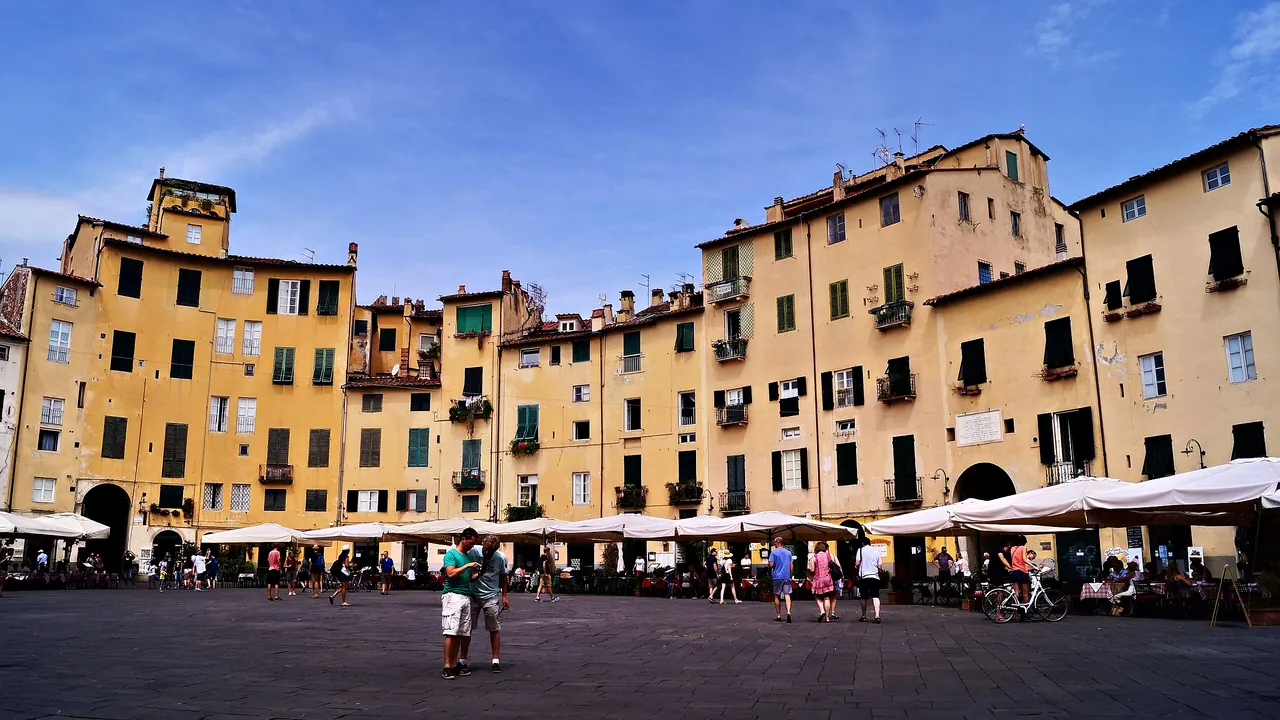
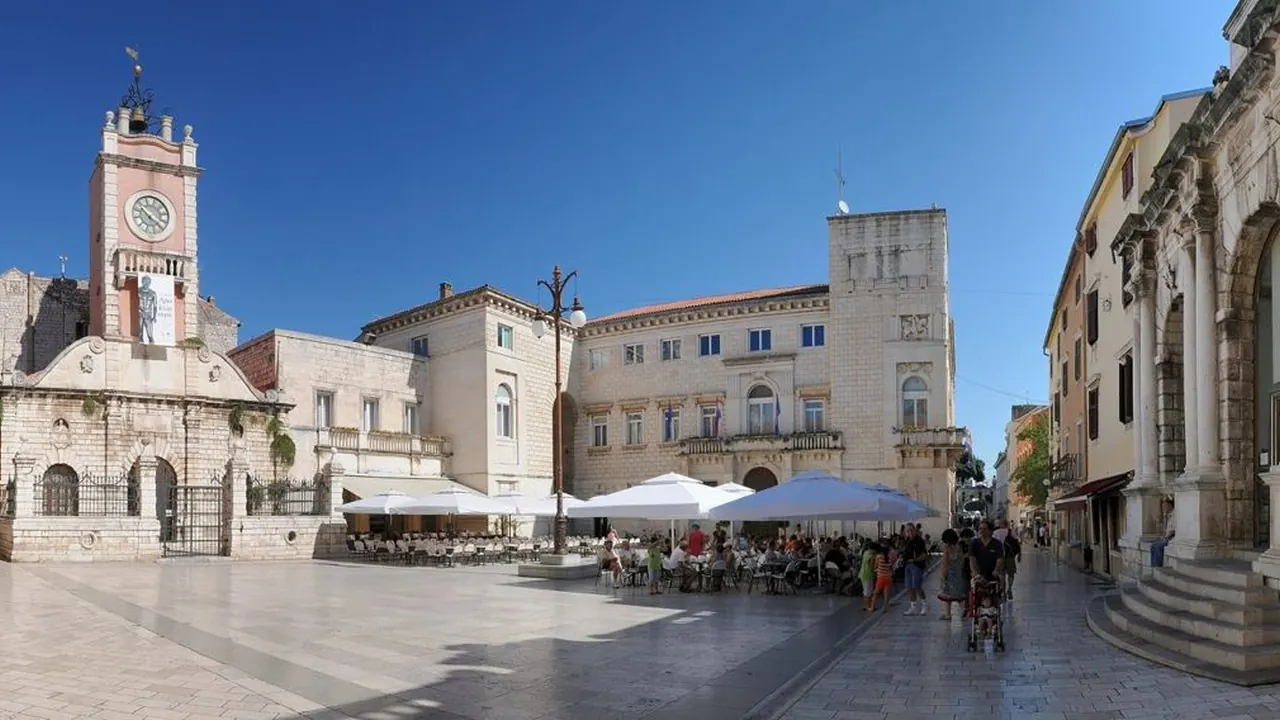
Photos: Lucca by Stefano Sansavini, CC BY-SA 4.0, cropped; Zadar by Böhringer Friedrich, CC BY-SA 2.5, cropped.
Lucca or Zadar?
Our verdict in twelve categories, each scored against the same fixed benchmark cities, and the climate month by month, so you can choose for your trip.
Choose Lucca for
- live music and the arts
- day trips
- getting around
Lucca suits travellers who want to walk or cycle everywhere inside an intact ring of Renaissance walls, eat plain Tuscan cooking, and spend evenings at a Puccini recital. Its greatest strength is as a base. Pisa, Florence, the Versilia sand and the spa towns are all an easy train ride away, so it works well for a trip that takes in a wider stretch of Tuscany without a car.
Choose Zadar for
- beaches
- nightlife
- nature and the outdoors
Zadar is the better pick when the sea is the point of the trip. You can swim straight off the town promenade, catch a ferry to the islands from the edge of the old town, and reach Paklenica, the Kornati and Krka within a short drive. Summer evenings are livelier too, starting with sunset at the Sea Organ. In exchange you get a thinner calendar of concerts and theatre, and the further sights are much easier with a car.
Scoreboard
Twelve categories on one fixed scale from 0 to 100. The shaded stretch is the gap between the two.
Your match
Pick a travel style or drag the sliders, and both match scores follow your weighting.
Wins on live music and the arts and day trips with your weighting.
Wins on beaches and nightlife with your weighting.
What matters to you?
Category by category
What the scores mean for a trip.
Beaches & swimming
Zadar has the sea right in town. Locals swim off the stone promenade and at Kolovare and Borik, although those beaches are pebble or concrete platforms. For sand, you go to Nin's long, shallow beaches or take a boat to Sakarun on Dugi Otok.
Lucca is inland. Its beach days start with a train ride of about half an hour to Viareggio. In return you get the broad, gently shelving sand of the Versilia coast, mostly laid out with rows of umbrellas at beach clubs, and the wilder dunes of the Lecciona.
Food & drink
Lucca gives the more rewarding table, though neither city has a wide range. Its cooking is rustic and very local: spelt soup with farro from the Garfagnana, tordelli in ragù, chestnut dishes in the colder months, cecina from bakery counters and buccellato. Mild olive oil and wines from the Colline Lucchesi go with it, mostly served in family trattorias inside the walls.
Zadar's menus are about the Adriatic: grilled fish and squid, black risotto, peka-cooked lamb, Pag cheese, and a glass of Maraschino at the end. Its konobas repeat one another even more than Lucca's trattorias do, and the cheaper places along the main streets are aimed at passing visitors.
Culture & sights
Lucca has the richer set of sights. The walls survive whole, the streets inside are packed with towers and churches, and the Romanesque façades of San Michele and San Frediano are the highlight. The cathedral holds the tomb of Ilaria del Carretto, and the oval piazza still follows the outline of the Roman amphitheatre.
Zadar packs a longer span of history into its peninsula. It has an open Roman forum, the round ninth-century St Donatus and Venetian gates, plus a fine glass museum. Its most memorable modern sight, the Sea Organ, has no equivalent in Lucca. Both cities take about two days to see properly.
Nightlife
Neither city is for serious partying, but Zadar has more going on after dark. On summer nights people gather at sunset on the Riva, then move to café-bars along Kalelarga and terrace bars on the walls, and they stay out late. Anyone who wants clubs can reach Zrće on Pag in about an hour.
In Lucca, evenings mean aperitivo in Piazza San Michele, a long dinner and a walk on the walls. The centre is quiet by midnight. Dancing means a late drive to the Versilia coast.
Nature & outdoors
Zadar has the wilder and more varied outdoors. Paklenica's limestone gorges are about 45 minutes away and are known for climbing. Out at sea are the bare Kornati islands and Telašćica's cliffs, and Krka's waterfalls are an hour south. Sea kayaking and island cycling are easy to arrange.
Lucca's countryside is gentler, with olive groves and villa gardens close at hand and the 4km ring of the walls for running and cycling. Real mountains are within an hour in the Apuan Alps and the Garfagnana, and Lake Massaciuccoli is good for birdwatching. What Lucca can't offer is a coastline of islands.
Day trips
Lucca is one of the best bases in Tuscany, mainly because the train does the work. Pisa is half an hour away, Florence a little over an hour, and Pistoia and Montecatini are on the same line. The villas at Marlia and Collodi, the marble studios of Pietrasanta and the villages of the Garfagnana fill further days.
Zadar's outings are good but take more effort. Šibenik's cathedral and Nin are easy, while Split and Trogir make long days by motorway. The islands are reached by ferry, and for most other trips you need a car or an organised excursion.
Good for families
Both cities are about equally easy with children, but the days look different. In Lucca, family time centres on renting bikes or a quadricycle to ride the walls and climbing the tree-topped Torre Guinigi. Pinocchio Park at Collodi is twenty minutes away, and teenagers love Lucca Comics & Games in autumn.
In Zadar, family days are spent mostly by the water. Children love the Sea Organ and the tiles that light up after dark, Nin's shallow sand is ideal for small children, and short ferry rides feel like an adventure. Neither city has much else built specifically for children.
Getting around
Lucca is the easier of the two. The walled centre is flat and largely closed to traffic, bike rental is found at every gate, and the station just outside the southern walls has regular trains to Pisa, Viareggio and Florence.
Zadar's peninsula is just as walkable, and the island ferries leave from its edge. Beyond that, local buses are basic, and the national parks and the wider coast really call for a hire car. Both cities need a car for their countryside.
Shopping & style
Lucca gives a shopper more to do, though neither city is worth a trip just for its shops. Via Fillungo, the narrow main street, mixes fashion and jewellery with shopfronts that still have their early twentieth-century decoration, and the lanes around it hold artisan workshops, paper shops and delicatessens stocked with the province's oil, farro and buccellato. The antiques market is the one thing worth planning a date around. It is among the oldest in Italy and takes over the streets near the cathedral one weekend a month.
Zadar has nothing to match that market. Kalelarga, its marble main street, is mostly chain stores and souvenirs and has less character than Via Fillungo. Where Zadar holds its own is food and craft from the islands. Maraschino, Pag cheese and figs from the stalls below the walls make a better bag to take home than anything on the main street, and the fine lace made on Pag has no equivalent in Lucca.
Affordability
Costs are close, and Zadar is slightly easier on the budget. Private apartments there are good value outside July and August, and ferries and buses are inexpensive, although national park entry and boat trips add up.
In Lucca, the walls and many churches are free and trattoria meals are fair. The main cost is accommodation, since few hotels sit inside the walls. Staying just outside them usually saves money.
Live music & performing arts
This is where the two differ most. Thanks to Puccini, a visit to Lucca can include opera on almost any evening of the year, through recitals of his arias in a central church. The Teatro del Giglio runs a full season, Piazza Napoleone hosts big outdoor concerts in July, and the lakeside Puccini Festival at Torre del Lago is half an hour away.
Zadar's highlight is beautiful but seasonal: early and chamber music inside St Donatus in summer, plus klapa singing in the squares. Outside July and August, there is little to attend.
Wellness & relaxation
Lucca has proper thermal water within reach, though not in town. Montecatini's belle époque spa halls are half an hour away by train, Monsummano has warm cave pools, and Bagni di Lucca has steam grottoes up the Serchio valley.
Zadar has no bathing tradition. Your options are hotel spas at Borik and the old mud lagoon at Nin. Both cities are restful in a similar way: the calm comes from a slow pace, whether that means an evening walk on Lucca's shaded walls or sunset from the Sea Organ steps.
When should you go?
Pick your month. The climate figures are measured averages, not a forecast.
Lucca in July
Zadar in July
Daytime high, °C
Rainfall in the month, mm
Where the figures come from
Zadar has no rain gauge within 25 km of the centre, so its rainfall comes from a gridded climate dataset read at the city rather than from a gauge further away.
Temperature and rainfall are climate normals, averaged over the years shown. Lucca: 1991-2020 normals, Pisa / S. Giusto (21.4 km from centre). Zadar: 1999-2020 (rainfall 1991-2020) normals, Zadar / Zemunik (9.9 km from centre).
The two climates are close to identical. Both have hot summers, with daytime highs around 30°C in July and August, so walking the streets is best in the morning or evening. In both, the sea is warm enough for swimming from June to September and peaks at about 25°C in August. Summer is also the driest time of year, and Lucca gets its sunniest stretch in July.
Things turn in September. Rain picks up in both cities and is heaviest from October to November, when Lucca is the wetter of the two at around 130mm a month. May and late September are the best months for sightseeing and hiking in either place. In winter both drop to mild highs in the low teens: good enough for Lucca's churches and museums, but quiet and too cool for the sea in Zadar.
Which traveller are you?
For a beach and sun trip, Zadar is the clear choice. You can swim every day off the promenade or at Kolovare, Nin's sandy shallows are twenty minutes away, and ferries reach island coves. Lucca's beaches mean a train ride to the Versilia coast each time.
On a culture and arts trip, Lucca comes out ahead. It has complete Renaissance walls and carved Romanesque façades such as San Michele, plus Puccini, with recitals most evenings, the Teatro del Giglio and open-air opera at Torre del Lago. Florence and Pisa are both an easy train ride away.
For an outdoors trip, Zadar gives more variety. Paklenica's gorges offer hiking and climbing, the Kornati and Telašćica are for sailing, and Krka and Plitvice are within reach. Lucca has the Apuan Alps and the Garfagnana, but nothing like Zadar's sea and islands.
Before you go
| Measure | Lucca | Zadar |
|---|---|---|
| Official language | Italian | Croatian |
| Currency | Euro (EUR) | Euro (EUR) |
| Sockets | CFL230 V, 50 Hz | CF230 V, 50 Hz |
| Driving side | Right | Right |
| Time zone | UTC+1, UTC+2 in summer | UTC+1, UTC+2 in summer |
| Emergency number | 112 | 112 |
| Elevation | 19 m | 5 m |
| Main airport | Pisa International Airport (PSA)21 km from centre82 non-stop destinations | Zadar Airport (ZAD)10 km from centre66 non-stop destinations |
| Public holidays this year | 13 days | 14 days |
By the numbers
| Measure | Lucca | Zadar |
|---|---|---|
| City population | 88,798 | 70,779 |
| People per km² | 478 | - |
| Museums within 10 km | 20 | 1 |
| UNESCO World Heritage sites within 50 km | 4 | 2 |
| Swim season, months above 21 °C | 4 months | 4 months |
Where else could you go?
Every comparison below shares a destination with this one, so you can follow Lucca or Zadar somewhere new.