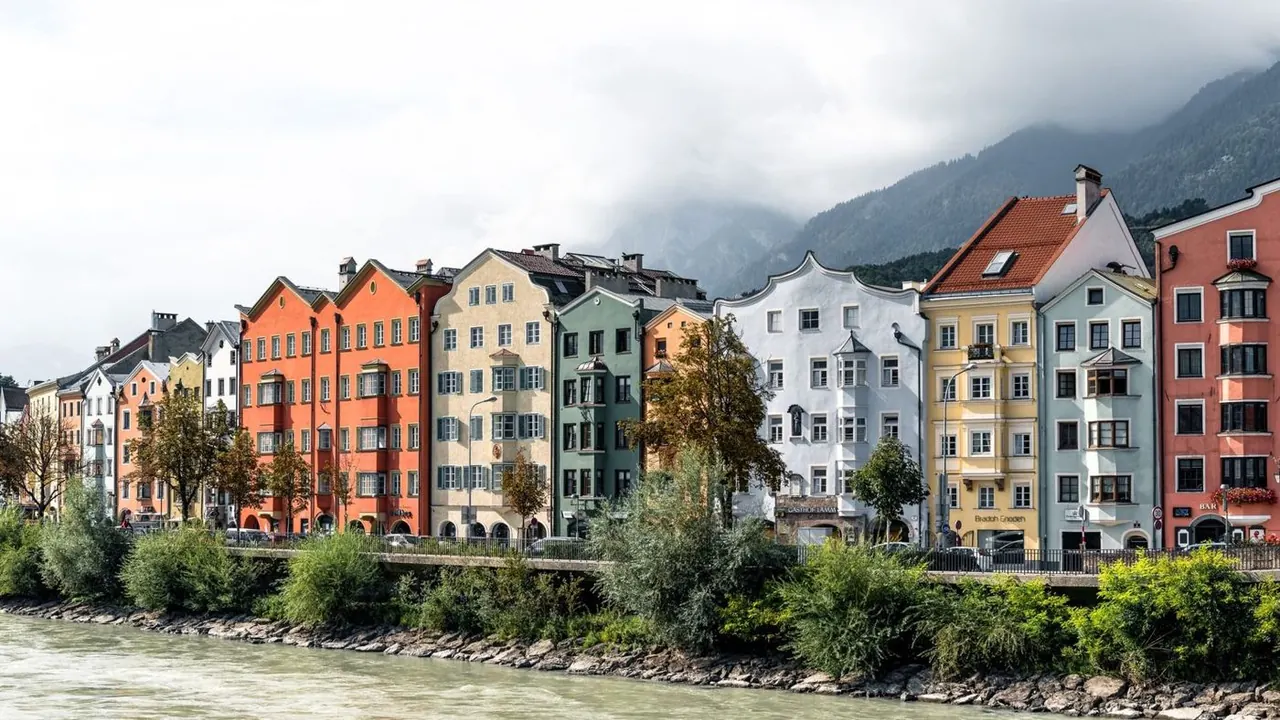
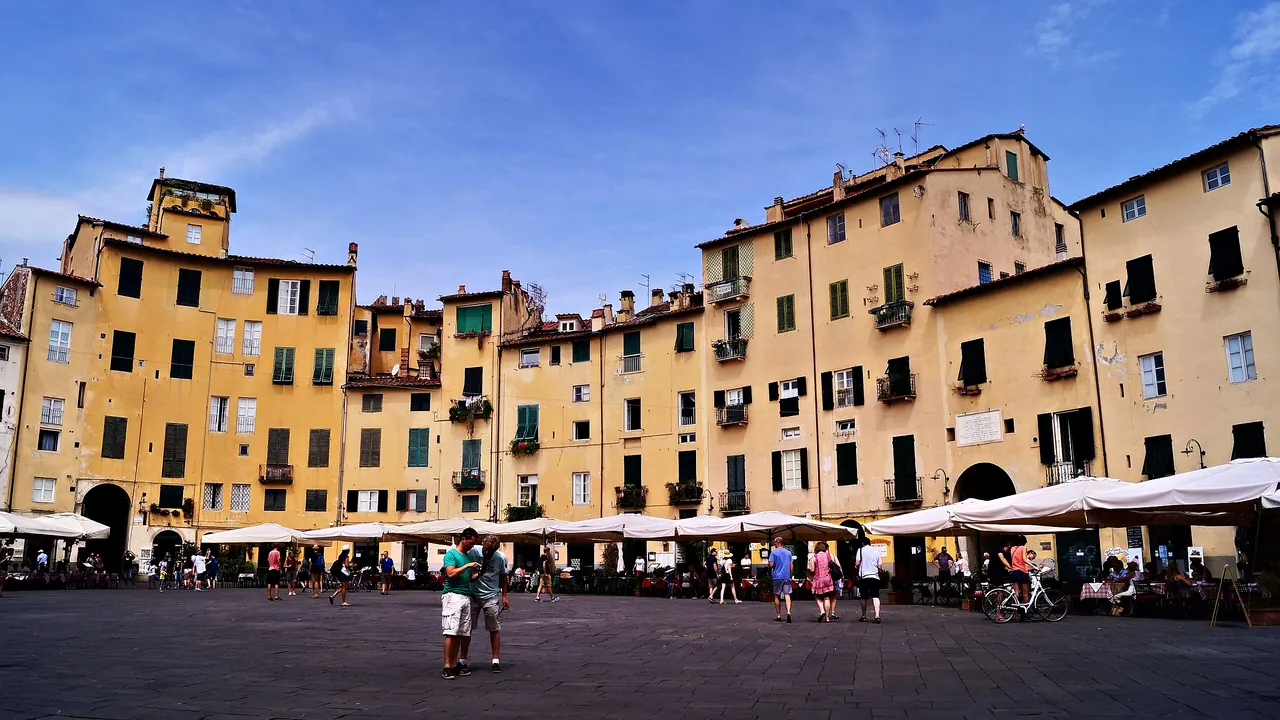
Photos: Innsbruck by Wolfgang Weiser, Pexels License; Lucca by Stefano Sansavini, CC BY-SA 4.0, cropped.
Innsbruck or Lucca?
Our verdict in twelve categories, each scored against the same fixed benchmark cities, and the climate month by month, so you can choose for your trip.
Choose Innsbruck for
- nature and the outdoors
- nightlife
- families
Innsbruck suits travellers whose best days start above the tree line. Cable cars from the edge of the old town reach high ridges in minutes, the Karwendel and the Stubai glaciers are close by, and in winter the same mountains turn into ski slopes. The Habsburg old town fills a day or two, and the student bars give evenings a little more life than Lucca manages.
Choose Lucca for
- beaches
- day trips
- food and drink
For Tuscany at walking pace, Lucca is the better pick. It offers Romanesque churches inside intact walls, plain and honest cooking with local wine, Puccini in the evening and a sandy beach half an hour away. Above all it is a base: Pisa, Florence, the Versilia coast and the Apuan Alps are all within easy reach, and the trip costs a little less than one in Innsbruck.
Scoreboard
Twelve categories on one fixed scale from 0 to 100. The shaded stretch is the gap between the two.
Your match
Pick a travel style or drag the sliders, and both match scores follow your weighting.
Wins on nature and the outdoors and nightlife with your weighting.
Wins on beaches and day trips with your weighting.
What matters to you?
Category by category
What the scores mean for a trip.
Beaches & swimming
Innsbruck is deep in the Alps, so swimming means the small, shallow lakes on the plateaus above town, such as the Lanser See and Natterer See. They are pleasant on a hot July afternoon, and the clear, cool Achensee is lovely to look at.
Lucca is inland too, but the Versilia coast is about 25 minutes away by train. It has wide, gently shelving sand, rows of beach-club umbrellas from Viareggio to Forte dei Marmi, and wilder dunes backed by pine woods at the Lecciona. A morning of churches followed by an afternoon in the sea is easy here and impossible from Innsbruck.
Food & drink
Innsbruck's cooking is filling mountain food: Gröstl, Kaspressknödel, Speck and Kaiserschmarrn. It tastes best at a mountain hut after a long walk. In town the choice thins out quickly, there are no markets or street food, and the restaurants near the Golden Roof mostly serve tour groups.
Lucca is plain by Tuscan standards, but it has more to discover. There is farro soup from the Garfagnana, tordelli in ragù, cecina from bakery counters, buccellato and chestnut dishes in the colder months, all eaten in family trattorias. The olive oil and the Colline Lucchesi and Montecarlo wines come from the hills you can see from the walls, while Innsbruck's wine travels in from elsewhere.
Culture & sights
Innsbruck's heritage comes down to a handful of strong Habsburg monuments. The best are the Golden Roof, the Hofburg, and the Hofkirche with Maximilian I's tomb and its ring of bronze giants. Ambras Castle on the edge of town has one of the oldest surviving cabinets of curiosities.
In Lucca, the sightseeing builds up as you walk. The complete Renaissance walls enclose a medieval grid where San Michele's tiered arcades, San Frediano's gold mosaic and the cathedral's tomb of Ilaria del Carretto are only streets apart. The oval Piazza dell'Anfiteatro and the oak-topped Torre Guinigi complete a townscape that makes a more absorbing two days than Innsbruck's.
Nightlife
Innsbruck has a university, and it shows. The brick arches under the railway viaduct hold bars and small clubs that stay open late at weekends, and in winter there is après-ski in the resorts around the city.
Lucca's evenings are an aperitivo in Piazza San Michele, a long dinner and a stroll along the walls, and the centre is quiet by midnight. In summer, anyone who wants to dance has to go to the Versilia beach clubs and arrange a late taxi back.
Nature & outdoors
Innsbruck has high mountains right on its doorstep. The funicular from the old town links to cable cars that reach a ridge at about 2,300m, and Austria's largest nature park, the Karwendel, starts just behind it. Across the valley are the glaciers of the Stubai, ski areas in winter, and via ferratas, mountain biking and rafting in summer.
Lucca's outdoors starts gently, with the 4km tree-lined ring of the walls, cycle paths along the Serchio and olive groves in the hills. For drama you drive about an hour north to the marble peaks of the Apuan Alps or the chestnut woods of the Garfagnana. The reed beds at Massaciuccoli add birdwatching that Innsbruck has no equivalent for.
Day trips
Innsbruck's position on the Alpine rail lines opens up three countries. Hall in Tirol and Rattenberg are close, Munich and Salzburg are just under two hours by train, and over the Brenner you reach Bolzano, Merano and Ötzi the Iceman. Many of the bigger names, though, take most of a day.
From Lucca, the famous places are much nearer. Pisa's Campo dei Miracoli is half an hour away and Florence a little over an hour, and the villa gardens at Marlia and Collodi are on the doorstep. Pietrasanta's sculptors' studios, the Carrara quarries and, with an early start, the Cinque Terre or San Gimignano make it the richer base.
Good for families
Both are safe, small and easy with children, but they keep them busy in different ways. Innsbruck's days are mountain days: the Alpenzoo with its ibex and lynx reached by funicular, adventure trails and playgrounds by the huts, and ski schools in winter. Rainy days need some planning.
Lucca's fun is flat and car-free. Children love pedalling a family quadricycle round the walls and climbing to the trees on the Torre Guinigi. The Pinocchio Park at Collodi and the beaches are both close, and Lucca Comics & Games in autumn is a big draw for teenagers.
Getting around
Both centres are compact and flat enough to walk in minutes. The difference is what lies beyond them. Innsbruck's trams, buses and the funicular from the old town take you straight up into the mountains without a car, and ski buses run out to the slopes in winter.
Lucca is best on foot or by bike, since the area inside the walls is largely closed to traffic, and the station just outside has good trains to Pisa and Florence. The villas and the Garfagnana are another matter, because buses are sparse and a car makes those days far simpler.
Shopping & style
Neither city has a luxury district or much depth, so the real difference is what you take home. Innsbruck is where you kit yourself out for the mountains, with boots, technical clothing and ski gear from shops staffed by people who use them. The old-town arcades sell loden jackets, dirndls, woodcarvings, Speck and schnapps, and the familiar chains line Maria-Theresien-Strasse.
What you buy in Lucca is either edible or old. Via Fillungo winds past Liberty-era shopfronts, and the lanes around it sell farro, buccellato and wine from the nearby hills. Once a month a long-established antiques market spreads through the streets around the cathedral, and it is worth timing a weekend to catch it. Innsbruck has nothing like it.
Affordability
Neither is cheap, but Lucca is somewhat easier on the wallet. Innsbruck adds an Alpine resort premium, peaking in ski season and at Christmas, and cable car tickets mount up on an active trip. The guest and city cards soften that, and spring and autumn are noticeably cheaper.
In Lucca the walls and many churches are free, the paid sights are modest, and trattoria meals and regional trains are fairly priced. Accommodation is the main cost, so staying just outside the walls often pays.
Live music & performing arts
Lucca has the stronger musical draw, because it is Puccini's birthplace. Recitals of his arias run in a central church for most of the year, and the Teatro del Giglio has a full season. In summer there is open-air opera beside the lake at Torre del Lago and big concerts in Piazza Napoleone.
Innsbruck offers a solid provincial programme at the Tiroler Landestheater and from its symphony orchestra. Its standout is the summer Festival of Early Music in historic rooms such as the Spanish Hall at Ambras, and folk evenings with yodelling and brass add a local touch.
Wellness & relaxation
Innsbruck's way of unwinding is a sauna after a day on the mountain, while Lucca offers a day out in old Tuscan spa towns, which gives it a slight edge. Innsbruck's best spas are in hotels up at Igls and on the plateaus, often with mountain views. An evening in a hut slows things down, and the large thermal complexes of the Ötztal and Zillertal are about an hour away.
From Lucca, Montecatini's belle époque bathhouses are half an hour away by train. Monsummano has warm pools inside a cave, and Bagni di Lucca in the wooded Serchio valley has natural steam grottoes. Back in town, the quiet, traffic-free streets and a shaded evening walk on the walls do the rest.
When should you go?
Pick your month. The climate figures are measured averages, not a forecast.
Innsbruck in July
Lucca in July
Daytime high, °C
Rainfall in the month, mm
Temperature and rainfall are climate normals, averaged over the years shown. Innsbruck: 1991-2020 normals, Innsbruck-Flughafen (3.3 km from centre). Lucca: 1991-2020 normals, Pisa / S. Giusto (21.4 km from centre).
Innsbruck is at its best from late May to September, when the trails, huts and cable cars are all open and afternoons reach about 26°C in July. Summer is also the wettest time, with August bringing around 144mm, so expect showers that build over the mountains in the afternoon. September and early October are often more settled and good for walking. From December to February the town is cold and the days are short, which suits skiers rather than sightseers, and the plateau lakes are only really warm enough for a swim in July and August.
Lucca works the other way round. Summer is hot, dry and very sunny, with highs near 30°C in July and August. That makes midday sightseeing hard work, but the sea reaches about 25°C, so June to September is beach season on the Versilia coast. The rain sets in during September and peaks in October and November at around 132mm a month. April, May and early autumn are the most comfortable months for walking the walls and the old streets, and the winters are far milder than Innsbruck's.
Which traveller are you?
For an outdoors trip, Innsbruck is in a different league. The Nordkette ridge is under half an hour from the old town, and from there you have hut-to-hut hiking, via ferratas, paragliding and rafting in summer. Lucca's Apuan Alps are good, but they take a drive.
On a beach and sun trip, Lucca wins easily. It has long sunny summers, the sandy Versilia beaches start about 25 minutes away by train, and the sea is warm from June to September. Innsbruck only has small mountain lakes for a short spell in high summer.
On a culture and arts trip, Lucca gives more. Its whole walled centre is the sight, with Puccini recitals and opera through the year, and Pisa and Florence are an easy train ride away. Innsbruck's Habsburg monuments are fine but take less time to see.
Before you go
| Measure | Innsbruck | Lucca |
|---|---|---|
| Official language | German, Austrian Sign Language | Italian |
| Currency | Euro (EUR) | Euro (EUR) |
| Sockets | CF230 V, 50 Hz | CFL230 V, 50 Hz |
| Driving side | Right | Right |
| Time zone | UTC+1, UTC+2 in summer | UTC+1, UTC+2 in summer |
| Emergency number | 112 | 112 |
| Elevation | 574 m | 19 m |
| Main airport | Innsbruck Airport (INN)4 km from centre40 non-stop destinations | Pisa International Airport (PSA)21 km from centre82 non-stop destinations |
| Public holidays this year | 16 days | 13 days |
By the numbers
| Measure | Innsbruck | Lucca |
|---|---|---|
| City population | 132,499 | 88,798 |
| People per km² | 1,263 | 478 |
| Museums within 10 km | 28 | 20 |
| UNESCO World Heritage sites within 50 km | 1 | 4 |
| Swim season, months above 21 °C | - | 4 months |
Where else could you go?
Every comparison below shares a destination with this one, so you can follow Innsbruck or Lucca somewhere new.