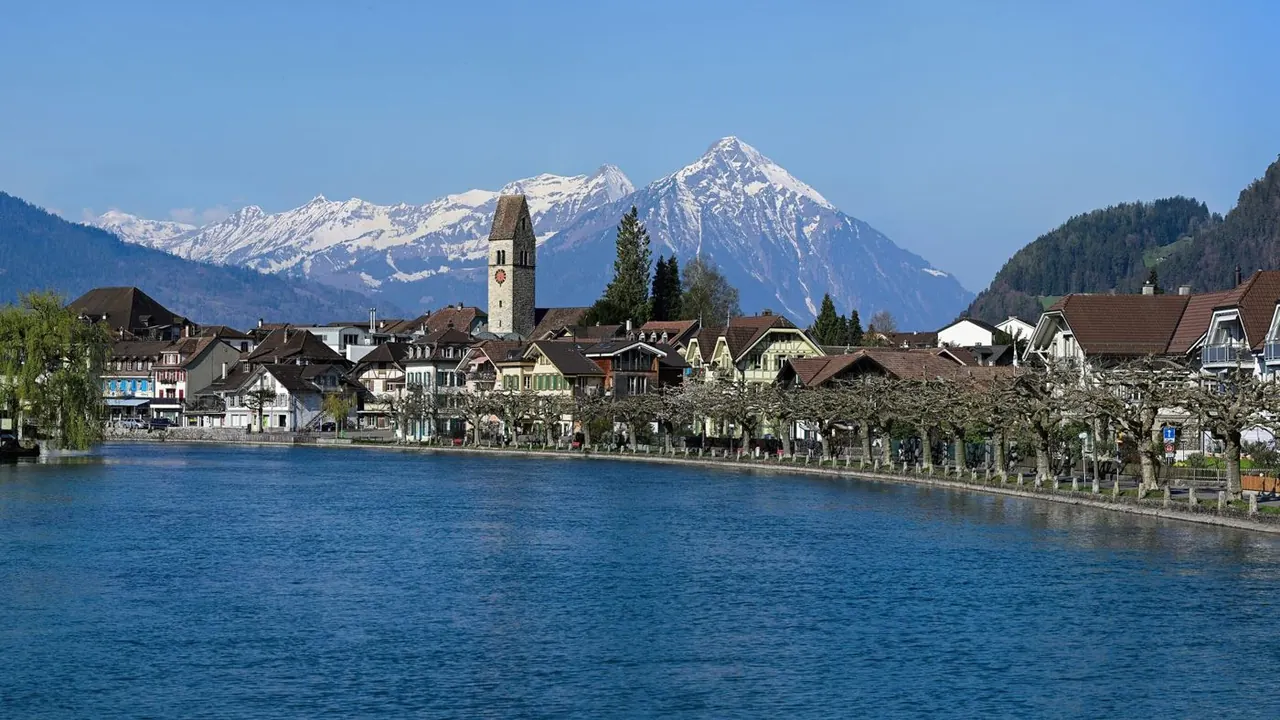
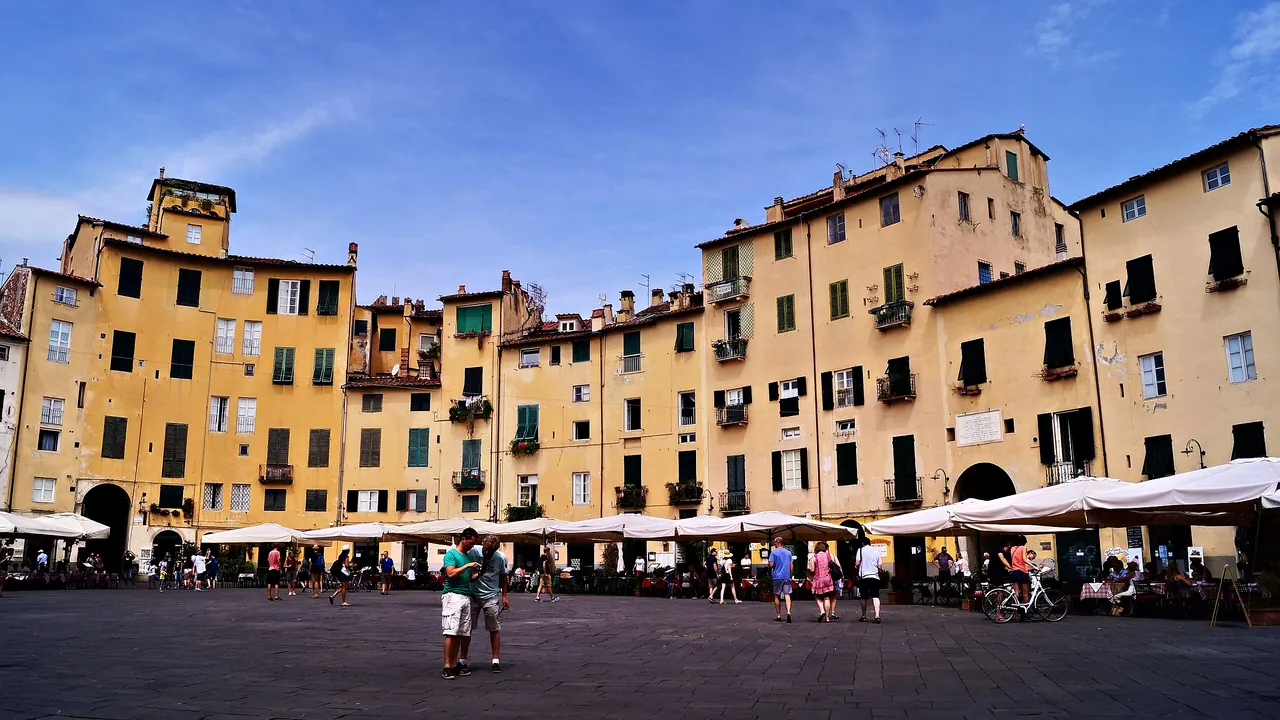
Photos: Interlaken by Roy Egloff, CC BY-SA 4.0, cropped; Lucca by Stefano Sansavini, CC BY-SA 4.0, cropped.
Interlaken or Lucca?
Our verdict in twelve categories, each scored against the same fixed benchmark cities, and the climate month by month, so you can choose for your trip.
Choose Interlaken for
- nature and the outdoors
- families
- getting around
Interlaken suits travellers whose plans start and end in the mountains. Glaciers, waterfalls, high trails and adventure sports are all within an hour by rail, the transport network makes everything easy without a car, and children love the trains and gondolas. Go knowing that the town itself is plain, the food is functional and the bill will be steep.
Choose Lucca for
- culture and sights
- live music and the arts
- prices
For art, history and good meals, Lucca is the better pick. Its walled medieval centre is a pleasure to walk and cycle, Puccini fills its evenings with music, and Pisa, Florence and the Versilia beaches are all within easy reach. It costs far less, though the nearest real mountains are an hour away and the evenings stay gentle.
Scoreboard
Twelve categories on one fixed scale from 0 to 100. The shaded stretch is the gap between the two.
Your match
Pick a travel style or drag the sliders, and both match scores follow your weighting.
Wins on nature and the outdoors and families with your weighting.
Wins on culture and sights and live music and the arts with your weighting.
What matters to you?
Category by category
What the scores mean for a trip.
Beaches & swimming
Interlaken's swimming happens in its two lakes. Lake Thun is the milder, with lidos and shingle beaches at Neuhaus, while Brienz has colder turquoise water and a bathing area at Bönigen. A swim there is a refreshing end to a mountain day in July or August, but not much more.
From Lucca you reach real sand. Viareggio is under half an hour by train, with wide, gently shelving beaches running up to Forte dei Marmi and free dunes at the Lecciona. It is still a half-day outing rather than a beach stay, but it gives you a proper afternoon by the sea.
Food & drink
Food is one of the clearer reasons to choose Lucca. In Interlaken the menus are built around fondue, raclette and rösti for visitors, plus a run of Indian and Asian places. The memorable meals happen at hut terraces and mountain dairies higher up, and many people simply picnic from the supermarket.
Lucca's trattorias inside the walls serve a rooted local cooking: spelt soup from the Garfagnana, tordelli in ragù, cecina from bakery counters, buccellato and wines from the nearby hills. The range is narrow, but here meals are part of the reason to come, not just fuel for the next outing.
Culture & sights
The two barely compare here. Interlaken was built as a base for the mountains. Its sights amount to the row of grand hotels and the Kursaal on the Höheweg and a few timber houses in Unterseen, and for real old towns you take the train to Bern or Thun.
Lucca is a sight in its own right. Complete Renaissance walls surround a medieval street grid, with the carved Romanesque fronts of San Michele and the cathedral, the golden mosaic of San Frediano and the oval Piazza dell'Anfiteatro. Its museums are modest, but churches, towers and palaces easily fill two slow days.
Nightlife
Neither is a place for late nights, though Lucca's evenings have a little more to them. Interlaken goes to bed early before morning trains and paragliding flights, leaving a few backpacker pubs, a couple of basement clubs and the Kursaal casino.
An evening in Lucca means an aperitivo in a piazza, a long dinner and a stroll on the walls, and student wine bars are as lively as it gets. In summer, dancing means the beach clubs of the Versilia coast and a late taxi back.
Nature & outdoors
This is Interlaken's whole case. The Eiger, Mönch and Jungfrau, the waterfalls of Lauterbrunnen and the railway to the Jungfraujoch above the Aletsch glacier all lie within an hour. Cable cars lift you straight onto high trails, and paragliding, canyoning, rafting and winter skiing all start from town. Only low cloud gets in the way.
Lucca offers good walking country rather than great scenery on the doorstep: the walls, the cycle paths along the Serchio and the olive-covered hills. The marble peaks of the Apuan Alps and the forests of the Garfagnana are about an hour north. They reward a few outdoor days in spring or autumn, but not a trip built around them.
Day trips
Both make strong bases, but Lucca has more within reach. From Interlaken, trains and lake steamers put Bern's arcaded old town, Thun's castle, the lakeside castles at Spiez and Oberhofen and the Ballenberg open-air museum within easy range. Lucerne is a longer, scenic journey.
From Lucca, Pisa is half an hour away and Florence a little over an hour. Pistoia, the sculptors' studios of Pietrasanta and the villa gardens at Marlia and Collodi are all close, and the Cinque Terre and San Gimignano are possible on a long day. No Alpine base can match that many major Tuscan names so close together.
Good for families
Interlaken works better with children, mainly because getting around is itself the fun. There are rack railways, gondolas and lake steamers, playgrounds and summer toboggan runs at the summit stations, the St Beatus caves and the farm animals at Ballenberg. Rainy days and high altitude for very young children are the weak spots.
Lucca is easy and free of traffic, and riding the walls on a family quadricycle is a highlight. The Pinocchio Park at Collodi and the beaches are nearby. Beyond those, its days are made of churches and palaces, which tire children faster.
Getting around
Both are easy without a car, in different ways. Interlaken's strength is its reach. The small, flat town is walkable between its two stations, and from there mainline trains, mountain railways, gondolas and steamers connect neatly across the whole Jungfrau region. They get crowded only on the busiest summer routes.
Lucca's strength is the centre itself, which is flat, closed to traffic and best explored on foot or by bike. The station sits just outside the walls for trains to Pisa and Florence. Buses to the villas and hill villages are sparse, though, so those days are easier with a car.
Shopping & style
Interlaken's Höheweg sells to tour groups: big watch and jewellery stores, army knives, cuckoo clocks, chocolate and outdoor gear, with Brienz woodcarving the one local craft worth seeking out. Lucca makes for a more enjoyable browse along Via Fillungo, with its Liberty-style shopfronts, delicatessens for olive oil and buccellato, paper shops and a monthly antiques market that is one of Italy's oldest. Neither is a serious shopping city, but in Lucca the shopping feels local.
Affordability
Lucca is far easier on the budget. Interlaken charges full Swiss prices for beds, meals and drinks. The mountain railways, the Jungfraujoch above all, and the adventure sports push the cost of doing the region properly well beyond what most visitors expect, and hostels, picnics and transport passes help only so much.
Lucca costs what you would expect in central Italy. It is not cheap, and rooms are scarce in summer, but trattoria meals and trains are fairly priced, and the walls and many churches cost nothing.
Live music & performing arts
Interlaken's stage is mostly seasonal and small: the amateur William Tell performed in the woods each summer, folklore evenings with alphorns and yodelling, and the occasional concert at the Kursaal. For an orchestra you go to Bern.
Lucca has Puccini, and that makes the difference. Short recitals of his arias are held in a central church for much of the year, and the Teatro del Giglio runs a full season of opera and concerts. Summer brings the Puccini Festival by the lake at Torre del Lago and large outdoor concerts in Piazza Napoleone.
Wellness & relaxation
Neither town has hot springs of its own, so the difference lies in pace and in what is nearby. Interlaken's centre is busy with coach groups and backpackers and geared to activity. Rest comes from the spas in the grand Höheweg hotels, the town's wellness area, slow steamer crossings and nights up in Wengen or Mürren.
Lucca is calmer from the start, with quiet streets, long lunches and evening walks on the walls. Real thermal water is close by: the belle époque baths of Montecatini and the cave pools of Monsummano are about half an hour away, and the steam grottoes of Bagni di Lucca are a little further.
When should you go?
Pick your month. The climate figures are measured averages, not a forecast.
Interlaken in July
Lucca in July
Daytime high, °C
Rainfall in the month, mm
Where the figures come from
Interlaken has no rain gauge within 25 km of the centre, so its rainfall comes from a gridded climate dataset read at the city rather than from a gauge further away.
Interlaken's sunshine is measured 66 km from the centre, at Sion.
Temperature and rainfall are climate normals, averaged over the years shown. Interlaken: 2005-2020 (sunshine 1961-1990, rainfall 1991-2020) normals, Meiringen / Unterbach (19.3 km from centre). Lucca: 1991-2020 normals, Pisa / S. Giusto (21.4 km from centre).
Interlaken is at its best in summer, with a second season in winter. From June to September the days are mild, peaking around 24°C in July, which is right for hiking and the high trails. The heaviest rain falls from May to August, about 127mm in June, so expect showers and cloud over the peaks. Lake swimming only really works in July and August. From November to March daytime highs are only a few degrees above freezing, and that is when the ski areas take over.
Lucca's rain comes at the opposite time of year. Summer is its driest and sunniest season, and July and August reach 30°C. That is hot for sightseeing but right for the coast, where the sea is at 25°C in high summer and good for swimming from June to September. Spring and September are the best times for walking the streets. From late September the rain builds, reaching around 132mm in November.
Which traveller are you?
For an outdoors trip, Interlaken is the obvious choice. Cable cars lift you onto high trails, the Lauterbrunnen waterfalls are close by, and paragliding and canyoning start from town, with skiing in winter. Lucca's Apuan Alps offer fine walking, but only as a side trip.
On a culture and arts trip, Lucca wins clearly. The walled medieval city, its Romanesque churches and the Puccini recitals and opera season give both days and evenings substance. In Interlaken you would spend your time taking trains elsewhere to find any history.
For a trip on a tight budget, Lucca makes your money go much further. Trattorias and regional trains are fairly priced and the walls and churches are free, whereas Interlaken's Swiss prices and costly mountain railways make even a careful stay expensive.
Before you go
| Measure | Interlaken | Lucca |
|---|---|---|
| Official language | French, German, Italian, Romansh | Italian |
| Currency | Swiss Franc (CHF) | Euro (EUR) |
| Sockets | CJ230 V, 50 Hz | CFL230 V, 50 Hz |
| Driving side | Right | Right |
| Time zone | UTC+1, UTC+2 in summer | UTC+1, UTC+2 in summer |
| Emergency number | 112 | 112 |
| Elevation | 571 m | 19 m |
| Main airport | Zürich Airport (ZRH)100 km from centre226 non-stop destinations | Pisa International Airport (PSA)21 km from centre82 non-stop destinations |
| Public holidays this year | 10 days | 13 days |
By the numbers
| Measure | Interlaken | Lucca |
|---|---|---|
| City population | 6,123 | 88,798 |
| People per km² | 1,424 | 478 |
| Museums within 10 km | 3 | 20 |
| UNESCO World Heritage sites within 50 km | 2 | 4 |
| Swim season, months above 21 °C | - | 4 months |
Where else could you go?
Every comparison below shares a destination with this one, so you can follow Interlaken or Lucca somewhere new.