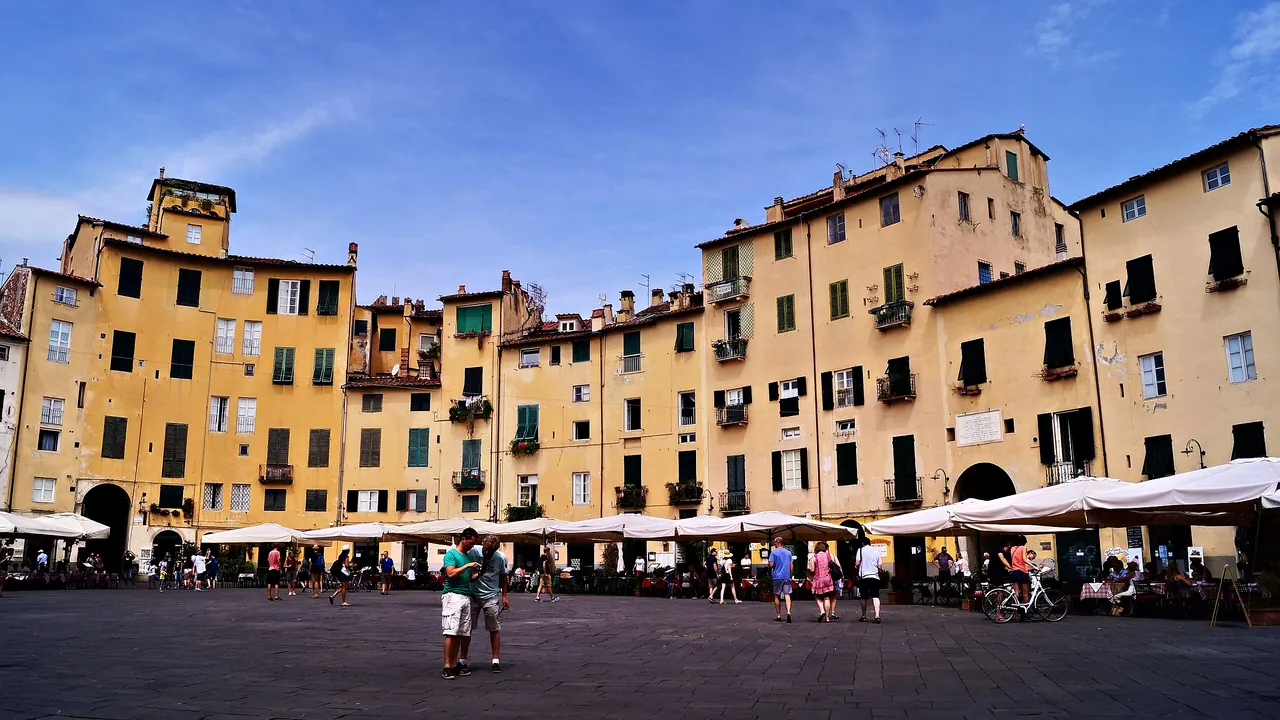
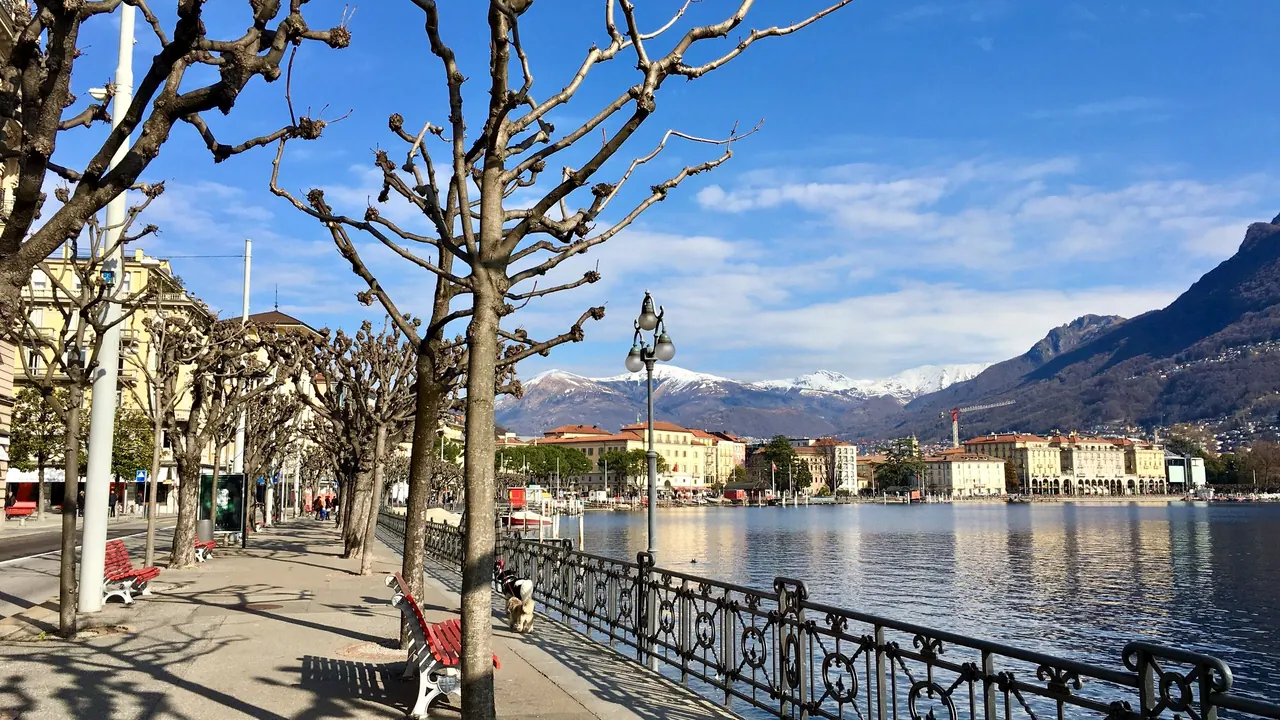
Photos: Lucca by Stefano Sansavini, CC BY-SA 4.0, cropped; Lugano by Thomas Woodtli from Zürich, Switzerland, CC BY-SA 2.0, cropped.
Lucca or Lugano?
Our verdict in twelve categories, each scored against the same fixed benchmark cities, and the climate month by month, so you can choose for your trip.
Choose Lucca for
- prices
- culture and sights
- food and drink
Lucca suits a traveller who wants Tuscany in miniature. It is a walled city of Romanesque churches and towers that you explore on foot or by bike, with Pisa, Florence and the Versilia sands all close by train. Choose it for art, Puccini, plain regional cooking and a budget that has to stretch. It works best as a base for several nights, with a day trip from each.
Choose Lugano for
- nature and the outdoors
- getting around
- nightlife
If the view matters more than the sights, Lugano is the better pick. Its draw is the lake set between steep wooded mountains, with funiculars, boats and ridge walks starting from town, and Milan and Lake Como within reach across the border. It is a calmer, more polished and far more expensive stay. It suits walkers and couples who want scenery and order more than churches and museums.
Scoreboard
Twelve categories on one fixed scale from 0 to 100. The shaded stretch is the gap between the two.
Your match
Pick a travel style or drag the sliders, and both match scores follow your weighting.
Wins on prices and culture and sights with your weighting.
Wins on nature and the outdoors and getting around with your weighting.
What matters to you?
Category by category
What the scores mean for a trip.
Beaches & swimming
Neither city is on a beach, but Lucca has better swimming within reach. The Versilia coast begins at Viareggio, under half an hour away by train. Wide, gently shelving sand runs north to Forte dei Marmi, mostly lined with rows of beach-club umbrellas, and there are wilder dunes backed by pine woods at the Lecciona.
Lugano swims in its lake instead. You bathe from lidos with lawns, wooden decks and ladders, at the mouth of the Cassarate and along the shore, and there is no sand at all. A quick dip is easier from Lugano because the lake is right there, but for a proper beach day Lucca wins.
Food & drink
Both cities cook rustic food from their own hills, but Lucca gives you more to eat, at fairer prices. Its trattorias and osterie inside the walls serve spelt soup, tordelli in ragù, chestnut dishes and slices of cecina, with local olive oil and Montecarlo wines. The menus do start to repeat after a few days.
Lugano's best meals are in its grotti, stone taverns under chestnut trees that serve polenta, braised meats and Ticino Merlot. They are a real pleasure on a warm evening. Beyond them the choice is thin and expensive, and many visitors cross into Italy to eat.
Culture & sights
Lucca is clearly the richer city for sightseeing, because the old centre itself is the attraction. Its tree-lined Renaissance walls survive complete around a medieval grid of towers and churches. Inside them are the tiers of carved arcades on San Michele in Foro, San Frediano's golden mosaic and Jacopo della Quercia's tomb of Ilaria del Carretto in the cathedral, and the oval Piazza dell'Anfiteatro still follows the outline of a Roman amphitheatre.
Lugano is pleasant rather than remarkable. It has arcaded Lombard streets around Piazza della Riforma, a lake view from San Lorenzo and one outstanding work, Luini's Passion fresco in Santa Maria degli Angioli. Its art collection is split between LAC and Palazzo Reali, and the Hermann Hesse museum in Montagnola makes a short trip into the hills.
Nightlife
Neither city is for late nights, and in both the evening means an aperitivo, a long dinner and a stroll. Lucca's version is cheaper and more casual, with wine bars, student pubs and a walk on the walls, and in summer people who want to dance head to the Versilia beach clubs. Lugano is dressier and more expensive, with cocktail and lounge bars by the lake and one or two clubs, and its young crowd goes to Milan.
Nature & outdoors
In Lugano the landscape starts at the edge of town. The lake winds between steep wooded mountains, and funiculars take you up Monte Brè and San Salvatore. The lakeside path to Gandria is an easy short walk, and the green rivers of the Verzasca and Maggia valleys are about an hour away.
Lucca's own outdoors is gentler: the 4km ring of the walls, cycle paths along the Serchio and hills of olive groves. Its dramatic scenery, the marble peaks of the Apuan Alps and the woods of the Garfagnana, lies about an hour to the north and is much easier with a car.
Day trips
Both are excellent bases, but Lucca offers a little more, and it is easier to reach. Pisa is half an hour away by train and Florence just over an hour. Pistoia, the villas and gardens of the Lucca countryside, Collodi and Pietrasanta are all close, and with an early start you can reach the Cinque Terre or San Gimignano.
Lugano's trips have the novelty of two countries. Milan and The Last Supper are just over an hour away and Como about half an hour, while Bellinzona's castles and Lake Maggiore are easy by Swiss rail. The choice is between Tuscan art towns and Italian and Swiss lakes.
Good for families
Families will find the two about equally easy, and in both the setting does more than any attraction. Lucca is flat and mostly free of traffic, so riding the walls on a family quadricycle is the classic outing, and Pinocchio Park at Collodi and sandy beaches are close by.
Lugano keeps children busy with water and heights: boat rides, lido slides, funiculars, the rack railway up Monte Generoso and the miniature Switzerland at Melide. Its steep streets are hard work with a pushchair. Lucca's autumn Comics & Games festival gives teenagers something Lugano has no match for.
Getting around
Both centres are small and best seen on foot, but the ground is different. Lucca is flat and mostly closed to traffic, so bikes do the work. Buses to the villas and the Garfagnana are sparse, though, so a car helps on country days.
Lugano climbs steeply from the shore, and a funicular links the station with the old town. In return, its boats, buses, mountain railways and the Swiss rail network reach almost everything without a car.
Shopping & style
Via Fillungo and Via Nassa sum up the difference, though the two towns are about level overall. Lucca's main street winds past fashion and jewellery shops, some still behind old Liberty-style shopfronts, and the side lanes sell olive oil, farro and buccellato. Once a month the antiques market around the cathedral, one of the oldest in Italy, is a good reason to time a visit.
Lugano's arcaded Via Nassa is more polished, with Swiss watchmakers, jewellers and Italian fashion houses serving wealthy buyers, and there is a large designer outlet towards Mendrisio. Neither goes very deep, and serious shoppers in Lugano make the trip to Milan.
Affordability
For the cost of a trip, the two are far apart, and Lucca is much the cheaper. Its trattorias are fairly priced and many sights are free. Staying just outside the walls makes the money go further, but rooms fill up in summer and during the big festivals.
Lugano has Swiss prices on everything from lakeside hotels to boat trips and mountain railways. Grotti, set lunches and the regional transport that comes with most hotel stays help a little, but there is no cheap way to stay.
Live music & performing arts
Lucca has the stronger musical identity, and it rests on Puccini. Recitals of his arias are held in a central church for most of the year, the Teatro del Giglio stages opera, and in July big-name concerts fill Piazza Napoleone. In summer the open-air Puccini Festival plays beside the lake at Torre del Lago.
Lugano's offer centres on LAC, whose concert hall is home to the Orchestra della Svizzera italiana, with drama and dance mostly in Italian. The free Estival Jazz concerts in Piazza della Riforma are the summer highlight, but opera lovers go to La Scala.
Wellness & relaxation
Lucca is the better base for a spa day out. Montecatini's grand belle époque spa buildings are half an hour away by train, and the warm cave pools at Monsummano and the natural steam grottoes of Bagni di Lucca are also close. In town, relaxing means quiet lanes with no traffic and an evening walk on the shaded walls.
Lugano has no bathing tradition to draw on, so it relies on hotel spas and a large indoor complex of pools and saunas near Rivera. Its calm comes from the lake instead: an afternoon on a lido, a bench in Parco Ciani, or a grotto lunch that runs on into the evening.
When should you go?
Pick your month. The climate figures are measured averages, not a forecast.
Lucca in July
Lugano in July
Daytime high, °C
Rainfall in the month, mm
Temperature and rainfall are climate normals, averaged over the years shown. Lucca: 1991-2020 normals, Pisa / S. Giusto (21.4 km from centre). Lugano: 1991-2020 normals, Lugano (1.2 km from centre).
Lucca has the hotter, drier summer. June to August are sunny and see little rain, highs reach 30°C in July and August, and the sea at Versilia warms to 25°C, so the beach season runs from June to September. That heat makes midday walking hard in high summer, so May and late September are more comfortable for the streets and the walls. The rain comes in autumn and is heaviest in October and November. Winters are mild.
Lugano is cooler all year, with summer highs of 27°C and only 7°C in January. Its wet season is long: every month from April to November brings heavy rain, and May is the wettest. Winter is its driest and, in midwinter, slightly sunnier spell, but it is cold for sitting outside. Late spring and early autumn give the best balance for hiking and lake days. For reliable sunshine, Lucca's dry summer is the safer bet.
Which traveller are you?
For a culture and arts trip, Lucca is the clear choice. The complete walls, the carved Romanesque façades and the Puccini recitals easily fill two days, and Pisa and Florence are close by train. Lugano's sights can be seen in a single day.
On an outdoors trip, Lugano comes out ahead. Funiculars climb Monte Brè and San Salvatore from the edge of town, the ridge from Monte Lema to Monte Tamaro is a fine day hike, and kayaks are easy to hire. Lucca's real mountains are about an hour away.
On a trip on a tight budget, Lucca is far easier on the wallet. Trattoria meals and regional trains are fairly priced, and the walls and many churches cost nothing. In Lugano, hotels, meals, boats and mountain railways all come at Swiss prices.
Before you go
| Measure | Lucca | Lugano |
|---|---|---|
| Official language | Italian | French, German, Italian, Romansh |
| Currency | Euro (EUR) | Swiss Franc (CHF) |
| Sockets | CFL230 V, 50 Hz | CJ230 V, 50 Hz |
| Driving side | Right | Right |
| Time zone | UTC+1, UTC+2 in summer | UTC+1, UTC+2 in summer |
| Emergency number | 112 | 112 |
| Elevation | 19 m | 283 m |
| Main airport | Pisa International Airport (PSA)21 km from centre82 non-stop destinations | Milan Malpensa International Airport (MXP)46 km from centre208 non-stop destinations |
| Public holidays this year | 13 days | 15 days |
By the numbers
| Measure | Lucca | Lugano |
|---|---|---|
| City population | 88,798 | 63,495 |
| People per km² | 478 | 837 |
| Museums within 10 km | 20 | 17 |
| UNESCO World Heritage sites within 50 km | 4 | 5 |
| Swim season, months above 21 °C | 4 months | - |
Where else could you go?
Every comparison below shares a destination with this one, so you can follow Lucca or Lugano somewhere new.