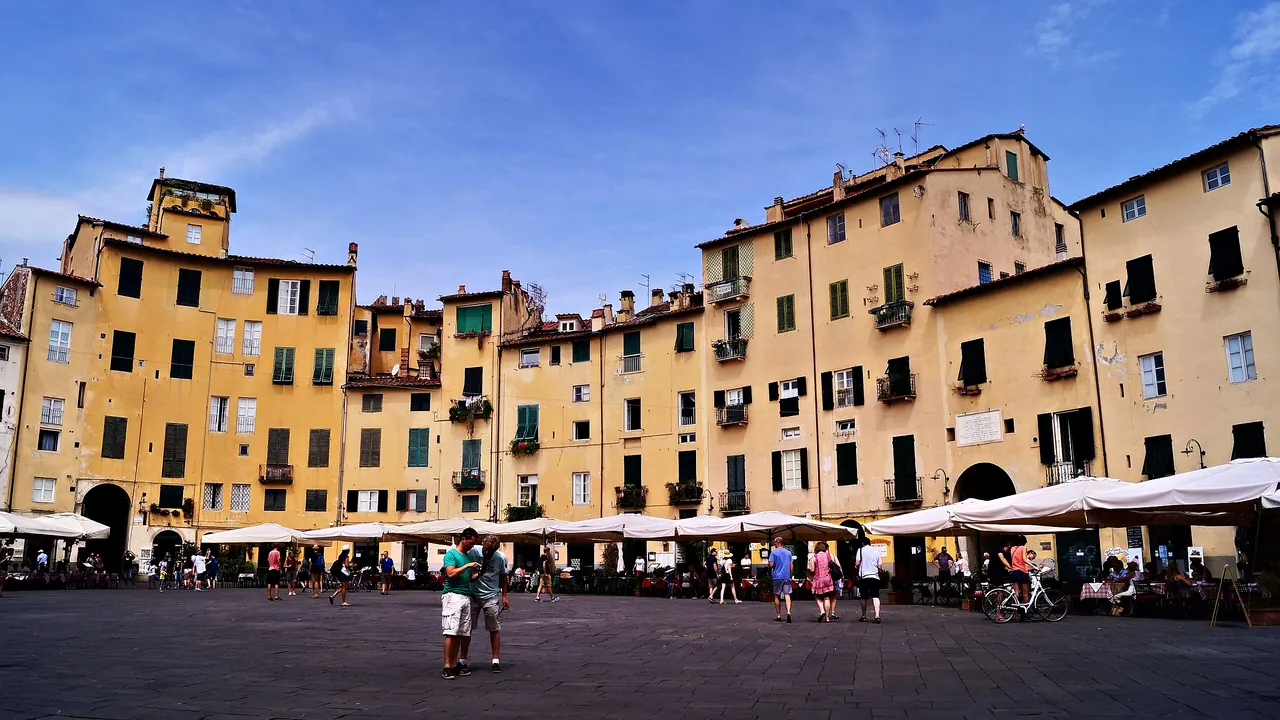
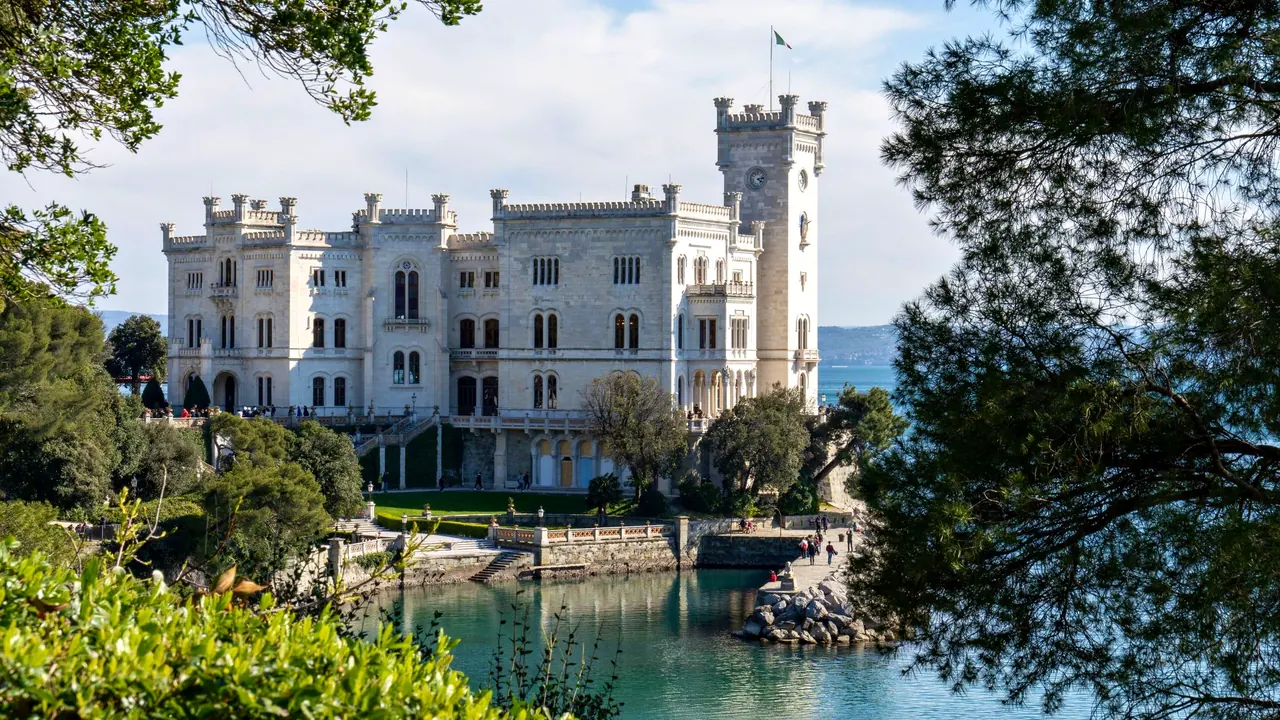
Photos: Lucca by Stefano Sansavini, CC BY-SA 4.0, cropped; Trieste by Tibor Szabo, Pexels License.
Lucca or Trieste?
Our verdict in twelve categories, each scored against the same fixed benchmark cities, and the climate month by month, so you can choose for your trip.
Choose Lucca for
- day trips
- wellness
- getting around
Lucca suits travellers who want a base more than a destination. You come back each evening to a walled, traffic-free town, and Pisa, Florence, the Versilia sands and the great villa gardens are all easy trips out. It also fits a slower, gentler trip, with the old spa towns of Montecatini and Bagni di Lucca close by when you want a proper soak.
Choose Trieste for
- nightlife
- beaches
- prices
Pick Trieste if you want the sea in your everyday routine and a city with a more unusual, layered character, where Habsburg squares, Austrian and Slavic cooking and the Karst cliffs sit side by side. It is a little easier on the budget and slightly livelier after dark. It also suits swimmers who don't mind ladders and rocks instead of sand.
Scoreboard
Twelve categories on one fixed scale from 0 to 100. The shaded stretch is the gap between the two.
Your match
Pick a travel style or drag the sliders, and both match scores follow your weighting.
Too close to call, level with your weighting
Wins on day trips and wellness with your weighting.
Wins on nightlife and beaches with your weighting.
What matters to you?
Category by category
What the scores mean for a trip.
Beaches & swimming
Trieste has the sea at the end of the street. Locals spread towels on Barcola's stepped concrete and pine-shaded lawns, climb down ladders into clear water, and head for the pebble coves at Sistiana, Duino and Grignano. Swimming is part of ordinary summer days there, though sand is almost absent.
Lucca has to travel for its swim, but the Versilia coast it reaches by train has what Trieste lacks. Wide, gently shelving sand runs from Viareggio to Forte dei Marmi, mostly lined with tidy rows of umbrellas, and the wilder Lecciona dunes are backed by pine woods. It works as an afternoon outing rather than something you do every day.
Food & drink
The two eat equally well but in very different styles. Lucca's cooking is plain Tuscan country food: spelt soup, tordelli in ragù, chestnut dishes in the cold months, cecina from bakery counters and its own buccellato, all with mild local olive oil and Montecarlo wine.
Trieste leans towards Central Europe. Boiled pork with horseradish is carved at buffet counters, jota sits beside marinated sardoni, and coffee comes with its own local vocabulary. In both cities the range is narrow, but Trieste's coffee houses and Karst farmhouse osmize give it more variety.
Culture & sights
Both have plenty to see, but the history behind them differs. Lucca is medieval and Romanesque, with complete Renaissance walls around a grid of towers and carved church façades such as San Michele in Foro and San Frediano. The whole town is the main sight, and two days cover it.
Trieste is Habsburg and maritime. Its sights are the grand seafront square of Piazza Unità, the Canal Grande quarter, the cathedral and castle on San Giusto, and Miramare's white castle on the coast. A great synagogue and the Risiera memorial add a harder twentieth-century history that Lucca does not have.
Nightlife
Neither is a place for a big night out, but Trieste stays up a little later. Aperitivo spreads from Piazza Unità into the lanes of Cavana, students keep a few streets of wine bars busy, and in summer the kiosks along Barcola stay open into warm nights.
Lucca's evening is an aperitivo, dinner and a walk on the walls, and the centre is calm by midnight. Anyone who wants to dance has to go to the Versilia coast and take a taxi back.
Nature & outdoors
The outdoors is about equally good in both, but it lies at different distances. Trieste's is right behind the houses: the Strada Napoleonica above the gulf, the Rilke Path on the Duino cliffs, Val Rosandra's gorge and the vast Grotta Gigante. The water adds sailing, plus snorkelling in the Miramare reserve.
Lucca's own green space is the ring of walls and the bike paths along the Serchio. Its most dramatic scenery, the marble peaks of the Apuan Alps and the beech woods of the Garfagnana, is an hour's drive north.
Day trips
Lucca is the stronger base, because its best trips are both famous and close, mostly on one railway line. Pisa is half an hour away by train and Florence a little over an hour, with Pistoia's medieval centre and the old spa town of Montecatini on the same route. The villa gardens at Marlia and Collodi's baroque Villa Garzoni are nearer still. To the north are Viareggio, known for its carnival, and the marble towns of Pietrasanta and Carrara.
Trieste's range is wider but more spread out, and it covers three countries: Aquileia's mosaics, the star-shaped fortress town of Palmanova, Piran across the Slovenian border and Ljubljana beyond it. Istria needs a car, and Venice is a long day at two hours each way.
Good for families
Both work for families, but they suit different ages. Lucca is flat and largely free of cars, which suits small children. They can ride a family quadricycle around the walls, and Pinocchio Park and sandy beaches are each under half an hour away.
Trieste's steep, stepped streets and rocky swimming spots are harder with toddlers. Older children, though, get a cave big enough to amaze them, a castle by the sea, an aquarium and a hands-on science centre.
Getting around
Both centres are compact and easy on foot, but they are built differently. Lucca is flat and largely closed to cars, so bikes are the natural way to get about, and trains run straight from outside the walls. Outside town, though, buses are thin and a car becomes necessary.
Trieste's waterfront is level, but the old town climbs in long flights of steps up to San Giusto. To make up for it, city buses reach Miramare and the Karst, and boats cross the bay to Muggia.
Shopping & style
Neither is a shopping destination, and the best things to buy in both are edible. Lucca has the prettier main street, Via Fillungo, with its Liberty-style shopfronts, and one of Italy's oldest antiques markets fills the streets once a month. Trieste's equivalent is the antique and second-hand shops of its old town, and the best things to take home are coffee from local roasters, Karst wine and presnitz.
Affordability
Trieste is the easier city on a budget. Buffet lunches and bar coffee cost little, buses are cheap, and its best pleasures are free: swimming at Barcola, walks on the Karst and the cathedral hill.
Lucca is fair for Tuscany and cheaper than Florence, but rooms are its weak point. There are few hotels inside the walls, and they fill up in summer and during festivals, so many visitors end up staying just outside the walls.
Live music & performing arts
Opera leads in both cities, from different angles. Lucca's draw is Puccini: short recitals of his arias are held most of the year, the Lucca Summer Festival fills Piazza Napoleone, and open-air opera is staged by the lake at Torre del Lago.
Trieste's Teatro Verdi on the waterfront has a full season of opera and ballet, and the city keeps up a Habsburg taste for operetta that is rare in Italy. A Slovenian-language theatre and summer concerts in the San Giusto castle courtyard add to it.
Wellness & relaxation
Lucca has the edge for unwinding, mostly because thermal water is part of the country around it, with several historic spa towns less than an hour away. In town, rest means long lunches and a turn on the walls in the evening, when the light goes gold over the rooftops.
Trieste's calm is more urban and literary. Days stretch out over a newspaper in an old coffee house, set by an older, unhurried population, and end with a walk to the tip of the Molo Audace as the sun sets over the gulf. There are hotel spas and a few day spas for treatments, but for thermal baths you have to leave the city.
When should you go?
Pick your month. The climate figures are measured averages, not a forecast.
Lucca in July
Trieste in July
Daytime high, °C
Rainfall in the month, mm
Temperature and rainfall are climate normals, averaged over the years shown. Lucca: 1991-2020 normals, Pisa / S. Giusto (21.4 km from centre). Trieste: 1991-2020 normals, Trieste (1.6 km from centre).
The two run on similar summer heat, but the rain falls at different times. Lucca's summer is hot and dry, with highs around 30°C in July and August and barely 32mm of rain in July. That makes June to August reliable for the beach, though the plain is sticky for sightseeing at midday. Trieste is a degree or so cooler in summer but wetter, with showers through May and 78mm in August. In both cities the sea warms to 25°C in July and August, and Lucca gets a little more sunshine in every month.
In spring and autumn both are pleasant for walking, and May and late September are the best balance of warmth and comfort. Autumn is the wet season in both, and Lucca's October and November are the wettest months of its year, at around 125mm. Winter is milder in Lucca. Trieste drops to about 9°C in January, and its sea stays colder for longer into spring.
Which traveller are you?
For a relaxing and wellness trip, Lucca is the clear pick. Its quiet streets have no traffic and its shaded walls are good for slow walks. Montecatini's belle époque spas, the cave pools at Monsummano and Bagni di Lucca's steam grottoes are all close by, while Trieste offers only hotel spas.
On a trip on a tight budget, Trieste goes further. Lunch at a buffet counter and coffee at a standing bar cost little, buses are cheap, and swimming at Barcola is free. Lucca has few beds inside its walls, so rooms there fill up and push costs up.
For a food and nightlife trip, Trieste has the edge. Its boiled-meat buffets, coffee houses and Karst osmize are more unusual than Lucca's trattorias. Its evenings run later too, with student wine bars and summer bars along the seafront, while Lucca is mostly asleep by midnight.
Before you go
| Measure | Lucca | Trieste |
|---|---|---|
| Official language | Italian | Italian |
| Currency | Euro (EUR) | Euro (EUR) |
| Sockets | CFL230 V, 50 Hz | CFL230 V, 50 Hz |
| Driving side | Right | Right |
| Time zone | UTC+1, UTC+2 in summer | UTC+1, UTC+2 in summer |
| Emergency number | 112 | 112 |
| Elevation | 19 m | 2 m |
| Main airport | Pisa International Airport (PSA)21 km from centre82 non-stop destinations | Trieste Airport (TRS)31 km from centre32 non-stop destinations |
| Public holidays this year | 13 days | 13 days |
By the numbers
| Measure | Lucca | Trieste |
|---|---|---|
| City population | 88,798 | 198,417 |
| People per km² | 478 | 2,332 |
| Museums within 10 km | 20 | 33 |
| UNESCO World Heritage sites within 50 km | 4 | 5 |
| Swim season, months above 21 °C | 4 months | 4 months |
Where else could you go?
Every comparison below shares a destination with this one, so you can follow Lucca or Trieste somewhere new.