Ischia or Umbria?
Our verdict in twelve categories, each scored against the same fixed benchmark cities, and the climate month by month, so you can choose for your trip.
Choose Ischia for
- beaches
- wellness
- families
Ischia is the choice for a stay in one place with the sea and hot water close by. Days go between thermal gardens, volcanic sand and a harbour dinner, with ferries to Procida, Naples and the Phlegraean Fields when you want an outing. It suits couples and families who want a slow, warm trip rather than a full sightseeing plan.
Choose Umbria for
- culture and sights
- live music and the arts
- nature and the outdoors
For anyone who travels to look at things and to eat well, Umbria is far stronger. It is a landlocked region of medieval hill towns, each with a cathedral, a fresco cycle or a great square, with truffles and Sagrantino on the table and the mountains to the east. You will need a car and you give up the sea entirely, but a week here gives a different town every day.
Scoreboard
Twelve categories on one fixed scale from 0 to 100. The shaded stretch is the gap between the two.
Your match
Pick a travel style or drag the sliders, and both match scores follow your weighting.
Wins on beaches and wellness with your weighting.
Wins on culture and sights and live music and the arts with your weighting.
What matters to you?
Category by category
What the scores mean for a trip.
Beaches & swimming
This is a contest between an island and a region with no coast at all. Ischia has dark volcanic sand at Maronti, sunset swims at Citara, calm shallow water at San Montano and small coves reached by water taxi, with a warm sea from June into October.
Umbria's swimming is at the lido beaches on Lake Trasimeno, which are warm and shallow but cloudy and soft underfoot, or in cold river pools and a farmhouse pool. The nearest sea beach is a drive of two hours or more.
Food & drink
Both cuisines are built from a few local products, but Umbria's are the stronger ones. Ischia has its rabbit braised in terracotta, grilled fish in the harbours of Sant'Angelo and Forio, and Biancolella white wine from the slopes of Epomeo. Many visitors eat half-board in their hotel, though, and the good tables have to be found.
Umbria eats better and more widely. It has black truffle on strangozzi, the pork butchery of Norcia, porchetta vans at the markets, Castelluccio lentils and Trevi oil, and estates to visit for Sagrantino and Orvieto. Ischia is the place for seafood, which Umbria barely has.
Culture & sights
The gap here is wide. Ischia has the Aragonese Castle on its rock off Ischia Ponte and the Pithekoussai finds at Lacco Ameno, including Nestor's Cup, and after that mostly attractive villages and the Mortella gardens. Anyone who wants more heritage takes the ferry to Naples.
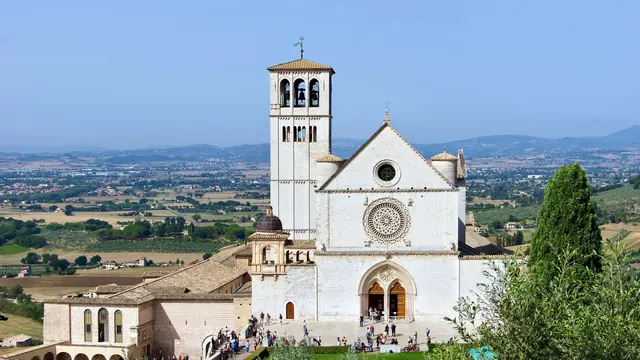
Umbria has art of the first rank in several towns. There is the Basilica of St Francis in Assisi with its frescoes by Giotto and Cimabue, Signorelli's Last Judgement in Orvieto, the Perugino and Piero della Francesca paintings in Perugia, and Gubbio, Spoleto, Spello and Montefalco after that. The region could fill a week of sightseeing several times over.
Nightlife
Neither is a place to go out, and in both an evening means a long dinner and a stroll. On Ischia, the late evenings are along the waterfront at Ischia Porto, with cocktail terraces and a couple of summer discos in July and August. In Umbria, Perugia's student population keeps the cathedral steps and a few wine bars busy, and this lasts beyond the summer. On Ischia the late nights are for resort guests in summer, while Perugia's are student nights through the academic year.
Nature & outdoors
Ischia's landscape is one volcano. You can walk through chestnut woods and vineyards up Monte Epomeo, see steam vents on the south coast and snorkel or dive in the marine reserve, but a week covers it.
Umbria has more variety and more space. It has the Monti Sibillini above 2,000m, the Castelluccio plain in flower, rafting and canyoning in the Valnerina, the Marmore Falls, hiking on Subasio and Cucco, and a cycle path on the old Spoleto to Norcia railway. Anyone coming for the outdoors on land will find more to do here, though Ischia has the sea.
Day trips
Ischia's outings all begin at the ferry quay, and what lies across the water is good: Procida's pastel harbour and Terra Murata, Naples with its archaeological museum, the Phlegraean Fields by way of Pozzuoli, and Capri or Sorrento in summer. Each one means a crossing there and back, though, and Pompeii by boat and local train takes up a long day.
Umbria offers more outings, and closer ones. From a base near Perugia or Spoleto, Gubbio, Todi, Spello, Bevagna, Norcia and the Montefalco wineries are short drives apart, so a new town fits easily into a morning. Cortona, Montepulciano and Siena lie over the Tuscan border, and Rome is a little over an hour by train from Orvieto.
Good for families
Neither has much built for children, and both suit a slow trip, but Ischia is the easier of the two. The calm water at San Montano and Maronti and the thermal parks with pools at different temperatures make beach and pool days, and boat trips help keep older children busy.
In Umbria, a family stays at a farmhouse with a pool and animals, swims at Lake Trasimeno and makes outings to the Marmore Falls or the amusement park near Perugia. Days spent on frescoes and steep cobbled lanes are hard work with a pushchair.
Getting around
The two islands of transport ask for opposite approaches. Ischia works best without a car of your own. You settle in one village, explore it on foot and use the island's bus loop, the little open microtaxis and the boats for everything else, and in Sant'Angelo there is no traffic at all. The drawback is summer, when buses on the coast road crawl and fill up, and every arrival and departure means a crossing from Naples or Pozzuoli.
Umbria works the other way round, and with a car it is the easier of the two. Drives between towns are short and the roads quiet, and the hill towns keep cars below their walls, with escalators and funiculars up into Perugia, Orvieto and Spoleto. Without a car, the railway through Perugia, Assisi and Spoleto helps, but buses to Gubbio or Todi are sparse and the farmhouse countryside is hard to reach at all.
Shopping & style
Neither is a shopping destination, but Umbria has more worth bringing home. Ischia has one evening strip between Ischia Porto and Ischia Ponte, selling linen, sandals and jewellery, along with ceramics, limoncello and cosmetics made with its thermal waters.
Umbria's shopping is craft and food. There is majolica from Deruta's workshops, hand-loomed linen in Montefalco and Bevagna, cashmere outlets near Perugia, Norcia's hams and truffles, and wine bought direct at the estates.
Affordability
Both are ordinary Italian destinations rather than luxury ones, and Umbria is a little cheaper. On Ischia, half-board spa hotels and fair ferry and bus fares keep costs moderate, but sunbeds, thermal park entry and boat trips add up in summer.
In Umbria, farmhouse stays cost less than across the border in Tuscany, village set lunches and local wine are cheap, and most churches are free. The extra cost is the hire car.
Live music & performing arts
Umbria has two festivals people travel for, and Ischia has none on that scale. Umbria Jazz fills Perugia in July, with free bands in the squares, and the Festival dei Due Mondi brings opera, dance and theatre to Spoleto's Roman theatre in early summer.
Ischia offers chamber music at the Mortella gardens, summer screenings and concerts at the Aragonese Castle, and band music on village saint's days. For opera, you cross to Naples.
Wellness & relaxation
Ischia is about thermal bathing in a way Umbria is not. Hotels pipe hot spring water into their pools, the terraced parks at Citara, Lacco Ameno and Casamicciola step down to the sea, and at Sorgeto you can sit in hot water in the rock pools by the shore. There are steam caves at Cavascura and mud treatments.
Umbria's restorative side is quiet rather than water. It means slow country days, yoga or massage at a farmhouse and silence in Assisi's hermitages, with only small historic spas at San Gemini and Nocera Umbra.
When should you go?
Pick your month. The climate figures are measured averages, not a forecast.
Ischia in July
Umbria in July
Daytime high, °C
Rainfall in the month, mm
Where the figures come from
Ischia's temperatures are measured 36 km from the centre, at Grazzanise.
Ischia has no rain gauge within 25 km of the centre, so its rainfall comes from a gridded climate dataset read at the destination rather than from a gauge further away.
Umbria's temperatures are measured 53 km from the centre, at Frontone.
Umbria has no rain gauge within 25 km of the centre, so its rainfall comes from a gridded climate dataset read at the destination rather than from a gauge further away.
Temperature and rainfall are climate normals, averaged over the years shown. Ischia: 1991-2020 normals, Grazzanise (36 km from centre). Umbria: 1991-2020 normals, Frontone (52.9 km from centre).
Around Ischia's main resort area, summer is long and dry. The sea is warm enough to swim from June to early October and reaches about 26°C in August, with long sunny days and almost no rain in July and August. The rain arrives in autumn and peaks in November, but the mild winters still allow a soak at Sorgeto on a cool evening. April to June and late September to October are best for combining walks with the thermal parks.
Umbria lies inland and has bigger swings. January highs are around 7°C, cold for long days of sightseeing in hill towns, and the valleys reach about 30°C in July, warm for steep lanes in the afternoon. Spring and early autumn are the best times for walking the towns and hills. June brings the Castelluccio flowers, and the wettest months are October and November. In midsummer Ischia is the easier place to be comfortable, while Umbria is at its best in spring and autumn.
Which traveller are you?
On a beach and sun trip, Ischia is the obvious choice. It has the long volcanic sand of Maronti, the sheltered bay of San Montano and a warm sea all summer, while Umbria's swimming is limited to a muddy-bottomed lake or a farmhouse pool.
For a culture and arts trip, choose Umbria. Giotto's frescoes in Assisi, Orvieto's cathedral, Perugia's gallery and a chain of medieval towns are first-rate, and Spoleto's festival and Umbria Jazz add music. Ischia has its castle and a museum, which take a couple of days.
On a relaxing and wellness trip, Ischia is better. Its hot springs fill hotel pools, terraced thermal parks and the sea pools at Sorgeto, with mud treatments as a local speciality. Umbria offers quiet countryside and retreats in Assisi, but has little thermal bathing.
Before you go
| Measure | Ischia | Umbria |
|---|---|---|
| Official language | Italian | Italian |
| Currency | Euro (EUR) | Euro (EUR) |
| Sockets | CFL230 V, 50 Hz | CFL230 V, 50 Hz |
| Driving side | Right | Right |
| Time zone | UTC+1, UTC+2 in summer | UTC+1, UTC+2 in summer |
| Emergency number | 112 | 112 |
| Main airport | Naples International Airport (NAP)131 non-stop destinations | Perugia San Francesco d'Assisi – Umbria International Airport (PEG)17 non-stop destinations |
| Public holidays this year | 13 days | 13 days |
By the numbers
| Measure | Ischia | Umbria |
|---|---|---|
| Population | 62,027 | 852,085 |
| People per km² | 1,340 | 101 |
| Swim season, months above 21 °C | 5 months | - |
Where else could you go?
Every comparison below shares a destination with this one, so you can follow Ischia or Umbria somewhere new.
- Caprivs Ischia
- Amalfi Coastvs Ischia
- Tuscanyvs Umbria
- Cinque Terrevs Umbria
- Pugliavs Ischia
- Sicilyvs Ischia