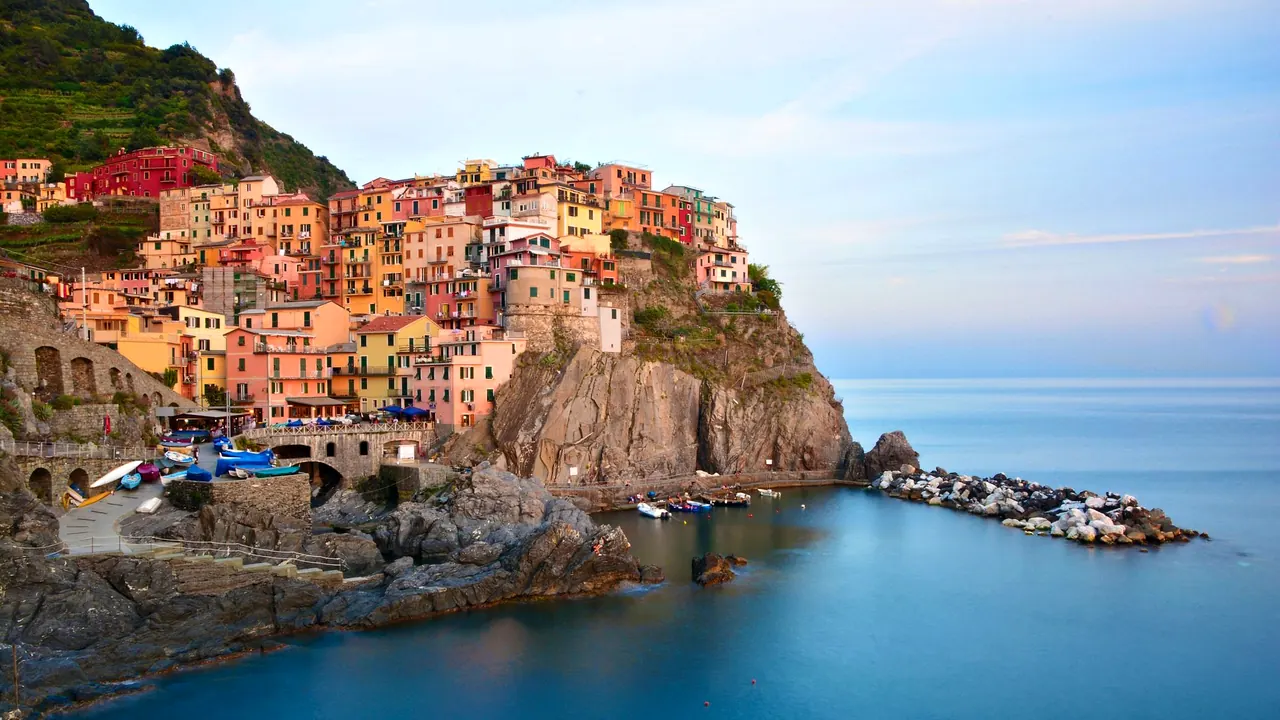
Photos: Cinque Terre by Narcisa Aciko, Pexels License.
Cinque Terre or Umbria?
Our verdict in twelve categories, each scored against the same fixed benchmark cities, and the climate month by month, so you can choose for your trip.
Choose Cinque Terre for
- beaches
- getting around
- nature and the outdoors
Cinque Terre suits walkers and swimmers on a shorter stay. The pleasure is hiking the cliff paths between the five villages, swimming off the rocks or from Monterosso's beach, and taking the train back, all without a car. In return it asks for sure feet, patience with summer crowds and a bigger budget for rooms, and it has little to offer after dark or on a wet day.
Choose Umbria for
- culture and sights
- live music and the arts
- wellness
For a longer, slower trip with a car, Umbria is the better choice. Its hill towns hold some of Italy's finest frescoes, its truffles, pork and Sagrantino make lunch the centre of the day, and from a farmhouse base Gubbio, Orvieto or Cortona are easy outings. It is cheaper and easier with children, but it has no sea.
Scoreboard
Twelve categories on one fixed scale from 0 to 100. The shaded stretch is the gap between the two.
Your match
Pick a travel style or drag the sliders, and both match scores follow your weighting.
Wins on beaches and getting around with your weighting.
Wins on culture and sights and live music and the arts with your weighting.
What matters to you?
Category by category
What the scores mean for a trip.
Beaches & swimming
Cinque Terre has the sea, and that decides it. Monterosso's long stretch of sand and fine pebble at Fegina is the one proper beach. In the other villages you swim off rocks and slipways in clear water, which is ideal for a dip between walks, and Levanto just north has a broader beach.
Umbria has no coast at all. The lidos at Castiglione del Lago and Passignano on Lake Trasimeno are warm and shallow, which suits paddling, but the water is often cloudy and the bottom soft in places. Most visitors end up swimming in a farmhouse pool instead.
Food & drink
Both kitchens rest on a few strong local products, but Umbria's goes deeper. Black truffle shaved over strangozzi, Norcia's pork, Castelluccio lentils and Sagrantino tasted at the Montefalco estates make eating a reason for the trip, and Perugia has the widest choice of restaurants.
Cinque Terre cooks from the sea and the terraces: trofie with pesto, Monterosso's anchovies, fried fish in a paper cone and a glass of sweet Sciacchetrà, which inland Umbria cannot match for seafood. The range is narrow, though, and in the busiest villages many menus are written for day-trippers, so the better meals take some finding.
Culture & sights
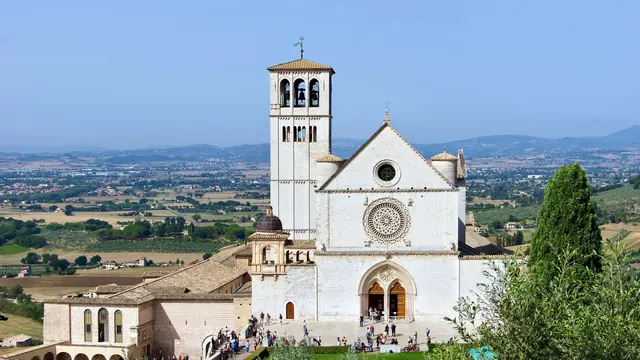
The gap here is wide. Umbria holds art of the first rank: Giotto's frescoes in the Basilica of St Francis at Assisi, Signorelli's Last Judgement in Orvieto's cathedral and Perugino in Perugia's Galleria Nazionale. Gubbio, Spoleto, Todi and Spello each deserve an unhurried day of their own.
In Cinque Terre the landscape is the heritage. The terraced coast and its five villages are UNESCO-listed, and the real sight is walking Vernazza's harbour or Corniglia's ridge-top lanes. The striped parish churches and the Doria tower are pleasant, but a day or two covers them.
Nightlife
Neither has clubs, but Umbria has the livelier evenings, almost entirely because of Perugia. With its students, the cathedral steps and the wine bars around the old centre fill on warm nights. In Cinque Terre the evening means a sunset glass on a harbour wall and one of the few bars in Monterosso or Riomaggiore, and most of the coast is asleep before midnight.
Nature & outdoors
Cinque Terre edges ahead for walkers because its paths are the whole point. The Sentiero Azzurro runs between the villages above the sea, the Sentiero Rosso follows the wooded ridge, and you can take the train back. Kayaks go out to the grottoes, and divers explore the marine reserve.
Umbria's outdoors are broader and gentler, spread across wooded hills and river valleys. Highlights include the flowering plain of Castelluccio below the Monti Sibillini, rafting in the Valnerina, the Marmore Falls and cycling the old Spoleto to Norcia railway path. It suits a road trip with boots and a bike better than a coast you walk from end to end.
Day trips
Umbria is made for day trips. From a base near Perugia or Spoleto, Gubbio, Todi, Bevagna and the Montefalco wine hills are each a short drive away. Cortona, Montepulciano and Siena lie over the Tuscan border, and Rome is a little over an hour by train from Orvieto.
Cinque Terre does well too, mostly by rail and boat: Portovenere by sea, Lerici and Sarzana close by, Pisa and Lucca along the main line, and Genoa and Portofino to the north. The difference is that in Umbria the outings are the trip, while here they fill a day or two between walks.
Good for families
Neither is easy with small children, but Umbria is the kinder choice. A countryside farmhouse with a pool, animals and space to run, the shallow water of Lake Trasimeno and an outing to the Marmore Falls make for a calm family week.
Cinque Terre's villages are built of stairs and steep alleys, Corniglia sits hundreds of steps above its station, and the trains are packed in summer. It works with older children who like walking and swimming off rocks. Families with toddlers usually stay in Monterosso, which is mostly flat and has a gently shelving beach.
Getting around
Cinque Terre is the easier place to manage without a car. The coastal train links all five villages a few minutes apart, ferries run between the harbours in season, and the trails connect them on foot. A car is only a burden here, though crowded summer platforms and the constant climbs take effort.
Umbria is the reverse. Driving is easy, and you park below each hill town and ride up by escalator or funicular, as in Perugia and Orvieto. Without a car, the railway covers Assisi, Spello and Spoleto, but buses to Gubbio or Todi are infrequent and the countryside is out of reach.
Shopping & style
Umbria gives you far more to buy, almost all of it craft and food: Deruta's painted majolica, hand-loomed linen from Montefalco and Bevagna, cashmere outlets near Perugia, and hams and truffles in Norcia. Cinque Terre's shops stop at pesto, anchovies, lemon liqueur and bottles of Sciacchetrà, which make good gifts but not a day's shopping. Neither offers fashion beyond Perugia's ordinary high street.
Affordability
Umbria is the cheaper vacation. Farmhouse stays and small town hotels cost noticeably less than in the Tuscan hills, village set lunches are good value and most churches cost little or nothing. The costs that add up are a hire car and summer rooms in Assisi and Orvieto.
In Cinque Terre the rooms are the problem. They are few, small and in heavy demand, so they cost far more than elsewhere on the coast, and you also pay for the park paths. Food and the train stay reasonable, and many travellers sleep in La Spezia or Levanto to save money.
Live music & performing arts
Umbria is far ahead, though mainly in early summer. Umbria Jazz fills Perugia in July, with free bands in the squares, and Spoleto's Festival dei Due Mondi brings opera, theatre and dance to its Roman theatre and opera house from late June. Orvieto holds a winter jazz edition around the New Year.
Cinque Terre has almost nothing beyond the odd summer concert in a church and the bands that follow the processions on the patron saints' feast days. For a play or an orchestra you go to La Spezia or Genoa.
Wellness & relaxation
In Cinque Terre, rest depends on when you go. The car-free villages and a terrace above the sea are soothing early in the morning, or in spring and autumn. On a summer afternoon, though, the lanes are too full to unwind, and apart from a massage at a few guesthouses there is no spa.
Umbria's quiet is steadier because it comes from the countryside. Days pass slowly between a long lunch and an evening walk, and many country houses have a pool, massage or yoga. The hermitages on Monte Subasio above Assisi draw people looking for silence. The small spas at San Gemini and Nocera Umbra, known for their mineral waters, are modest but a real option.
When should you go?
Pick your month. The climate figures are measured averages, not a forecast.
Cinque Terre in July
Umbria in July
Daytime high, °C
Rainfall in the month, mm
Where the figures come from
Cinque Terre's temperatures are measured 78 km from the centre, at Pisa / S. Giusto.
Cinque Terre has no rain gauge within 25 km of the centre, so its rainfall comes from a gridded climate dataset read at the destination rather than from a gauge further away.
Umbria's temperatures are measured 53 km from the centre, at Frontone.
Umbria has no rain gauge within 25 km of the centre, so its rainfall comes from a gridded climate dataset read at the destination rather than from a gauge further away.
Temperature and rainfall are climate normals, averaged over the years shown. Cinque Terre: 1991-2020 normals, Pisa / S. Giusto (77.8 km from centre). Umbria: 1991-2020 normals, Frontone (52.9 km from centre).
Cinque Terre's beach season runs from June to September, when the sea is warm enough for long swims and reaches 25°C in August. July is the sunniest and driest month. Spring and early autumn are the walking seasons, before the cliff paths get hot at midday or after the summer heat has passed. From October the rain sets in hard, with around 170mm a month through October and November, the wettest time on the coast, though winters stay mild by the sea.
Umbria lies inland and has sharper seasons. Winter highs of about 7°C make January in the hill towns cold and grey. In July and August both places reach 30°C, and in Umbria the valleys become hot work for sightseeing on foot. Rain is lighter and more evenly spread than on the coast, so late May, at around 21°C, and September are the best months for touring the towns, and June brings the flowers on the Castelluccio plain.
Which traveller are you?
On a beach and sun trip, choose Cinque Terre, though it suits swimmers more than sunbathers: the best days pair a morning on the cliff path with a plunge off the rocks. Umbria is two hours or more from the sea, so a farmhouse pool has to stand in.
For a culture and arts trip, Cinque Terre's five villages are themselves the sight, and a day or two covers them. Umbria fills a week, with slow mornings in frescoed churches, afternoons driving on to the next hill town and, if you time it right, the early-summer festivals.
On a tight budget, the expense in Cinque Terre is a bed, so saving money means sleeping outside the villages and taking the train in each day. Umbria goes further: the hire car is the main cost, and only a truffle dish makes a meal bill climb.
Before you go
| Measure | Cinque Terre | Umbria |
|---|---|---|
| Official language | Italian | Italian |
| Currency | Euro (EUR) | Euro (EUR) |
| Sockets | CFL230 V, 50 Hz | CFL230 V, 50 Hz |
| Driving side | Right | Right |
| Time zone | UTC+1, UTC+2 in summer | UTC+1, UTC+2 in summer |
| Emergency number | 112 | 112 |
| Main airport | Pisa International Airport (PSA)82 non-stop destinations | Perugia San Francesco d'Assisi – Umbria International Airport (PEG)17 non-stop destinations |
| Public holidays this year | 13 days | 13 days |
By the numbers
| Measure | Cinque Terre | Umbria |
|---|---|---|
| Population | - | 852,085 |
| People per km² | - | 101 |
| Swim season, months above 21 °C | 4 months | - |
Where else could you go?
Every comparison below shares a destination with this one, so you can follow Cinque Terre or Umbria somewhere new.
- Portofinovs Cinque Terre
- Tuscanyvs Umbria
- Tuscanyvs Cinque Terre
- Lake Gardavs Cinque Terre
- Lake Comovs Cinque Terre
- French Rivieravs Cinque Terre