Italy
Cinque Terre
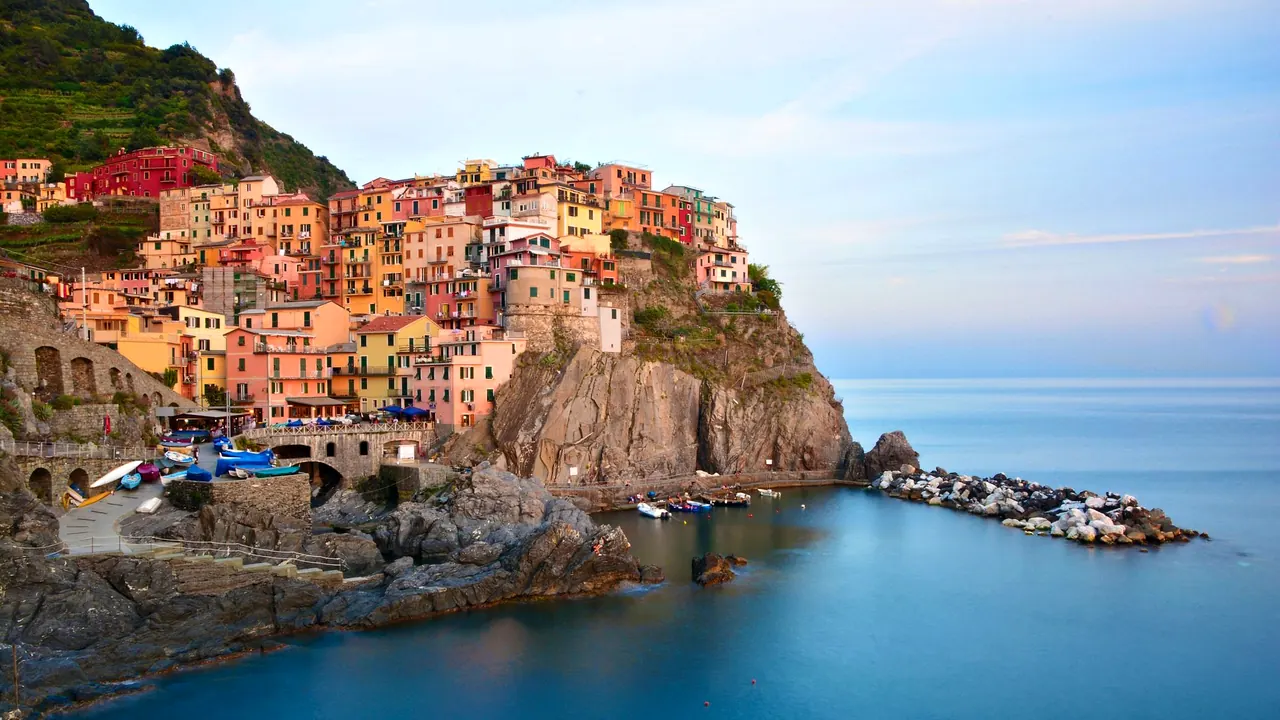
Manarola in the evening light
- Nature & outdoors78
- Day trips72
- Getting around66
Photo: Narcisa Aciko, Pexels License
Match
41
Every category weighted equally
- Beach & sun44
- Culture & arts40
- Food & nightlife37
- Family trip47
- Outdoors52
- Relax & unwind45
- Shopping & style37
- On a budget40
Cinque Terre in twelve categories
Our verdict on each, scored 0 to 100 against the same fixed benchmark cities, so a score means the same thing on every page.
Beaches & swimming. Scores 62 out of 100.
Food & drink. Scores 52 out of 100.
Culture & sights. Scores 40 out of 100.
Nightlife. Scores 12 out of 100.
Nature & outdoors. Scores 78 out of 100.
Day trips. Scores 72 out of 100.
Good for families. Scores 28 out of 100.
Getting around. Scores 66 out of 100.
Shopping & style. Scores 14 out of 100.
Affordability. Scores 30 out of 100.
Live music & performing arts. Scores 7 out of 100.
Wellness & relaxation. Scores 28 out of 100.
Cinque Terre category by category
Beaches & swimming
62The sea here is clear and warm enough to swim from June to September, reaching about 24°C in August. The shore, though, is mostly cliff. Monterosso is the one village with real beaches, a long stretch of sand and fine pebble at Fegina and a smaller cove by the old town. That makes it the base for anyone who wants beach days, though in summer the umbrellas stand in close rows.
In the other villages people swim off rocks and concrete slipways: from the harbour at Vernazza, the rock shelves below Manarola, the boulder cove at Riomaggiore. These are wonderful for a quick dip between walks but no good for a lazy day on the sand. Levanto, just north, has a broader beach. The coves around Portovenere and Lerici to the south are about an hour away.
Food & drink
52Ligurian cooking is the reason to eat well here. Trofie with basil pesto, focaccia and farinata from bakery counters, and the salted and marinated anchovies of Monterosso, the local speciality. Fried seafood comes in paper cones to eat on the harbour wall. The steep terraces produce a crisp white wine and Sciacchetrà, a rare sweet wine made from dried grapes, worth trying in the village where it was grown.
The range is narrow, and in the busiest villages many menus are written for day-trippers. The better meals tend to be in Monterosso and in the quieter hilltop settlements above the coast. Anyone after variety or serious fine dining goes to La Spezia or further along the Riviera.
Culture & sights
40The heritage here is the landscape itself. Five medieval fishing and wine villages are stacked on rock above the sea, ringed by centuries of dry-stone terraces, and the whole coast is UNESCO-listed for the way people shaped it. Walking through Vernazza's harbour square, Manarola's colour-washed houses or Corniglia's ridge-top lanes is the main thing to see.
The individual sights are modest. There are Ligurian Gothic parish churches with striped facades and rose windows in Monterosso, Vernazza and Riomaggiore, the Doria watchtower above Vernazza, and the small castle at Riomaggiore. Pilgrimage sanctuaries sit in the hills above each village. There are no museums of any size, and most visitors see the villages in a day or two.
Nightlife
12Evenings are about watching the sunset with a glass of local white on a harbour wall or a cliffside terrace. Once the day-trippers leave, the villages become calm and pleasant. Monterosso and Riomaggiore have a few wine and cocktail bars that stay open a little later in summer, but there are no clubs, and most of the coast is asleep well before midnight. Anyone who wants a night out travels to La Spezia.
Nature & outdoors
78Walking is the reason most people come. The Sentiero Azzurro links the five villages along the cliffs, through olive groves and vineyards with the sea below. It is short, but steep and stony in places. Higher up, the Sentiero Rosso follows the ridge through pine and chestnut woods, and dozens of old mule tracks drop down to the coast. You can walk village to village and ride the train back.
The coast is a national park and a marine reserve. Kayaks and boats go out to the cliffs and grottoes, and divers explore the rocky seabed. Spring and autumn are the best seasons for hiking. Summer heat and crowds make the main coastal path hard going at midday, and heavy rain sometimes closes sections of it.
Day trips
72The southern end of the coast leads quickly to the Gulf of La Spezia. Boats run in season to Portovenere, with its fortified church on a headland, and the castle town of Lerici is close by. La Spezia and medieval Sarzana are a short train ride away, and so are the marble quarries above Carrara.
On the main coastal railway, Pisa takes about an hour and a quarter, and Lucca a little longer. Heading north, Sestri Levante's two bays come first. Further on are Santa Margherita and Portofino on the Riviera, and Genoa, with its painted palaces and huge medieval centre, is about an hour and a half away. That is a broad mix of Ligurian ports, Tuscan cities and Riviera resorts for a short stay.
Good for families
28This is hard work with small children. The villages are vertical, built of steps and steep alleys, and a pushchair is useless almost everywhere. Corniglia sits hundreds of steps above its station. Summer brings packed trains and narrow paths, and nothing on the coast is made for children.
It works better with older children who like walking. Short stretches of trail, boat trips and swimming off the rocks can make for a good few days. Families with younger children usually stay in Monterosso, where there is a beach with gently shelving water and the town is mostly flat.
Getting around
66A local train runs along the coast through tunnels, linking all five villages, La Spezia and Levanto, with only a few minutes between stops. In season, ferries sail between the harbours except Corniglia's, and the trails let you walk from one village to the next. The villages are car-free at their centres. Driving down the narrow hill roads only leads to scarce, distant parking, so a car is a burden here.
The effort comes from the crowds and the climbs. In summer the platforms and carriages are crammed, and the paths and stairways need sure feet. Rough seas sometimes stop the boats.
Shopping & style
14Shopping is limited to small shops selling local produce and souvenirs. The things worth taking home are the edible ones: pesto, jarred anchovies, lemon liqueur and bottles of the terraced white wine and sweet Sciacchetrà. Beyond that there are ceramics, linen and postcards, with no fashion or design shopping of any kind.
Affordability
30Accommodation drives the cost. Rooms in the villages are few and small and much in demand, so in the visiting season they cost far more than similar rooms elsewhere on the Italian coast. Path access in the national park is paid. Eating is less of a problem: focaccia, takeaway fried fish and simple trattoria meals keep daily costs reasonable, and the train is cheap. Many travellers on a budget stay in La Spezia or Levanto and take the train in.
Live music & performing arts
7There is almost no live music or theatre here. Summer brings the odd concert in a church or on a village square, and the patron saints' feast days have processions and bands. For a play or an orchestra you have to go to La Spezia or Genoa.
Wellness & relaxation
28There is no spa or bathing culture to speak of. A few guesthouses offer massages, and that is all. What relaxation there is comes from the pace: no cars, a terrace above the sea, and quiet villages once the day visitors leave. In spring and autumn, or early in the morning, the coast can feel restful. On a summer afternoon, with the lanes full, it does not.
Where to stay in Cinque Terre
Monterosso is the easiest base, and the usual choice for a first visit. It has the coast's only real beaches, mostly level streets and the widest choice of places to eat, plus a few bars that stay open later in summer. Families with younger children and anyone who wants beach days between walks will find it the most comfortable.
Vernazza, Manarola and Riomaggiore suit walkers who want to wake up in one of the classic harbour villages. Rooms are few and small, and steep stairs are part of every stay, but once the day visitors leave the lanes go quiet and evenings are spent with a glass of white above the water. Riomaggiore, at the southern end, is handy for boats to Portovenere and trains to La Spezia. Corniglia, on its ridge hundreds of steps above the station, is the quietest base of all and best for light packers.
Travellers on a budget stay just outside the park. Levanto, to the north, has more rooms and a broader beach. La Spezia, to the south, has more restaurants, the only real night out and quick trains to Pisa. The coastal train links all of these in a short ride, so one base covers the whole coast and there is no need to move. Leave the car at home.
When should you go?
Pick a month to see what it is like. The climate figures are measured averages, not a forecast.
Cinque Terre in July
Daytime high, °C
Rainfall in the month, mm
The whole year
Shaded against this city’s own year: the deepest cell is its best month for that figure and the palest its weakest.
Where the figures come from
Cinque Terre's temperatures are measured 78 km from the centre, at Pisa / S. Giusto.
Cinque Terre has no rain gauge within 25 km of the centre, so its rainfall comes from a gridded climate dataset read at the destination rather than from a gauge further away.
Temperature and rainfall are climate normals, averaged over the years shown. Cinque Terre: 1991-2020 normals, Pisa / S. Giusto (77.8 km from centre).
Before you go
| Measure | Cinque Terre |
|---|---|
| Official language | Italian |
| Currency | Euro (EUR) |
| Sockets | CFL230 V, 50 Hz |
| Driving side | Right |
| Time zone | UTC+1, UTC+2 in summer |
| Emergency number | 112 |
| Main airport | Pisa International Airport (PSA)82 non-stop destinations |
| Public holidays this year | 13 days |
By the numbers
| Measure | Cinque Terre |
|---|---|
| Swim season, months above 21 °C | 4 months |
Compare Cinque Terre with
Every comparison with a written verdict behind it.