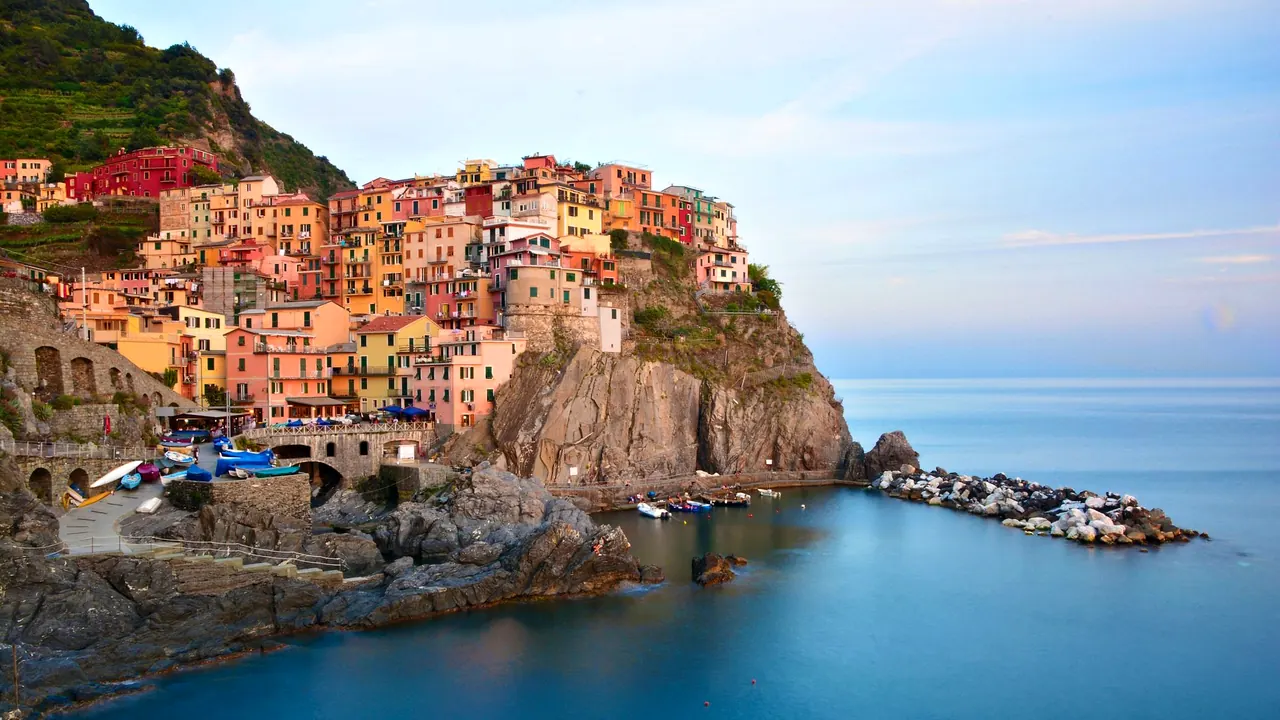
Photos: Cinque Terre by Narcisa Aciko, Pexels License.
Cinque Terre or Dolomites?
Our verdict in twelve categories, each scored against the same fixed benchmark cities, and the climate month by month, so you can choose for your trip.
Choose Cinque Terre for
- beaches
- getting around
Cinque Terre suits a compact trip that mixes sea and walking: a few days on the cliff paths between five car-free villages, a swim off the rocks or on Monterosso's sand, and a glass of the terraced white on a harbour wall at sunset. The local train makes it easy to manage without a car. It works best for adults and older children who don't mind steep steps, and for travellers who want to be by the water.
Choose Dolomites for
- families
- wellness
- shopping
For a longer stay built around the mountains themselves, the Dolomites are the stronger choice. The lifts carry you straight onto the high meadows and limestone towers for hiking in summer and skiing in winter, there are lunches at mountain huts, and many hotels have serious spas. It is also much easier with young children. What you give up is the sea and the simplicity of one railway line, since moving between valleys means slow pass roads.
Scoreboard
Twelve categories on one fixed scale from 0 to 100. The shaded stretch is the gap between the two.
Your match
Pick a travel style or drag the sliders, and both match scores follow your weighting.
Wins on beaches and getting around with your weighting.
Wins on families and wellness with your weighting.
What matters to you?
Category by category
What the scores mean for a trip.
Beaches & swimming
Cinque Terre has the real sea. It is clear and warm from June, with sand and fine pebble at Monterosso's Fegina and swimming off rock shelves and harbour slipways in Vernazza, Manarola and Riomaggiore. Only Monterosso is good for a lazy beach day, but every village is good for a quick dip.
The Dolomites offer lakes instead, and the famous high ones such as Braies and Carezza are too cold to swim in. For a proper swim you go down to the lidos and lawns of Lake Caldaro or drive to Riva on Lake Garda. That is pleasant for an afternoon but no substitute for the coast.
Food & drink
Cinque Terre eats well within a narrow Ligurian range: trofie with pesto, focaccia and farinata, Monterosso's anchovies, fried seafood in paper cones and a sip of sweet Sciacchetrà. In the busiest villages many menus are written for day-trippers, so the better meals are in Monterosso and the hill villages.
The Dolomites have more to offer at the table. Speck, canederli and strudel from South Tyrol meet Ladin dishes in Gardena and Badia and Trentino's polenta and trout. Lunch on a hut terrace is part of every walking day, and Alta Badia has a surprising number of high-end kitchens. The wines, Lagrein and Gewürztraminer among them, are worth a trip of their own, especially at autumn Törggelen evenings.
Culture & sights
In Cinque Terre the landscape is the monument. The terraced villages are UNESCO-listed as a whole, and Vernazza's harbour, Corniglia's ridge-top lanes and the striped Gothic churches are seen in a day or two, with no museums of any size.
The Dolomites have more to visit, mostly down in the valleys. You can see Ötzi the Iceman in Bolzano's archaeology museum, the frescoed rooms of Trento's Castello del Buonconsiglio, Bressanone's cathedral and Novacella Abbey, and Runkelstein's medieval secular frescoes. The First World War tunnels on the high passes add a history you won't find on the Ligurian coast.
Nightlife
Neither is a place for a night out, and Cinque Terre is the quieter of the two. A sunset drink on a cliff terrace and a handful of later bars in Monterosso and Riomaggiore are about all there is, and anyone who wants more takes the train to La Spezia.
The Dolomites have a little more life, mainly in winter. There is après-ski at the foot of the slopes in Selva, Ortisei, Canazei and Cortina, Cortina has a dressier wine-bar crowd, and Bolzano and Trento have student bars all year. Even so, the evenings end early.
Nature & outdoors
Cinque Terre is excellent for walking on a small scale. The Sentiero Azzurro runs along the cliffs between the villages and the Sentiero Rosso follows the ridge above, and the marine reserve adds kayaking to sea grottoes and diving, which the mountains cannot match.
The Dolomites are on another scale. Lifts from almost every village reach the Tre Cime, Sella and Seceda, the Alta Via 1 crosses the range hut to hut over a week or more, and the via ferrata cables put non-climbers on high rock. In winter the Dolomiti Superski area and the Sella Ronda make it one of the great ski regions as well.
Day trips
Both are fine bases for outings, but they work differently. From Cinque Terre everything runs along one coastal railway or by boat. Portovenere and Lerici lie to the south, Pisa and Lucca are about an hour or so away, and Genoa and Portofino lie to the north, all without a car.
From the Dolomites the best trips start in the Adige valley: Merano, Bressanone, the wine route, Verona, the north end of Lake Garda and even Innsbruck over the Brenner. From a high village each of these starts with a winding pass road, so many visitors split their stay between the mountains and a valley town.
Good for families
Cinque Terre is hard work with small children. The villages are made of steps, Corniglia sits high above its station, and summer trains and paths are packed. Only Monterosso, which is flat and has gently shelving water, really suits younger children, though older children who like walking and boat trips can have a good few days.
The Dolomites are far easier. Wide, nearly level paths on the Alpe di Siusi and the Armentara meadows, playgrounds and farm animals at the huts, adventure parks and summer toboggans, and hotels with children's clubs make summer simple, and the ski schools take over in winter. The weak spot is rainy days, with no zoos or theme parks to fall back on.
Getting around
Cinque Terre is the easier of the two to get around. A local train links all five villages within minutes of each other, ferries cover most harbours in season, and you can walk from one village to the next, so a car is only a burden. The catch is crammed summer carriages and stairways that need sure feet.
In the Dolomites trains and buses work well along the Adige and Puster valleys, with one regional pass, and lifts do the climbing once you are in a village. Crossing from one valley to another means slow hairpin passes busy with cars and motorbikes in high summer, and Cortina has no station. Most visitors who want to see several areas hire a car.
Shopping & style
Shopping in Cinque Terre comes down to food and wine to take home: pesto, jarred anchovies, lemon liqueur and Sciacchetrà, plus ceramics and linen. There are no clothes or design shops.
The Dolomites offer more. You can buy carved figures and nativity scenes from Val Gardena's woodcarvers in Ortisei, old-established loden and food shops under Bolzano's arcades, and outdoor gear and luxury boutiques on Cortina's main street. In December the Advent markets in Bolzano, Merano, Bressanone and Brunico draw visitors in their own right.
Affordability
Both are expensive in season, for different reasons. In Cinque Terre it is the scarcity of rooms in the villages, though focaccia, takeaway fish and the cheap train keep daily costs down, and staying in La Spezia or Levanto saves a good deal.
In the Dolomites the costs are lift passes, guided climbs and the prices of Cortina and Alta Badia. Val di Fassa, Val di Fiemme and the valley towns cost less, and June or September give the same mountains for less.
Live music & performing arts
Cinque Terre has almost nothing to attend beyond the odd church concert and the processions and bands of patron saints' days. For a play or an orchestra you have to go to La Spezia or Genoa.
The Dolomites offer more, though it is seasonal. Bolzano and Trento have orchestras and municipal theatres, and Bolzano hosts a long-established piano competition. In summer musicians play on alpine meadows and hut terraces for Trentino's mountain festival, and jazz moves through castles and wineries. Merano adds an autumn festival in its old spa halls.
Wellness & relaxation
Cinque Terre has no spa culture beyond a few guesthouse massages. What rest it offers comes from the car-free villages and quiet terraces early in the morning or outside summer.
The Dolomites are built for this. South Tyrol's mountain hotels have saunas facing rock walls and heated outdoor pools in the snow, and you can try the old hay bath around Völs am Schlern. Merano's thermal baths sit beside the river promenade, and Levico Terme is in the Valsugana. Choose the hotel with the spa in mind.
When should you go?
Pick your month. The climate figures are measured averages, not a forecast.
Cinque Terre in July
Dolomites in July
Daytime high, °C
Rainfall in the month, mm
Where the figures come from
Cinque Terre's temperatures are measured 78 km from the centre, at Pisa / S. Giusto.
Cinque Terre has no rain gauge within 25 km of the centre, so its rainfall comes from a gridded climate dataset read at the destination rather than from a gauge further away.
Temperature and rainfall are climate normals, averaged over the years shown. Cinque Terre: 1991-2020 normals, Pisa / S. Giusto (77.8 km from centre). Dolomites: 1991-2020 normals, Dobbiaco (22.3 km from centre).
Cinque Terre is a summer coast. From June to September the sea is warm enough to swim, reaching about 25°C in August, and July is the sunniest and driest month. Daytime highs of about 30°C in July and August make the exposed cliff paths hard going at midday, so walkers do better in April, May and late September. The rain sets in from September, October and November are the wettest months at about 170mm each, and winter is mild but short on sun.
The Dolomites figures describe the high resort villages where most visitors stay, and summer highs there reach only about 22°C, which is good for long hikes. The Adige valley towns such as Bolzano and Trento are a good deal hotter in July and August. Summer is also the wettest season up high, with about 130mm in July, often as afternoon storms. Spring and autumn are drier, and September is still mild enough for walking. From December to February highs in the resort villages hover around freezing, which is the ski season, while the Ligurian coast stays mild but too cool for the sea.
Which traveller are you?
On a beach and sun trip, Cinque Terre is the clear pick. It has a warm, clear sea all summer and Monterosso's sandy beach for long days. In the Dolomites, swimming means a cold mountain lake or a valley lido.
On a family trip with young children, the Dolomites are far easier. There are flat high-pasture paths on the Alpe di Siusi, playgrounds at the huts, toboggan runs and hotels built for families. Cinque Terre's stepped villages defeat pushchairs and toddlers alike.
For a relaxing and wellness trip, choose the Dolomites. South Tyrol's hotel spas, with saunas facing rock walls, the hay baths below the Schlern and Merano's thermal baths, have no counterpart on the Ligurian coast, where calm depends on avoiding the summer crowds.
Before you go
| Measure | Cinque Terre | Dolomites |
|---|---|---|
| Official language | Italian | Italian |
| Currency | Euro (EUR) | Euro (EUR) |
| Sockets | CFL230 V, 50 Hz | CFL230 V, 50 Hz |
| Driving side | Right | Right |
| Time zone | UTC+1, UTC+2 in summer | UTC+1, UTC+2 in summer |
| Emergency number | 112 | 112 |
| Main airport | Pisa International Airport (PSA)82 non-stop destinations | Venice Marco Polo Airport (VCE)103 non-stop destinations |
| Public holidays this year | 13 days | 13 days |
By the numbers
| Measure | Cinque Terre | Dolomites |
|---|---|---|
| Swim season, months above 21 °C | 4 months | - |
Where else could you go?
Every comparison below shares a destination with this one, so you can follow Cinque Terre or Dolomites somewhere new.
- Portofinovs Cinque Terre
- Austrian Alpsvs Dolomites
- Tuscanyvs Cinque Terre
- Lake Gardavs Cinque Terre
- Lake Gardavs Dolomites
- Bavariavs Dolomites