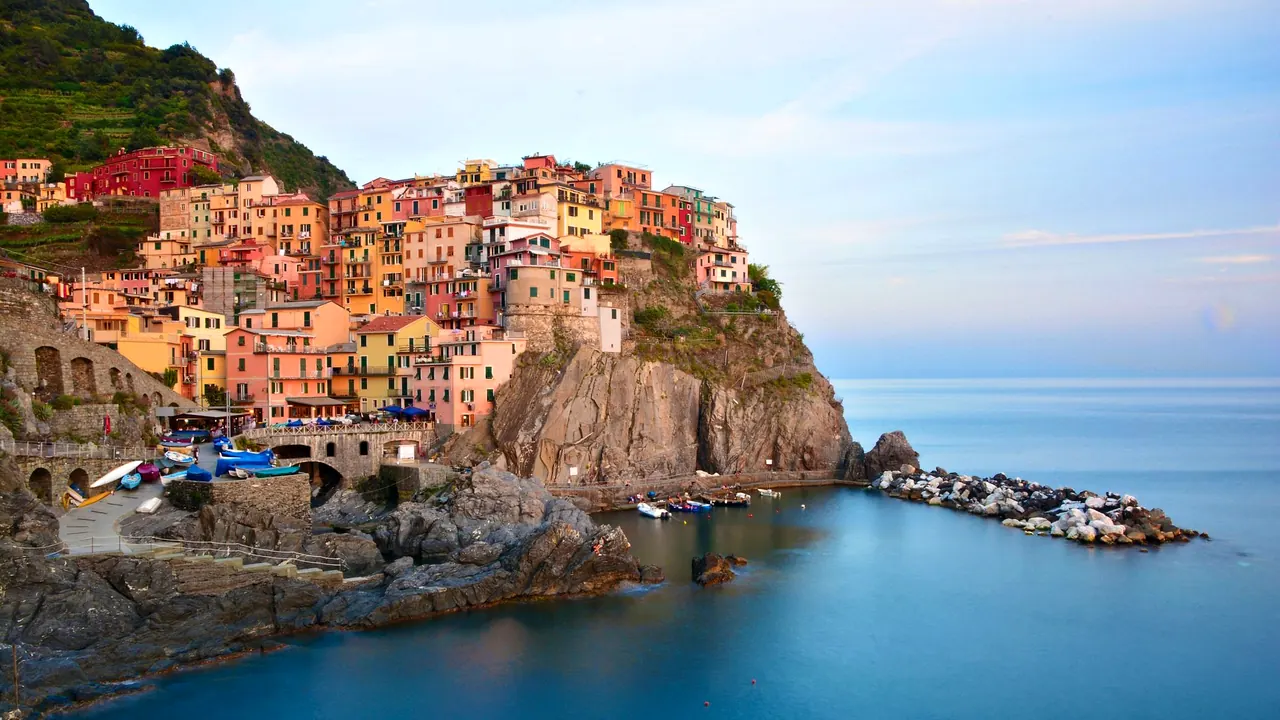
Photos: Cinque Terre by Narcisa Aciko, Pexels License.
Cinque Terre or Corsica?
Our verdict in twelve categories, each scored against the same fixed benchmark cities, and the climate month by month, so you can choose for your trip.
Choose Cinque Terre for
- getting around
- day trips
Cinque Terre suits a short, slow trip on foot, ideally for couples or adults who like walking and don't mind steps. You walk the cliff paths from one car-free village to the next, swim off the rocks and spend the evening over a glass of local white on a harbour wall. Its rail line also makes it easy to fit into a wider tour of Italy. The cost of that compactness is everything else: there is little real beach, almost no nightlife and not much to keep small children happy.
Choose Corsica for
- families
- beaches
- live music and the arts
Travellers with a week or more and a hire car will get more from Corsica. It combines two vacations in one, with Mediterranean bays of pale sand on the coast and real mountains inland for serious walking, canyoning and diving, plus Genoese citadels and hill villages along the way. Families, sun-seekers and anyone who wants space will find it more generous. The price is effort, because you plan around the car, and the island repays those who stay a while rather than skim it.
Scoreboard
Twelve categories on one fixed scale from 0 to 100. The shaded stretch is the gap between the two.
Your match
Pick a travel style or drag the sliders, and both match scores follow your weighting.
Wins on getting around and day trips with your weighting.
Wins on families and beaches with your weighting.
What matters to you?
Category by category
What the scores mean for a trip.
Beaches & swimming
Corsica is far ahead. The far south has some of the best pale-sand bays in the Mediterranean at Palombaggia, Santa Giulia and Rondinara. The Agriates and the long bay at Calvi add more in the north, and the sea stays warm enough to swim into October.
Cinque Terre is better for a swim than for a beach day. Fegina at Monterosso is the only proper stretch of sand, and in summer the umbrellas stand in close rows. Elsewhere you swim off the rocks below Manarola or the harbour at Vernazza, which makes a fine dip between walks but not a lazy day on the sand.
Food & drink
Both cuisines are regional and fairly narrow, but Corsica's has more to it. It is mountain cooking: cured pork such as lonzu and figatellu, brocciu cheese in everything from omelettes to fiadone, chestnut flour and wild boar. Serious wines from Patrimonio and Sartène go with it, and the best food is in inland inns and the markets of Ajaccio and Bastia.
Cinque Terre does a handful of things well: trofie with pesto, focaccia, Monterosso's anchovies and fried fish in a paper cone, with Sciacchetrà to finish. Many village menus are written for day-trippers, so the better meals are in Monterosso or the hilltop settlements.
Culture & sights
Cinque Terre's heritage is the terraced coast and its five villages, which take a day or two to see. Striped Gothic churches and the Doria watchtower are modest extras.
Corsica has more to see, but it is spread out. There is Bonifacio's old town on its white cliffs, the citadels of Calvi and Corte, Napoleon's birthplace and the paintings of the Palais Fesch in Ajaccio, and the carved standing stones of Filitosa. It suits a week of sightseeing by car rather than a stroll between neighbouring villages.
Nightlife
Neither place is for nightlife, but Corsica at least has a summer scene. There are open-air clubs in the hills behind Porto-Vecchio, beach bars in Calvi that stay busy late, and bars in Ajaccio and Bastia that stay open all year. In Cinque Terre the evening is a glass of wine at sunset on a harbour wall, with a few later bars in Monterosso and Riomaggiore. For anything more, you take the train to La Spezia.
Nature & outdoors
Both are superb for walking, but on very different scales. In Cinque Terre, the Sentiero Azzurro along the cliffs and the higher Sentiero Rosso on the ridge make a compact network through vineyards and woods. You can walk it in sections and ride the train back, and there is kayaking and diving in the marine reserve.
Corsica goes much further. It has peaks over 2,700m, the GR20 along its spine, the red granite of Piana, the sea cliffs of Scandola and the jagged needles of Bavella. On top of that come canyoning in the rivers and diving around the Lavezzi islands. It will fill a week or more outdoors, not just a few days on coastal paths.
Day trips
The coastal railway makes Cinque Terre the better base for outings. La Spezia, medieval Sarzana and the marble quarries above Carrara are a short ride away, Pisa and Lucca lie a little over an hour south, and to the north the line runs past Sestri Levante's two bays and Santa Margherita to Genoa. Portovenere's headland church is reached by boat in season, and the castle town of Lerici sits on the same gulf, a bus ride from La Spezia.
Corsica's day trips are mostly to other Corsican places: Sartène, the Balagne villages, Cap Corse and Corte by rail. The one outing off the island is the short ferry from Bonifacio to Sardinia. Slow mountain roads mean each base has only its own handful of trips.
Good for families
Corsica is much easier with children. One base near a calm southern bay, a campsite or resort with a pool, and short outings to river pools or sea caves make a relaxed vacation. The drawbacks are the long, winding drives and the lack of any zoo, aquarium or theme park.
Cinque Terre means steps, steep alleys, crowded summer trains and narrow paths, so it works best with older children who like walking. With small children, Monterosso is the only comfortable base, with a mostly flat town and a gently shelving beach.
Getting around
Getting around is far simpler in Cinque Terre. A local train links all five villages with Levanto and La Spezia, only minutes apart, and summer ferries sail between most of the harbours. The village centres are car-free, so a car is only a burden. The effort comes from crammed summer carriages and endless stairways.
Corsica almost requires a car. The roads are narrow and winding and take far longer than the map suggests. The scenic narrow-gauge railway between Ajaccio, Corte, Bastia and Calvi skips the south, and buses between towns are infrequent.
Shopping & style
Neither is a shopping destination, but Corsica has a little more choice. There are hand-forged knives, charcuterie and cheese from the Ajaccio and Bastia morning markets, pottery from the Balagne villages and a few summer boutiques in Porto-Vecchio and Calvi. Cinque Terre's best buys are things to eat and drink: pesto, jarred anchovies, lemon liqueur and a bottle of Sciacchetrà.
Affordability
Both are expensive in the main season, for different reasons. In Cinque Terre it is the scarce, small village rooms and the paid entry to the park paths. Food and the train stay cheap, and many travellers on a budget sleep in La Spezia or Levanto.
In Corsica the bill comes from resort rooms in Porto-Vecchio, Bonifacio and Calvi, plus car hire and the ferry crossing. Campsites, inland villages and a June or September trip bring it down.
Live music & performing arts
Corsica has a living musical tradition worth seeking out: polyphonic singing by unaccompanied male voices, heard in village and town churches. Summer adds jazz in Calvi and guitar evenings among the vineyards around Patrimonio. Cinque Terre has little beyond the odd church concert and the bands at saints' day processions, so a play or an orchestra means going to La Spezia or Genoa.
Wellness & relaxation
In Cinque Terre, calm depends on timing. A sea-view terrace in a car-free village is restful in spring or early in the morning, but much less so on a crowded summer afternoon, and beyond a few guesthouse massages there is nothing in the way of treatments.
Corsica is the easier place to slow down. Long lunches, siestas in the heat and mountain villages where little happens after dark set the pace. Hotel spas around Porto-Vecchio, Calvi and Ajaccio and simple thermal springs such as Pietrapola add a little more, though not enough to build a trip around.
When should you go?
Pick your month. The climate figures are measured averages, not a forecast.
Cinque Terre in July
Corsica in July
Daytime high, °C
Rainfall in the month, mm
Where the figures come from
Cinque Terre's temperatures are measured 78 km from the centre, at Pisa / S. Giusto.
Cinque Terre has no rain gauge within 25 km of the centre, so its rainfall comes from a gridded climate dataset read at the destination rather than from a gauge further away.
Temperature and rainfall are climate normals, averaged over the years shown. Cinque Terre: 1991-2020 normals, Pisa / S. Giusto (77.8 km from centre). Corsica: 1991-2020 normals, Ajaccio (5.1 km from centre).
Both coasts are summer places with much the same sea. It is warm enough to swim from June, reaches about 25°C in August and is still pleasant in September. Cinque Terre's high summer reaches around 30°C, which makes the cliff paths hard going at midday, so April, May and early autumn are the walking months. From late September the rain comes in hard, and October and November are the wettest months, at close to 178mm each.
Corsica's figures are measured on the coast where most visitors stay. There it is drier and sunnier all year: July has almost no rain at 9mm, the sea stays warm into October, and winter days are milder than in Liguria. Spring and early autumn are the best hiking seasons here too, because high summer is hot at low altitude.
Which traveller are you?
On a beach and sun trip, Corsica is the clear choice. Palombaggia, Santa Giulia and Rondinara have pale sand on turquoise water, and the summers are drier and sunnier. In Cinque Terre most swimming is off rocks and slipways, and Monterosso has the only real beach.
On a family trip with children, Corsica also works better. Shallow bays near Porto-Vecchio, campsites with pools and river pools inland all suit young children. Cinque Terre's stepped villages defeat a pushchair, and Corniglia sits hundreds of steps above its station.
For a short city break, or a few days without a car, Cinque Terre fits more neatly. Trains link the five villages only minutes apart, the villages take a day or two to see, and Pisa, Lucca and Genoa are easy day trips by rail.
Before you go
| Measure | Cinque Terre | Corsica |
|---|---|---|
| Official language | Italian | French |
| Currency | Euro (EUR) | Euro (EUR) |
| Sockets | CFL230 V, 50 Hz | CE230 V, 50 Hz |
| Driving side | Right | Right |
| Time zone | UTC+1, UTC+2 in summer | UTC+1, UTC+2 in summer |
| Emergency number | 112 | 112 |
| Main airport | Pisa International Airport (PSA)82 non-stop destinations | Ajaccio Napoléon Bonaparte airport (AJA)29 non-stop destinations |
| Public holidays this year | 13 days | 11 days |
By the numbers
| Measure | Cinque Terre | Corsica |
|---|---|---|
| Population | - | 355,486 |
| People per km² | - | 41 |
| Swim season, months above 21 °C | 4 months | 4 months |
Where else could you go?
Every comparison below shares a destination with this one, so you can follow Cinque Terre or Corsica somewhere new.
- Portofinovs Cinque Terre
- Sardiniavs Corsica
- Lake Gardavs Cinque Terre
- Lake Comovs Cinque Terre
- Venicevs Cinque Terre
- Sardiniavs Cinque Terre