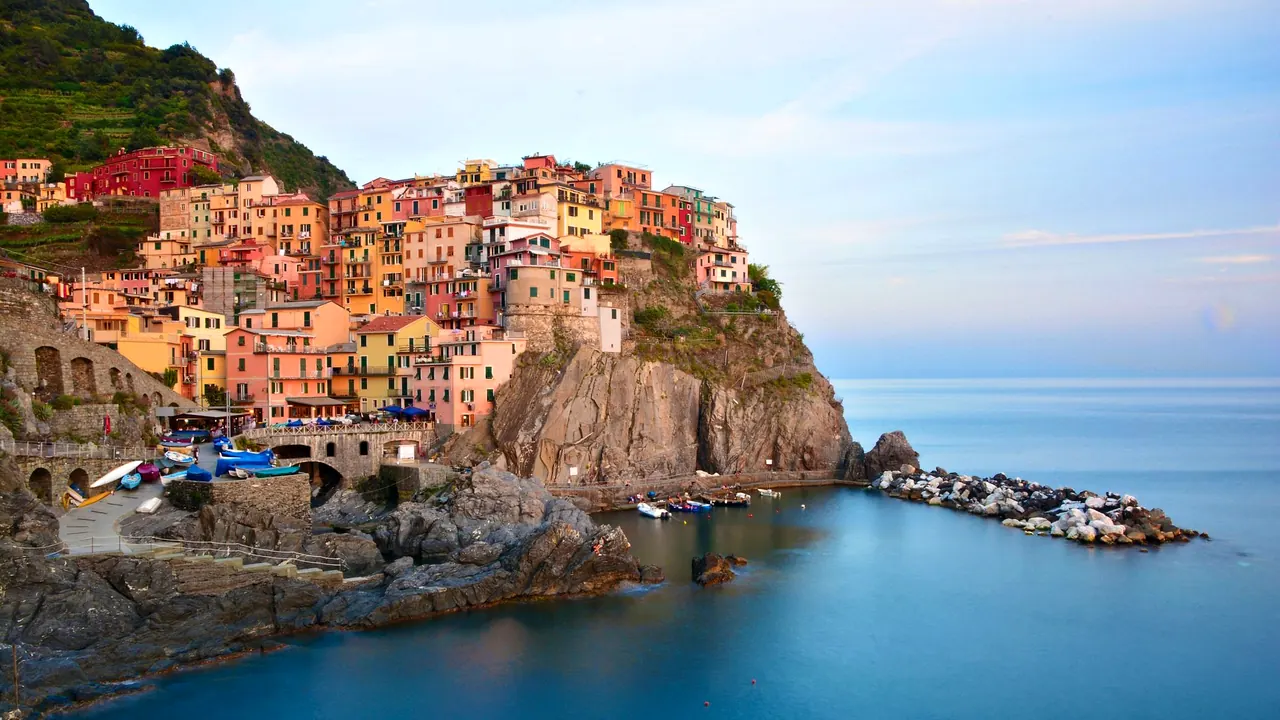
Photos: Cinque Terre by Narcisa Aciko, Pexels License.
Cinque Terre or French Alps?
Our verdict in twelve categories, each scored against the same fixed benchmark cities, and the climate month by month, so you can choose for your trip.
Choose Cinque Terre for
- getting around
- beaches
- prices
Cinque Terre suits a walker who wants the sea at the end of each day. Five cliff villages are joined by a coastal path and a local train, and the trip is simple: swimming off the rocks, pesto and anchovies, and quiet evenings on a harbour wall. A few car-free days here are best for couples and adults who don't mind steps, crowded summer trains and an early night.
Choose French Alps for
- wellness
- nightlife
- families
The French Alps are the choice for scale and range. Mont Blanc, the Vanoise and some of the largest linked ski areas in the world give far more to do outdoors. The region also does better for families, spas, food and evenings out, from après-ski in Val d'Isère to the terraces by Lake Annecy. What you give up is ease, because the valleys are far apart and travel between them takes time.
Scoreboard
Twelve categories on one fixed scale from 0 to 100. The shaded stretch is the gap between the two.
Your match
Pick a travel style or drag the sliders, and both match scores follow your weighting.
Wins on getting around and beaches with your weighting.
Wins on wellness and nightlife with your weighting.
What matters to you?
Category by category
What the scores mean for a trip.
Beaches & swimming
Cinque Terre has the sea, clear and warm through the summer, but full beach days only really work in Monterosso, at Fegina and the cove by the old town. Elsewhere you swim off rock shelves and slipways at Vernazza, Manarola and Riomaggiore.
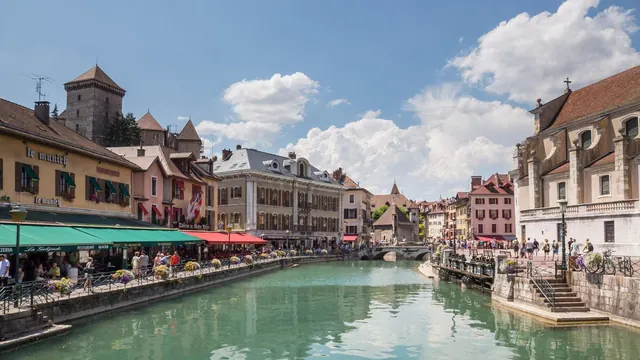
The French Alps have lake bathing instead. There are grassy public beaches and jetties around Lake Annecy, the quieter Lac du Bourget, and pebbly lidos on Lake Geneva. The water is pleasant from late June to early September, but the beaches are small and few people travel for them, so the Ligurian sea comes out ahead.
Food & drink
Cinque Terre's kitchen is Ligurian and coastal: trofie with pesto, focaccia, Monterosso's anchovies and the sweet Sciacchetrà. The range is narrow, and the better meals are in Monterosso or the hilltop villages rather than on the busy harbours.
The Alps eat richer and over a wider range. Savoyard cheese dishes and Reblochon or Beaufort bought at the farm sit alongside perch from the lakes and the markets of Annecy. The shores of Lake Annecy, Megève and Courchevel also have some of France's most decorated mountain kitchens, a top level the Ligurian villages cannot match, even if resort menus repeat the melted cheese.
Culture & sights
In Cinque Terre the sight is the coast itself: the UNESCO-listed terraces and the villages stacked above the sea, with striped Ligurian Gothic churches and the Doria tower but no museum of any size. A day or two covers it.
The Alps give you more to fill a rainy day. There is Annecy's old town with its canals and the Palais de l'Isle, the ducal château in Chambéry, Grenoble's fine-arts museum and the Vauban walls of Briançon. These are still half-day outings around the mountains rather than a reason to go.
Nightlife
Cinque Terre has almost no nightlife: a glass of white on the harbour wall at sunset, a handful of later bars in Monterosso and Riomaggiore, and the train to La Spezia for anything more.
In the French Alps, winter changes the picture. From December to April, Val Thorens, Val d'Isère and Méribel go from dancing on tables at slope-side restaurants to clubs open into the small hours. In summer it comes down to Annecy's terraces and Grenoble's student bars, which is still more than the Ligurian villages offer.
Nature & outdoors
Cinque Terre is a fine walking coast. The Sentiero Azzurro runs between the villages and the Sentiero Rosso follows the ridge above, and you can kayak or dive in the marine reserve. The walks are short and intimate: one village to the next, then the train back.
The Alps work on a different scale. There is Mont Blanc and the Aiguille du Midi, the Tour du Mont Blanc, ibex in the Vanoise and Écrins, and the huge linked ski areas of the Tarentaise. Add paragliding over Lake Annecy, cycling the Galibier and rafting on the Isère, and you have far more to do outdoors.
Day trips
Both make good bases for excursions, but of different kinds. From Cinque Terre the coastal railway puts Pisa, Lucca, Genoa and the Riviera towns of Portofino and Sestri Levante within reach, and boats cross to Portovenere and Lerici, all without a car.
The Alps rely on their borders. You can reach Geneva, take the Lake Geneva ferries to Lausanne and Lavaux, ride the train to Lyon, or go through the Mont Blanc tunnel to Courmayeur and Aosta. That works well from Annecy or Chamonix, and much less well from the deep Tarentaise valleys.
Good for families
Cinque Terre is hard going with small children. There are steps everywhere, a pushchair is useless and the summer trains are packed. Monterosso, flat and with a gently shelving beach, is the one easy base, and the coast suits older children who like to walk.
The Alps are set up for families. Ski schools have snow gardens for the youngest, and in car-free resorts such as Avoriaz and Flaine you can walk from the apartment to the slope. In summer there is the train to the Mer de Glace, marmot spotting and the shallow lake beaches at Annecy, though cold mornings, altitude and long transfer days take their toll.
Getting around
Cinque Terre is the simpler place to move around. One local train links the five villages with La Spezia and Levanto, only minutes apart, and ferries and trails do the rest. A car only gets in the way. The effort is the summer crowds and the climbing.
In the Alps, lifts make a single resort easy, but getting there means a transfer from Geneva, Lyon or Grenoble, with Saturday queues in the Tarentaise and snow chains in winter. In summer the lakes and passes lie in separate valleys, so a car pays off.
Shopping & style
Cinque Terre's shops sell pesto, jarred anchovies, lemon liqueur, Sciacchetrà and some ceramics, and little else. The Alps are no shopping destination either, but there is more to find. Chamonix has technical climbing and ski shops, Courchevel 1850 and Megève have luxury boutiques, and Annecy's markets sell Opinel knives and Beaufort, with Geneva just over the border.
Affordability
Neither is cheap, and the cost comes from different places. In Cinque Terre it is the rooms, which are scarce and in demand in season, plus the charge for using the park paths. Food and the train stay reasonable, and many people save by staying in La Spezia or Levanto.
In the Alps the cost is the winter ski trip, with lift pass, hire, ski school and chalet all adding up, and Courchevel or Megève are among Europe's costliest places to stay. Summer stays, low-season weeks and the ordinary French prices of Grenoble, Chambéry or the Bauges bring it down.
Live music & performing arts
Cinque Terre has next to nothing, beyond bands on feast days and the odd concert in a church. The Alps have more: Grenoble's arts centre and chamber orchestra, chamber music at Évian in summer and open-air festivals in Chamonix. For opera you still travel out from both, to Genoa from the coast and to Lyon or Geneva from the mountains.
Wellness & relaxation
In Cinque Terre the only way to relax is the pace: no cars, a terrace above the sea and quiet mornings out of season. There is no spa culture at all.
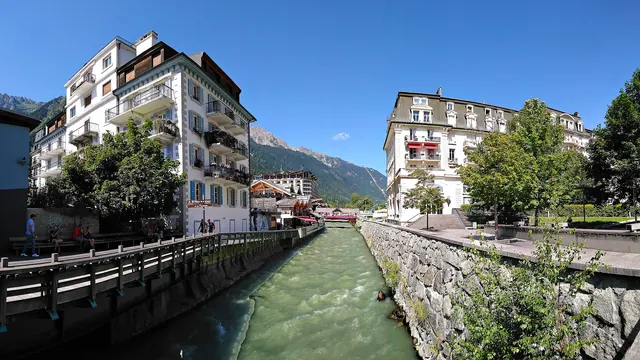
The Alps have taken the waters since Roman times. Aix-les-Bains and Évian are grand spa towns on the lakes, Saint-Gervais has thermal baths below Mont Blanc, and the upmarket resorts have hotel spas looking out over the snow. For a restful stay they are clearly the better choice, provided you avoid a resort in the busiest weeks of the ski season.
When should you go?
Pick your month. The climate figures are measured averages, not a forecast.
Cinque Terre in July
French Alps in July
Daytime high, °C
Rainfall in the month, mm
Where the figures come from
Cinque Terre's temperatures are measured 78 km from the centre, at Pisa / S. Giusto.
Cinque Terre has no rain gauge within 25 km of the centre, so its rainfall comes from a gridded climate dataset read at the destination rather than from a gauge further away.
French Alps's temperatures are measured 35 km from the centre, at Bourg-St-Maurice.
French Alps's station stands 179 m below the place it is measured for, so that place is likely a little cooler than the figures say.
French Alps has no rain gauge within 25 km of the centre, so its rainfall comes from a gridded climate dataset read at the destination rather than from a gauge further away.
Temperature and rainfall are climate normals, averaged over the years shown. Cinque Terre: 1991-2020 normals, Pisa / S. Giusto (77.8 km from centre). French Alps: 1999-2020 (rainfall 1991-2020) normals, Bourg-St-Maurice (35.1 km from centre).
Cinque Terre has a clear Mediterranean summer. The sea is warm enough to swim from June to September and reaches about 25°C in August. July and August are dry and very sunny, but at around 30°C the steep paths are hard going at midday. Spring and late September are the best months for walking. October and November are the wettest months on this coast, and winter is mild but grey.
The Alpine figures come from where most visitors stay, and the year there splits into two seasons. Summer highs of about 27°C suit lake swimming from late June to early September and walking in the high country. In January it drops to around 5°C, and the ski resorts run from December to April. The Alps get more rain than the Ligurian coast for most of the year, and much more in high summer, when the coast is at its driest. In October and November it turns the other way, and Cinque Terre is the wetter of the two. Spring and late autumn fall between the seasons and don't suit either kind of trip well.
Which traveller are you?
On a beach and sun trip, Cinque Terre is the clear pick. Its sea is clear and warm, Monterosso has a real beach of sand and pebble, and you can swim off the rocks at Vernazza and Manarola. The Alps offer only small lake beaches in a short summer.
On a family trip with children, the French Alps win easily. Ski schools with snow gardens, car-free resorts, marmot walks and Annecy's shallow lake beaches all suit young children. In Cinque Terre the endless steps and packed trains make every day hard work.
For a relaxing and wellness trip, choose the French Alps. Aix-les-Bains, Évian and Saint-Gervais are spa towns where people have taken the waters for centuries, and slow days by Lake Annecy help you unwind. Cinque Terre has no spas, and its lanes fill up on summer afternoons.
Before you go
| Measure | Cinque Terre | French Alps |
|---|---|---|
| Official language | Italian | French |
| Currency | Euro (EUR) | Euro (EUR) |
| Sockets | CFL230 V, 50 Hz | CE230 V, 50 Hz |
| Driving side | Right | Right |
| Time zone | UTC+1, UTC+2 in summer | UTC+1, UTC+2 in summer |
| Emergency number | 112 | 112 |
| Main airport | Pisa International Airport (PSA)82 non-stop destinations | Geneva International Airport (GVA)150 non-stop destinations |
| Public holidays this year | 13 days | 11 days |
By the numbers
| Measure | Cinque Terre | French Alps |
|---|---|---|
| Swim season, months above 21 °C | 4 months | - |
Where else could you go?
Every comparison below shares a destination with this one, so you can follow Cinque Terre or French Alps somewhere new.
- Portofinovs Cinque Terre
- Swiss Alpsvs French Alps
- Tuscanyvs Cinque Terre
- Lake Gardavs Cinque Terre
- Lake Comovs French Alps
- Lake Comovs Cinque Terre