French Alps or Swiss Alps?
Our verdict in twelve categories, each scored against the same fixed benchmark cities, and the climate month by month, so you can choose for your trip.
Choose French Alps for
- prices
- beaches
- nightlife
The French Alps suit a trip that mixes mountains with town life: Annecy's lakeside old town, Grenoble's museum and student bars, farm cheese from the Aravis valleys and loud winter après-ski in Val Thorens or Val d'Isère. It is the cheaper side of the range, and the better one for a warm lake swim in July. The cost is in the logistics. You face transfers up the Tarentaise in winter and need a car for the summer valleys.
Choose Swiss Alps for
- getting around
- wellness
- live music and the arts
If the point is the mountains with as little friction as possible, go Swiss. Trains, postbuses and cable cars take you from the station to the trailhead, car-free villages such as Wengen and Zermatt stay quiet at night, and the thermal baths at Leukerbad and Vals make it one of the most restful places in Europe. You pay far more for all of it, and the evenings are calmer, apart from the summer classical festivals at Verbier and Gstaad.
Scoreboard
Twelve categories on one fixed scale from 0 to 100. The shaded stretch is the gap between the two.
Your match
Pick a travel style or drag the sliders, and both match scores follow your weighting.
Too close to call, 2 points apart
Wins on prices and beaches with your weighting.
Wins on getting around and wellness with your weighting.
What matters to you?
Category by category
What the scores mean for a trip.
Beaches & swimming
Neither region has a sea, so this is lake swimming either way, and the French side does it better. Lake Annecy is clear and warms to about 23°C in high summer, with grassy public beaches at Sévrier, Talloires and Menthon-Saint-Bernard. Lac d'Aiguebelette and the Évian shore add more choice.
The lakes of the Bernese Oberland and central Switzerland are very clean but cooler, and their lidos with jetties and diving boards are better for a quick dip after a hike. For water as warm as Annecy's you have to go south to Lake Lugano or Lake Maggiore in Ticino.
Food & drink
Both kitchens rest on melted cheese, but there is more to eat around it on the French side. Savoie adds Reblochon and Beaufort bought at the farm, perch and féra from the lakes, Chartreuse and Génépi, the old-town markets of Annecy, and a top tier of celebrated cooking around Lake Annecy, Megève and Courchevel.
The Swiss Alps have real strengths of their own: raclette in Valais, air-dried beef from Graubünden and rare terraced Rhône wines such as Petite Arvine and Cornalin. Outside Zermatt, St Moritz and Gstaad, though, eating out mostly means hotel dining rooms and stuben, and there are no markets to browse.
Culture & sights
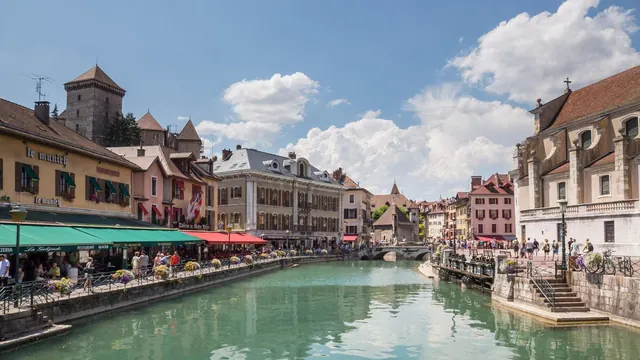
The French side has the better towns. Annecy's canal-lined old town with the Palais de l'Isle, the ducal château in Chambéry, Grenoble's fine-arts museum and Vauban's walls at Briançon give you real urban sightseeing between days in the mountains.
Swiss heritage lives in the villages and the landscape instead: the sgraffito houses of Guarda, the Albula and Bernina railways, the castles of Sion and Bellinzona and the Carolingian frescoes at Müstair. It is lovely to pass through, but nothing matches a museum like Grenoble's.
Nightlife
Both regions run on winter après-ski, and France simply has more of it. Val Thorens, Val d'Isère and Méribel each draw a big party crowd, and Chamonix adds climbers and young seasonal workers. In summer, Annecy's lakeside terraces and Grenoble's student bars keep some life going.
Switzerland's loud nights cluster in Verbier and Zermatt, while St Moritz and Gstaad offer polished hotel bars. Out of season the Swiss villages go to sleep early, and the Swiss side has no university city like Grenoble to fall back on.
Nature & outdoors
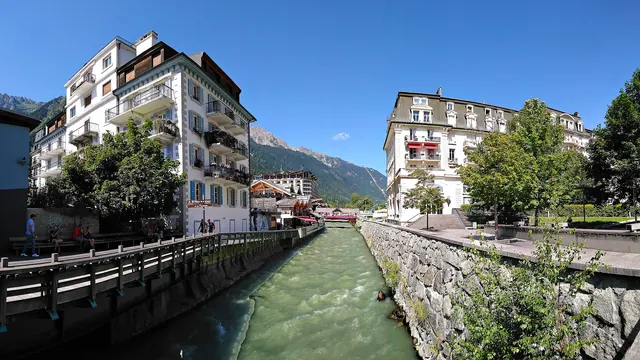
These are two of the finest mountain landscapes anywhere, and neither beats the other on scale. France has Mont Blanc and the Aiguille du Midi, the Tour du Mont Blanc, the huge linked ski domains of Les Trois Vallées and Paradiski, and wilder high country in the Vanoise and Écrins parks.
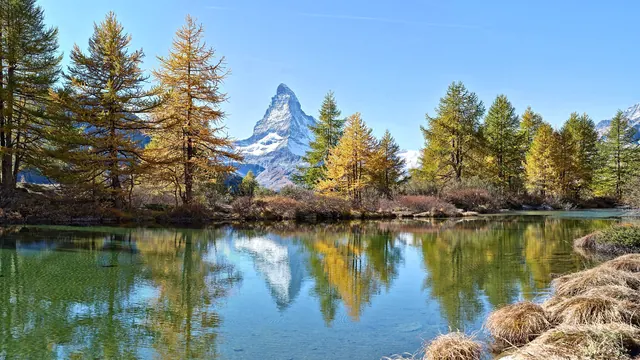
Switzerland has the Eiger, Mönch and Jungfrau above Lauterbrunnen, the Matterhorn and the Aletsch glacier. Its trail network is built around lifts and huts, so a hiker reaches high ground without a long climb first.
Day trips
Both regions make good bases for days out, but they lead in different directions. From Annecy or the Lake Geneva shore you can reach Geneva, walled Yvoire, Lausanne by ferry and Lyon by train, and from Chamonix you can cross into Italy for Aosta. The deep Tarentaise valleys are poor bases for outings.
From the Bernese Oberland, trains take you to Bern, Thun, Lucerne and Gruyères without any driving, though most of these are smaller names.
Good for families
Both regions are equally good with children, but they get there differently. France has car-free purpose-built resorts such as Avoriaz and Flaine, where families walk from the apartment to the slope, plus the rack railway to the Mer de Glace and shallow lake beaches at Annecy. The long transfer days can wear children out, though.
In Switzerland the getting about is part of the fun: cogwheel trains, cable cars and lake steamers entertain small children, and Ballenberg's farm animals and summer toboggan runs fill the gaps. Neither region has a big theme park.
Getting around
This is the widest gap between the two. On the Swiss side, trains, postbuses, cable cars and steamers run to timetables that connect with each other, so almost every village is reachable without a car, and Zermatt, Wengen and Mürren ban cars altogether.
In the French Alps, trains serve Annecy, Chambéry, Bourg-Saint-Maurice and the Chamonix valley, but the higher villages depend on patchy buses or transfers, and Saturday changeovers jam the Tarentaise road. In summer a car is close to essential. Switzerland's only drawback is the long, slow day it takes to move between regions.
Shopping & style
Neither region is a shopping destination, but the French side gives you more reason to browse. Chamonix's main streets are among Europe's best places for technical mountain gear, and Annecy's markets sell Beaufort, Génépi and Opinel knives. Grenoble and Geneva are close if you want anything wider.
The Swiss offer is thinner. There are luxury boutiques in St Moritz and Gstaad and watch and outdoor shops in Zermatt and Interlaken, and Brienz woodcarving or dairy cheese make good things to take home. Beyond cheese stalls and Christmas markets, there are no markets to wander.
Affordability
Both regions are expensive, but the French side gives you ways to spend less. Self-catering in purpose-built resorts, low-season ski weeks and stays in Grenoble, Chambéry or the Bauges bring prices down to ordinary French levels, even though Courchevel and Megève are as costly as anywhere.
In Switzerland the cost follows you everywhere: hotels, simple mountain meals and above all the cable cars and railways, where a few high excursions can cost more than the hotel. Travel passes, picnics and quieter valleys such as Goms help, but only so far.
Live music & performing arts
Neither region is the place for a season of opera, but Switzerland's summer festivals give it the edge. The Verbier Festival brings top soloists to the resort for several weeks in July, and the Menuhin Festival fills the Saanenland churches around Gstaad with chamber music and orchestras.
The French side has Grenoble's year-round arts centre and chamber orchestra and the chamber music gatherings at Évian. Away from Grenoble the stages are small, and in winter live music mostly means bands in après-ski bars.
Wellness & relaxation
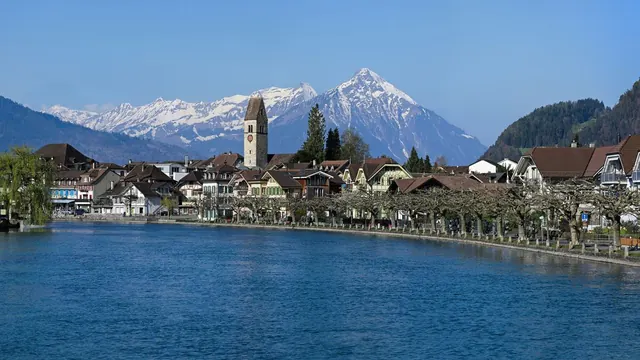
Both regions have old spa traditions, and the Swiss side makes them easier to enjoy. Leukerbad's open-air hot pools under the cliffs, the stone bath at Vals and the gorge springs at Bad Ragaz are worth a trip in themselves, and the car-free villages and quiet nights do the rest.
The French Alps answer with the Belle Époque spa town of Aix-les-Bains, Évian's lakeside promenades and the wooded gorge baths at Saint-Gervais, which reward a stay planned around the cure. A ski resort in full swing there is far from restful, so look to the lake towns or a high village instead.
When should you go?
Pick your month. The climate figures are measured averages, not a forecast.
French Alps in July
Swiss Alps in July
Daytime high, °C
Rainfall in the month, mm
Where the figures come from
French Alps's temperatures are measured 35 km from the centre, at Bourg-St-Maurice.
French Alps's station stands 179 m below the place it is measured for, so that place is likely a little cooler than the figures say.
French Alps has no rain gauge within 25 km of the centre, so its rainfall comes from a gridded climate dataset read at the destination rather than from a gauge further away.
Swiss Alps has no rain gauge within 25 km of the centre, so its rainfall comes from a gridded climate dataset read at the destination rather than from a gauge further away.
Swiss Alps's sunshine is measured 66 km from the centre, at Sion.
Temperature and rainfall are climate normals, averaged over the years shown. French Alps: 1999-2020 (rainfall 1991-2020) normals, Bourg-St-Maurice (35.1 km from centre). Swiss Alps: 2005-2020 (sunshine 1961-1990, rainfall 1991-2020) normals, Meiringen / Unterbach (19.5 km from centre).
Both regions are best in summer and in winter, with awkward seasons in between. On the French side, around the lake and valley towns where the figures are measured, summer is warmer, reaching 27°C in July. That is warm enough for Lake Annecy from late June to early September, though the old town can feel hot at midday. Rain is heavy all year with no dry season, and it peaks in late autumn and early winter, when December brings about 169mm.
The Swiss figures run a few degrees cooler, about 24°C at the height of summer, which is comfortable hiking weather. The rain pattern is reversed: winter is the drier half of the year, and May to August bring the most rain. July is still the sunniest month, with about 270 hours, while midwinter days are short on light. September in Switzerland is a good compromise, drier than high summer and still mild, with the passes open.
Which traveller are you?
On a trip on a tight budget, the French Alps give you room to choose. Skip the famous resorts, come in summer or in a quiet January week, and you still wake up under big mountains. In Switzerland, careful planning only trims the bill.
For a relaxing and wellness trip, the Swiss Alps are the easier choice. You can spend a morning in a thermal pool, take a slow train up a valley and sleep in a silent village, all without a car. In France you have to choose your base more carefully to find that calm.
On a food and nightlife trip, the French Alps keep a week more varied. Winter resorts party late, summer evenings move to the lake towns, and Lyon's cooking is a train ride away when the cheese starts to pall. Swiss nights end early outside a few resorts.
Before you go
| Measure | French Alps | Swiss Alps |
|---|---|---|
| Official language | French | French, German, Italian, Romansh |
| Currency | Euro (EUR) | Swiss Franc (CHF) |
| Sockets | CE230 V, 50 Hz | CJ230 V, 50 Hz |
| Driving side | Right | Right |
| Time zone | UTC+1, UTC+2 in summer | UTC+1, UTC+2 in summer |
| Emergency number | 112 | 112 |
| Main airport | Geneva International Airport (GVA)150 non-stop destinations | Zürich Airport (ZRH)226 non-stop destinations |
| Public holidays this year | 11 days | 10 days |
Where else could you go?
Every comparison below shares a destination with this one, so you can follow French Alps or Swiss Alps somewhere new.
- Lake Comovs Swiss Alps
- Black Forestvs Swiss Alps
- Lake Comovs French Alps
- Black Forestvs French Alps
- Lake Gardavs Swiss Alps
- French Rivieravs French Alps