Switzerland
Interlaken
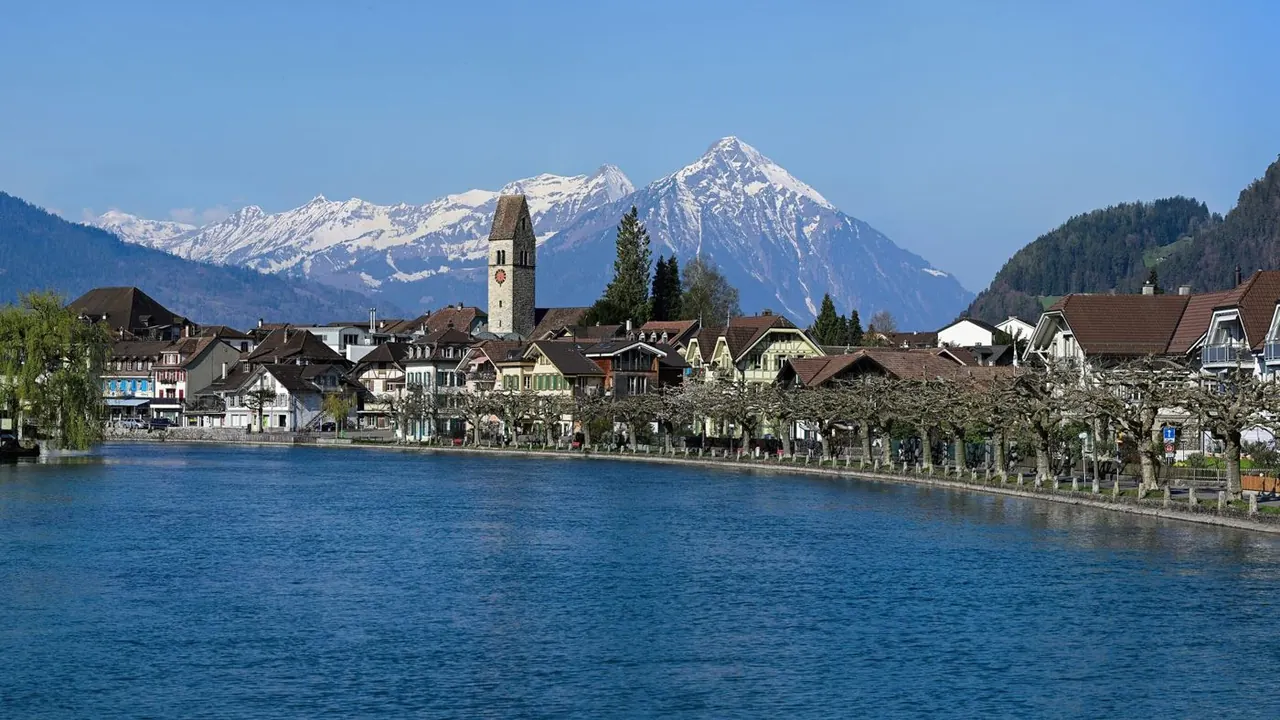
The Aare at Unterseen, Interlaken
- Nature & outdoors97
- Getting around80
- Day trips78
Photo: Roy Egloff, CC BY-SA 4.0, cropped
Match
41
Every category weighted equally
- Beach & sun41
- Culture & arts37
- Food & nightlife32
- Family trip49
- Outdoors53
- Relax & unwind43
- Shopping & style36
- On a budget37
Interlaken in twelve categories
Our verdict on each, scored 0 to 100 against the same fixed benchmark cities, so a score means the same thing on every page.
Beaches & swimming. Scores 30 out of 100.
Food & drink. Scores 25 out of 100.
Culture & sights. Scores 8 out of 100.
Nightlife. Scores 15 out of 100.
Nature & outdoors. Scores 97 out of 100.
Day trips. Scores 78 out of 100.
Good for families. Scores 72 out of 100.
Getting around. Scores 80 out of 100.
Shopping & style. Scores 22 out of 100.
Affordability. Scores 8 out of 100.
Live music & performing arts. Scores 15 out of 100.
Wellness & relaxation. Scores 40 out of 100.
Interlaken category by category
Beaches & swimming
30Interlaken sits on a strip of flat land between two lakes, and in July and August both can be swum in. Lake Thun is the warmer of the two, reaching about 21°C in a good summer, and there are grassy lidos and small shingle beaches at Neuhaus and along the shore towards Spiez. Lake Brienz is a striking glacial turquoise but noticeably colder, with a lakeside bathing area at Bönigen.
It is pleasant for a swim after a day in the mountains, and the setting under snow peaks is lovely. But the season is short, the water stays cool for most of the year and beach life plays no real part in a stay here.
Food & drink
25Eating in Interlaken is functional rather than memorable. The town's restaurants lean on Swiss staples for visitors, such as cheese fondue, raclette, rösti and veal in cream sauce, alongside a run of Indian, Asian and Middle Eastern places that serve the town's international crowd. Quality is reliable and portions are hearty, but there is little depth and almost nothing you would travel for.
The better food moments come from the region: Alpine cheese bought at mountain dairies, a meal at a hut terrace above Grindelwald or Mürren, or white wine from the shores of Lake Thun. Supermarket picnics are what many visitors live on.
Culture & sights
8Interlaken has very little to see in its own right. The Höheweg runs past a row of grand nineteenth-century hotels and the Kursaal, facing the open Höhematte meadow, and across the Aare the small old quarter of Unterseen keeps a handful of old timber houses and a church tower. A small local museum covers tourism and regional history.
That is about all. The town grew up as a base for the mountains, and anyone looking for museums or historic architecture will find them a short train ride away rather than here.
Nightlife
15Evenings are short in a town where people rise early for trains, hikes and paragliding. There is a small backpacker scene of pubs, sports bars and a couple of basement clubs near the hostels, livelier in summer and during the ski season, plus the casino in the Kursaal. Otherwise going out means a drink after dinner along the Höheweg, and the streets are quiet well before midnight.
Nature & outdoors
97This is the reason Interlaken exists. Within an hour by rail lie the Eiger, Mönch and Jungfrau, the sheer-walled Lauterbrunnen valley with its waterfalls, including the glacier meltwater thundering inside the rock at Trümmelbach, and the cog railway to the Jungfraujoch at 3,454m, looking over the Aletsch glacier. Cable cars and mountain trains make high trails easy to reach: around Grindelwald First, along the Schynige Platte ridge, from Mürren under the Schilthorn, and up the Harder Kulm funicular straight from town.
The town is also one of the world's great centres for outdoor sport. Paragliders land on the Höhematte all day, and canyoning, rafting on the Lütschine, kayaking and stand-up paddling on the two lakes, and long cycle routes are all run from here. In winter the Jungfrau ski areas around Grindelwald, Wengen and Mürren take over. Weather is the one limit: low cloud can hide the peaks for days.
Day trips
78Switzerland's rail network makes Interlaken a good base for towns as well as mountains. Bern, with its arcaded medieval old town, clock tower and bear park, is under an hour away. Thun, with its castle above the Aare, is half an hour along the lake, and the paddle steamers on both lakes stop at small shore towns such as Spiez and Oberhofen, each with its own castle. Brienz is the home of Swiss woodcarving, and nearby Ballenberg is a large open-air museum of rural buildings brought from across the country.
Lucerne, with its covered wooden bridges and lakefront, is about two hours away on a scenic line over the Brünig Pass. Car-free Wengen and Mürren and the village of Grindelwald give a sense of mountain life, though they are best known for their views.
Good for families
72Interlaken is easy and safe with children, and the mountains themselves are the attraction. Rack railways, gondolas and lake steamers are exciting in their own right, and the summit stations above Grindelwald and the Harder Kulm have playgrounds, short marked walks, cliff walks and summer toboggan runs. The St Beatus caves above Lake Thun and the farm animals and craft demonstrations at Ballenberg are reliable hits.
What it lacks is the usual set of zoos, aquariums or science museums, and wet days can be hard to fill. The highest excursions reach altitudes that can trouble very young children, and walking with pushchairs is easiest on the valley floor and the gentler panoramic paths.
Getting around
80The town itself is small and flat, and the walk between its two stations, Interlaken West and Interlaken Ost, takes about twenty minutes along the Höheweg. Local buses cover the rest, and many hotels give guests a regional transport card.
The real strength is the wider network. Mainline trains run to Bern and beyond, the narrow-gauge Bernese Oberland railways climb to Lauterbrunnen and Grindelwald, and cog railways, gondolas and lake steamers connect neatly with them, so the whole Jungfrau region can be explored without a car. Mürren and Wengen are car-free anyway. The one drawback is that summer crowds on the most popular mountain trains can be heavy.
Shopping & style
22Shopping in Interlaken is aimed squarely at visitors passing through. The Höheweg is lined with large Swiss watch and jewellery stores catering to tour groups, along with shops selling army knives, cuckoo clocks, chocolate and souvenirs, plus outdoor gear shops for anyone who arrived underprepared. Beyond that there is little: no independent boutiques or design shops to speak of. Hand-carved wooden pieces from Brienz are the one local craft worth seeking out.
Affordability
8Interlaken is a very expensive place to stay. Hotels, restaurant meals and drinks run at full Swiss levels, and the mountain railways and cable cars that make up the heart of any stay cost far more than visitors from almost anywhere expect, the Jungfraujoch above all. Adventure activities add more. Hostels, supermarket picnics, regional transport passes and walking from the valley floor soften the bill, but there is no cheap way to do the region properly.
Live music & performing arts
15Live performance here is seasonal and small. The town's best-known tradition is the open-air staging of Schiller's William Tell, performed by local amateurs in the woods each summer since the early twentieth century. The Kursaal hosts occasional concerts, and tourist folklore evenings offer yodelling, alphorns and flag throwing. Thun holds a summer musical on a lake stage, and Bern, under an hour away, has a proper theatre and orchestra for anyone wanting more.
Wellness & relaxation
40Interlaken has no thermal springs or bathing culture of its own. Relaxation comes from the grand old hotels on the Höheweg, several of which have sizeable spas, and from the public pool and wellness area in the town. The setting helps: early mornings on the lakeshore, slow steamer crossings and the quiet of the mountain villages above are genuinely restorative.
The town centre is less so. It is busy with coach groups and backpackers and geared towards activity rather than rest, so visitors looking to slow down tend to stay out in the lakeside villages or up in Wengen or Mürren.
When should you go?
Pick a month to see what it is like. The climate figures are measured averages, not a forecast.
Interlaken in July
Daytime high, °C
Rainfall in the month, mm
The whole year
Shaded against this city’s own year: the deepest cell is its best month for that figure and the palest its weakest.
Where the figures come from
Interlaken has no rain gauge within 25 km of the centre, so its rainfall comes from a gridded climate dataset read at the city rather than from a gauge further away.
Temperature and rainfall are climate normals, averaged over the years shown. Interlaken: 2005-2020 (rainfall 1991-2020) normals, Meiringen / Unterbach (19.3 km from centre).
Before you go
| Measure | Interlaken |
|---|---|
| Official language | French, German, Italian, Romansh |
| Currency | Swiss Franc (CHF) |
| Sockets | CJ230 V, 50 Hz |
| Driving side | Right |
| Time zone | UTC+1, UTC+2 in summer |
| Emergency number | 112 |
| Elevation | 571 m |
| Main airport | Zürich Airport (ZRH)100 km from centre226 non-stop destinations |
| Public holidays this year | 10 days |
By the numbers
| Measure | Interlaken |
|---|---|
| City population | 6,123 |
| People per km² | 1,424 |
| Museums within 10 km | 3 |
| UNESCO World Heritage sites within 50 km | 2 |
Compare Interlaken with
Every comparison with a written verdict behind it.
- Annecy
- Antibes
- Avignon
- Baden-Baden
- Banff
- Bariloche
- Bern
- Bled
- Bologna
- Cannes
- Cologne
- Como
- Dijon
- Florence
- Frankfurt
- Geneva
- Genoa
- Heidelberg
- Innsbruck
- La Spezia
- Lake Louise
- Lucerne
- Lyon
- Maastricht
- Marseille
- Milan
- Monaco
- Montpellier
- Munich
- Nice
- Nuremberg
- Paris
- Pisa
- Portofino
- Queenstown
- Rovinj
- Saint-Tropez
- Salzburg
- Siena
- Strasbourg
- Stuttgart
- Turin
- Venice
- Verona
- Zurich