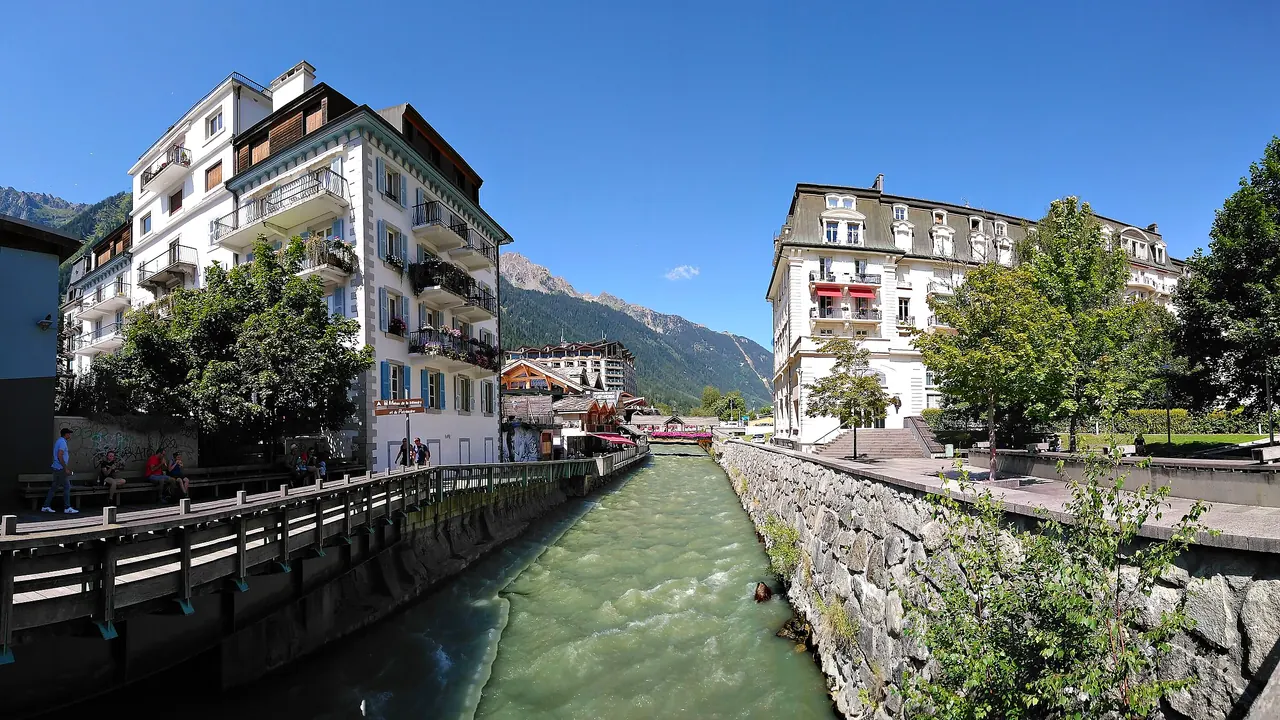
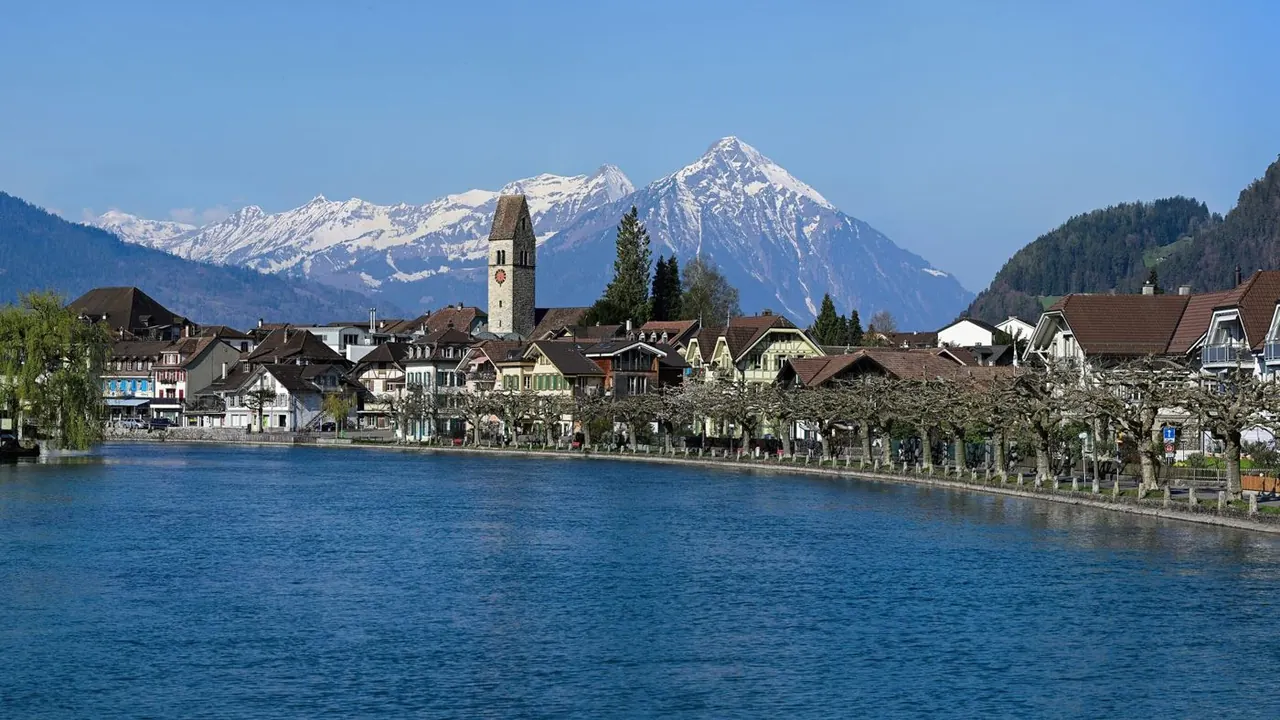
Photos: Chamonix by Tiia Monto, CC BY-SA 3.0, cropped; Interlaken by Roy Egloff, CC BY-SA 4.0, cropped.
Chamonix or Interlaken?
Our verdict in twelve categories, each scored against the same fixed benchmark cities, and the climate month by month, so you can choose for your trip.
Choose Chamonix for
- nightlife
- food and drink
- wellness
Chamonix suits travellers who want serious mountains with a lively town at the bottom of them. The Mont Blanc massif rises straight from the streets, the climbing and skiing culture runs deep, and evenings bring Savoyard cheese dishes, après-ski bars and a late crowd of guides and seasonal workers. It also has the better spa for aching legs, more mountaineering history to see and a little more choice in where to eat. It is still costly, but less punishing than the Swiss side.
Choose Interlaken for
- day trips
- beaches
- families
Pick Interlaken if you would rather ride up the mountains than climb them, and if you want to see a wider region while you are there. Trains, cog railways and lake steamers link up so well that the Jungfrau peaks, the Lauterbrunnen valley, Bern and the lakeside castles all make easy days out without a car. It is the easier choice with children and has two swimmable lakes in summer. In return, the food is plainer, nights are short, and Swiss prices bite harder.
Scoreboard
Twelve categories on one fixed scale from 0 to 100. The shaded stretch is the gap between the two.
Your match
Pick a travel style or drag the sliders, and both match scores follow your weighting.
Too close to call, 1 point apart
Wins on nightlife and food and drink with your weighting.
Wins on day trips and beaches with your weighting.
What matters to you?
Category by category
What the scores mean for a trip.
Beaches & swimming
Neither town is a place for beach life, but Interlaken gives you more chances to swim. Chamonix has the municipal pool in town and Lac de Passy further down the valley, and Lake Annecy is over an hour's drive away.
Interlaken lies between two lakes. In July and August you can swim from the lidos and shingle beaches of Lake Thun at Neuhaus or towards Spiez, or brave the colder turquoise water of Lake Brienz at Bönigen. Both are a short trip from town rather than a day out.
Food & drink
Chamonix eats noticeably better. Its Savoyard cooking is built on Reblochon, Beaufort and Abondance from the surrounding pastures, served with diots sausages and Savoie wines. Mountain restaurants and refuges on the trails add to it, and a few serious kitchens in the old grand hotels raise the level, even if menus in town tend to look alike.
Interlaken's restaurants are reliable but forgettable: fondue, rösti and veal in cream sauce for visitors, plus Indian and Asian places for the international crowd. Its best meals are out in the region, at a hut terrace above Grindelwald or with a bottle of Lake Thun white wine.
Culture & sights
Neither town is a place for museums, but Chamonix has a real story to tell. Alpinism began here with the first ascent of Mont Blanc in 1786. The Musée Alpin, the Espace Tairraz, the guides' quarter and the climbers' cemetery fill a good half day.
Interlaken has less of its own: the hotel row and Kursaal on the Höheweg, a few timber houses in Unterseen and a small local museum. Anyone wanting more heads by train to Bern.
Nightlife
Chamonix goes out properly for a mountain town. Après-ski starts in the late afternoon, then moves to a run of pubs on a narrow old town lane, and two or three small clubs stay open into the early hours on busy nights. The crowd is young, loud and mostly English-speaking, and things quieten in summer.
Interlaken's evenings end early because people are up for trains and paragliding. There are a few backpacker bars, a couple of basement clubs and the casino in the Kursaal, but most nights are a drink after dinner on the Höheweg.
Nature & outdoors
These are two of the great Alpine bases, and they differ in style rather than scale. Chamonix is the more raw, high-mountain place. Lifts carry you to the Aiguille du Midi at 3,842m, the Vallée Blanche and the Tour du Mont Blanc start from the valley, and mountaineering with the oldest guiding company in the world is the defining experience. Its skiing is steep and serious.
Interlaken spreads its scenery over a wider, more accessible area. The Eiger, Mönch and Jungfrau, the waterfalls of Lauterbrunnen and the railway to the Jungfraujoch are all reached by train. It adds two lakes for kayaking and paddling, plus rafting and canyoning. In both towns, low cloud can hide the peaks for days.
Day trips
Interlaken is the better base for days away. The Swiss rail network puts arcaded Bern within an hour and Thun's castle half an hour along the lake. Paddle steamers call at Spiez and Oberhofen, and Lucerne is a scenic ride over the Brünig Pass, with Ballenberg and Brienz woodcarving close at hand.
Chamonix's strength is its position near three countries. Through the Mont Blanc Tunnel lie Courmayeur and the Roman town of Aosta, and Annecy and Geneva are each about an hour's drive. Once you have seen those, mountain roads and nearby resorts limit what else you can do.
Good for families
Both work for outdoor families, but Interlaken is easier. The trains, gondolas and steamers are an adventure for children in themselves. Summit stations have playgrounds and toboggan runs, and the St Beatus caves and Ballenberg's farm animals give reliable extra days.
Chamonix has nursery slopes, a summer luge, the red train to the Mer de Glace and the Merlet animal park with its ibex and marmots. Much of its high terrain is better for teenagers, though. In both places, the highest lifts are a concern for small children and wet days are hard to fill.
Getting around
Both towns are small and flat enough to walk. The difference is in reaching the wider region. In Interlaken, mainline trains, Bernese Oberland railways, cog lines, gondolas and lake steamers connect smoothly, so you can explore the whole Jungfrau area without a car, though the popular trains get crowded in summer.
Chamonix relies on valley buses and the Mont Blanc Express, which are free with the guest card. In winter the ski buses are packed, and evening services thin out. A car helps for trips over the border.
Shopping & style
Neither is a shopping destination, but Chamonix has a clear speciality. Its pedestrian streets are full of climbing and ski shops, some run for generations, and serious mountaineers save their big gear purchases for a visit. Savoyard cheese, génépi and rock crystals make good gifts.
Interlaken's Höheweg mainly serves tour groups, with watch and jewellery stores, army knives, cuckoo clocks and chocolate. Brienz woodcarving is the one local craft worth looking for.
Affordability
Both are expensive, but Interlaken is harder on the wallet. Swiss hotel and restaurant prices are high, and the mountain railways that make the trip, especially the Jungfraujoch, cost more than most visitors expect. Hostels and passes help only a little.
Chamonix is costly too, with lift passes, guides and peak-week chalets adding up. Still, free valley transport, easy self-catering and cheaper shoulder seasons give you more room to save.
Live music & performing arts
Both towns have thin performing arts calendars that come alive in summer. Chamonix's highlight is a jazz festival with some sets played high in the mountains. Interlaken's is the open-air William Tell, staged by local amateurs in the woods, plus folklore evenings with yodelling and alphorns.
For a real theatre or orchestra, Interlaken has Bern within an hour by train. From Chamonix, you would go to Geneva.
Wellness & relaxation
Chamonix is the better place to recover after effort. Its large day spa in the Italian thermal style has hot outdoor pools facing the glaciers, and the old spring baths of Saint-Gervais are about 25 minutes down the valley.
Interlaken has no thermal tradition of its own and relies on the spas of its grand hotels and a public wellness area. It does have quieter pleasures, such as slow steamer crossings and lakeshore mornings. In both towns, the busy centres send those wanting real calm to outlying villages.
When should you go?
Pick your month. The climate figures are measured averages, not a forecast.
Chamonix in July
Interlaken in July
Daytime high, °C
Rainfall in the month, mm
Where the figures come from
Chamonix's temperatures are measured 35 km from the centre, at Bourg-St-Maurice.
Chamonix has no rain gauge within 25 km of the centre, so its rainfall comes from a gridded climate dataset read at the city rather than from a gauge further away.
Interlaken has no rain gauge within 25 km of the centre, so its rainfall comes from a gridded climate dataset read at the city rather than from a gauge further away.
Interlaken's sunshine is measured 66 km from the centre, at Sion.
Temperature and rainfall are climate normals, averaged over the years shown. Chamonix: 1999-2020 (rainfall 1991-2020) normals, Bourg-St-Maurice (34.9 km from centre). Interlaken: 2005-2020 (sunshine 1961-1990, rainfall 1991-2020) normals, Meiringen / Unterbach (19.3 km from centre).
Both towns are at their best for walking and hiking from June to September, when Chamonix reaches about 27°C in July and Interlaken stays a few degrees cooler. Only July and August are warm enough for a lake swim near either town, so June and September are months for hiking rather than swimming. Winter is cold in both. Interlaken's daytime highs sit just above freezing and Chamonix is slightly milder, so this is a season for skiing rather than strolling the streets. Spring and late autumn are cool in both towns.
The rain falls in different seasons. Chamonix is wet all year and wettest in late autumn and early winter, with about 169mm in December. July to September bring its warmest and least rainy weather. Interlaken is drier overall, and summer is its wettest season, with around 127mm in both June and July, while its winters are fairly dry. For the best chance of dry hiking days in Interlaken, choose September, which is still mild and much less wet.
Which traveller are you?
For a food and nightlife trip, Chamonix wins clearly. It has fondue and tartiflette on terraces facing the glaciers, a handful of ambitious kitchens and an après-ski scene that carries on along the old town lane into the early hours. Interlaken's streets go quiet before midnight.
On a family trip with children, Interlaken is the easier base. Rack railways, lake steamers, summit playgrounds, toboggan runs, the St Beatus caves and Ballenberg keep children busy, and a smooth transport network makes every outing simple. Chamonix's terrain often suits teenagers better than toddlers.
On a tight budget, Chamonix is the less painful of two expensive choices. You can self-cater easily, valley transport is free with the guest card and many trails start at the valley floor. In Interlaken, Swiss prices and the costly mountain railways leave no cheap way to see the region.
Before you go
| Measure | Chamonix | Interlaken |
|---|---|---|
| Official language | French | French, German, Italian, Romansh |
| Currency | Euro (EUR) | Swiss Franc (CHF) |
| Sockets | CE230 V, 50 Hz | CJ230 V, 50 Hz |
| Driving side | Right | Right |
| Time zone | UTC+1, UTC+2 in summer | UTC+1, UTC+2 in summer |
| Emergency number | 112 | 112 |
| Elevation | 995 m | 571 m |
| Main airport | Geneva International Airport (GVA)68 km from centre150 non-stop destinations | Zürich Airport (ZRH)100 km from centre226 non-stop destinations |
| Public holidays this year | 11 days | 10 days |
By the numbers
| Measure | Chamonix | Interlaken |
|---|---|---|
| City population | 8,705 | 6,123 |
| People per km² | 75 | 1,424 |
| Museums within 10 km | 3 | 3 |
| UNESCO World Heritage sites within 50 km | 0 | 2 |
Where else could you go?
Every comparison below shares a destination with this one, so you can follow Chamonix or Interlaken somewhere new.
- Bernvs Interlaken
- Lucernevs Interlaken
- Annecyvs Chamonix
- Genevavs Chamonix
- Lausannevs Chamonix
- Zurichvs Interlaken