Photos: Baden-Baden by Kent Wang, CC BY-SA 2.0, cropped; Interlaken by Roy Egloff, CC BY-SA 4.0, cropped.
Baden-Baden or Interlaken?
Our verdict in twelve categories, each scored against the same fixed benchmark cities, and the climate month by month, so you can choose for your trip.
Choose Baden-Baden for
- wellness
- culture and sights
- live music and the arts
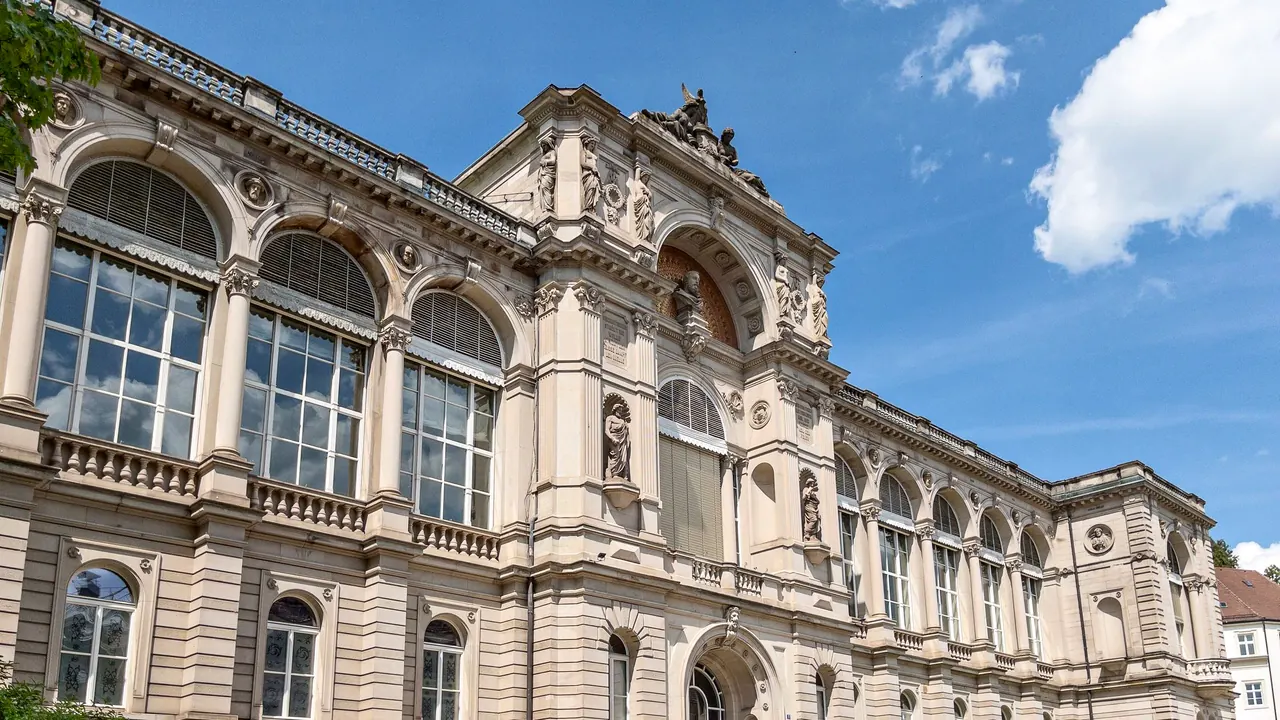
Baden-Baden is the better choice for a slow, comfortable stay built around the thermal baths, with evenings at the Festspielhaus, Belle Époque streets to wander and Riesling from the Rebland villages. It suits couples and older travellers who want rest, music and good regional food more than exertion. It also makes a fine base for Strasbourg and Alsace.
Choose Interlaken for
- nature and the outdoors
- beaches
- families
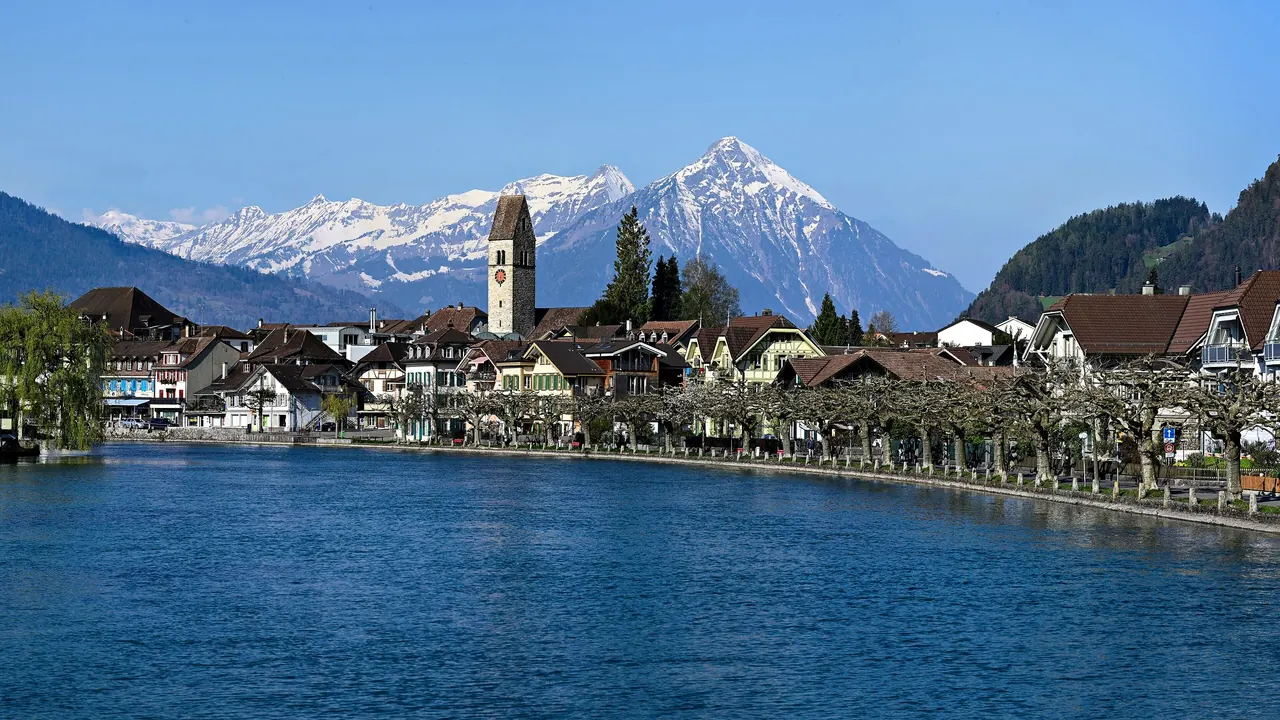
Go to Interlaken if the mountains are the point. Trains, cog railways and cable cars take you to the Jungfrau peaks, the Lauterbrunnen valley and high trails every morning, and paragliding, canyoning and lake paddling fill the rest of the day. Families and active travellers do best here, as long as they accept plain food, little to see in the town itself and very high Swiss costs.
Scoreboard
Twelve categories on one fixed scale from 0 to 100. The shaded stretch is the gap between the two.
Your match
Pick a travel style or drag the sliders, and both match scores follow your weighting.
Wins on wellness and culture and sights with your weighting.
Wins on nature and the outdoors and beaches with your weighting.
What matters to you?
Category by category
What the scores mean for a trip.
Beaches & swimming
Neither town is a beach destination, but Interlaken at least has open water. In July and August Lake Thun is warm enough to swim from the lidos and shingle beaches at Neuhaus, and the colder turquoise water of Lake Brienz at Bönigen makes a striking dip after a day in the mountains. Baden-Baden has no lake or coast, so summer swimming means outdoor pools or gravel pits out on the Rhine plain, and its water culture is the thermal baths.
Food & drink
Baden-Baden eats noticeably better. It sits in good Baden food and wine country, with Flammkuchen, venison and Black Forest gateau on the menus and French influence from across the Rhine. Riesling and Pinot Noir are poured in the tavern villages of Neuweier and Varnhalt, and the celebrated restaurants of the northern Black Forest are a short drive away.
Interlaken feeds hikers rather than food lovers. Its fondue, rösti and international restaurants are reliable but offer little depth. The best meals there tend to be lunch on a hut terrace above Grindelwald or cheese bought from a mountain dairy.
Culture & sights
This is one of the widest gaps between the two. Baden-Baden is a sight in itself, a Belle Époque resort counted among the Great Spa Towns of Europe. It has the Kurhaus, the Trinkhalle, the Museum Frieder Burda and the Kunsthalle, Brahms's summer house and Roman bath ruins under the old town, enough for a full day or two.
Interlaken has the row of hotels along the Höheweg, a few timber houses in Unterseen and a small local museum. Its visitors take the train to Bern or Thun for history and art.
Nightlife
Both go quiet early and neither has a real club scene, but the evenings feel different. Baden-Baden dresses up, with the gilded casino rooms in the Kurhaus, hotel bars and wine bars serving an older crowd. Interlaken's evenings are younger and more casual, with backpacker pubs, sports bars and a couple of basement clubs near the hostels that get livelier in summer and the ski season.
Nature & outdoors
Baden-Baden has good walking from the doorstep. The Merkur funicular, the Battert cliffs and the fir forest are close by, and the Black Forest High Road climbs to the Hornisgrinde moorland at just over 1,100m. This is rolling wooded upland, beautiful in autumn but gentle.
Interlaken is on another scale. The Lauterbrunnen valley with its waterfalls, Grindelwald and the trails under the Eiger, Mönch and Jungfrau are within an hour by rail, and a longer cog railway journey climbs to the Jungfraujoch at 3,454m above the Aletsch glacier. Paragliding, canyoning, rafting and winter skiing are all run from town, and only low cloud gets in the way.
Day trips
Both are excellent bases, but they point in different directions. From Baden-Baden the outings are about cities and wine: Strasbourg and the Alsace villages, Heidelberg, Freiburg and the cathedral at Speyer, and many of them are easier with a car.
Interlaken's excursions mix Swiss towns with lake travel. Bern is under an hour away, the castles at Thun, Spiez and Oberhofen can be reached by paddle steamer, and the Ballenberg open-air museum and Lucerne, over the Brünig Pass, are both easy by train.
Good for families
Interlaken works better with children because getting around is part of the fun. They have rack railways and gondolas, toboggan runs and playgrounds at Harder Kulm and above Grindelwald, the St Beatus caves and the farm animals at Ballenberg. Wet days and the highest altitudes are its weak points.
Baden-Baden is safe and calm but made for adults, and the Friedrichsbad does not admit young children. Families staying there tend to drive about an hour to Europa-Park or visit Karlsruhe's zoo to fill their days.
Getting around
Both centres are compact, but Interlaken's is flat, while Baden-Baden has steep streets and a railway station a bus ride out of town.
The bigger difference is further afield. Interlaken's trains, cog railways, cable cars and lake steamers connect so neatly that a car is unnecessary, and many hotels give guests a regional transport card. From Baden-Baden, trains to Karlsruhe and Freiburg are easy, but the Black Forest High Road, the wine villages and Alsace are much simpler with a car.
Shopping & style
Neither town is a shopping destination, but Baden-Baden's Sophienstraße and Lange Straße have real boutiques, watchmakers and delicatessens that make for a pleasant, slow browse. Interlaken's Höheweg is built for tour groups, with large watch stores, army knives, chocolate and outdoor gear. Its one craft worth seeking out is woodcarving from Brienz.
Affordability
Neither town is cheap, but Baden-Baden is easier on the wallet. Its guesthouses, wine taverns and bakeries are fairly priced by German standards, though a stay built around the spas and grand hotels soon adds up.
Interlaken charges full Swiss rates for beds, meals and drinks. The mountain railways, the line to the Jungfraujoch above all, are the biggest single cost. Hostels, picnics and transport passes help, but only so far.
Live music & performing arts
Baden-Baden offers far more than its size suggests. The Festspielhaus, one of Germany's largest opera and concert houses, brings international orchestras and soloists, the town's philharmonic plays in the Kurhaus, and the small nineteenth-century theatre stages opera and drama. Brahms and Clara Schumann both worked here.
Interlaken has the open-air William Tell, performed by locals in the woods each summer, as well as occasional concerts in the Kursaal and folklore evenings with yodelling and alphorns. For a full concert programme, visitors go to Bern.
Wellness & relaxation
The two towns offer rest in quite different ways. In Baden-Baden the bathing is the stay itself: springs used since Roman times feed the domed Friedrichsbad, with its silent, unclothed circuit of hot rooms and pools, and the Caracalla complex beside it, and the rest of the day follows their unhurried rhythm.
Interlaken has no springs or bathing tradition, so relaxing there means a grand hotel with a good spa or the public wellness area, and above all the setting: the lakeshore early in the morning and slow steamer crossings. Its centre, full of coach groups and backpackers, is built for activity, so anyone wanting real quiet stays in a lakeside village or up in Wengen or Mürren.
When should you go?
Pick your month. The climate figures are measured averages, not a forecast.
Baden-Baden in July
Interlaken in July
Daytime high, °C
Rainfall in the month, mm
Where the figures come from
Interlaken has no rain gauge within 25 km of the centre, so its rainfall comes from a gridded climate dataset read at the destination rather than from a gauge further away.
Interlaken's sunshine is measured 66 km from the centre, at Sion.
Temperature and rainfall are climate normals, averaged over the years shown. Baden-Baden: 1991-2020 normals, Baden-Baden-Geroldsau (3.9 km from centre). Interlaken: 2005-2020 (sunshine 1961-1990, rainfall 1991-2020) normals, Meiringen / Unterbach (19.3 km from centre).
Both towns are at their best in summer. July and August reach about 25°C in Baden-Baden and a degree less in Interlaken, and from December to February both are cold enough that a day of walking around needs a proper coat. Baden-Baden is wet in every month, so rain comes down to luck rather than season. Its sunshine, though, rises from a dim December to around 243 hours in July, which makes May to September the time for the forest trails and wine villages, and October is still mild for autumn colour.
Interlaken follows a different pattern. Its rain comes mostly in summer, about 125mm a month from June to August, often as low cloud that hides the peaks, while late winter is drier. The lakes are warm enough to swim in only in July and August. September, at about 18°C and wetter than winter but drier than high summer, is often the best compromise for hiking, and in winter the ski areas above town take over.
Which traveller are you?
On a relaxing and wellness trip, Baden-Baden is the clear pick, because the whole stay can revolve around its thermal baths, slow walks on the Lichtentaler Allee and early nights. Interlaken has restful moments, but its centre runs on adventure sports and early trains.
For an outdoors trip, choose Interlaken. Cog railways and cable cars reach high trails under the Eiger and Jungfrau, and paragliding, canyoning, rafting and skiing all start from town. The Black Forest walking around Baden-Baden is lovely but far gentler and lower.
On a culture and arts trip, Baden-Baden is well ahead. A day or two covers the Belle Époque spa quarter and the Frieder Burda and Kunsthalle collections, and the Festspielhaus adds evenings of opera and concerts. Interlaken has little to see and sends visitors to Bern.
Before you go
| Measure | Baden-Baden | Interlaken |
|---|---|---|
| Official language | German | French, German, Italian, Romansh |
| Currency | Euro (EUR) | Swiss Franc (CHF) |
| Sockets | CF230 V, 50 Hz | CJ230 V, 50 Hz |
| Driving side | Right | Right |
| Time zone | UTC+1, UTC+2 in summer | UTC+1, UTC+2 in summer |
| Emergency number | 112 | 112 |
| Elevation | 181 m | 571 m |
| Main airport | Karlsruhe Baden-Baden Airport (FKB)12 km from centre44 non-stop destinations | Zürich Airport (ZRH)100 km from centre226 non-stop destinations |
| Public holidays this year | 12 days | 10 days |
By the numbers
| Measure | Baden-Baden | Interlaken |
|---|---|---|
| Population | 56,952 | 6,123 |
| People per km² | 406 | 1,424 |
| Museums within 10 km | 11 | 3 |
| UNESCO World Heritage sites within 50 km | 3 | 2 |
Where else could you go?
Every comparison below shares a destination with this one, so you can follow Baden-Baden or Interlaken somewhere new.
- Strasbourgvs Baden-Baden
- Bernvs Interlaken
- Lucernevs Interlaken
- Stuttgartvs Baden-Baden
- Zermattvs Interlaken
- Heidelbergvs Baden-Baden