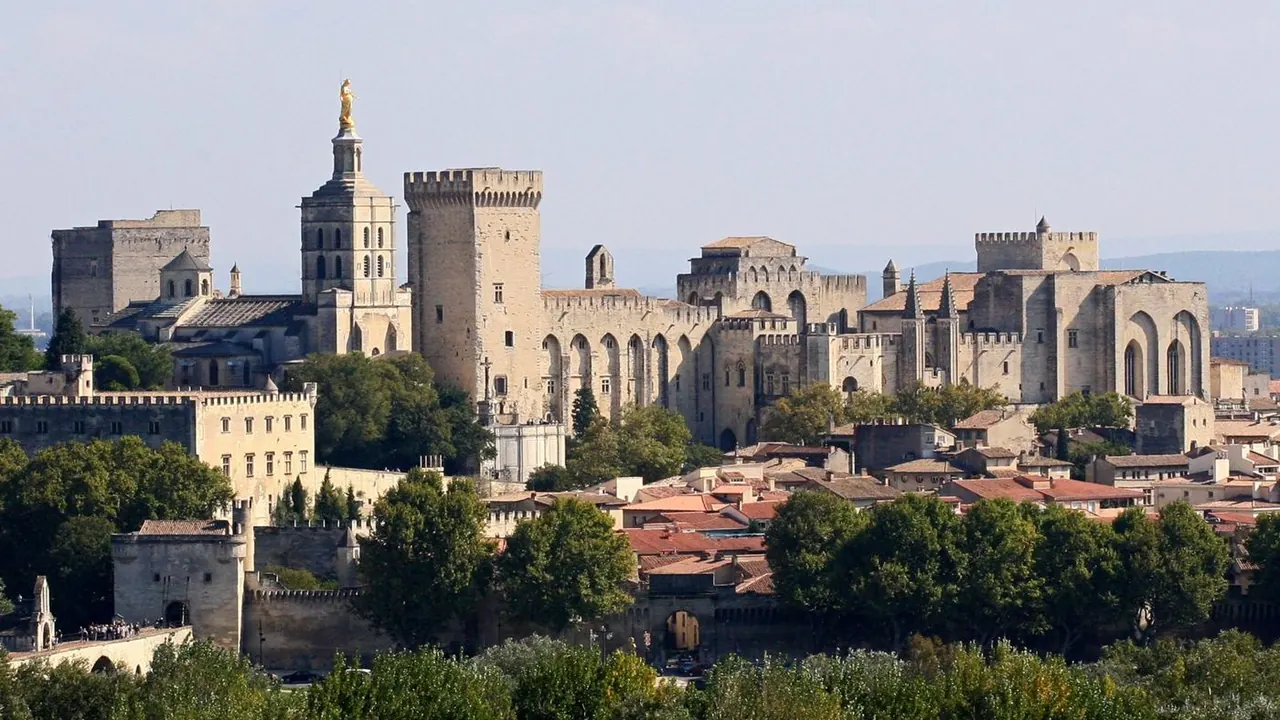
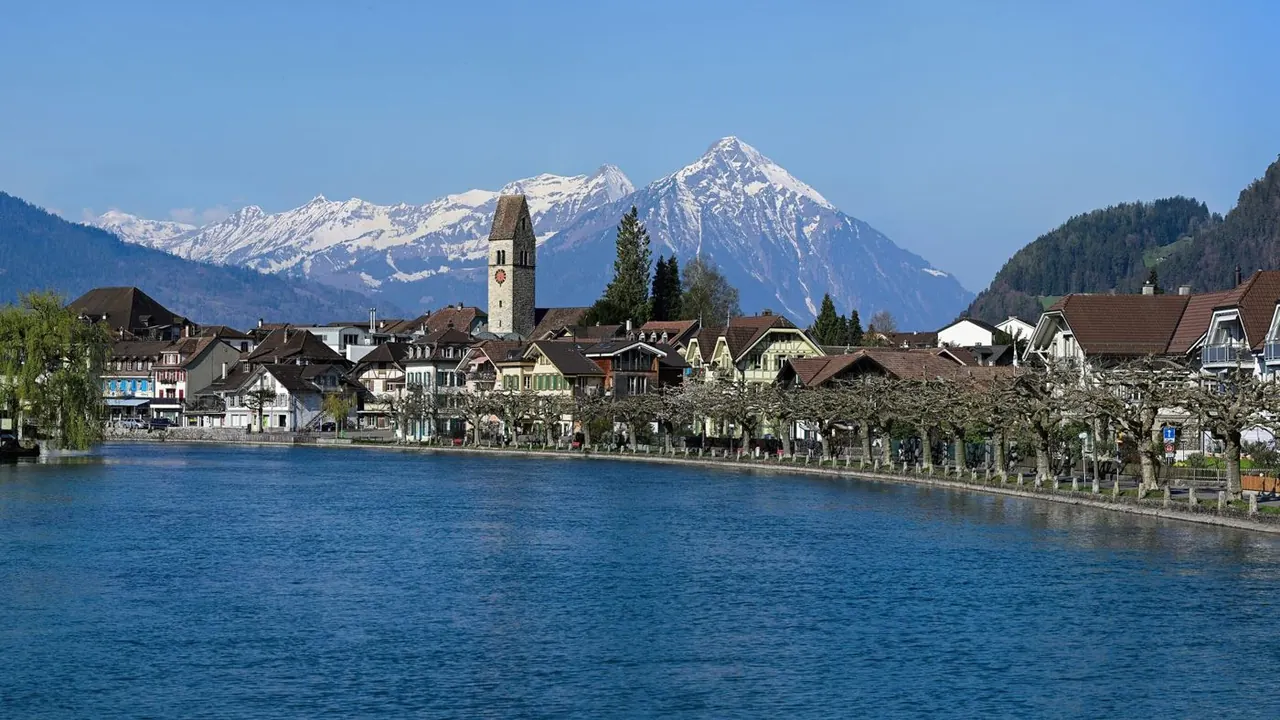
Photos: Avignon by BlueBreezeWiki, CC BY-SA 3.0, cropped; Interlaken by Roy Egloff, CC BY-SA 4.0, cropped.
Avignon or Interlaken?
Our verdict in twelve categories, each scored against the same fixed benchmark cities, and the climate month by month, so you can choose for your trip.
Choose Avignon for
- culture and sights
- live music and the arts
- prices
Avignon is the choice for a trip built around history, food and wine. The papal palace and the walled old town fill a couple of days on their own, and Roman Nîmes, Arles, Orange and the Pont du Gard lie within easy reach. Add Provençal markets, Châteauneuf-du-Pape on the doorstep and, in July, a theatre festival that takes over every courtyard in town. It also costs noticeably less to stay there, though you will want a car for the hill villages.
Choose Interlaken for
- nature and the outdoors
- families
- getting around
Interlaken is for people who travel to be outdoors. Its town centre has little to offer, but the Eiger, the Lauterbrunnen valley and the Jungfraujoch are an hour away by train, and you can hike, paraglide, raft and ski from the same base without ever needing a car. Families do well here too. The price is the drawback: this is among the most expensive places in Europe to spend a week, and evenings and meals are plain.
Scoreboard
Twelve categories on one fixed scale from 0 to 100. The shaded stretch is the gap between the two.
Your match
Pick a travel style or drag the sliders, and both match scores follow your weighting.
Wins on culture and sights and live music and the arts with your weighting.
Wins on nature and the outdoors and families with your weighting.
What matters to you?
Category by category
What the scores mean for a trip.
Beaches & swimming
Neither is a beach destination, but Interlaken lets you swim without leaving the area. In July and August you can walk or take a short bus ride to the grassy lidos and shingle shores at Neuhaus on Lake Thun, which is the warmer lake, or to Bönigen on the cold, turquoise Lake Brienz. A swim under snow peaks after a day of hiking is a real pleasure.
Avignon's river is not for swimming. The nearest proper swim is in the green pools of the Gardon below the Pont du Gard, half an hour away by car, and the Camargue sands are over an hour south. For a daily dip, most people rely on a hotel or rental pool.
Food & drink
Avignon is much the better place to eat. It has Provençal cooking built on produce from the surrounding plain, the stalls and lunch counters of Les Halles on Place Pie, and Rhône wines poured by the glass in the side-street bistros around Rue des Teinturiers. Food is one of the reasons people go.
Interlaken feeds you well enough on fondue, rösti and raclette, plus a run of Indian and Asian places. That gives it more variety from elsewhere than Avignon, but little depth. Its best meals come from mountain dairies and hut terraces above the valley, not from the town itself.
Culture & sights
This is where the two differ most. Avignon has a UNESCO-listed papal palace, a cathedral, the broken bridge of the song and almost 4km of medieval walls. Inside the walls are cardinals' mansions and three good museums, from Italian primitives to contemporary art, with Villeneuve's charterhouse just across the river.
Interlaken has a row of grand nineteenth-century hotels, the Kursaal and a few timber houses in Unterseen, and not much else. For history, you take the train to Bern or Thun.
Nightlife
In July, Avignon's festival keeps the squares and terraces full until the small hours, and it is the one time of year either town has a real night out. For the rest of the year Avignon still makes the more pleasant evening: an aperitif on Place Pie, a glass of Côtes du Rhône on a terrace, a few student bars. By midnight it is quiet, and there are hardly any clubs.
Interlaken goes to bed earlier still, because people rise early for the first mountain train. What it has is a small backpacker scene of pubs, sports bars and a couple of basement clubs near the hostels, plus the casino in the Kursaal. It is livelier in summer and the ski season, but not something to plan a trip around.
Nature & outdoors
Interlaken is one of Europe's great mountain bases. Trains and cable cars take you into the Lauterbrunnen valley, to the Jungfraujoch above the Aletsch glacier, and onto ridge trails at Schynige Platte and Grindelwald First. Paragliders land on the meadow in the middle of town, and in winter the ski areas take over.
Avignon's landscapes are gentler but still very good. There is Mont Ventoux for cyclists, the ochre trails of the Luberon, the crags of the Alpilles, canoeing in the Gardon gorges, and flamingos and white horses in the Camargue. It is best in spring and autumn, before the summer heat or the mistral make walking hard.
Day trips
Both make good bases, but Avignon has more within easy reach. Nîmes, Arles, Orange and the Pont du Gard give you some of the finest Roman remains outside Italy, all about half an hour away. The Luberon villages, Les Baux, L'Isle-sur-la-Sorgue and the Châteauneuf vineyards are close too, though the villages need a car.
Interlaken's trips run by train and boat instead. Bern's arcaded old town is under an hour away, there are lakeside castles at Thun, Spiez and Oberhofen, and the Ballenberg open-air museum is near Brienz. Lucerne is a longer, scenic ride over the Brünig Pass.
Good for families
Interlaken is the easier place for children, because simply getting up the mountains entertains them. Rack railways, gondolas and lake steamers lead to summit playgrounds, cliff walks and summer toboggan runs, and the St Beatus caves and Ballenberg's farm animals fill the gaps. Wet days are the weak point, and the highest summits are not ideal for toddlers.
Avignon offers a short burst of fun at the palace, with its tablet tour, and dancing on the bridge, and then mostly relies on days out by car to the Gardon or the Camargue. Hot July and cobbled lanes also make it harder going with a pushchair.
Getting around
Both towns are easy to walk, but beyond them Interlaken is far easier. Mainline trains, narrow-gauge mountain lines, cog railways, gondolas and steamers all connect, so you can explore the whole Jungfrau region without a car. The only drawback is crowded trains on the busiest summer routes.
Avignon's walled centre is compact, and regional trains reach Arles, Nîmes and Orange easily. Once you head for the vineyards, the Luberon or Ventoux, buses are few, and a hire car or a tour becomes the realistic way to go.
Shopping & style
Neither town is worth a trip just for the shopping, but Avignon has more to browse and better things to take home. Away from the chain stores on Rue de la République, the lanes around Rue des Marchands have independent fashion and design boutiques next to shops selling printed Provençal cottons and olive wood. The best buys are things to eat and drink, such as tapenade from Les Halles or a bottle of Rhône wine bought from the producer.
Interlaken has nothing like that. Its Höheweg is aimed at tour groups passing through, with big watch and jewellery stores, army knives and cuckoo clocks, and there are almost no independent shops. Woodcarving from Brienz is the one local craft worth looking for.
Affordability
Avignon is far cheaper, though not a bargain by French standards. Bistro set lunches and producers' wine are fair value, and rooms are reasonable outside the festival.
In Interlaken, everything is priced at full Swiss levels. The mountain railways and cable cars you came for, the Jungfraujoch above all, add a large sum to the bill. Passes and picnics help, but there is no cheap way to do the region properly.
Live music & performing arts
Avignon is in another league. Every July the Festival d'Avignon fills the palace's Cour d'honneur, and its huge fringe, the Off, puts on well over a thousand shows a day in cellars and courtyards. For the rest of the year there is the opera house on Place de l'Horloge, a dozen small theatres and a jazz club.
Interlaken's main tradition is the amateur open-air William Tell in the woods each summer, plus folklore evenings with yodelling and alphorns. Anyone wanting a real orchestra goes to Bern.
Wellness & relaxation
The two are broadly level here, and neither has a bathing culture of its own, so what differs is the kind of rest. In Avignon it is the southern pace: long lunches under plane trees, or a farmhouse guesthouse among the vines with a pool and nothing to do. July in town and days of mistral work against it.
Interlaken has bigger spas in its grand Höheweg hotels and a public wellness area, and it calms you with slow steamer crossings and quiet mornings by the lake. Its busy centre is less restful, so the calm is up in Wengen or Mürren.
When should you go?
Pick your month. The climate figures are measured averages, not a forecast.
Avignon in July
Interlaken in July
Daytime high, °C
Rainfall in the month, mm
Where the figures come from
Avignon has no rain gauge within 25 km of the centre, so its rainfall comes from a gridded climate dataset read at the city rather than from a gauge further away.
Avignon's sunshine is measured 65 km from the centre, at Marseille / Marignane.
Interlaken has no rain gauge within 25 km of the centre, so its rainfall comes from a gridded climate dataset read at the city rather than from a gauge further away.
Temperature and rainfall are climate normals, averaged over the years shown. Avignon: 2005-2020 (sunshine 1991-2020, rainfall 1991-2020) normals, Avignon / Morières-lès-Avignon (8.6 km from centre). Interlaken: 2005-2020 (rainfall 1991-2020) normals, Meiringen / Unterbach (19.3 km from centre).
Avignon is at its best from April to June, when it is warm enough to eat outside and cool enough to walk the town all day. July and August are long, very sunny and hot, around 31°C, which suits a lazy afternoon by a pool but not hours on the cobbles. September and October stay warm but are the wettest part of the year, with about 85mm of rain in September, so a visit then means pleasant days broken by heavy downpours. Winter is mild but often grey and windy.
Interlaken's good season comes later and is shorter. Highs reach the low twenties from June to August, about 24°C in July, which is ideal for hiking and just warm enough for a swim in Lake Thun. Rain falls through the whole year, and midsummer is its wettest stretch, when cloud can hide the peaks. From December to February highs stay around 3°C, and that is when the ski areas above town take over. So Avignon has the hotter summer and the softer winter, and Interlaken is the place to go in summer heat or for snow.
Which traveller are you?
On a culture and arts trip, Avignon is the clear choice. You get the Palais des Papes, the ramparts, the Petit Palais and Musée Calvet, and Roman monuments a short train ride away. The July festival is a major draw for theatre lovers. Interlaken has almost nothing comparable.
For an outdoors trip, choose Interlaken. Mountain trains and cable cars take you straight to high trails under the Eiger and Jungfrau, and paragliding, canyoning, rafting and winter skiing all start from town. Avignon has Ventoux and the Luberon, but they are not on this scale.
On a tight budget, Avignon is far easier on the wallet. Set lunches, wine bought from producers and an old town you can explore for free keep costs down, especially outside July. In Interlaken even hostels and picnics cannot offset the price of the mountain railways.
Before you go
| Measure | Avignon | Interlaken |
|---|---|---|
| Official language | French | French, German, Italian, Romansh |
| Currency | Euro (EUR) | Swiss Franc (CHF) |
| Sockets | CE230 V, 50 Hz | CJ230 V, 50 Hz |
| Driving side | Right | Right |
| Time zone | UTC+1, UTC+2 in summer | UTC+1, UTC+2 in summer |
| Emergency number | 112 | 112 |
| Elevation | 10 m | 571 m |
| Main airport | Marseille Provence Airport (MRS)65 km from centre126 non-stop destinations | Zürich Airport (ZRH)100 km from centre226 non-stop destinations |
| Public holidays this year | 11 days | 10 days |
By the numbers
| Measure | Avignon | Interlaken |
|---|---|---|
| City population | 92,188 | 6,123 |
| People per km² | 1,420 | 1,424 |
| Museums within 10 km | 11 | 3 |
| UNESCO World Heritage sites within 50 km | 6 | 2 |
Where else could you go?
Every comparison below shares a destination with this one, so you can follow Avignon or Interlaken somewhere new.