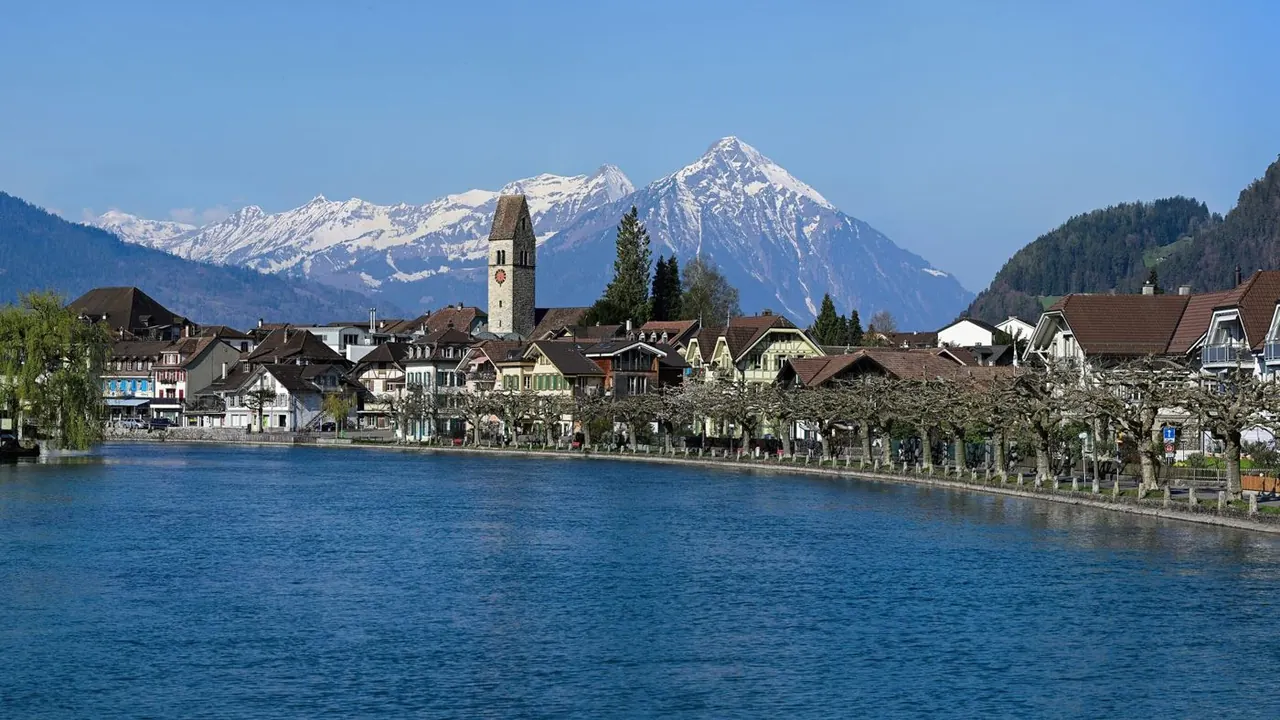
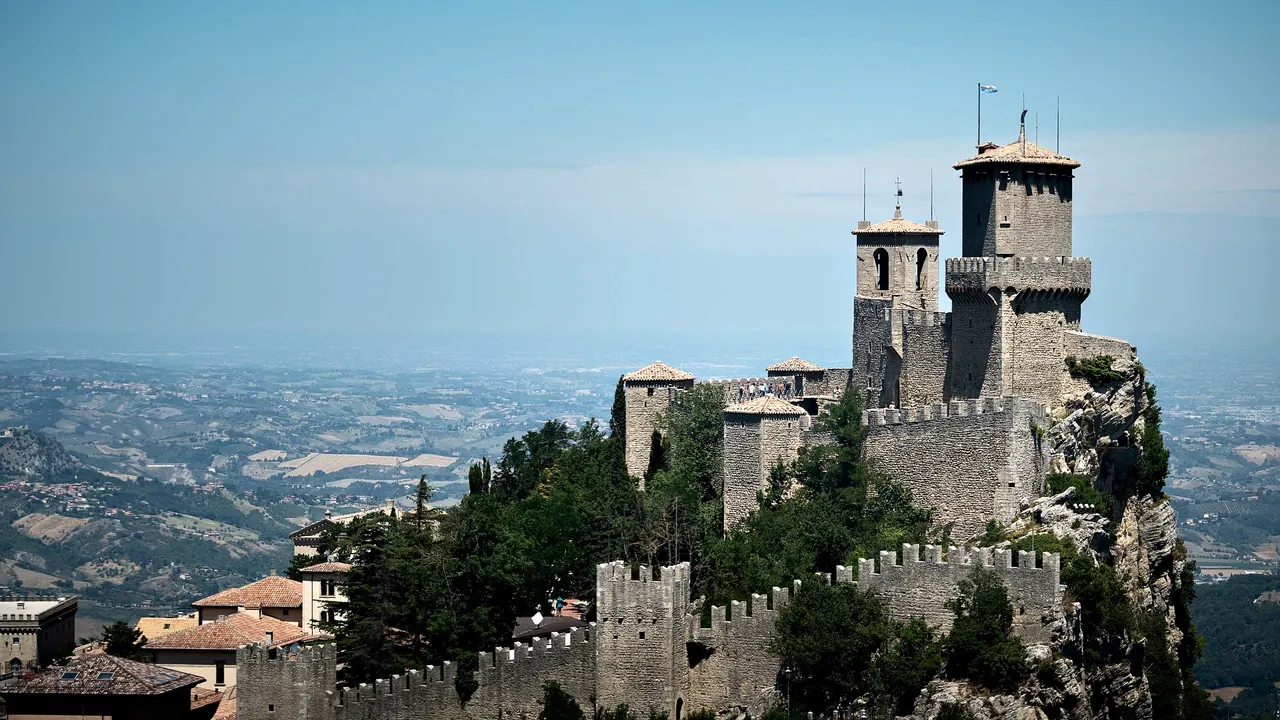
Photos: Interlaken by Roy Egloff, CC BY-SA 4.0, cropped; San Marino by Tibor Szabo, Pexels License.
Interlaken or San Marino?
Our verdict in twelve categories, each scored against the same fixed benchmark cities, and the climate month by month, so you can choose for your trip.
Choose Interlaken for
- nature and the outdoors
- getting around
- families
Interlaken is for travellers who plan their days around the mountains: the railway to the Jungfraujoch, the waterfalls of the Lauterbrunnen valley, high trails reached by gondola, paragliding and canyoning in summer and skiing in winter. Trains and steamers connect so well that a car is never needed, and children take to it easily. In return you get plain food, early nights and a very large bill.
Choose San Marino for
- prices
- culture and sights
- beaches
San Marino suits a slower and cheaper trip built on history and the Italian countryside around it. The walled town and towers on Monte Titano fill half a day, and the real reward is using the mountain as a base for Urbino, San Leo, Ravenna and the Romagna coast, ideally with a car. It costs far less than Switzerland, and the beaches below are close enough for summer afternoons.
Scoreboard
Twelve categories on one fixed scale from 0 to 100. The shaded stretch is the gap between the two.
Your match
Pick a travel style or drag the sliders, and both match scores follow your weighting.
Wins on nature and the outdoors and getting around with your weighting.
Wins on prices and culture and sights with your weighting.
What matters to you?
Category by category
What the scores mean for a trip.
Beaches & swimming
Neither is a beach destination. Interlaken offers lake swimming in July and August, in the milder water of Lake Thun at Neuhaus or the colder glacial turquoise of Lake Brienz at Bönigen, lovely under the peaks but cool and brief.
San Marino has the real sea within reach. The long sands of Rimini and Riccione are about half an hour down the mountain, with warm, shallow water and rows of umbrellas from July to early September, a proper beach day rather than a dip.
Food & drink
Interlaken's restaurants serve fondue, raclette and rösti alongside Indian and Asian kitchens, filling and dependable but rarely more, and the better meals are on hut terraces above Grindelwald or picnics of mountain dairy cheese.
San Marino eats somewhat better on the Romagna and Montefeltro cooking of hand-rolled strozzapreti, passatelli in broth and piadina, with the republic's own Sangiovese to drink. The trick is to skip the summit view terraces for the family trattorias of Borgo Maggiore.
Culture & sights
Interlaken has almost nothing to see in town beyond the grand hotels and Kursaal on the Höheweg and the timber houses of Unterseen. It was built as a base for the mountains, and its history and museums are in Bern and Thun.
San Marino is a sight in itself: a walled medieval town along the crest of Monte Titano, the Guaita and Cesta towers joined by a cliffside path, and the Palazzo Pubblico where the Captains Regent are installed. Half a day covers it, but the story of one of the world's oldest surviving republics gives it a weight Interlaken cannot match.
Nightlife
Interlaken has more going on after dark, though early starts for trains and paragliding keep evenings short. A small backpacker scene of pubs, sports bars and a couple of basement clubs gathers near the hostels, busiest in summer and the ski season, and the casino in the Kursaal gives a quieter option.
On Monte Titano the evening ends when the coaches leave. A glass of wine on a terrace with the lights of the coast below is about all there is. For clubs and seafront bars that stay open late, you have to drive down to Rimini and Riccione.
Nature & outdoors
Interlaken is one of the great Alpine bases. The Eiger, Mönch and Jungfrau are within an hour by rail, the Lauterbrunnen valley falls away in waterfalls, gondolas lift you to trails at Grindelwald First and Schynige Platte, and paragliding, canyoning, rafting and winter skiing are all run from town.
San Marino's Monte Titano is a limestone ridge of about 740m, with cliff views to the Adriatic and woodland paths down to Borgo Maggiore. It makes a fine morning walk or a drive into the Montefeltro hills, but with no high peaks or adventure sports it is scenery rather than a playground.
Day trips
Both make good bases, and the difference lies as much in how you travel as where. From Interlaken, trains and paddle steamers reach Bern's arcaded old town in under an hour, the castles of Thun, Spiez and Oberhofen, the open-air museum at Ballenberg and, over the Brünig Pass, Lucerne, all without a car.
San Marino's list is just as rich in history, with the fortress of San Leo, Renaissance Urbino, Ravenna's mosaics and the castle at Gradara. Beyond the bus to Rimini, though, most of it needs a car, which tips the balance slightly towards Interlaken.
Good for families
Interlaken works better with children. Rack railways, gondolas and lake steamers are adventures in themselves, the summit stations have playgrounds, cliff walks and summer toboggan runs, and the St Beatus caves fill a morning; wet days and the altitude for toddlers are the weak points.
San Marino's towers and battlements thrill children for a morning, but steep steps make pushchairs hard work and the summit has little built for them. The family draws, Italia in Miniatura, Fiabilandia and the waterparks, are down on the coast.
Getting around
Interlaken is flat, walkable between its two stations, and tied into a network where mainline trains, narrow-gauge lines, cog railways, cable cars and steamers all connect, so a car is never needed. Only the summer crowds on the busiest mountain trains spoil it.
San Marino's centre is small but steep, all climbs and steps, with a cable car down to Borgo Maggiore. Arriving without a car means the bus from Rimini, and beyond that the surrounding hill towns realistically need a hire car.
Shopping & style
Shopping is a minor part of either stay, and the two sell different things. Interlaken's Höheweg is given over to large watch and jewellery stores for tour groups, army knives, cuckoo clocks, chocolate and outdoor gear, with Brienz woodcarving the one craft worth seeking out.
San Marino has a little more range: lower taxes make perfume, leather goods and spirits worth a look, an outlet centre on the valley floor adds fashion brands, and collectors come for the republic's stamps and coins.
Affordability
Interlaken is expensive in every direction: Swiss hotel and restaurant levels, plus mountain railways and cable cars that cost far more than most visitors expect, with the Jungfraujoch the steepest of all. Hostels, transport passes and supermarket picnics help, but only so far.
San Marino follows provincial central Italy, with moderate hotels outside August, fairly priced trattorias in the lower villages and inexpensive sights. Sleeping off the summit trims the bill further, and money goes a great deal further than in the Bernese Oberland.
Live music & performing arts
Each town's stage comes down to one summer tradition. In Interlaken it is the open-air William Tell, played by local amateurs in the woods since the early twentieth century, with folklore evenings of yodelling and alphorns and the odd concert in the Kursaal. For proper theatre and an orchestra, Bern is under an hour away by train.
In San Marino it is the Medieval Days festival, when costumed musicians, crossbow contests and flag-throwers fill the old town, and summer evenings bring music to the squares. For opera or a full concert season, visitors go to Bologna, or to Pesaro for Rossini.
Wellness & relaxation
Interlaken offers more ways to unwind: sizeable spas in the grand Höheweg hotels, a public pool and wellness area, slow steamer crossings, and quiet nights up in Wengen or Mürren, even if the town centre itself is geared to activity.
San Marino has only a few hotel spas and no bathing culture. Its restful side is the evening walk along the walls once the day visitors have gone, with thermal spas a separate outing to the coast or the Apennine valleys.
When should you go?
Pick your month. The climate figures are measured averages, not a forecast.
Interlaken in July
San Marino in July
Daytime high, °C
Rainfall in the month, mm
Where the figures come from
Interlaken has no rain gauge within 25 km of the centre, so its rainfall comes from a gridded climate dataset read at the city rather than from a gauge further away.
Interlaken's sunshine is measured 66 km from the centre, at Sion.
San Marino's temperatures are measured 52 km from the centre, at Frontone.
San Marino has no rain gauge within 25 km of the centre, so its rainfall comes from a gridded climate dataset read at the city rather than from a gauge further away.
Temperature and rainfall are climate normals, averaged over the years shown. Interlaken: 2005-2020 (sunshine 1961-1990, rainfall 1991-2020) normals, Meiringen / Unterbach (19.3 km from centre). San Marino: 1991-2020 normals, Frontone (51.5 km from centre).
Interlaken is at its best from June to September, when highs reach about 24°C in July and the high trails and lakes are open for walking and swimming. Summer is also the wettest season, with around 125mm a month from May to August, so showers and cloud over the peaks are part of the deal, though July is also the sunniest month. Winter is cold in the valley and belongs to the skiers.
San Marino runs warmer and drier in summer. July is the driest month and reaches about 30°C, hot for climbing the steep streets at midday but ideal for afternoons on the coast, where the sea peaks at 26°C in August. May, June and September are the most comfortable for walking the walls, while rain builds through autumn to a wet November of around 105mm.
Which traveller are you?
On an outdoors trip, Interlaken is the obvious choice. High trails reached by cable car, the Lauterbrunnen valley, paragliding, canyoning and rafting, then skiing around Grindelwald and Wengen in winter, give it a range that the gentle woodland paths of Monte Titano cannot approach.
For a culture and arts trip, San Marino wins. Its walled town and cliff-top towers tell the story of an ancient republic, and Urbino, Ravenna and San Leo are all within a drive, while Interlaken itself offers little beyond grand hotels and leaves history to Bern.
On a tight budget, San Marino is far kinder. Hotels and trattorias follow provincial Italian levels and the sights cost little, whereas Interlaken charges full Swiss rates for beds and meals, and its mountain railways quickly become the biggest expense of the trip.
Before you go
| Measure | Interlaken | San Marino |
|---|---|---|
| Official language | French, German, Italian, Romansh | Italian |
| Currency | Swiss Franc (CHF) | Euro (EUR) |
| Sockets | CJ230 V, 50 Hz | CFL230 V, 50 Hz |
| Driving side | Right | Right |
| Time zone | UTC+1, UTC+2 in summer | UTC+1, UTC+2 in summer |
| Emergency number | 112 | 112 |
| Elevation | 571 m | 675 m |
| Main airport | Zürich Airport (ZRH)100 km from centre226 non-stop destinations | Bologna Guglielmo Marconi Airport (BLQ)114 km from centre98 non-stop destinations |
| Public holidays this year | 10 days | 18 days |
By the numbers
| Measure | Interlaken | San Marino |
|---|---|---|
| City population | 6,123 | 4,040 |
| People per km² | 1,424 | 569 |
| Museums within 10 km | 3 | 19 |
| UNESCO World Heritage sites within 50 km | 2 | 2 |
| Swim season, months above 21 °C | - | 4 months |
Where else could you go?
Every comparison below shares a destination with this one, so you can follow Interlaken or San Marino somewhere new.
- Bernvs Interlaken
- Lucernevs Interlaken
- Zermattvs Interlaken
- Zurichvs Interlaken
- Lausannevs Interlaken
- Assisivs San Marino