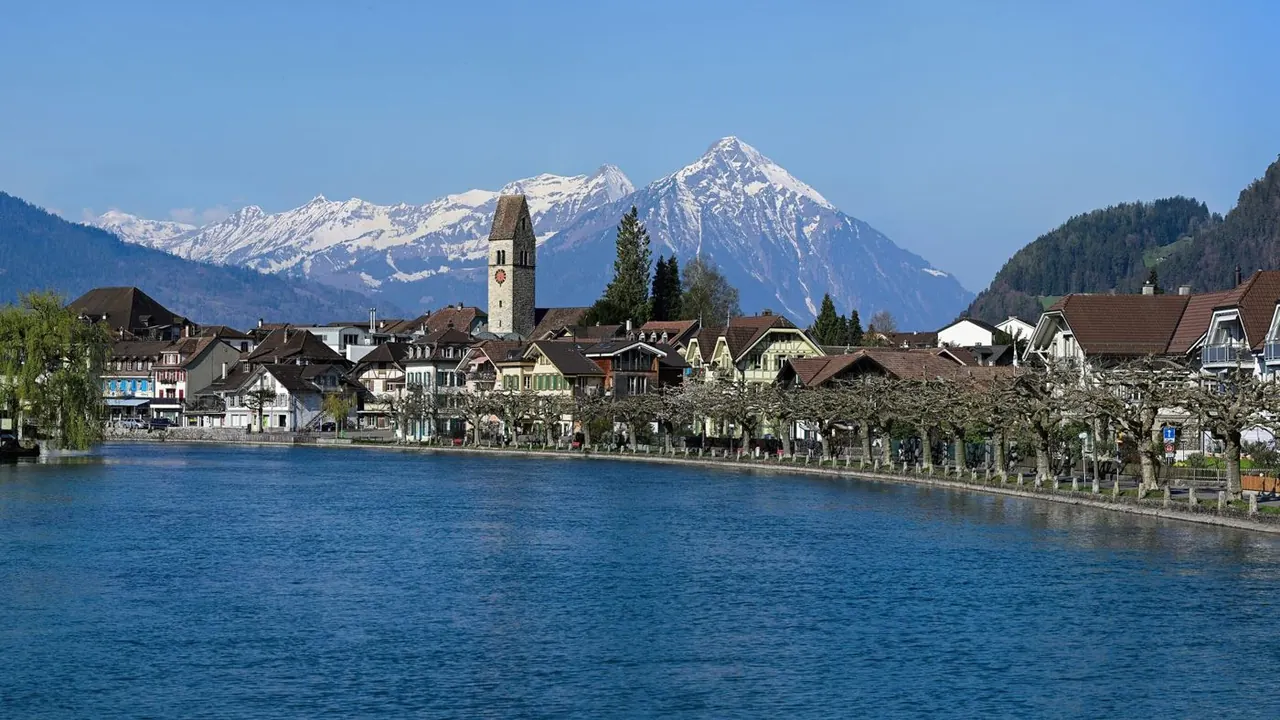
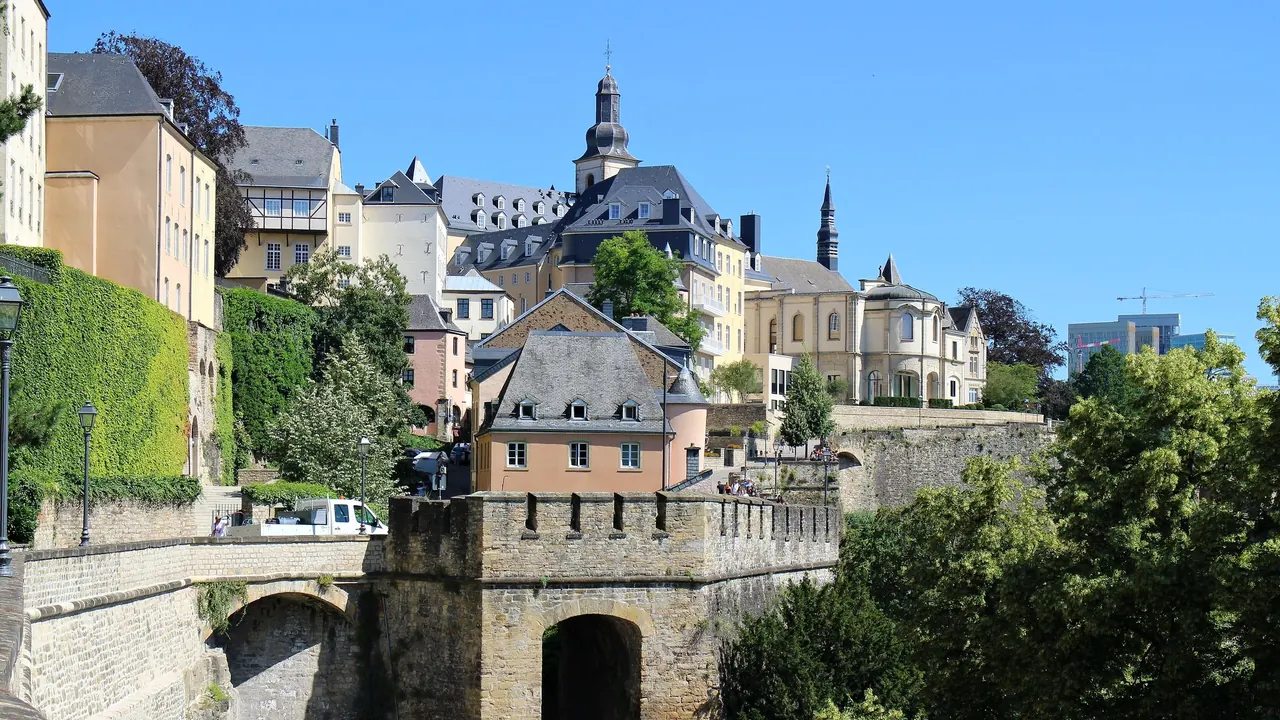
Photos: Interlaken by Roy Egloff, CC BY-SA 4.0, cropped; Luxembourg by Suicasmo, CC BY-SA 4.0, cropped.
Interlaken or Luxembourg?
Our verdict in twelve categories, each scored against the same fixed benchmark cities, and the climate month by month, so you can choose for your trip.
Choose Interlaken for
- nature and the outdoors
- families
- beaches
Interlaken is for travellers who come for the mountains and are happy to treat the town as a bed and a railway station. The Eiger views, the Lauterbrunnen valley and a full menu of paragliding, canyoning and lake paddling are all within an hour, and the Jungfraujoch makes a longer, full-day excursion for the glacier. Children tend to find the cog railways and summit playgrounds as exciting as the views. Expect simple evenings, plain food and a very large bill.
Choose Luxembourg for
- culture and sights
- live music and the arts
- food and drink
Luxembourg makes more sense if you want a small, civilised capital with real sights in it. The fortress casemates, the Grund and the gorges below the old town give two good days of walking, there is a concert hall of genuine quality, and the French-leaning tables and Moselle wines are a step above anything in the Bernese Oberland. Its countryside is green and gentle rather than dramatic, and Trier and Metz are close enough for easy extra days.
Scoreboard
Twelve categories on one fixed scale from 0 to 100. The shaded stretch is the gap between the two.
Your match
Pick a travel style or drag the sliders, and both match scores follow your weighting.
Wins on nature and the outdoors and families with your weighting.
Wins on culture and sights and live music and the arts with your weighting.
What matters to you?
Category by category
What the scores mean for a trip.
Beaches & swimming
Neither is a beach destination, but Interlaken has more to offer a swimmer. Lake Thun warms to about 21°C in a good summer, with grassy lidos and shingle beaches at Neuhaus and towards Spiez, and the turquoise of Lake Brienz under snow peaks makes even a short, cold dip memorable.
Luxembourg's bathing means a drive of about an hour to the Upper Sûre reservoir or an afternoon at the old gravel pits of Remerschen, and for most visitors the indoor pools in town are the realistic option.
Food & drink
Luxembourg eats noticeably better. French cooking sets the tone in its restaurants, Portuguese and Italian neighbourhood places add range, and the city has a fine-dining tier unusual for its size, all washed down with Moselle Riesling and crémant.
Interlaken's kitchens serve fondue, rösti and international standbys competently but without much ambition. Its best meals happen above the town, on a hut terrace near Mürren or Grindelwald with cheese from a mountain dairy, and plenty of visitors simply live on supermarket picnics.
Culture & sights
This is where the gap is widest. Luxembourg's old town sits on a sandstone plateau ringed by fortress remains, and you can walk the Bock casemates, look down on the Grund from the Chemin de la Corniche, then visit the Grand Ducal Palace, the cathedral and the national museum before crossing to MUDAM on Kirchberg.
Interlaken offers a row of grand hotels along the Höheweg, the Kursaal and a few timber houses in Unterseen, which takes an hour at most. For history and museums from there you take the train to Bern or Thun.
Nightlife
Luxembourg has the livelier evenings, though only modestly so. The bars and clubs of the Rives de Clausen, the stone pubs of the Grund and the later venues in Hollerich draw an international crowd of young professionals, busiest on Thursdays and Fridays.
Interlaken goes to bed early because everyone is up for the first train or a paraglide. Its nightlife is a handful of backpacker pubs and basement clubs near the hostels, the casino and a quiet drink on the Höheweg.
Nature & outdoors
Interlaken is one of the great mountain bases in Europe, and Luxembourg cannot compete. The cliffs and waterfalls of Lauterbrunnen, the faces of the Eiger, Mönch and Jungfrau, and high trails reached by cable car at Grindelwald First or Schynige Platte are all within an hour. The cog railway up to the Jungfraujoch and its view over the Aletsch glacier takes about two hours each way, so that one needs a whole day. Rafting, canyoning and winter skiing come on top, with low cloud the only real spoiler.
Luxembourg's outdoors is green and walkable rather than grand. The wooded Pétrusse and Alzette gorges cut through the city itself, the mossy rock passages of the Müllerthal are half an hour away, and the Ardennes and the Moselle cycle paths add quiet days, best in autumn.
Day trips
Both make excellent bases, but they point you towards different things. From Interlaken the trips are Swiss and largely scenic: Bern's arcaded old town, Thun's castle, steamer stops at Spiez and Oberhofen, the open-air museum at Ballenberg and Lucerne over the Brünig Pass.
From Luxembourg you cross borders. Roman Trier and the Gothic cathedral at Metz are each under an hour away, Nancy a little further, and closer to home the castle at Vianden, Echternach and the Moselle wine villages make slower outings.
Good for families
Interlaken keeps children busier. Rack railways, gondolas and lake steamers are an adventure in themselves, and the summit stations above Grindelwald and the Harder Kulm add playgrounds, cliff walks and summer toboggan runs, with the St Beatus caves and Ballenberg's farm animals as dependable extras. Rainy days and high altitude for toddlers are the weak points.
Luxembourg is calm, safe and easy with a buggy thanks to its lifts, and the casemate tunnels thrill most children. Beyond the fortress, the natural history museum and the small Parc Merveilleux, though, there is little built for them, so it suits a few days rather than a full week.
Getting around
Both are easy without a car, in different ways. Interlaken's strength is its linked web of mainline trains, narrow-gauge railways, cog lines, gondolas and lake boats that carries you across the whole Jungfrau region, though the popular mountain trains get crowded in summer.
Luxembourg makes things simple in another way: every tram, bus and second-class train in the country is free. Its centre is walkable but sits on several levels, with public lifts and a funicular linking the old town to the valley quarters and Kirchberg.
Shopping & style
Luxembourg is the better place to shop, if not an exciting one. The Grand-Rue carries luxury and premium fashion for a wealthy local clientele, Avenue de la Gare has the chains, and Villeroy & Boch porcelain, crémant and the market on Place Guillaume II give you something local to take home.
Interlaken's Höheweg is given over to watch stores for tour groups, army knives, cuckoo clocks and chocolate, plus outdoor gear. Carved wood from Brienz is the one craft worth seeking out.
Affordability
Both are among the costliest places to stay in Europe, but Interlaken is harder on the wallet. Swiss hotel and restaurant prices are only the start, since the mountain railways and the Jungfraujoch, which are the whole point of coming, add a heavy daily cost.
Luxembourg is expensive too, yet free public transport, several free museums, cheaper weekend hotel rates and lunch menus take some of the edge off, and staying in Trier or Metz is a common workaround.
Live music & performing arts
Luxembourg has a proper cultural calendar. The Philharmonie on Kirchberg is a first-rate concert hall with its own orchestra and touring soloists, the Grand Théâtre brings opera, dance and drama, and the Rotondes and summer concerts at Neimënster round it out.
Interlaken's offer is seasonal and folkloric: the long-running open-air William Tell performed by local amateurs, yodelling and alphorn evenings, and occasional Kursaal concerts. Anything more serious means an evening trip to Bern.
Wellness & relaxation
Luxembourg is slightly the better place to unwind, mainly because of Mondorf-les-Bains, a nineteenth-century thermal spa half an hour away with mineral-fed pools in a landscaped park. The city's quiet evenings and river walks through the Grund add to the calm.
Interlaken has no spring of its own and relies on hotel spas along the Höheweg and the town pool. Its restful moments come from slow steamer crossings and the hush of Wengen or Mürren, not from the busy, activity-minded centre.
When should you go?
Pick your month. The climate figures are measured averages, not a forecast.
Interlaken in July
Luxembourg in July
Daytime high, °C
Rainfall in the month, mm
Where the figures come from
Interlaken has no rain gauge within 25 km of the centre, so its rainfall comes from a gridded climate dataset read at the city rather than from a gauge further away.
Interlaken's sunshine is measured 66 km from the centre, at Sion.
Temperature and rainfall are climate normals, averaged over the years shown. Interlaken: 2005-2020 (sunshine 1961-1990, rainfall 1991-2020) normals, Meiringen / Unterbach (19.3 km from centre). Luxembourg: 1991-2020 normals, Luxembourg / Luxembourg (6.3 km from centre).
The two share almost the same temperature curve. Both reach about 24°C in July and August and both are cold from December to February, so summer is the obvious time for walking and lake swims in either. The difference is in the rain and the sky. Interlaken gets its wettest weather in early summer, with around 127mm in June, often as afternoon storms that can bring cloud down over the peaks, yet July is also its sunniest month at about 270 hours. September is a good compromise there, drier and still mild for high trails.
Luxembourg is steadier, with moderate rain spread evenly through the year and a dry, bright spring, so April and May suit its river walks and day trips well, and autumn brings the vineyard colours. Its winters are grey with very little sun, while Interlaken's cold months, around 3°C in the valley, are the ski season rather than a time to stay away.
Which traveller are you?
For an outdoors trip, Interlaken is the clear choice. High trails at Grindelwald First and Schynige Platte, the waterfalls of Lauterbrunnen, glacier views and adventure sports on two lakes are all reachable by train, while Luxembourg offers gentle forest walking in the Müllerthal and nothing alpine.
On a culture and arts trip, Luxembourg wins easily. The UNESCO-listed fortress, the casemate tunnels, the national museum and MUDAM fill two days, and evenings can go to the Philharmonie or the Grand Théâtre, whereas Interlaken has almost nothing to see in town.
On a family trip with children, Interlaken holds attention for longer. Mountain trains, gondolas, summer toboggan runs, the St Beatus caves and Ballenberg fill a week, while Luxembourg is calm and safe but suits only a short stay of two or three days.
Before you go
| Measure | Interlaken | Luxembourg |
|---|---|---|
| Official language | French, German, Italian, Romansh | French, German, Luxembourgish |
| Currency | Swiss Franc (CHF) | Euro (EUR) |
| Sockets | CJ230 V, 50 Hz | CF230 V, 50 Hz |
| Driving side | Right | Right |
| Time zone | UTC+1, UTC+2 in summer | UTC+1, UTC+2 in summer |
| Emergency number | 112 | 112 |
| Elevation | 571 m | 300 m |
| Main airport | Zürich Airport (ZRH)100 km from centre226 non-stop destinations | Luxembourg-Findel International Airport (LUX)6 km from centre115 non-stop destinations |
| Public holidays this year | 10 days | 12 days |
By the numbers
| Measure | Interlaken | Luxembourg |
|---|---|---|
| City population | 6,123 | 137,678 |
| People per km² | 1,424 | 2,663 |
| Museums within 10 km | 3 | 19 |
| UNESCO World Heritage sites within 50 km | 2 | 4 |
Where else could you go?
Every comparison below shares a destination with this one, so you can follow Interlaken or Luxembourg somewhere new.
- Bernvs Interlaken
- Lucernevs Interlaken
- Zermattvs Interlaken
- Zurichvs Interlaken
- Lausannevs Interlaken
- Baselvs Interlaken