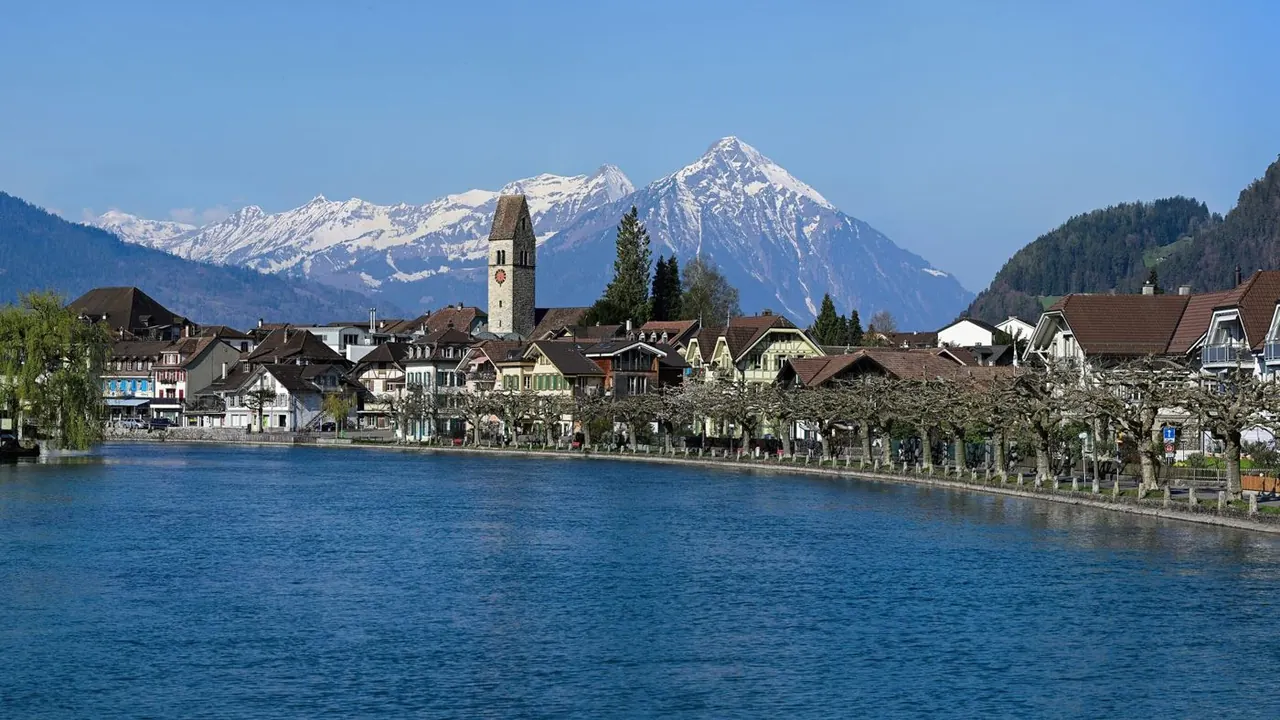
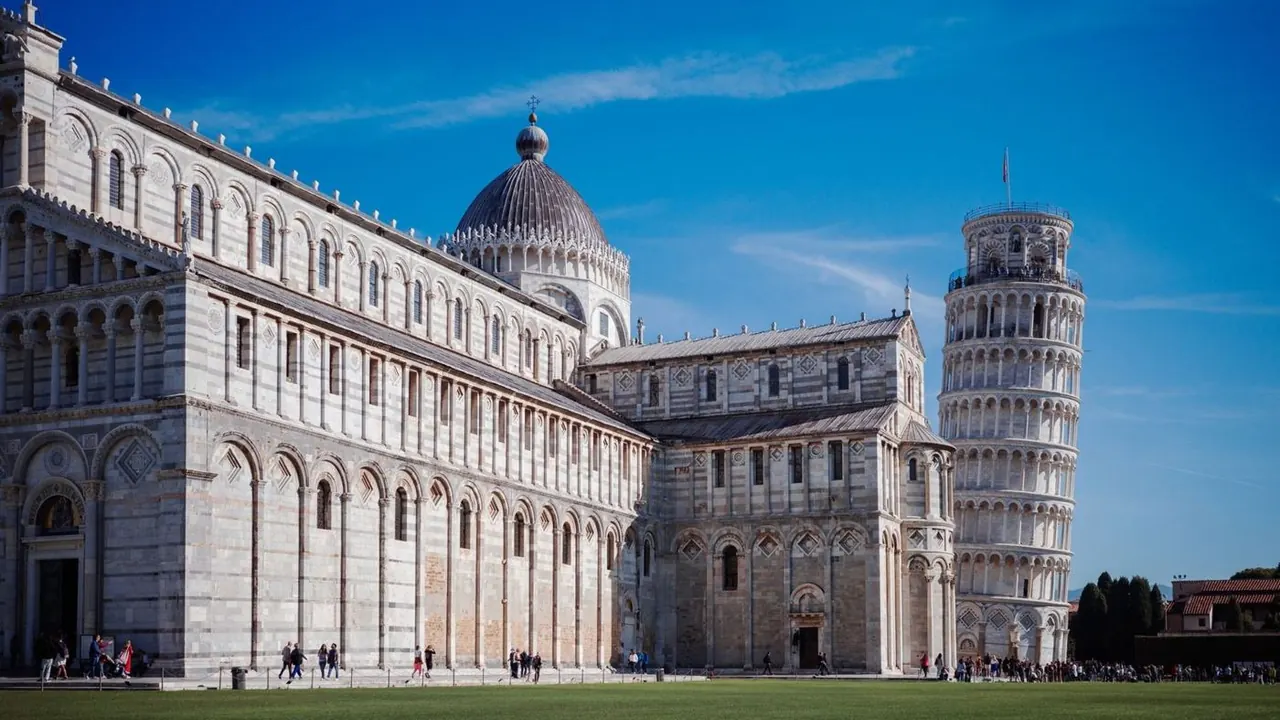
Photos: Interlaken by Roy Egloff, CC BY-SA 4.0, cropped; Pisa by Bruno Kraler, Pexels License.
Interlaken or Pisa?
Our verdict in twelve categories, each scored against the same fixed benchmark cities, and the climate month by month, so you can choose for your trip.
Choose Interlaken for
- nature and the outdoors
- families
- getting around
Interlaken is for travellers who come for the mountains and little else. The rail lines, gondolas and trails of the Jungfrau region, paragliding over the Höhematte and the winter ski areas make it one of the finest outdoor bases anywhere. Families also find the trains and summit playgrounds easy going. Expect to pay heavily for all of it, and to eat and spend your evenings simply.
Choose Pisa for
- culture and sights
- prices
- food and drink
Pisa suits someone who wants art, history and a taste of Tuscany without a Swiss-sized bill. The Piazza dei Miracoli and the quieter city beyond it fill a couple of days, and the trattorias around the old market are honest and good. Florence, Lucca and the Cinque Terre are all an easy train ride away. Nature here is gentler, but a sandy summer beach is close at hand.
Scoreboard
Twelve categories on one fixed scale from 0 to 100. The shaded stretch is the gap between the two.
Your match
Pick a travel style or drag the sliders, and both match scores follow your weighting.
Wins on nature and the outdoors and families with your weighting.
Wins on culture and sights and prices with your weighting.
What matters to you?
Category by category
What the scores mean for a trip.
Beaches & swimming
Interlaken has lake swimming rather than beaches. There are grassy lidos and shingle on Lake Thun and the colder glacial turquoise of Lake Brienz, lovely under the peaks but only really swimmable in July and August.
Pisa has a proper coast about 12km away. Tirrenia and Calambrone have long sandy beaches backed by pines, with shallow, warm water in high summer and the full Italian set-up of rented umbrellas. Versilia is a short train ride north. It still works best as an afternoon off from sightseeing.
Food & drink
Interlaken's restaurants are dependable and hearty, with fondue, raclette and rösti alongside Indian, Asian and Middle Eastern places, but nothing in town is worth seeking out. The good meals come from the region around it: cheese from the mountain dairies, lunch on a hut terrace above Grindelwald or Mürren, or a white wine from Lake Thun.
Pisa eats better, though it is no dining destination either. Cecina comes hot from wood ovens, and the trattorias around the Piazza delle Vettovaglie market serve ribollita, game and salt cod at student-friendly prices. The menus to skip are the ones near the tower, and the seafood is better out on the coast.
Culture & sights
This is the widest gap between the two. In Interlaken the sights are a row of grand hotels, the Kursaal and a few timber houses in Unterseen. Anything more means a train to Bern or Thun.
Pisa has one of Italy's great architectural ensembles in the Piazza dei Miracoli, where the tower, cathedral, baptistery and Camposanto stand together on one lawn. Beyond it lies a quieter second layer: Piazza dei Cavalieri, Santa Maria della Spina on the Arno, and the medieval collections of San Matteo.
Nightlife
Neither is a place to go out, but Pisa has more of an evening. Interlaken's nights end early, with a few backpacker pubs and basement clubs near the hostels and the Kursaal casino for a change. In Pisa, students fill the squares around the old market during term, Borgo Stretto and the riverbanks draw an aperitivo crowd, and in summer the action moves to the beach bars.
Nature & outdoors
Interlaken is in a different league here. The Eiger, Mönch and Jungfrau and the waterfalls of the Lauterbrunnen valley are all within an hour by rail. A full day's excursion on the cog railway reaches the Jungfraujoch, which looks out over the Aletsch glacier. The town is also a centre for paragliding, canyoning and rafting, with skiing in winter.
Pisa's outdoors are softer. There are deer in the pine woods and dunes of San Rossore, olive-terrace paths on the Monte Pisano and birdwatching at Massaciuccoli. For real mountain hiking you have to travel further, to the Apuan Alps or the cliff paths of the Cinque Terre.
Day trips
Interlaken is a well-connected base. Trains and lake steamers reach Bern's arcaded old town, Thun's castle, the shore castles of Spiez and Oberhofen and the Ballenberg open-air museum, with Lucerne a longer scenic ride over the Brünig Pass. Many of its other outings are mountain villages, much like the scenery on its doorstep.
Pisa's range is wider and more varied. Florence is about an hour away and Lucca under half an hour, and the Cinque Terre, Volterra, San Gimignano and Siena each make a full day. Each of these feels quite different from Pisa itself.
Good for families
Interlaken is the stronger choice with children, because getting about is part of the fun. There are rack railways, gondolas and lake steamers, summit playgrounds, summer toboggan runs, the St Beatus caves and the farm animals at Ballenberg. Wet days and the high altitudes, which can trouble toddlers, are the catches.
Pisa is flat and compact, and the tower photo always goes down well, but little else is designed for children, and younger ones cannot climb the tower. The best family days are on the shallow beaches of Tirrenia or cycling in San Rossore.
Getting around
Both are easy without a car, but in different ways. Interlaken's own streets matter little. Its strength is the network of mainline trains, cog railways, gondolas and steamers across the Jungfrau region, though the popular trains get crowded in summer. Pisa is first a city you walk, with the airport a shuttle ride from the station and frequent trains across western Tuscany, though a car helps for the inland hill towns.
Shopping & style
Pisa has ordinary Italian shopping, while Interlaken has mostly souvenirs. The Höheweg sells watches, army knives, cuckoo clocks and chocolate to tour groups, and Brienz woodcarving is the one local craft worth seeking out. Pisa has mid-range fashion on Corso Italia, smarter shoes and old pastry shops under the arcades of Borgo Stretto, and a monthly antiques market along the river.
Affordability
Pisa is far easier on the wallet. Interlaken charges full Swiss prices for rooms, meals and drinks. On top of that come the mountain railways that are the point of the stay, the Jungfraujoch above all, and picnics and transport passes only soften the bill.
Pisa is moderately priced for a famous Italian city, with student trattorias, mid-range rooms and a centre you can cover on foot for free. The main extras are the tower climb and summer beach loungers.
Live music & performing arts
Pisa has more on stage. The Teatro Verdi, a 19th-century horseshoe-shaped house, runs opera, concerts, ballet and drama from autumn to spring, and the university and the churches add chamber music and recitals. Interlaken's highlight is the amateur open-air William Tell, staged in the woods each summer, along with folklore evenings of yodelling and alphorns. These are charming but slight, and Bern's theatre and orchestra are under an hour away.
Wellness & relaxation
Neither has a bathing culture in town, and in both the calm comes mostly from the setting. Interlaken relies on grand hotel spas, a public wellness area, slow steamer crossings and the quiet of Wengen or Mürren, above a busy centre geared to activity. Pisa has real thermal water nearby, at the Roman-era springs of San Giuliano Terme and the larger pool at Casciana Terme, and its old town has an easy, small-scale pace away from the cathedral square.
When should you go?
Pick your month. The climate figures are measured averages, not a forecast.
Interlaken in July
Pisa in July
Daytime high, °C
Rainfall in the month, mm
Where the figures come from
Interlaken has no rain gauge within 25 km of the centre, so its rainfall comes from a gridded climate dataset read at the city rather than from a gauge further away.
Temperature and rainfall are climate normals, averaged over the years shown. Interlaken: 2005-2020 (rainfall 1991-2020) normals, Meiringen / Unterbach (19.3 km from centre). Pisa: 1991-2020 normals, Pisa / S. Giusto (3.9 km from centre).
Interlaken is a summer and winter destination with a grey gap in between. From June to September the valley is warm enough for walking and a lake swim, peaking around 24°C in July, and this is when the high trails and mountain railways are at their best. In winter the ski areas take over while the town sits near 3°C in January. Rain is spread fairly evenly through the year and summer is no drier than winter, so low cloud over the peaks is a risk in every season.
Pisa is warmer all year. Spring and early autumn are best for walking the streets, because July and August reach 30°C on the humid plain. Those are also the months when the sea is warmest, around 25°C, and the sun is most reliable. The wet season comes late. June to August are the driest months, while October and November are the wettest, at up to 132mm. Mild winters make Pisa a reasonable city break while Interlaken is under snow.
Which traveller are you?
On an outdoors trip, Interlaken is the obvious choice. Each morning brings a choice of ridge, valley or lake, the trains do the climbing, and evenings end early because the next day starts early too. In Pisa, the outdoors fills pleasant half-days rather than a whole trip.
For a culture and arts trip, Interlaken leaves you catching trains to find anything to look at. Pisa fills the days by itself, with slow mornings among marble and frescoes, afternoons in quiet side streets, a night at the opera in season, and other Tuscan art cities close by.
On a tight budget, Interlaken means counting every fare, carrying lunch up the mountain and watching the best views slip behind another ticket. In Pisa you can eat out every night and walk everywhere, then spend what you save on a day out in Florence or the hills.
Before you go
| Measure | Interlaken | Pisa |
|---|---|---|
| Official language | French, German, Italian, Romansh | Italian |
| Currency | Swiss Franc (CHF) | Euro (EUR) |
| Sockets | CJ230 V, 50 Hz | CFL230 V, 50 Hz |
| Driving side | Right | Right |
| Time zone | UTC+1, UTC+2 in summer | UTC+1, UTC+2 in summer |
| Emergency number | 112 | 112 |
| Elevation | 571 m | 4 m |
| Main airport | Zürich Airport (ZRH)100 km from centre226 non-stop destinations | Pisa International Airport (PSA)4 km from centre82 non-stop destinations |
| Public holidays this year | 10 days | 13 days |
By the numbers
| Measure | Interlaken | Pisa |
|---|---|---|
| City population | 6,123 | 88,737 |
| People per km² | 1,424 | 479 |
| Museums within 10 km | 3 | 27 |
| UNESCO World Heritage sites within 50 km | 2 | 3 |
| Swim season, months above 21 °C | - | 4 months |
Where else could you go?
Every comparison below shares a destination with this one, so you can follow Interlaken or Pisa somewhere new.