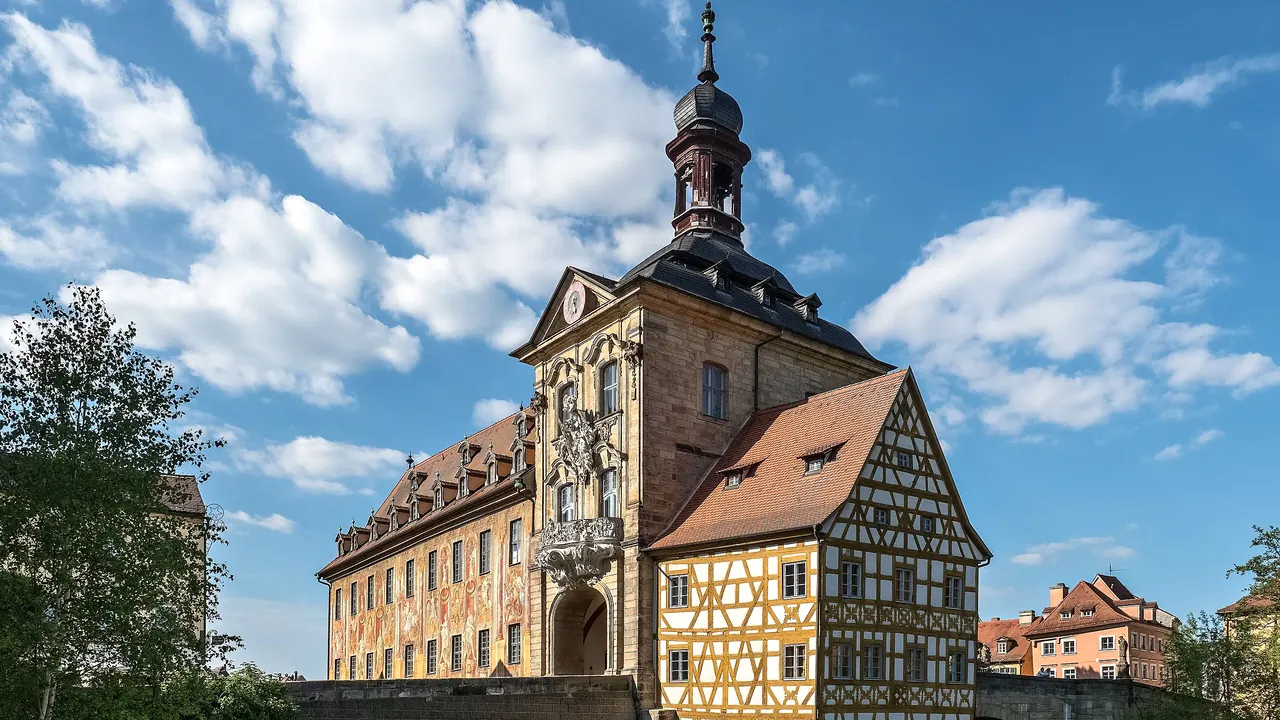
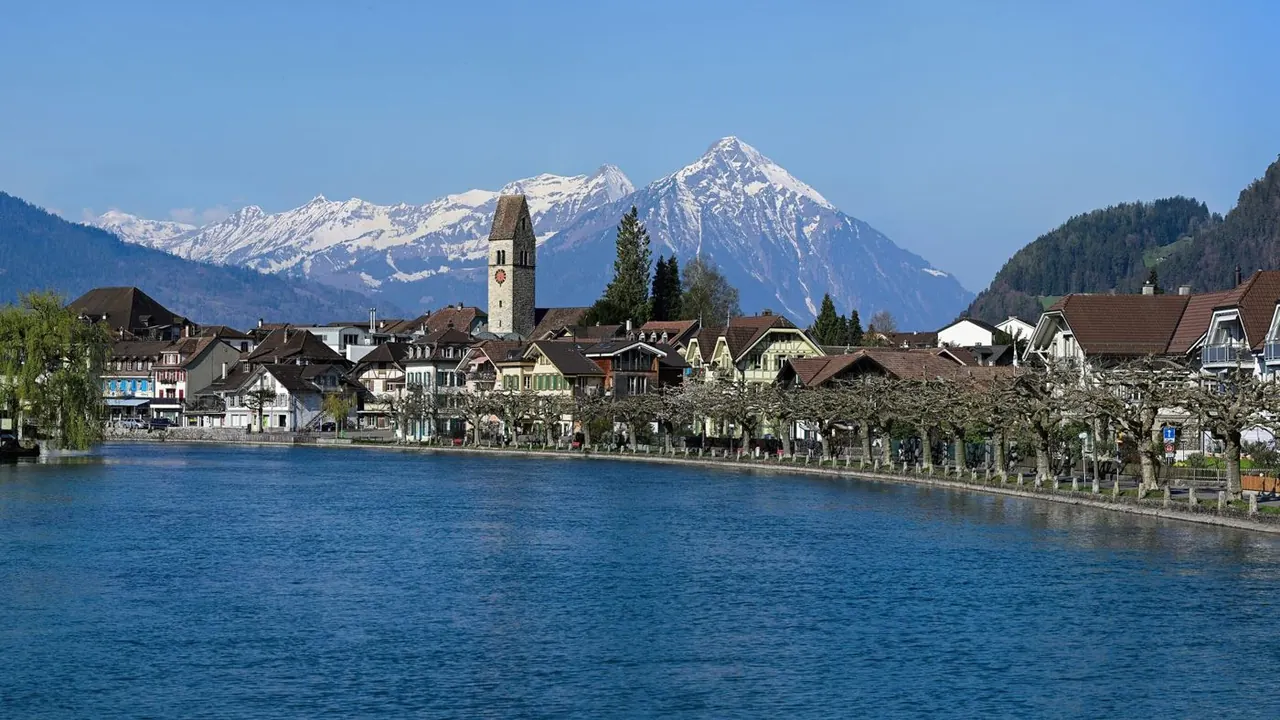
Photos: Bamberg by Ermell, CC BY-SA 4.0, cropped; Interlaken by Roy Egloff, CC BY-SA 4.0, cropped.
Bamberg or Interlaken?
Our verdict in twelve categories, each scored against the same fixed benchmark cities, and the climate month by month, so you can choose for your trip.
Choose Bamberg for
- culture and sights
- prices
- food and drink
Bamberg suits travellers who want an old town to wander and a table to sit at afterwards. Its UNESCO-listed centre, cathedral hill and brewery taverns reward slow days on foot. Evenings come with smoked beer rather than early alarms, and the bill stays at ordinary German levels. Nuremberg, Würzburg and Bayreuth are close enough by train to fill a longer stay.
Choose Interlaken for
- nature and the outdoors
- families
- beaches
Interlaken is the choice when the trip is about mountains. The Eiger, the Jungfrau and the Lauterbrunnen valley are within an hour, trains and cable cars take you up to high trails with little effort, and children tend to love the rack railways and summit playgrounds. Expect to pay heavily for it, and to find little in the town itself once the day outdoors is over.
Scoreboard
Twelve categories on one fixed scale from 0 to 100. The shaded stretch is the gap between the two.
Your match
Pick a travel style or drag the sliders, and both match scores follow your weighting.
Wins on culture and sights and prices with your weighting.
Wins on nature and the outdoors and families with your weighting.
What matters to you?
Category by category
What the scores mean for a trip.
Beaches & swimming
Neither is a beach destination, but Interlaken at least gives you a proper lake swim in high summer. Lake Thun warms up enough for the grassy lidos and shingle shores at Neuhaus and towards Spiez. The colder turquoise water of Lake Brienz at Bönigen makes for a bracing dip beneath snow peaks.
Bamberg has the river bathing spot in the Hain park, the gravel-pit lakes on the edge of town and its public pools. They are fine for cooling off but have none of the scenery.
Food & drink
Bamberg is the better place to eat and drink, as long as beer and pork appeal. Its dense cluster of small breweries, Rauchbier poured from wooden barrels and summer evenings in the hillside Bierkeller give meals a strong sense of place, and the Schäufele and dumplings match them.
Interlaken has more international kitchens but serves little you would remember, mostly fondue, rösti and curries for visitors. Its best food is out in the region: cheese from the mountain dairies, a hut terrace above Grindelwald or Mürren, a glass of white wine from Lake Thun.
Culture & sights
Here the gap is wide. Bamberg's old town came through the war intact and is listed as a whole. You can spend a day on the Imperial Cathedral with the Bamberg Horseman, the rose garden of the Neue Residenz, the frescoed Town Hall on its island and the fishermen's houses of Little Venice. The museums are modest, but the townscape itself is the sight.
Interlaken has the grand hotels and the Kursaal on the Höheweg and a few timber houses in Unterseen, and not much more. For history and architecture, visitors take the train to Bern or Thun.
Nightlife
Bamberg has the longer evenings, though they revolve around beer rather than dancing. The brewery taverns fill up after work, the student bars of the Sand quarter below the cathedral keep going late in term time, and in summer people linger at the long tables of the hillside beer cellars. Clubs are few and small, so for a big night out people take the train to Nuremberg.
Interlaken winds down early, because most of its visitors are up at dawn for trains, hikes and paragliding. A handful of backpacker pubs and basement clubs near the hostels get livelier in summer and in the ski season. Otherwise the evening means a drink along the Höheweg after dinner or the casino in the Kursaal, and the streets fall quiet long before midnight.
Nature & outdoors
Interlaken is in another league. The Eiger, Mönch and Jungfrau, the waterfalls of the Lauterbrunnen valley and the Jungfraujoch above the Aletsch glacier are all within an hour. The town is also a major centre for paragliding, canyoning and rafting, and in winter for skiing at Grindelwald, Wengen and Mürren. Low cloud is the only real catch.
Bamberg's countryside is pleasant rather than spectacular. It has the limestone valleys and rock towers of Franconian Switzerland, the beech woods of the Steigerwald and flat cycle paths along the Main, many of them linking one village brewery to the next.
Day trips
Both make excellent bases, and Interlaken has a slight edge for the variety on its doorstep. Bern's arcaded old town is under an hour away, and paddle steamers call at the castle towns of Thun, Spiez and Oberhofen. Ballenberg, Brienz and Lucerne add rural buildings, woodcarving and a lakefront.
Bamberg's outings are mostly to towns with deep history: Nuremberg's castle, Würzburg's Residence, Coburg, Bayreuth and the baroque basilica of Vierzehnheiligen. Rothenburg is within reach on a long day.
Good for families
Interlaken is much the easier sell to children. Rack railways, gondolas and steamers are an adventure in themselves, and the summit stations above Grindelwald and at Harder Kulm add playgrounds, cliff walks and toboggan runs. The St Beatus caves and the farm animals at Ballenberg add variety, though wet days and high altitude with toddlers are the weak points.
Bamberg is safe and gentle but has less for children: the playgrounds in the Hain park, boats on the Regnitz, a leisure pool with slides and beer gardens where children play among the tables. The cobbles up the cathedral hill are hard going with a pushchair.
Getting around
Both are easy without a car, and both have centres you can walk. Bamberg's island town, cathedral hill and Little Venice are minutes apart, although the climbs are steep and cobbled and the station is a fair walk out.
Interlaken pulls ahead on how far you can go. Its flat town links two stations along the Höheweg. From there, narrow-gauge lines, cog railways, gondolas and lake steamers connect smoothly across the whole Jungfrau region, though the busiest mountain trains get crowded in summer.
Shopping & style
Bamberg's best buys are grown, brewed or collected in the town itself, while Interlaken's shops mostly sell national souvenirs to tour groups. Around Grüner Markt and Lange Strasse, Bamberg has independent bookshops and boutiques among the chain stores, antique dealers near the cathedral quarter, and produce from the market gardens and bottled smoked beer from the brewery shops to take home.
Interlaken's Höheweg is lined with big watch and jewellery stores, army knives, cuckoo clocks and chocolate, plus outdoor gear for anyone short of a rain jacket. Carved wood from Brienz is the one local craft worth looking for.
Affordability
The difference in cost is stark. Bamberg has ordinary Western European prices, with cheap local beer, modest tavern meals and moderately priced rooms outside busy weekends. You walk everywhere, so transport costs little.
Interlaken is expensive at every turn. On top of Swiss hotel and restaurant prices, the mountain railways and cable cars you go there for add a heavy extra cost. Hostels, picnics and regional passes help, but only so far.
Live music & performing arts
Bamberg has a real classical music scene for a town of its size. The Bamberg Symphony plays its home season in the concert hall on the Regnitz, the ETA Hoffmann Theatre stages drama, and the churches hold organ and choral concerts. The Bayreuth Festival is an hour away.
Interlaken has a seasonal, homespun programme: the amateur open-air William Tell in the woods each summer, folklore evenings with alphorns and yodelling, and the odd concert in the Kursaal. For serious music you go to Bern.
Wellness & relaxation
Rest takes different forms in the two towns. In Bamberg the calm comes from the pace: slow mornings by the river and long afternoons in the beer gardens, in a town that grows quiet once the day visitors leave. For proper thermal bathing, the warm brine pools of Bad Staffelstein are half an hour away by train.
Interlaken has no thermal tradition either, but the grand hotels on the Höheweg have sizeable spas. Steamer crossings, early mornings on the lakeshore and the mountain villages above are restful too. The centre itself is busy and geared to activity, so people who want quiet stay by the lakes or up in Wengen or Mürren.
When should you go?
Pick your month. The climate figures are measured averages, not a forecast.
Bamberg in July
Interlaken in July
Daytime high, °C
Rainfall in the month, mm
Where the figures come from
Interlaken has no rain gauge within 25 km of the centre, so its rainfall comes from a gridded climate dataset read at the city rather than from a gauge further away.
Interlaken's sunshine is measured 66 km from the centre, at Sion.
Temperature and rainfall are climate normals, averaged over the years shown. Bamberg: 1991-2020 normals, Bamberg (2.8 km from centre). Interlaken: 2005-2020 (sunshine 1961-1990, rainfall 1991-2020) normals, Meiringen / Unterbach (19.3 km from centre).
Both are inland towns with cold winters and warm but not hot summers, and both are at their best from May to September. Bamberg is a little warmer, reaching about 26°C in July, and much drier, so beer-garden evenings and walks over the seven hills are reliable through the summer. From November to February it is cold and grey with very little sun, though the old town still makes a good walk in a warm coat.
Interlaken peaks a degree or two cooler and is far wetter, with around 125mm a month from May to August, and cloud can hide the peaks. Even so, it gets more sunshine than Bamberg for most of the year, up to 270 hours in July, and the lakes are only warm enough to swim in July and August. Winter is cold in the valley but brings the ski season to the slopes above, which gives Interlaken a second season that Bamberg lacks.
Which traveller are you?
For an outdoors trip, Interlaken has no real rival here. Mountain railways and cable cars reach high trails under the Eiger and Jungfrau, and paragliding, canyoning, rafting and winter skiing all start from town. Bamberg offers gentle hills and riverside cycle paths.
On a culture and arts trip, Bamberg is the clear pick. Its whole old town is UNESCO-listed, from the cathedral hill to the Town Hall on its river island, and the Bamberg Symphony plays its home season beside the Regnitz. From Interlaken, the sights are a train ride away.
On a trip with a tight budget, Bamberg makes the money go much further. Tavern meals and local beer are cheap, rooms are moderately priced and you can walk everywhere. In Interlaken, hotels, meals and above all the mountain railways all cost full Swiss prices.
Before you go
| Measure | Bamberg | Interlaken |
|---|---|---|
| Official language | German | French, German, Italian, Romansh |
| Currency | Euro (EUR) | Swiss Franc (CHF) |
| Sockets | CF230 V, 50 Hz | CJ230 V, 50 Hz |
| Driving side | Right | Right |
| Time zone | UTC+1, UTC+2 in summer | UTC+1, UTC+2 in summer |
| Emergency number | 112 | 112 |
| Elevation | 262 m | 571 m |
| Main airport | Nuremberg Airport (NUE)46 km from centre56 non-stop destinations | Zürich Airport (ZRH)100 km from centre226 non-stop destinations |
| Public holidays this year | 12 days | 10 days |
By the numbers
| Measure | Bamberg | Interlaken |
|---|---|---|
| City population | 77,218 | 6,123 |
| People per km² | 1,414 | 1,424 |
| Museums within 10 km | 11 | 3 |
| UNESCO World Heritage sites within 50 km | 1 | 2 |
Where else could you go?
Every comparison below shares a destination with this one, so you can follow Bamberg or Interlaken somewhere new.
- Bernvs Interlaken
- Nurembergvs Bamberg
- Lucernevs Interlaken
- Zermattvs Interlaken
- Rothenburg ob der Taubervs Bamberg
- Zurichvs Interlaken