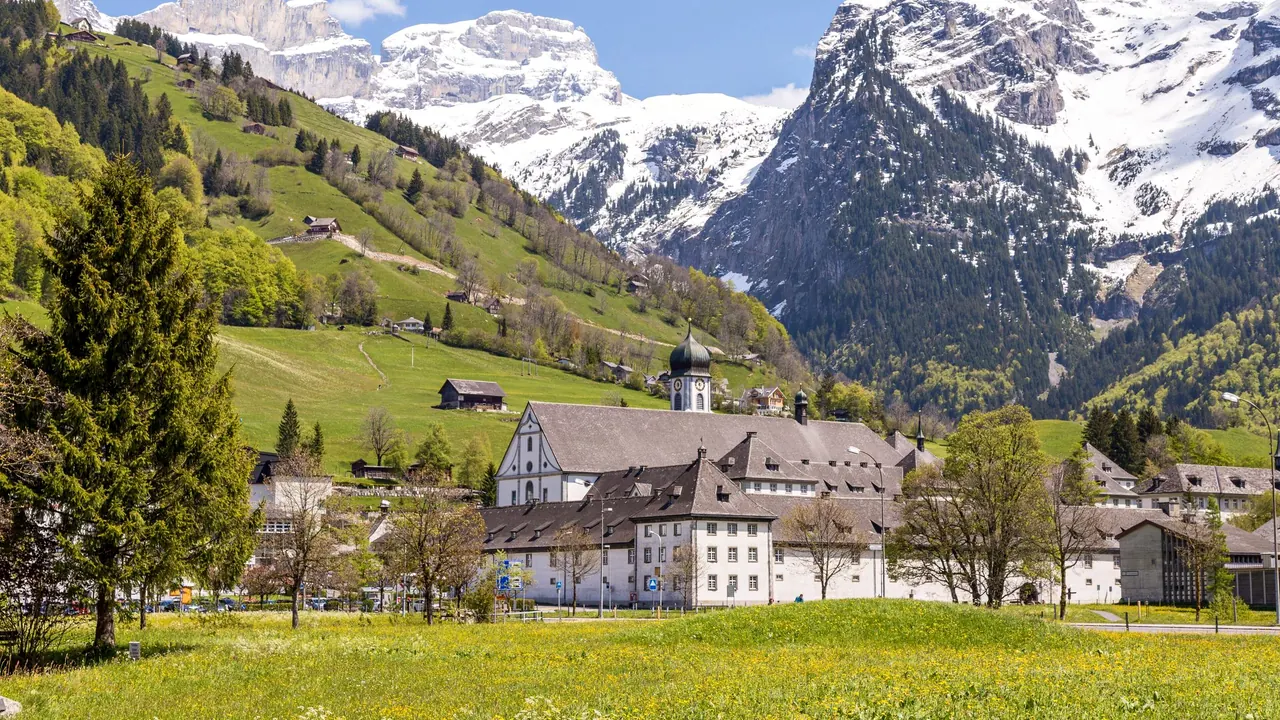
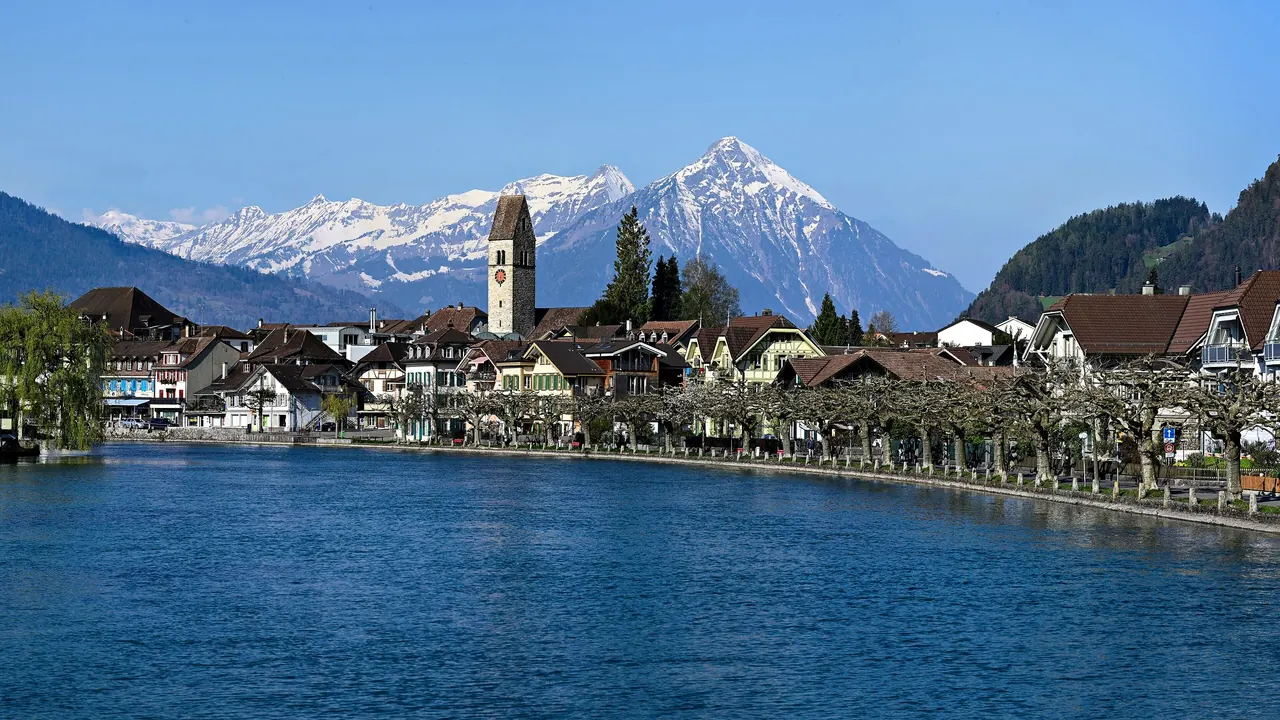
Photos: Engelberg by JoachimKohler-HB, CC BY-SA 4.0, cropped; Interlaken by Roy Egloff, CC BY-SA 4.0, cropped.
Engelberg or Interlaken?
Our verdict in twelve categories, each scored against the same fixed benchmark cities, and the climate month by month, so you can choose for your trip.
Choose Engelberg for
- culture and sights
- nightlife
- wellness
Engelberg suits travellers who want one valley and one mountain done thoroughly. Titlis and its glacier rise straight from the edge of the village, the Benedictine abbey gives the place a real centre, and in winter the steep north faces draw freeriders from across Europe. It is the quieter, more self-contained choice, best for a week of skiing or walking with little need to go anywhere else.
Choose Interlaken for
- beaches
- day trips
- nature and the outdoors
Interlaken is the better base for someone who wants to range widely. The Jungfrau peaks, the Lauterbrunnen valley and a dense web of mountain railways are all close by, and Bern, Thun and the lake steamers add towns and castles to the mix. Families, adventure-sport fans and anyone hoping for a summer lake swim will find more to do here, as long as they don't mind a busier, more transient town.
Scoreboard
Twelve categories on one fixed scale from 0 to 100. The shaded stretch is the gap between the two.
Your match
Pick a travel style or drag the sliders, and both match scores follow your weighting.
Wins on culture and sights and nightlife with your weighting.
Wins on beaches and day trips with your weighting.
What matters to you?
Category by category
What the scores mean for a trip.
Beaches & swimming
Neither is a beach destination, but Interlaken at least lets you swim on your doorstep in high summer. Lake Thun warms to around 21°C, with grassy lidos at Neuhaus and along the shore towards Spiez, and the colder turquoise water of Lake Brienz can be tried at Bönigen.
From Engelberg, a swim means the train down to Lake Lucerne, about an hour away, or an indoor pool. The Trübsee is for walking round, not for bathing.
Food & drink
The two are about level, and in both places the meals are mostly fondue, raclette and rösti at high prices. Engelberg feels more rooted in the Alps: it has the cheese dairy inside the monastery, Älplermagronen in wood-panelled rooms and terrace lunches facing the glacier.
Interlaken has a wider spread of Indian, Asian and Middle Eastern places for its international crowd. Its best moments are out in the region, at hut terraces above Grindelwald or with a white wine from Lake Thun.
Culture & sights
Both are thin on sights, but Engelberg has the one real monument. The abbey founded in 1120 has a late-baroque church and one of Switzerland's largest organs, and the monastery shapes the whole valley floor. Interlaken offers a row of grand hotels on the Höheweg, the Kursaal and a few old timber houses in Unterseen, and its serious history and architecture lie a train ride away in Bern or Thun.
Nightlife
Neither keeps anyone up late, and the difference is in season and crowd. Engelberg comes alive only in winter, when après-ski bars at the foot of the slopes fill up and Scandinavian freeriders and seasonal workers keep a small club going at weekends. In summer it goes quiet.
Interlaken's scene is backpacker pubs, sports bars and basement clubs near the hostels, busy in both summer and the ski season. It also has the casino in the Kursaal.
Nature & outdoors
Both are superb, and Interlaken goes further. Within an hour by rail it reaches the Eiger, Mönch and Jungfrau, the waterfalls of Lauterbrunnen, Trümmelbach and the Jungfraujoch above the Aletsch glacier. It is also a major centre for paragliding, canyoning, rafting and lake paddling.
Engelberg puts one great mountain right at the door. Titlis's glacier, ice cave and suspension bridge are a cable car from the village, the Four Lakes walk crosses the Jochpass, and in winter its north faces are among the best-known freeride terrain in the Alps.
Day trips
Every day trip from Engelberg begins with the train back down the valley. Lucerne is the obvious one, under an hour away, with its covered bridges, old town and paddle steamers to Weggis and Vitznau. Stans is on the way, and Schwyz, Einsiedeln's baroque abbey, Zug and Zurich make a good but short list.
Interlaken has the wider choice because it sits on the main rail network. Bern's arcaded old town is under an hour away, Thun and its castle are half an hour along the lake, and Lake Thun's steamers call at Spiez and Oberhofen, each with its own castle. The open-air museum at Ballenberg, with farm buildings brought from across Switzerland, makes a different kind of outing.
Good for families
In Engelberg children can pole rafts across the Härzlisee, play beside the Trübsee and throw snowballs on Titlis in July, and everything from the station to the lifts is a short walk. Winter adds ski schools, gentle beginner slopes and sledging. The glacier station at 3,000m is hard going for the very young, and on wet days Lucerne's transport museum is close.
Interlaken keeps children busy for longer. Cog railways and lake steamers are outings in themselves, and the summit stations above Grindelwald and on the Harder Kulm have playgrounds, cliff walks and summer toboggan runs. It has no zoo or science museum, though, so rainy days take some planning.
Getting around
From Engelberg station everything in the village is a short walk, and in the ski season a free shuttle runs to the hotels and cable cars. Lifts reach both mountain areas, but no road runs on past the head of the valley, so every journey further afield starts with the cog-railway descent to Lucerne.
Interlaken is a junction rather than a terminus. Its two stations, twenty minutes apart on foot along the Höheweg, link mainline trains to Bern with the narrow-gauge lines to Lauterbrunnen and Grindelwald, and cog railways, gondolas and lake steamers connect neatly with them. Neither place needs a car, though Interlaken's busiest mountain trains fill up in summer.
Shopping & style
Neither is worth a trip for shopping, but Interlaken has more of it. The Höheweg is lined with big watch and jewellery stores, shops selling army knives and cuckoo clocks, and outdoor gear shops, and Brienz woodcarving is a genuine local craft to take home. In Engelberg the best things to take home are edible: cheese from the monastery dairy, dried meats and chocolate, plus ski and outdoor gear on the main street.
Affordability
Both are equally and painfully expensive, at full Swiss resort prices for beds, meals and drinks. Where the money goes differs. In Engelberg the big costs are the Titlis cable car and ski passes. In Interlaken it is the run of mountain railways, above all the Jungfraujoch, plus adventure sports, though its hostels give budget travellers a cheaper place to sleep.
Live music & performing arts
Engelberg's music is centred on the abbey church, where organ recitals and concerts fill the late-baroque interior, and a small summer festival brings classical concerts to the village. For anything bigger, Lucerne's concert halls are less than an hour away.
Interlaken's signature is Schiller's William Tell, staged in the woods by local amateurs every summer since the early twentieth century. Folklore evenings with yodelling and alphorns, occasional concerts in the Kursaal, and Bern's theatre and orchestra under an hour away give it a little more range.
Wellness & relaxation
There is little to choose between them. Neither has thermal springs, so in both a spa day means a hotel sauna, steam room and pool. Interlaken's grand Höheweg hotels have the larger spas, and its public pool has its own wellness area, so you don't need to book a spa hotel to use one. In Engelberg the only public option is a swim in the sports-centre pool.
The setting is what differs most. Engelberg's calm comes from staying put in one enclosed valley, as long as you avoid the peak ski weeks and the busiest hours on the Titlis cable car. Interlaken's calm comes from its two lakes: a bench by the water, or a summer swim in Lake Thun, after a day spent among the crowds at the stations.
When should you go?
Pick your month. The climate figures are measured averages, not a forecast.
Engelberg in July
Interlaken in July
Daytime high, °C
Rainfall in the month, mm
Where the figures come from
Engelberg has no weather station within reach, so its figures come from a gridded climate model rather than a measured record, and read a broad area rather than one spot.
Interlaken has no rain gauge within 25 km of the centre, so its rainfall comes from a gridded climate dataset read at the destination rather than from a gauge further away.
Interlaken's sunshine is measured 66 km from the centre, at Sion.
Temperature and rainfall are climate normals, averaged over the years shown. Engelberg: 2001-2020 normals, NASA POWER reanalysis grid, no weather station within 90 km. Interlaken: 2005-2020 (sunshine 1961-1990, rainfall 1991-2020) normals, Meiringen / Unterbach (19.3 km from centre).
Engelberg's summer is short and mild, with daytime highs of around 21°C in July and August. It is also the wetter of the two all year, with roughly 150mm of rain in each month from May to August, so summer walks are best started early, before the showers build. From December to February the days barely rise above freezing, which keeps the snow in good shape for skiing, and late autumn turns grey between the seasons.
Interlaken sits lower, between its lakes, and stays two or three degrees warmer through winter, spring and summer, reaching about 24°C in July. Spring walking starts a little earlier there, and high summer is warm enough for the lakes. Its rain also peaks from June to August, but July is its sunniest month and gives the best chance of clear views of the peaks, while the valley floor gets little sun in midwinter. The two are almost level only in autumn. In both places September is the best month for walking: still mild, and clearly drier than the summer.
Which traveller are you?
On an outdoors trip, Interlaken has the edge. It has the Eiger, Mönch and Jungfrau, the Jungfraujoch railway, and canyoning, rafting and paragliding run from town. Engelberg is the pick only for freeriders who come specifically for the steep slopes of Titlis.
On a family trip with children, Interlaken offers more variety: rack railways, lake steamers, summer toboggan runs, the St Beatus caves and Ballenberg's farm animals. Engelberg's Härzlisee rafts and Trübsee boats are charming, but there is less to fill a fortnight.
For a relaxing and wellness trip, Engelberg is the calmer stay. It began as a health resort, and its quiet valley and abbey bells suit slowing down. Interlaken's centre is geared to coach groups and activity, so rest there means escaping to Wengen or Mürren.
Before you go
| Measure | Engelberg | Interlaken |
|---|---|---|
| Official language | French, German, Italian, Romansh | French, German, Italian, Romansh |
| Currency | Swiss Franc (CHF) | Swiss Franc (CHF) |
| Sockets | CJ230 V, 50 Hz | CJ230 V, 50 Hz |
| Driving side | Right | Right |
| Time zone | UTC+1, UTC+2 in summer | UTC+1, UTC+2 in summer |
| Emergency number | 112 | 112 |
| Elevation | 1,015 m | 571 m |
| Main airport | Zürich Airport (ZRH)72 km from centre226 non-stop destinations | Zürich Airport (ZRH)100 km from centre226 non-stop destinations |
| Public holidays this year | 13 days | 10 days |
By the numbers
| Measure | Engelberg | Interlaken |
|---|---|---|
| Population | 4,181 | 6,123 |
| People per km² | 56 | 1,424 |
| Museums within 10 km | 0 | 3 |
| UNESCO World Heritage sites within 50 km | 2 | 2 |
Where else could you go?
Every comparison below shares a destination with this one, so you can follow Engelberg or Interlaken somewhere new.
- Grindelwaldvs Interlaken
- Andermattvs Engelberg
- Lucernevs Engelberg
- Grindelwaldvs Engelberg
- Bernvs Interlaken
- Wengenvs Engelberg