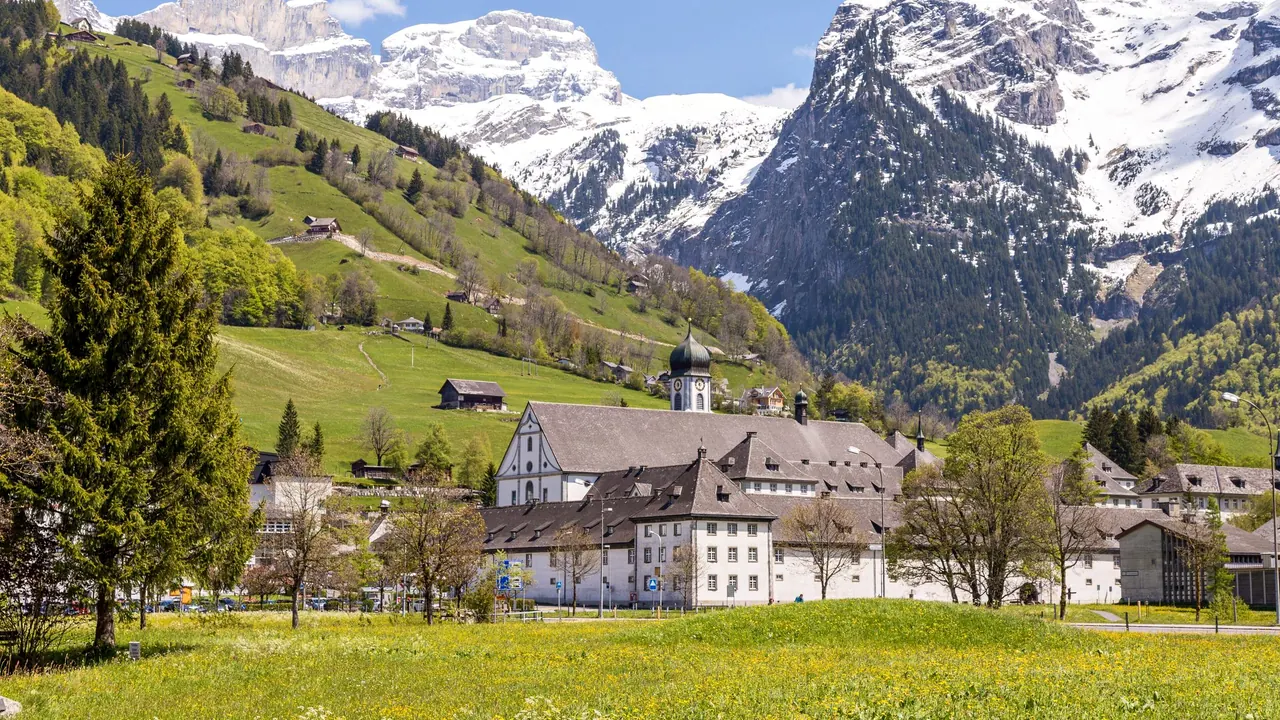
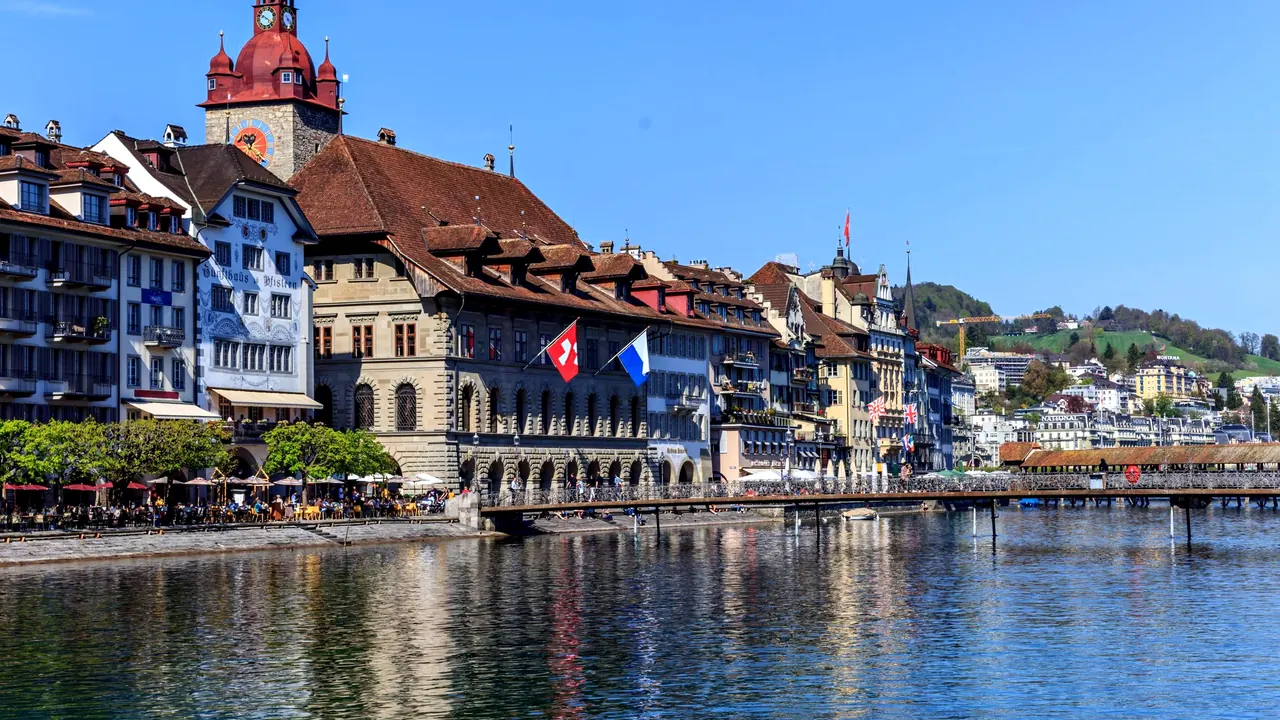
Photos: Engelberg by JoachimKohler-HB, CC BY-SA 4.0, cropped; Lucerne by ILOVESwitzerland, Pexels License.
Engelberg or Lucerne?
Our verdict in twelve categories, each scored against the same fixed benchmark cities, and the climate month by month, so you can choose for your trip.
Choose Engelberg for
Engelberg does not lead in any category we score.
Engelberg is the choice when the mountain itself is the trip. You sleep at the foot of Titlis, step out to the cable cars in the morning and spend the day on glacier snow, freeride slopes or high summer trails, with a quiet hotel evening afterwards. It suits skiers, walkers and families who want the Alps right outside the door and don't mind a narrow choice of food, sights and evenings.
Choose Lucerne for
- live music and the arts
- culture and sights
- shopping
Lucerne suits travellers who want a town as well as a view. The medieval Old Town, the Chapel Bridge, a world-class concert hall and lake steamers outside the station come together in one compact place, and trains reach Bern, Basel and Zurich easily. It is the better base for a first visit to central Switzerland, a mix of sights and excursions, or anyone who wants a lakeside stroll and a choice of restaurants at the end of the day.
Scoreboard
Twelve categories on one fixed scale from 0 to 100. The shaded stretch is the gap between the two.
Your match
Pick a travel style or drag the sliders, and both match scores follow your weighting.
Has no clear advantage with the weighting you have chosen.
Wins on live music and the arts and culture and sights with your weighting.
What matters to you?
Category by category
What the scores mean for a trip.
Beaches & swimming
Neither place has a beach, but Lucerne at least has a summer bathing culture right in town. On warm days people swim from the Lido, the old wooden lake baths and the lawns at Ufschötti, all a short walk from the centre.
In Engelberg, small mountain lakes like the Trübsee are for walking around, not for swimming. Anyone who wants a swim takes the train down to that same Lake Lucerne, so if a dip matters, the city is simply closer to the water.
Food & drink
Both serve the same Alpine staples of fondue, raclette and rösti, but Lucerne offers a little more variety. Its guild-house taverns add Chügelipastete and perch or whitefish from the lake, and the Saturday riverside market and a few modern bistros in the Neustadt widen the choice.
Engelberg's menus are mostly hotel dining rooms and mountain huts, with very little international food. What it has that Lucerne lacks is the monastery's show dairy, where you can watch cheese being made, and lunch on a terrace with a view of the glacier.
Culture & sights
This is one of the biggest gaps between the two. Engelberg has one real sight, the Benedictine abbey founded in 1120, with its bright church and huge organ, plus a small valley museum and some Belle Époque hotels. An hour covers it.
Lucerne needs a day or two. There is the Chapel Bridge with its Water Tower, the towers of the Musegg Wall that you can climb, the Lion Monument carved into a cliff, the Bourbaki Panorama, the Rosengart Collection's Picasso and Klee, and Wagner's villa at Tribschen.
Nightlife
Lucerne gives more choice through the year, though it is never late or loud. Wine bars along the Reuss, cocktail bars in the Neustadt and student weekends keep it going, and during Fasnacht the whole town stays out in costume until dawn.
Engelberg's nightlife lasts only as long as the ski season. In winter, après-ski bars and a small club full of freeriders and seasonal workers get lively, but in summer the night ends with a drink on a hotel terrace, and between seasons many places close.
Nature & outdoors
Both places are outstanding for scenery, but in different ways. Engelberg puts you high in the mountains. Cable cars from the village climb to Titlis's glacier, ice cave and suspension bridge, and the Brunni side has a via ferrata, the Four Lakes walk crosses the Jochpass, and steep freeride slopes take over in winter.
Lucerne gives you a lake with several peaks around it: the cogwheel railway up Pilatus, ridge walks on Rigi and the open-top cable car on the Stanserhorn. Steamers let you combine a boat ride and a hike in one day. It has more variety, but less of the glacier and the real high Alps.
Day trips
Lucerne is the better hub. Bern, Basel and Zurich are each under an hour by train, steamers run down the lake to the Rütli meadow and Altdorf, and the scenic line over the Brünig Pass reaches Interlaken.
From Engelberg every outing starts with the train back down the valley, so Lucerne itself is the main day trip, with Stans along the way and Einsiedeln or Schwyz further on. That covers a week easily, but a stay in Lucerne puts more of Switzerland within reach.
Good for families
Both work well with children, but in different ways: Engelberg keeps them busy on the mountain, Lucerne with a big museum and boats on the lake. Above the village, Brunni has stepping stones and rafts on the Härzlisee and adventure trails, the Trübsee has a playground and small boats, and in winter there are ski schools and sledging runs. Children love the snow on Titlis even in summer, though the thin air and cold at the glacier station, at around 3,000m, can be hard on toddlers.
In Lucerne the Swiss Museum of Transport is the main draw, with trains, planes and a planetarium that easily fill a day, and families staying in Engelberg come down the valley for it when it rains. The mirror maze at the Glacier Garden, the wildlife park at Goldau, steamer rides and the summer toboggan run on Pilatus fill the rest of the time, with the lakeside lawns for picnics in between.
Getting around
Neither needs a car, but Lucerne's setup is smoother. The station, boat piers and Old Town sit together on the lakefront, and one integrated ticket system links buses, steamers, cogwheel trains and cable cars across the region.
Engelberg is easy to walk, with a free shuttle in the ski season and cable cars at the edge of the village. The catch is the dead-end valley: any trip outside it starts with the same train ride of nearly an hour down to Lucerne.
Shopping & style
Lucerne is the place for Swiss watches, with big watch and jewellery houses around Schwanenplatz and shops selling army knives, cuckoo clocks and chocolate, plus a few independent boutiques in the Old Town lanes. It has little fashion or design beyond that.
Engelberg's main street is mostly ski hire and outdoor gear. The best things to take home are cheese from the monastery dairy, local butter and dried meats.
Affordability
Neither offers a cheap stay. Hotels, meals and drinks cost far more than the European norm in both. What differs is where the money goes. In Engelberg, the Titlis cable car, ski passes and equipment hire take the biggest share. In Lucerne, central hotels in summer and festival weeks are the big expense, along with a string of mountain railways and boat trips.
A Swiss travel pass and supermarket picnics help in either place, and self-catering apartments in Engelberg can cut the cost of a week.
Live music & performing arts
Lucerne is in another league here. The Lucerne Festival brings leading orchestras to Jean Nouvel's lakefront hall, which is famous for its acoustics, and the hall also has a year-round programme alongside the city theatre's opera, drama and dance.
In Engelberg, live performance means organ recitals and concerts in the baroque abbey church and a small summer festival. For anything more, people go down to Lucerne's concert halls.
Wellness & relaxation
Both are calm places, but the calm feels different, and neither has thermal springs. Engelberg started out as a health resort, and its valley silence and clean air make it restful, with relaxation centred on hotel spas, except during peak ski weeks.
Lucerne offers slow walks along the lake promenade, afternoons on a steamer and a dip in the old wooden lake baths. Botta's mineral bath high on the Rigi is the best soak in the region, though the Old Town is crowded around midday.
When should you go?
Pick your month. The climate figures are measured averages, not a forecast.
Engelberg in July
Lucerne in July
Daytime high, °C
Rainfall in the month, mm
Where the figures come from
Engelberg has no weather station within reach, so its figures come from a gridded climate model rather than a measured record, and read a broad area rather than one spot.
Lucerne has no rain gauge within 25 km of the centre, so its rainfall comes from a gridded climate dataset read at the destination rather than from a gauge further away.
Lucerne's sunshine is measured 42 km from the centre, at Zurich Town / Ville..
Temperature and rainfall are climate normals, averaged over the years shown. Engelberg: 2001-2020 normals, NASA POWER reanalysis grid, no weather station within 90 km. Lucerne: 2005-2025 (sunshine 1991-2020, rainfall 1991-2020) normals, Emmen (4.2 km from centre).
Engelberg sits much higher and is several degrees colder all year. Its village highs barely get above freezing from December to February, which is what keeps the snow good for skiing, and it only reaches about 21°C in July and August. Lucerne is milder, with summer highs around 24°C and July, its sunniest month, at 225 hours of sunshine. July and August are the only months when Lake Lucerne is warm enough for a swim. Spring and September are pleasant for walking around the city.
Summer is also the wettest time in both places. Engelberg gets more rain, close to 158mm in August, often as afternoon storms in the valley, so set out early for high walks. Late autumn is grey in both, and Engelberg is caught between seasons with many places closed. Lucerne's short, dull winter days suit museums and concerts, while Engelberg in winter is all about the snow.
Which traveller are you?
On a skiing trip, Engelberg is the place to stay. The steep north faces of Titlis make it one of the best-known freeride areas in the Alps, the lifts start at the edge of the village, and après-ski bars fill up every afternoon in high season.
For a culture and arts trip, Lucerne is far ahead. It has the Chapel Bridge, the Lion Monument, Picasso and Klee at the Rosengart Collection, and the Lucerne Festival in Jean Nouvel's concert hall. Engelberg's culture comes down to its abbey church and an organ recital.
For a short city break, Lucerne is the obvious pick. The station, the boat piers and the Old Town sit side by side, so two days easily cover the sights, a steamer trip and an evening by the Reuss. Engelberg's dead-end valley makes it a mountain stay rather than a city break.
Before you go
| Measure | Engelberg | Lucerne |
|---|---|---|
| Official language | French, German, Italian, Romansh | French, German, Italian, Romansh |
| Currency | Swiss Franc (CHF) | Swiss Franc (CHF) |
| Sockets | CJ230 V, 50 Hz | CJ230 V, 50 Hz |
| Driving side | Right | Right |
| Time zone | UTC+1, UTC+2 in summer | UTC+1, UTC+2 in summer |
| Emergency number | 112 | 112 |
| Elevation | 1,015 m | 436 m |
| Main airport | Zürich Airport (ZRH)72 km from centre226 non-stop destinations | Zürich Airport (ZRH)49 km from centre226 non-stop destinations |
| Public holidays this year | 13 days | 12 days |
By the numbers
| Measure | Engelberg | Lucerne |
|---|---|---|
| Population | 4,181 | 86,234 |
| People per km² | 56 | 2,963 |
| Museums within 10 km | 0 | 14 |
| UNESCO World Heritage sites within 50 km | 2 | 1 |
Where else could you go?
Every comparison below shares a destination with this one, so you can follow Engelberg or Lucerne somewhere new.
- Andermattvs Engelberg
- Grindelwaldvs Engelberg
- Zurichvs Lucerne
- Interlakenvs Engelberg
- Wengenvs Engelberg
- Mürrenvs Engelberg