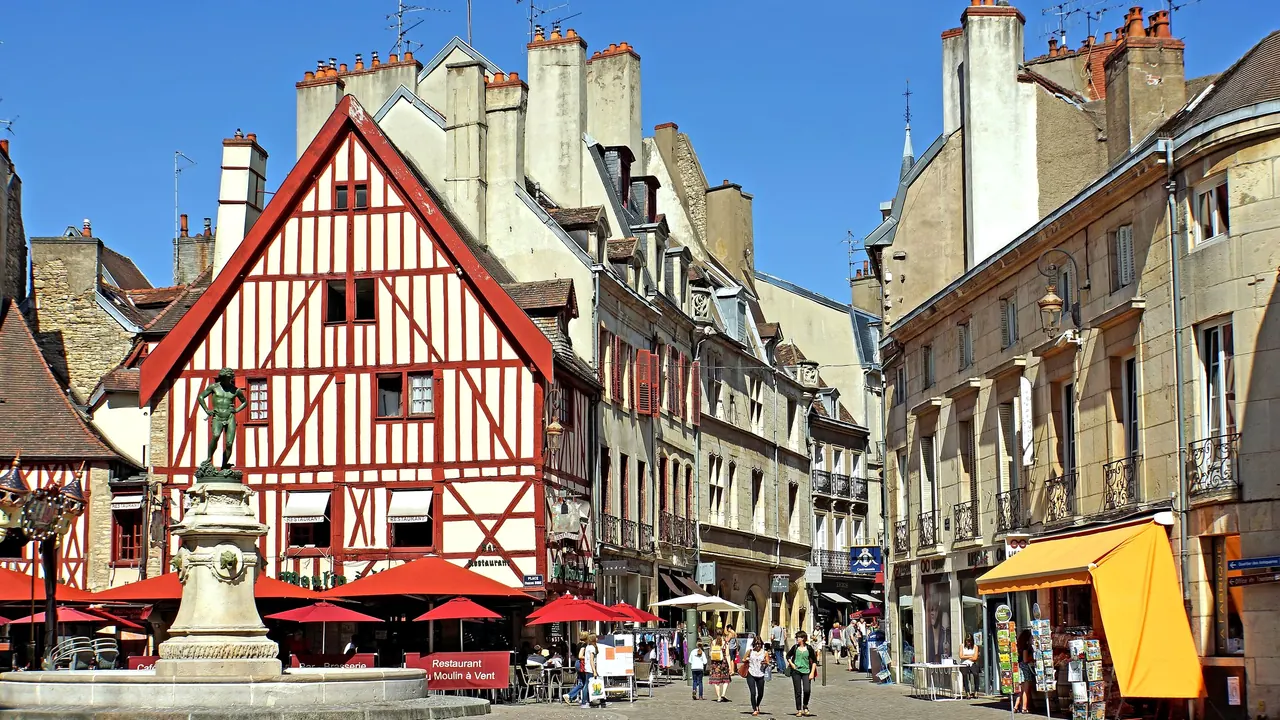
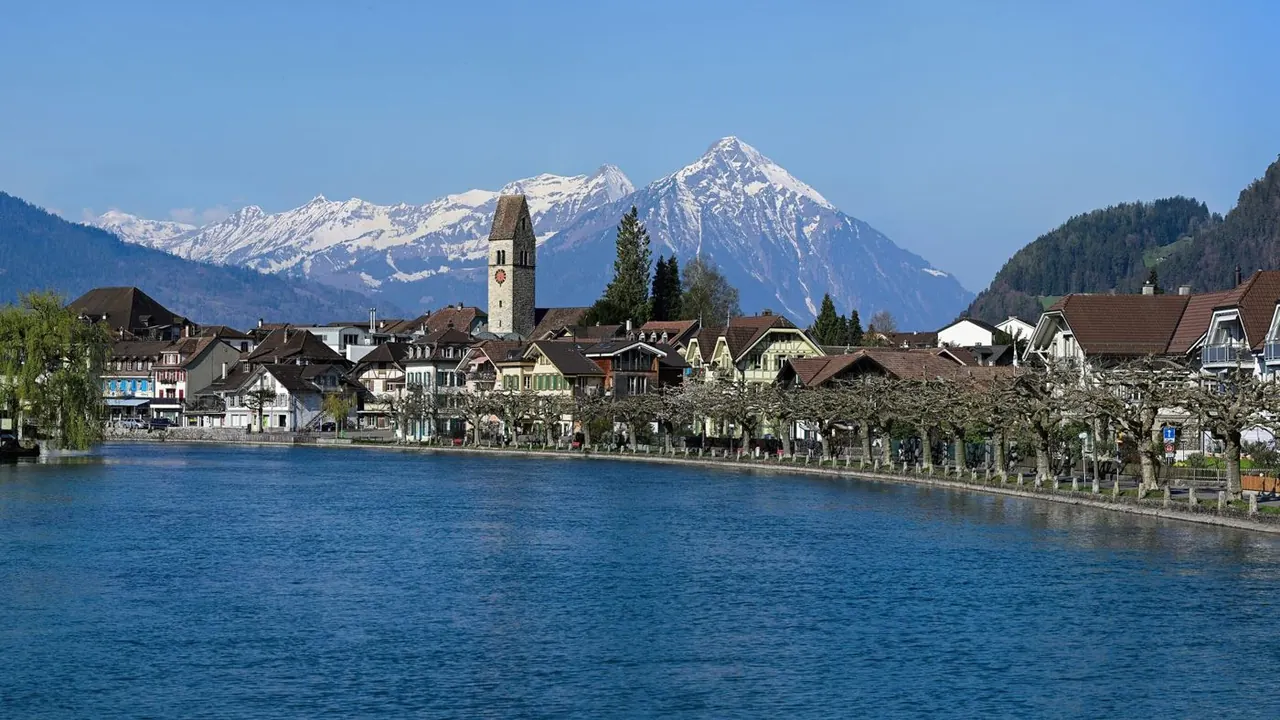
Photos: Dijon by Dennis G. Jarvis, CC BY-SA 2.0, cropped; Interlaken by Roy Egloff, CC BY-SA 4.0, cropped.
Dijon or Interlaken?
Our verdict in twelve categories, each scored against the same fixed benchmark cities, and the climate month by month, so you can choose for your trip.
Choose Dijon for
- culture and sights
- prices
- food and drink
Dijon is the choice for travellers who plan their days around the table and the past. It offers Burgundian cooking, wine bars pouring village wines by the glass, the Palace of the Dukes and a half-timbered old centre, with the Côte de Nuits starting at the edge of town. It also costs far less, and its evenings, though modest, have more life in them.
Choose Interlaken for
- nature and the outdoors
- families
- beaches
Interlaken is for people who want mountains rather than streets. The Jungfrau peaks, the Lauterbrunnen valley and the high trails are all an easy train or cable car ride away, and the trains, gondolas and toboggan runs that get you there keep children happy too. The trade-offs are that it costs a great deal, the food is plain and there is very little to see in the town itself.
Scoreboard
Twelve categories on one fixed scale from 0 to 100. The shaded stretch is the gap between the two.
Your match
Pick a travel style or drag the sliders, and both match scores follow your weighting.
Wins on culture and sights and prices with your weighting.
Wins on nature and the outdoors and families with your weighting.
What matters to you?
Category by category
What the scores mean for a trip.
Beaches & swimming
Neither is a beach destination, but Interlaken gives you better swimming. In July and August you can swim from the grassy lidos and shingle shores of Lake Thun around Neuhaus, or brave the cold glacial turquoise of Lake Brienz at Bönigen, with snow peaks behind you.
Dijon has only Lac Kir, a reservoir on the western edge of town with a supervised patch of lawn and sand. Beyond that, a swim means a municipal or hotel pool.
Food & drink
Food is one of the main reasons to choose Dijon. It sits at the head of Burgundy, with boeuf bourguignon, jambon persillé, snails and gougères, its own mustard and cassis, and the iron market hall of Les Halles stacked with Bresse poultry and Époisses. Wine bars pour village Burgundies by the glass, and the Cité de la Gastronomie fills the old hospital with tastings and cookery.
Interlaken feeds people well enough but gives them little to remember. Fondue, rösti and raclette sit beside Indian and Asian places for the international crowd. The better meals come from the mountains around it: dairy cheese and hut terraces above Grindelwald or Mürren.
Culture & sights
The gap here is wide. Dijon was the capital of the Valois dukes, and its palace holds one of France's oldest museums, with the mourner-ringed ducal tombs as its treasure. Around it lie Renaissance mansions, Notre-Dame with its lucky owl, Saint-Bénigne's crypt and Sluter's Well of Moses, enough for two or three full days.
Interlaken was built as a base for the mountains and has almost nothing to see beyond the grand hotels and Kursaal on the Höheweg and a few timber houses in Unterseen. Visitors who want history take the train to Bern or Thun.
Nightlife
Neither is a place for big nights, but Dijon has more going on after dark thanks to its university. Rue Berbisey's small bars and the terraces around Place Émile Zola make for a long evening of wine, beer and late dinners, at least during term time.
Interlaken goes to bed early because its visitors are up for trains and paragliding. You will find a few backpacker pubs and basement clubs, the casino in the Kursaal and a drink on the Höheweg, and little else.
Nature & outdoors
Interlaken has some of the most dramatic scenery in Europe within an hour's ride. The Eiger, Mönch and Jungfrau, the sheer Lauterbrunnen valley, Trümmelbach's falls inside the rock and the Jungfraujoch above the Aletsch glacier are all reached by train or cable car. It is also a major centre for paragliding, canyoning and rafting, and for skiing in winter, though low cloud can hide the peaks.
Dijon's outdoors is gentle and pleasant: climbing and walking in the Combe à la Serre and Combe de Lavaux, flat cycling along the canal towpath and the vineyard ride to Beaune.
Day trips
Both make excellent bases, but the outings are of different kinds. From Dijon, days out mean wine and abbeys: the Route des Grands Crus through Gevrey-Chambertin and Vougeot to walled Beaune, Fontenay's Cistercian abbey, and Semur-en-Auxois or Alésia. Much of it is easiest by car, bike or small tour.
From Interlaken the outings are towns and lakes, all by rail or boat. You can reach Bern's arcaded old town in under an hour, ride paddle steamers to the castles at Spiez, Oberhofen and Thun, see woodcarving at Brienz and the Ballenberg open-air museum, or take the scenic line to Lucerne.
Good for families
Interlaken is the better place for children, because the journey up the mountain is the fun. Rack railways and gondolas lead to summit stations with playgrounds and summer toboggan runs, and the St Beatus caves and the farm animals at Ballenberg seldom disappoint. Rainy days and very high altitudes are the weak points.
Dijon is calm and easy with a pushchair, with the planetarium at the Jardin de l'Arquebuse, the lawns of the Parc de la Colombière and paddling at Lac Kir. Most of its days, though, are built around tastings and galleries.
Getting around
Both centres are small enough to walk. Interlaken pulls ahead on the wider network, where mainline trains, narrow-gauge mountain railways, cog lines, gondolas and lake steamers connect so well that the whole Jungfrau region needs no car, although the popular mountain trains get crowded in summer.
Dijon has two tram lines, regional trains to Beaune and fast trains to Paris, so the city and the main wine town are easy to reach. The vineyard villages away from the railway, though, need a hire car, a bike or a tour.
Shopping & style
Dijon is the better place to shop, as long as you mostly want things to eat and drink. Mustard in dozens of flavours, pain d'épices, cassis, Burgundy from cellar merchants and cheese around Les Halles fill the bags, and Rue de la Liberté and its side lanes add a department store, antiques and independents.
Interlaken's Höheweg is aimed at tour groups, with big watch and jewellery stores, army knives, cuckoo clocks and chocolate. Carved wood from Brienz is the one local craft worth buying.
Affordability
Dijon costs far less. Hotels are moderate, bistro set lunches are a good way to eat well, and wine by the glass is cheap for France. The bill grows mainly when you add fine dining and cellar tours.
Interlaken charges full Swiss prices for beds, meals and drinks, and the mountain railways and cable cars that are the point of coming, the Jungfraujoch above all, are very expensive. Hostels, picnics and transport passes help, but there is no cheap way to see the region properly.
Live music & performing arts
Dijon has a real season. The Opéra de Dijon stages opera, concerts and dance in the old Grand Théâtre and the acoustically admired Auditorium, alongside a national drama centre and a venue for touring bands. That programme follows the academic year and thins out in summer.
Interlaken is the reverse, with its main performance in summer: the open-air William Tell, played by local amateurs in the woods, plus folklore evenings with alphorns and yodelling. For more serious music you have to go to Bern.
Wellness & relaxation
For a restful stay with a little pampering, Interlaken has the edge, though the calm is found around the town more than in it. Dijon's rest comes from its pace: long lunches, quiet squares and slow afternoons among the vines. Beyond that it has only a few hotel spas, some offering grape-based treatments, and no bathing tradition of its own.
In Interlaken, several of the grand hotels on the Höheweg have sizeable spas, and the town has a public pool with a wellness area. The centre is busy with coach groups, so the real calm lies beyond it: early mornings on the lakeshore, slow steamer crossings, or a night up in Wengen or Mürren.
When should you go?
Pick your month. The climate figures are measured averages, not a forecast.
Dijon in July
Interlaken in July
Daytime high, °C
Rainfall in the month, mm
Where the figures come from
Interlaken has no rain gauge within 25 km of the centre, so its rainfall comes from a gridded climate dataset read at the city rather than from a gauge further away.
Temperature and rainfall are climate normals, averaged over the years shown. Dijon: 1991-2020 normals, Dijon (7 km from centre). Interlaken: 2005-2020 (rainfall 1991-2020) normals, Meiringen / Unterbach (19.3 km from centre).
Dijon has the warmer and sunnier summer. July reaches about 27°C with long bright days, and June to early September is the easy season for strolling the old centre and cycling the vineyards. Rain is spread fairly evenly through the year, with wetter spells in May and again in October and November. From December to February the days are short, grey and around 6°C, which suits cellars and museums better than walking.
Interlaken stays a few degrees cooler all year and peaks near 24°C in July, comfortable for hiking rather than hot. Summer is also its wettest season, with about 127mm in June, so mountain days often have to fit around showers and low cloud. September is clearly drier than high summer and still mild on the trails. In winter the town sits close to 3°C and the action moves up to the ski slopes.
Which traveller are you?
For an outdoors trip, Interlaken is the obvious pick. Mountain railways and cable cars put the Jungfrau, Lauterbrunnen's waterfalls and high ridge trails within an hour, and paragliding, canyoning and lake paddling all start from town. Dijon's combes and canal towpath are gentle by comparison.
On a culture and arts trip, Dijon is far richer. You get the ducal palace with its sculpted tombs, gargoyled Notre-Dame, a Romanesque crypt and an opera season split between two halls. Interlaken has a row of grand hotels and little else, so you would be catching trains to Bern instead.
On a family trip with children, Interlaken works better. Cog railways, gondolas and steamers feel like adventures in themselves, and the summit stations have playgrounds, cliff walks and toboggan runs. Dijon is safe and relaxed, but its vineyards and galleries interest parents more than children.
Before you go
| Measure | Dijon | Interlaken |
|---|---|---|
| Official language | French | French, German, Italian, Romansh |
| Currency | Euro (EUR) | Swiss Franc (CHF) |
| Sockets | CE230 V, 50 Hz | CJ230 V, 50 Hz |
| Driving side | Right | Right |
| Time zone | UTC+1, UTC+2 in summer | UTC+1, UTC+2 in summer |
| Emergency number | 112 | 112 |
| Elevation | 220 m | 571 m |
| Main airport | Lyon Saint-Exupéry Airport (LYS)178 km from centre141 non-stop destinations | Zürich Airport (ZRH)100 km from centre226 non-stop destinations |
| Public holidays this year | 11 days | 10 days |
By the numbers
| Measure | Dijon | Interlaken |
|---|---|---|
| City population | 161,830 | 6,123 |
| People per km² | 3,890 | 1,424 |
| Museums within 10 km | 8 | 3 |
| UNESCO World Heritage sites within 50 km | 1 | 2 |
Where else could you go?
Every comparison below shares a destination with this one, so you can follow Dijon or Interlaken somewhere new.