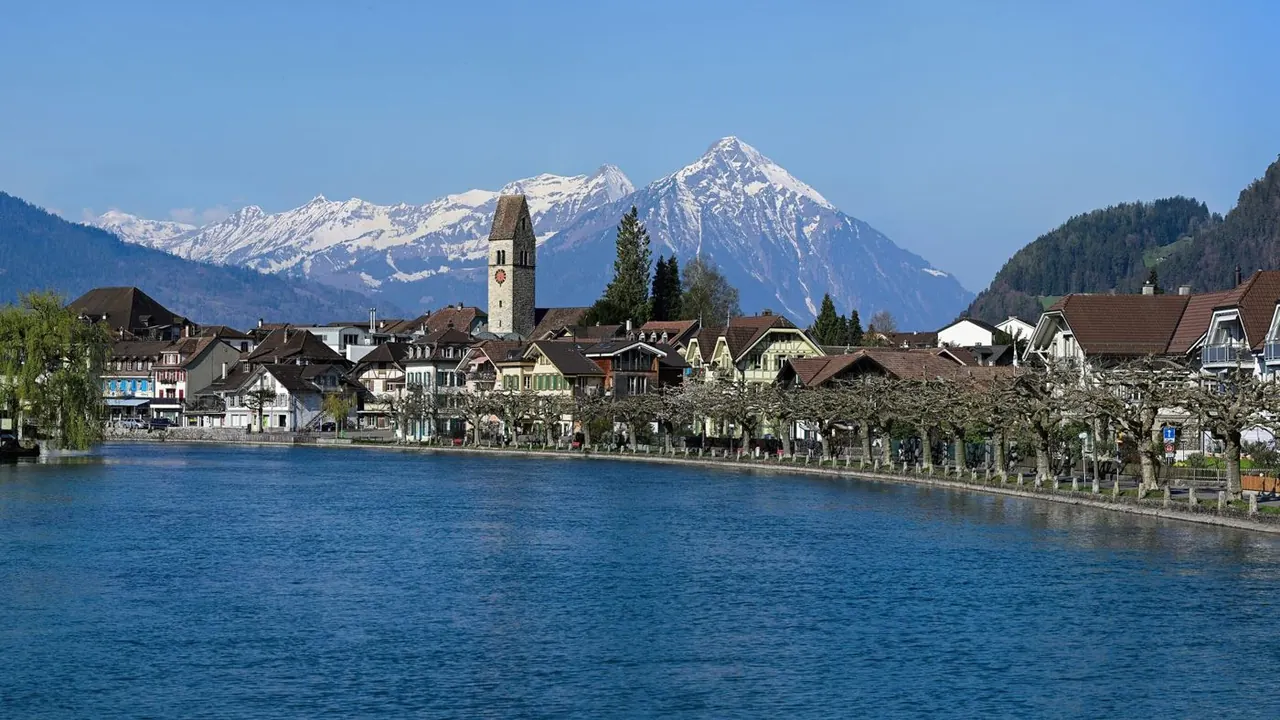
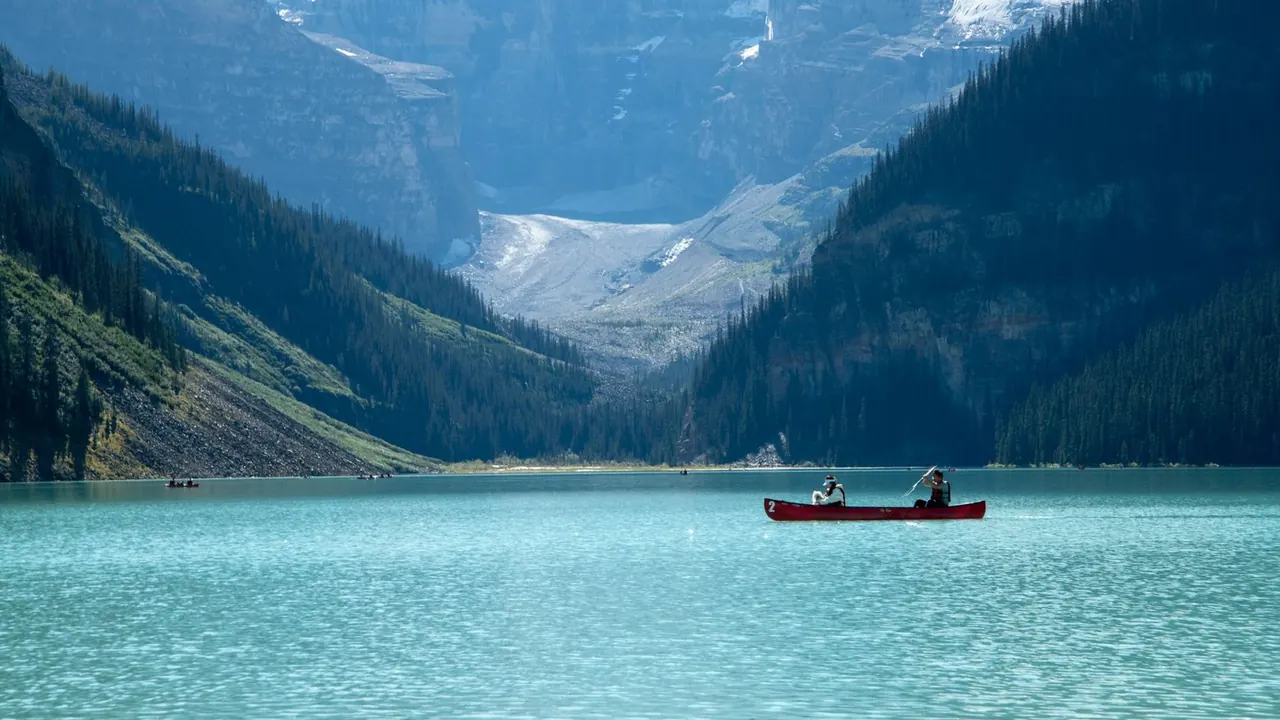
Photos: Interlaken by Roy Egloff, CC BY-SA 4.0, cropped; Lake Louise by Andrew Patrick Photo, Pexels License.
Interlaken or Lake Louise?
Our verdict in twelve categories, each scored against the same fixed benchmark cities, and the climate month by month, so you can choose for your trip.
Choose Interlaken for
- getting around
- day trips
- families
Interlaken is the better pick for a first Alpine trip without a car, and for families. Trains, cog railways and lake steamers take you from a small, walkable town to the Jungfraujoch, the Lauterbrunnen valley or a paragliding flight onto the Höhematte. On a cloudy day you can go to Bern, Thun or Lucerne instead, and in summer you can end the day with a swim in Lake Thun.
Choose Lake Louise for
- wellness
- prices
Walkers who want wild country right outside the door will be happier at Lake Louise. Trails climb straight from the shore to glaciers, teahouses and larch valleys, grizzlies roam the slopes, and the Icefields Parkway runs north past glaciers to the Columbia Icefield. Bring a car and be ready for quiet evenings, because there is little to do here except be outdoors.
Scoreboard
Twelve categories on one fixed scale from 0 to 100. The shaded stretch is the gap between the two.
Your match
Pick a travel style or drag the sliders, and both match scores follow your weighting.
Wins on getting around and day trips with your weighting.
Wins on wellness and prices with your weighting.
What matters to you?
Category by category
What the scores mean for a trip.
Beaches & swimming
Neither is a beach destination, but only Interlaken lets you swim in summer. In a good July or August Lake Thun reaches about 21°C, with grassy lidos at Neuhaus and shingle shores towards Spiez. The turquoise water of Lake Brienz is colder, but it still has a bathing area at Bönigen.
Lake Louise and Moraine Lake stay at around 4°C even in August, so jumping in is a photo opportunity rather than a swim. For a real dip you need the shallow lakes near Banff, under an hour's drive away, or a hotel pool.
Food & drink
Neither place is worth the journey for its food, and the real difference is where you eat. Interlaken has a town's worth of restaurants: fondue, raclette and rösti alongside Indian, Asian and Middle Eastern places. Cheese from mountain dairies and white wine from Lake Thun are close by.
At Lake Louise almost every meal is in a hotel dining room or lodge, serving Alberta beef and game. The best moment is soup and baking at the Lake Agnes or Plain of Six Glaciers teahouses after a climb. Keen diners drive to Banff. In Interlaken, plenty of visitors simply live on supermarket picnics.
Culture & sights
Both are bases for scenery rather than places to go sightseeing, and each has a little railway-age heritage. In Interlaken that means the row of grand hotels and the Kursaal along the Höheweg, plus the old timber houses of Unterseen across the Aare. At Lake Louise it is the Chateau, which grew from an 1890s log chalet, and the old log railway station. Anyone who wants museums will find Interlaken's within easy reach by train, while Lake Louise's are a drive away in Banff.
Nightlife
Interlaken at least has a small backpacker scene. There are pubs, sports bars and a couple of basement clubs near the hostels, plus the casino in the Kursaal, and it is liveliest in summer and the ski season. Lake Louise has a hotel lounge, a lodge pub with a fireplace and après-ski drinks, and anyone who wants a late night drives to Banff. In both places, early starts for the mountain trains or sunrise at the lakes keep evenings short.
Nature & outdoors
These are two of the world's great mountain landscapes, and the difference is in how you reach them. Around Interlaken the Alps are built for easy access. Cog railways climb to the Jungfraujoch at 3,454m and cable cars run up to Grindelwald First and Mürren. Paragliding, canyoning, rafting on the Lütschine and paddling on the two lakes are all run from town.
Lake Louise feels wilder. You walk from the shore under the Victoria Glacier to Lake Agnes or Larch Valley, canoe on milky turquoise water and may see grizzlies above the gondola, with the Icefields Parkway and Yoho beyond. Both are serious winter destinations: Lake Louise has one of Canada's largest ski areas, and Interlaken has the Jungfrau slopes of Wengen, Grindelwald and Mürren.
Day trips
This is where Interlaken pulls clearly ahead. Bern's arcaded old town is under an hour away by train and Thun's castle half an hour, while lake steamers call at castle towns such as Spiez and Oberhofen. Brienz woodcarving, the Ballenberg open-air museum and Lucerne, reached over the Brünig Pass, fill more days.
From Lake Louise nearly every outing is into the scenery. Banff, about 45 minutes away, is the one proper town trip. Canmore, Field and Golden make modest stops, and Calgary, two hours away, is the only city within reach.
Good for families
Interlaken is the easier choice with children. Rack railways and steamers are an outing in themselves. The summit stations at Grindelwald First and Harder Kulm have playgrounds, cliff walks and summer toboggan runs, and the St Beatus caves and Ballenberg's farm animals are reliable hits.
Lake Louise works best with older children who like to walk: canoeing, the gondola and the hike to the Lake Agnes teahouse. Toddlers are mostly limited to the flat lakeshore path, and the long drives and summer crowds wear on families more. Both places are safe, and both are hard to fill on a wet day.
Getting around
This is one of the sharpest differences between them. Interlaken is small and flat, and its mountain trains, cog railways, gondolas and lake steamers connect so well that you can explore the whole Jungfrau region without a car. Wengen and Mürren are car-free anyway.
At Lake Louise the village is not where the sights are. The lake is a steep 4km uphill, Moraine Lake is further along a winding road, and summer parking fills early, so most visitors rely on shuttles and coaches. For the Icefields Parkway or Yoho you need a car, and in winter it needs proper tyres.
Shopping & style
Interlaken's Höheweg at least gives you a street to browse. It has large Swiss watch and jewellery stores, army knives, cuckoo clocks and chocolate, and woodcarving from Brienz is the one local craft worth seeking out. Lake Louise has a small village mall with outdoor gear, maps and groceries, and a few boutiques in the Chateau, which covers whatever you forgot to pack. Neither has independent or design shops to speak of.
Affordability
Both are very expensive places to stay, but the costs come from different places. In Interlaken it is the mountain railways and cable cars, the Jungfraujoch above all, on top of full Swiss prices for hotels and meals.
At Lake Louise there are few beds and little competition, so rooms and meals are priced like a resort, and park passes and gondola tickets add to the bill. Hiking costs nothing once you are there, and staying in Banff or Canmore or coming outside high summer saves money. In Interlaken, hostels, regional passes and supermarket picnics do the same job.
Live music & performing arts
Interlaken has a little more going on. Local amateurs have staged Schiller's William Tell in the woods every summer since the early twentieth century. There are also Kursaal concerts, folklore evenings with yodelling and alphorns, and a lake-stage musical in Thun, with Bern's theatre and orchestra within reach. Lake Louise has at most a pianist or folk singer in a hotel lounge, so for a real programme you go to the arts centre in Banff.
Wellness & relaxation
Neither has a bathing culture of its own, so in both places the big hotel spas and the quiet of the mountains do the work. Around Interlaken you find calm in the lakeside villages, on slow steamer crossings or up in car-free Wengen and Mürren, away from the coach groups on the Höheweg.
At Lake Louise peace is a matter of timing. The lakeshores fill with coaches in July and August, while winter brings snow and silent forest. For hot springs, Banff's historic pools on Sulphur Mountain are about 45 minutes away.
When should you go?
Pick your month. The climate figures are measured averages, not a forecast.
Interlaken in July
Lake Louise in July
Daytime high, °C
Rainfall in the month, mm
Where the figures come from
Interlaken has no rain gauge within 25 km of the centre, so its rainfall comes from a gridded climate dataset read at the city rather than from a gauge further away.
Lake Louise has no rain gauge within 25 km of the centre, so its rainfall comes from a gridded climate dataset read at the city rather than from a gauge further away.
Temperature and rainfall are climate normals, averaged over the years shown. Interlaken: 2005-2020 (rainfall 1991-2020) normals, Meiringen / Unterbach (19.3 km from centre). Lake Louise: 1991-2020 normals, Yoho Park (11.2 km from centre).
Summer is the season for both, but Interlaken is warmer and wetter. Daytime highs reach about 24°C in July, warm enough for a swim in Lake Thun from late June through August. Those are also its wettest months, at around 125mm each, so expect showers and days when cloud hides the peaks. September stays mild and dry enough to be one of the best walking months. From November to February the valley is cold and the ski season takes over higher up.
Lake Louise is cooler all year. It peaks at around 20°C in July and August, the only months when the high trails are reliably clear of snow, and late September brings the golden larches. It gets less rain than Interlaken in every month. Winter is much harsher than in the Alps: daytime highs stay below freezing from November to February and drop to about -8°C in December. That suits skiing and skating on the frozen lake, but not long hours outdoors.
Which traveller are you?
On a family trip with children, Interlaken is the easier base. The mountain trains and steamers are fun in themselves, summit playgrounds and toboggan runs fill the afternoons, Ballenberg and the St Beatus caves cover the gentler days, and you never need a car.
For a beach and sun trip, neither is ideal, but Interlaken at least has summer swimming, with Lake Thun reaching about 21°C off its lidos and shingle beaches. Lake Louise stays near 4°C all summer, so a swim means the hotel pool.
For wildlife watchers, Lake Louise offers something Interlaken lacks. Grizzlies are often seen on the slopes above the gondola, and the Icefields Parkway and Yoho carry the search on into wild Rockies country that is best covered by car.
Before you go
| Measure | Interlaken | Lake Louise |
|---|---|---|
| Official language | French, German, Italian, Romansh | French, English |
| Currency | Swiss Franc (CHF) | Canadian Dollar (CAD) |
| Sockets | CJ230 V, 50 Hz | AB120 V, 60 Hz |
| Driving side | Right | Right |
| Time zone | UTC+1, UTC+2 in summer | UTC-7, UTC-6 in summer |
| Emergency number | 112 | 911 |
| Elevation | 571 m | 1,600 m |
| Main airport | Zürich Airport (ZRH)100 km from centre226 non-stop destinations | Calgary International Airport (YYC)155 km from centre102 non-stop destinations |
| Public holidays this year | 10 days | 13 days |
By the numbers
| Measure | Interlaken | Lake Louise |
|---|---|---|
| City population | 6,123 | - |
| People per km² | 1,424 | - |
| Museums within 10 km | 3 | 0 |
| UNESCO World Heritage sites within 50 km | 2 | 2 |
Where else could you go?
Every comparison below shares a destination with this one, so you can follow Interlaken or Lake Louise somewhere new.