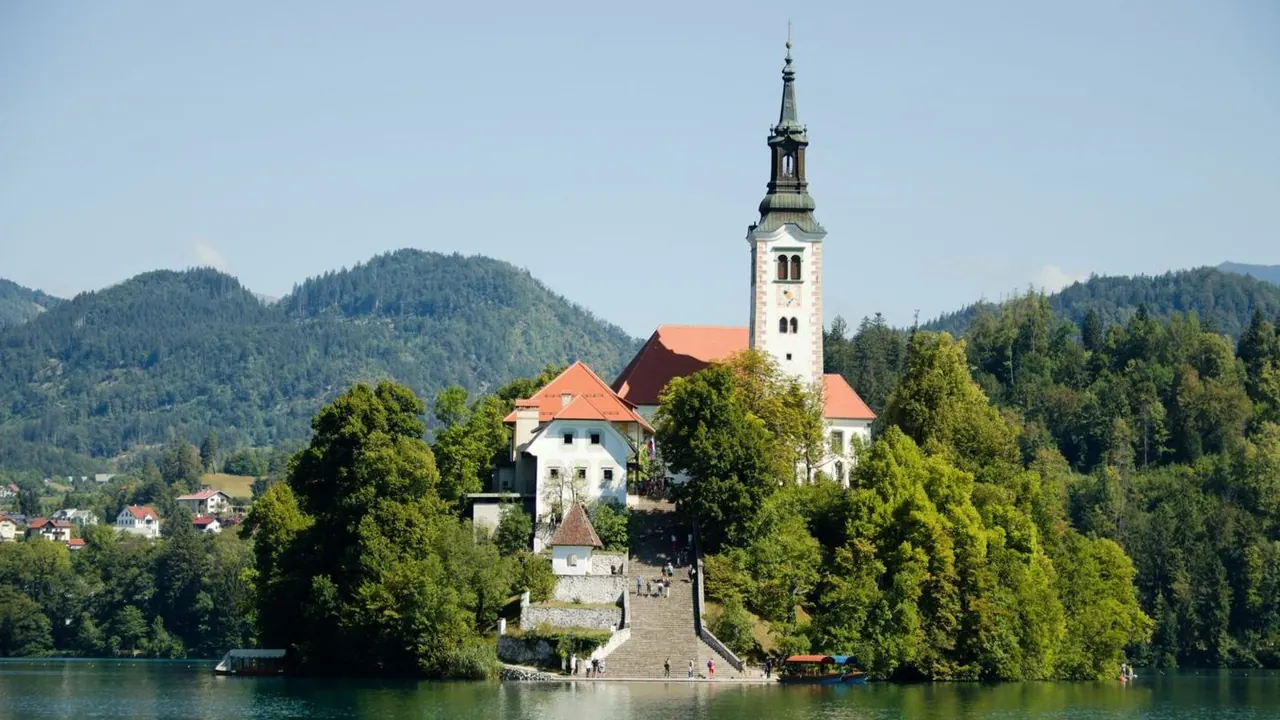
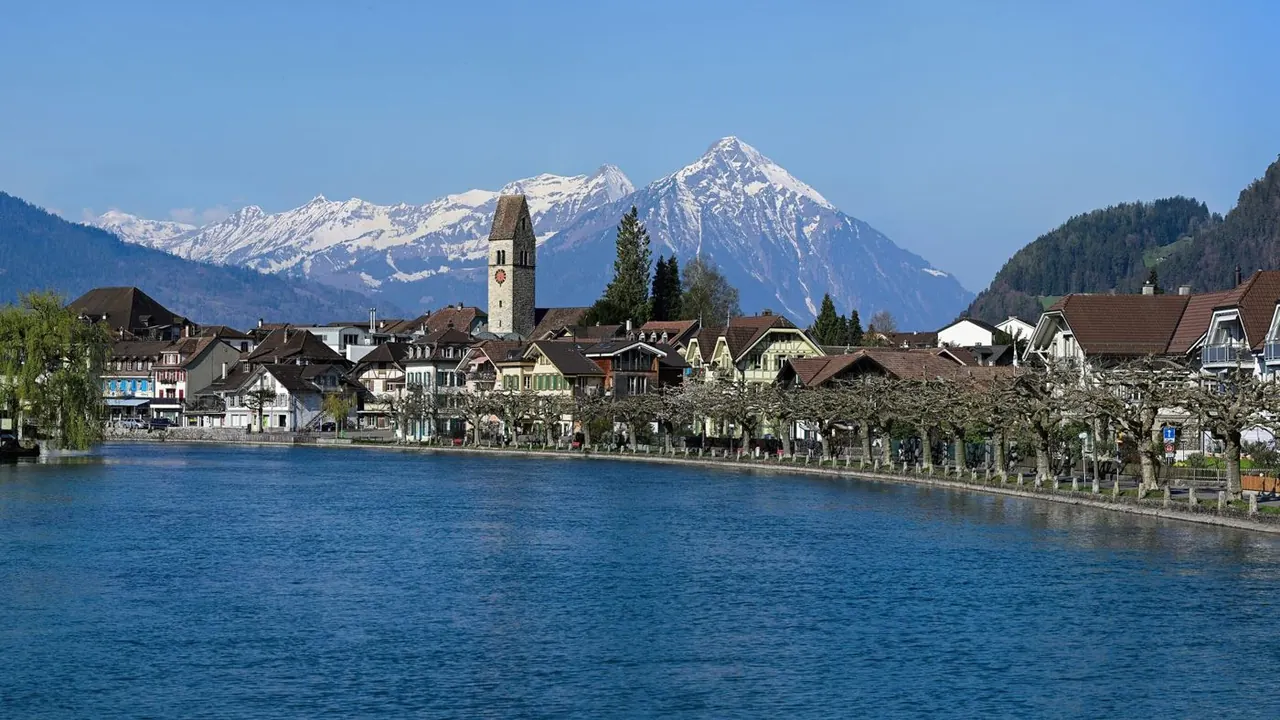
Photos: Bled by Philipp Schwarz, Pexels License; Interlaken by Roy Egloff, CC BY-SA 4.0, cropped.
Bled or Interlaken?
Our verdict in twelve categories, each scored against the same fixed benchmark cities, and the climate month by month, so you can choose for your trip.
Choose Bled for
- prices
- beaches
- wellness
Bled suits a slower, gentler Alpine trip. You get a lake that is warm enough for real swimming in high summer, a castle and an island church to fill a day, and a resort that began with rest cures and still goes quiet early in the evening. It costs far less than the Swiss mountains, and Ljubljana, the Soča valley and the Adriatic coast are close enough to add variety.
Choose Interlaken for
- getting around
- shopping
- families
Interlaken is the choice when the mountains are the whole point. Trains, cog railways and cable cars take you to the Jungfrau peaks, the Lauterbrunnen valley and high ridge trails without a car, and paragliding, canyoning and rafting all start from the town itself. It also works well with children and has a little more going on after dark. The catch is the bill: you pay full Swiss prices for almost everything, the mountain railways above all.
Scoreboard
Twelve categories on one fixed scale from 0 to 100. The shaded stretch is the gap between the two.
Your match
Pick a travel style or drag the sliders, and both match scores follow your weighting.
Too close to call, 1 point apart
Wins on prices and beaches with your weighting.
Wins on getting around and shopping with your weighting.
What matters to you?
Category by category
What the scores mean for a trip.
Beaches & swimming
Neither town is on the coast, but Bled has the better swimming. Its lake warms to around 24°C in high summer, and the lidos below the castle and the shallow western end near Velika Zaka make a lake afternoon a proper part of the stay. Some people even swim out to the island, and Bohinj is nearby if you want a wilder, colder alternative.
Interlaken has two lakes, but the water is cooler. The lidos at Neuhaus on Lake Thun are fine for a dip after a day in the hills, while turquoise Lake Brienz is bracing. A swim here is a nice extra, not a reason to come.
Food & drink
Neither is a place to travel for food, but the two disappoint in different ways. Bled sticks closer to its region: kremšnita cream slices on the lake terraces, trout, žlikrofi dumplings and buckwheat dishes. The best meals are in the farm inns of the surrounding valleys.
Interlaken offers more variety but less local character. Fondue, raclette and rösti sit beside the Indian, Asian and Middle Eastern places that feed its international crowd. Its best food moments are higher up, with cheese from mountain dairies, a meal on a hut terrace or a glass of Lake Thun white wine, and many visitors live on supermarket picnics.
Culture & sights
Bled has the more memorable sights, though they fill only a day. There is the cliff-top castle with its museum and printing workshop, the pletna boat ride to the baroque island church with its wishing bell, and the old spa villas along the shore.
Interlaken has even less: the grand hotels and the Kursaal on the Höheweg, and a few old timber houses in Unterseen across the Aare. In both towns, museums and serious architecture mean a trip to Ljubljana or to Bern.
Nightlife
Both towns go quiet before midnight, but Interlaken has a little more to offer. Its backpacker pubs, sports bars and a couple of basement clubs near the hostels are livelier in summer and in the ski season, and the Kursaal has a casino. In Bled an evening out means a drink on a lakeside terrace and a walk along the lit shore. For anything more, you go to Ljubljana.
Nature & outdoors
Both are first-class mountain bases, but Interlaken works on a bigger, higher scale. Within an hour by rail you can stand at 3,454m on the Jungfraujoch above the Aletsch glacier, walk the cliff-walled Lauterbrunnen valley past Trümmelbach's falls, or take lifts straight onto ridge trails. Paragliders land on the Höhematte in the middle of town. The one drawback is low cloud, which can hide the peaks for days.
Bled's version is gentler and closer to the ground. It has the level lake circuit, short steep climbs to Ojstrica and Osojnica, the walkways of the Vintgar Gorge and the Triglav park around Bohinj, with the Soča valley over the Vršič pass. You walk and drive to these places rather than ride lifts up to them.
Day trips
Interlaken makes the easier base, because almost everything is on the rails or the lake steamers. Bern's arcaded old town is under an hour away. Thun, Spiez and Oberhofen each have a castle on the lakeshore, Ballenberg's open-air museum is near Brienz, and Lucerne is a scenic ride over the Brünig Pass.
From Bled the trips reach further afield and cross more borders. You can go to Ljubljana, medieval Radovljica, the Postojna cave and Predjama Castle, Venetian Piran on the coast, and over into Austria. Several of these work best with a car.
Good for families
Interlaken does more for children, mainly because getting up the mountains is an adventure in itself. Rack railways, gondolas and steamers lead to summit playgrounds, cliff walks and toboggan runs, and the St Beatus caves and Ballenberg's farm animals are reliable favourites. The highest excursions can be hard on very young children, though.
Bled is smaller and simpler. Children can row out to the island to ring the bell, swim from the shallow lidos and ride the toboggan on Straža hill, and the flat lake path is ideal for pushchairs. Neither town has a zoo or a big indoor attraction for rainy days.
Getting around
Interlaken is far easier to explore without a car. Mainline trains, the narrow-gauge Oberland railways, cog railways, gondolas and steamers all link up, so the whole Jungfrau region is within reach, and Wengen and Mürren are car-free anyway. The main hassle is crowding on the busiest summer trains.
Bled is easy on foot around the lake, and buses run to Ljubljana and Bohinj. But the trailheads, the Pokljuka plateau and the Vršič pass are poorly served by public transport, so most visitors hire a car and then struggle to park by the lake in summer.
Shopping & style
Bled has no shopping street at all, while Interlaken's Höheweg gives you a whole row of shops to browse. In Bled there are just a few gift stalls by the lake selling honey, lace and painted beehive panels, plus a small supermarket. For anything more you go to Ljubljana.
Interlaken's shops are aimed at visitors passing through. There are big watch and jewellery stores for the tour groups, army knives, cuckoo clocks and chocolate, and outdoor gear shops if you arrived without boots. You won't find independent boutiques, but carved woodwork from Brienz is a local craft worth buying.
Affordability
This is where the two differ most. Interlaken charges full Swiss prices for beds, meals and drinks, and the railways and cable cars that make up any stay, the Jungfraujoch especially, cost more than most visitors expect. Hostels and passes help only so much.
Bled is pricier than the rest of Slovenia and its lakefront charges for the view, but it is still far cheaper overall. Guesthouses in nearby villages, the lakeside campsite and stays in Radovljica or Bohinj lower the bill further, and the walking costs nothing.
Live music & performing arts
Interlaken has the one real tradition between them: the open-air William Tell, performed by local amateurs in the woods each summer since the early twentieth century. Add the occasional Kursaal concert, yodelling and alphorn evenings, Thun's summer musical on its lake stage and Bern's theatre and orchestra nearby. Bled offers only occasional summer concerts in the castle or the churches, and anything more means a trip to Ljubljana.
Wellness & relaxation
Bled has the deeper tradition of rest. In the nineteenth century the Swiss naturopath Arnold Rikli turned the lakeside village into a health resort, bringing guests for air and sun cures. Mild springs at the eastern end of the lake still warm the pools of its big hotel spas. Outside high summer the whole place moves at a calm, unhurried pace.
Interlaken has good spas in its grand Höheweg hotels and a public wellness area, but the centre is geared to coach groups and adrenaline. Visitors who want real quiet tend to stay in the lakeside villages or up in Wengen and Mürren.
When should you go?
Pick your month. The climate figures are measured averages, not a forecast.
Bled in July
Interlaken in July
Daytime high, °C
Rainfall in the month, mm
Where the figures come from
Bled's temperatures are measured 36 km from the centre, at Klagenfurt.
Bled has no rain gauge within 25 km of the centre, so its rainfall comes from a gridded climate dataset read at the city rather than from a gauge further away.
Interlaken has no rain gauge within 25 km of the centre, so its rainfall comes from a gridded climate dataset read at the city rather than from a gauge further away.
Temperature and rainfall are climate normals, averaged over the years shown. Bled: 1991-2020 normals, Klagenfurt (35.5 km from centre). Interlaken: 2005-2020 (rainfall 1991-2020) normals, Meiringen / Unterbach (19.3 km from centre).
Both towns are at their best from June to September, but their summers differ. Bled gets hotter, with highs around 27°C in July and the most sunshine of the year, so its lake swimming season from late June to early September is the warmer one. Those are also among its wetter months, though, with rain reaching around 152mm in August, so plan for some wet afternoons. Interlaken's summer is milder, reaching about 24°C in July. That is comfortable for long walks and climbs, but it means fewer days warm enough for a swim.
Interlaken's rain is spread evenly through the year, with no very wet month, and spring is fairly dry, which makes April and May good for walking in the valley. Bled's driest months are in winter, when highs sit near freezing and the days are dull and short. Both towns are cold from December to February, which suits skiers and sledgers more than anyone hoping to walk around the lake or the town.
Which traveller are you?
On a tight budget, Bled is much easier on the wallet. The lake path, the viewpoints and the mountain trails cost nothing, and you can sleep for less in Radovljica or Bohinj. In Interlaken the railways and cable cars you came for are very expensive.
For an outdoors trip, Interlaken comes out ahead. The Jungfraujoch, the Lauterbrunnen valley and the trails from Grindelwald First and Mürren are all reachable by train, and adventure sports start from the town. Bled has superb walking too, but you need a car to reach most of it.
On a relaxing and wellness trip, Bled is the calmer place to slow down. It grew up as a nineteenth-century health resort, and its lakeside hotel pools are fed by mild springs. The centre of Interlaken is busy with coach groups and backpackers, and the town is built around activity.
Before you go
| Measure | Bled | Interlaken |
|---|---|---|
| Official language | Slovene | French, German, Italian, Romansh |
| Currency | Euro (EUR) | Swiss Franc (CHF) |
| Sockets | CF230 V, 50 Hz | CJ230 V, 50 Hz |
| Driving side | Right | Right |
| Time zone | UTC+1, UTC+2 in summer | UTC+1, UTC+2 in summer |
| Emergency number | 112 | 112 |
| Elevation | 501 m | 571 m |
| Main airport | Ljubljana Jože Pučnik Airport (LJU)31 km from centre32 non-stop destinations | Zürich Airport (ZRH)100 km from centre226 non-stop destinations |
| Public holidays this year | 21 days | 10 days |
By the numbers
| Measure | Bled | Interlaken |
|---|---|---|
| City population | 4,969 | 6,123 |
| People per km² | 26 | 1,424 |
| Museums within 10 km | 4 | 3 |
| UNESCO World Heritage sites within 50 km | 3 | 2 |
Where else could you go?
Every comparison below shares a destination with this one, so you can follow Bled or Interlaken somewhere new.