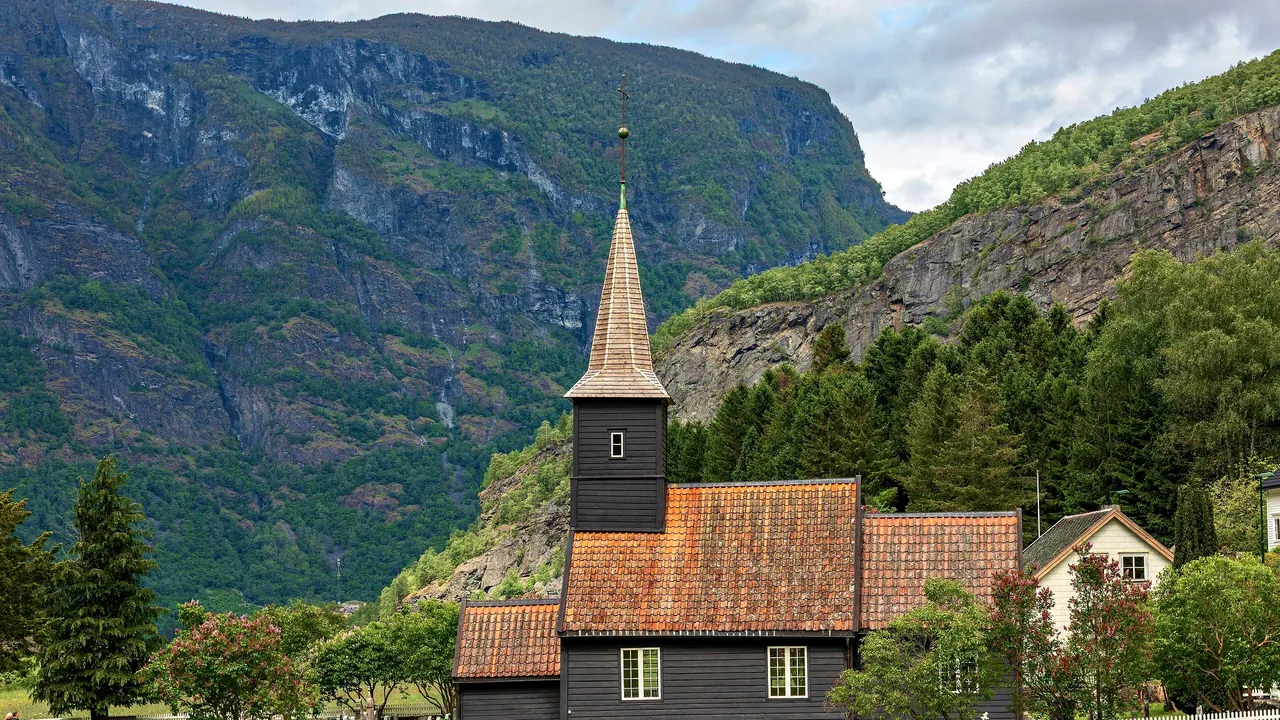
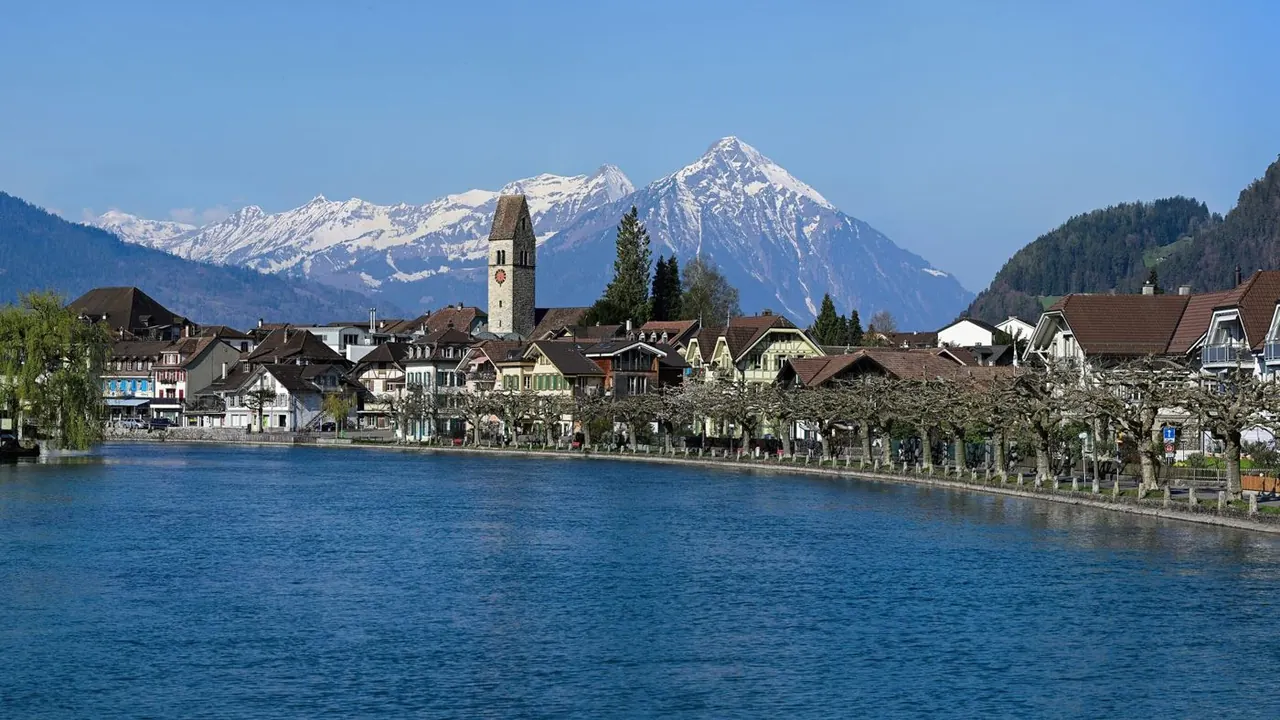
Photos: Flåm by Ximonic (Simo Räsänen), CC BY-SA 4.0, cropped; Interlaken by Roy Egloff, CC BY-SA 4.0, cropped.
Flåm or Interlaken?
Our verdict in twelve categories, each scored against the same fixed benchmark cities, and the climate month by month, so you can choose for your trip.
Choose Flåm for
- culture and sights
Flåm suits travellers who want one great landscape and very little else: a fjord trip with boats, kayaks, the mountain railway and long walks, followed by evenings that go completely still. It is a place for a few focused days, ideally as part of a wider Norway journey, and for people happy to trade choice for silence and scale.
Choose Interlaken for
- day trips
- families
- getting around
Interlaken is the better base for a longer or more varied stay. The Swiss rail and cable-car network puts glaciers, ridge walks, lake towns and Bern within easy reach, it handles families far more comfortably, and its evenings, while modest, give you a few more options. Choose it if you want the Alps and some range around them.
Scoreboard
Twelve categories on one fixed scale from 0 to 100. The shaded stretch is the gap between the two.
Your match
Pick a travel style or drag the sliders, and both match scores follow your weighting.
Wins on culture and sights with your weighting.
Wins on day trips and families with your weighting.
What matters to you?
Category by category
What the scores mean for a trip.
Beaches & swimming
Interlaken at least offers a proper summer swim. In July and August Lake Thun warms enough for the grassy lidos and small shingle beaches at Neuhaus and towards Spiez, and the colder turquoise Lake Brienz has a bathing area at Bönigen.
Flåm has nothing comparable. The fjord shore is rock, shingle and quay, and the snowmelt-fed water suits a quick plunge after a sauna more than an afternoon of swimming.
Food & drink
Neither place is a food destination, and both lean on hearty, filling meals. Flåm's eating is tightly limited to a handful of harbour spots, though it has a stronger sense of place in its smoked fjord salmon, valley lamb and the goat cheeses from Undredal. Interlaken offers more choice, from fondue and rösti to Indian and Asian kitchens, plus the pleasure of a hut terrace lunch high above Grindelwald or Mürren.
Culture & sights
Both are thin on sights of their own, since each exists for the scenery around it. Flåm's two real visits are the small railway museum, which explains how the line was cut through the mountain, and the painted wooden church from 1670 up the valley. Interlaken offers the look of an old resort instead, with its row of grand hotels and the Kursaal on the Höheweg and the timber houses of Unterseen across the Aare.
Nightlife
Interlaken gives you somewhere to go after dinner. Its backpacker pubs, sports bars and a couple of basement clubs near the hostels, plus the casino in the Kursaal, liven up in summer and the ski season, even if the streets empty well before midnight.
Flåm has only a brewery pub and hotel bars, and on light summer evenings the main activity is a stroll by the fjord before an early night.
Nature & outdoors
Both are among the great mountain bases of Europe, and the difference is in the kind of landscape. Flåm is about water and walls of rock: the narrow, UNESCO-listed Nærøyfjord seen from a boat or kayak, the Stegastein platform over the Aurlandsfjord, and routes such as Aurlandsdalen and the Rallarvegen cycle road across the plateau.
Interlaken is about height and adrenaline. Rail lines and cable cars carry you to the Jungfraujoch over the Aletsch glacier, to ridge walks at Schynige Platte and First, and into Lauterbrunnen's waterfall valley, while paragliding, canyoning and winter skiing add a sporting side Flåm lacks. Low cloud can hide the Swiss peaks, while Flåm's winter darkness limits walking.
Day trips
Interlaken is far the stronger base for outings. Bern's arcaded old town is under an hour by train, Thun and the castle villages of Spiez and Oberhofen are reached by paddle steamer, and Brienz's woodcarving and the Ballenberg open-air museum sit close by, with Lucerne a scenic run over the Brünig Pass.
From Flåm the choices are rural and few: Undredal's goat-cheese hamlet, the Viking village at Gudvangen, and the drive through the Lærdal tunnel to the Borgund stave church. Bergen is too far for an easy return in a day.
Good for families
Flåm gives children a few big moments rather than a full programme. A ride up to Myrdal and a boat between the cliffs of the Nærøyfjord can fill a couple of days, and a self-catering cabin in a village this small makes family life simple. After that, though, there is little to fall back on, and what you do next depends on how far young legs can walk.
Interlaken has much more to offer families, because its network of trains, gondolas and lake steamers turns almost every outing into a ride. Several of the scenic routes are flat enough for a pushchair, and Bern and Thun are close if you want a change from the mountains. Like Flåm, it has no zoo or aquarium for a rainy day, and the thin air on the Jungfraujoch is a good reason to keep the youngest at the lower stations.
Getting around
Both can be done without a car, but Interlaken makes it effortless. Mainline trains, mountain railways, cog lines, gondolas and lake steamers connect neatly, and many hotels give guests a regional transport card, though the busiest mountain trains can be crowded in summer.
Flåm is a ten-minute village with the railway, fjord boats and buses leaving from the same spot. Services thin out after summer and need planning, and reaching Stegastein, Borgund or Lærdal is far easier with a car on tunnelled, coach-filled roads.
Shopping & style
Interlaken has more to browse, though it is still visitor shopping: watch and jewellery stores along the Höheweg, army knives, chocolate and cuckoo clocks, and hand-carved pieces from Brienz as the one craft worth seeking out. Flåm is limited to a few gift shops by the station selling trolls, knitwear and goat cheese.
Affordability
Both are among the most expensive places to spend a vacation, and transport is a big part of the bill in each, from the Flåm railway and fjord boats to the Jungfraujoch trains. Flåm's main savings are its self-catering cabins, campsite and supermarket, while Interlaken offers hostels and regional travel passes, and in both, walking from the valley floor is free.
Live music & performing arts
Interlaken has a little live culture where Flåm has essentially none. Its signature is the open-air William Tell, staged by local amateurs in the woods each summer, backed by occasional Kursaal concerts and folklore evenings with alphorns and yodelling.
In Flåm the most you can hope for is a musician in the pub on a summer night.
Wellness & relaxation
Neither has a bathing culture, but the way to unwind differs. Flåm offers stillness and the Nordic cold-plunge ritual from a floating sauna on the fjord, with the whole village quiet once the day boats leave.
Interlaken has larger spas in its grand Höheweg hotels and a public wellness area, but the town centre is busy and active, so real calm means a lakeside village or a night up in Wengen or Mürren.
When should you go?
Pick your month. The climate figures are measured averages, not a forecast.
Flåm in July
Interlaken in July
Daytime high, °C
Rainfall in the month, mm
Where the figures come from
Flåm's temperatures are measured 59 km from the centre, at Evanger.
Flåm has no rain gauge within 25 km of the centre, so its rainfall comes from a gridded climate dataset read at the city rather than from a gauge further away.
Interlaken has no rain gauge within 25 km of the centre, so its rainfall comes from a gridded climate dataset read at the city rather than from a gauge further away.
Interlaken's sunshine is measured 66 km from the centre, at Sion.
Temperature and rainfall are climate normals, averaged over the years shown. Flåm: 2010-2025 (rainfall 1991-2020) normals, Evanger (59.3 km from centre). Interlaken: 2005-2020 (sunshine 1961-1990, rainfall 1991-2020) normals, Meiringen / Unterbach (19.3 km from centre).
Both are summer places, and neither ever gets truly hot. Flåm is mild from June to August, peaking around 21°C in July, and its driest stretch is late spring, with April and May the least rainy months. From September the rain builds steadily and stays heavy through winter, when short, cold days make it a quiet, dark place for anyone not there for the snow.
Interlaken runs a few degrees warmer through the year, reaching about 24°C in July, which is warm enough for a lake swim in high summer. Its pattern is the reverse of Flåm's for rain: May to August are the wettest months, with afternoon showers, yet they are also the sunniest, with about 270 hours in July. September is a good compromise there, still mild, drier and often clear. Winter is cold in both, but in Interlaken it brings the ski season rather than shutting things down.
Which traveller are you?
On a family trip with children, Interlaken is the easier choice. Summit stations with playgrounds and toboggan runs, the St Beatus caves and Ballenberg's farm animals fill days, while Flåm's appeal rests on the railway, the boats and hikes better suited to older children.
For a relaxing and wellness trip, Flåm has the edge in calm. Once the day visitors leave, the village falls silent, and a floating sauna with a plunge into the fjord is the evening ritual. Interlaken's spas are larger, but its centre stays busy.
For an outdoors trip, both are superb, so the choice is about terrain. Pick Flåm to paddle and walk a narrow fjord world of cliffs and waterfalls. Pick Interlaken for glaciers, high ridge trails, paragliding and canyoning, and ski slopes in winter.
Before you go
| Measure | Flåm | Interlaken |
|---|---|---|
| Official language | Norwegian, Nynorsk, Bokmål, Sámi | French, German, Italian, Romansh |
| Currency | Norwegian Krone (NOK) | Swiss Franc (CHF) |
| Sockets | CF230 V, 50 Hz | CJ230 V, 50 Hz |
| Driving side | Right | Right |
| Time zone | UTC+1, UTC+2 in summer | UTC+1, UTC+2 in summer |
| Emergency number | Police 112, ambulance 113, fire 110 | 112 |
| Elevation | 49 m | 571 m |
| Main airport | Bergen Airport, Flesland (BGO)121 km from centre64 non-stop destinations | Zürich Airport (ZRH)100 km from centre226 non-stop destinations |
| Public holidays this year | 13 days | 10 days |
By the numbers
| Measure | Flåm | Interlaken |
|---|---|---|
| City population | 293 | 6,123 |
| People per km² | - | 1,424 |
| Museums within 10 km | 0 | 3 |
| UNESCO World Heritage sites within 50 km | 1 | 2 |
Where else could you go?
Every comparison below shares a destination with this one, so you can follow Flåm or Interlaken somewhere new.
- Bernvs Interlaken
- Lucernevs Interlaken
- Zermattvs Interlaken
- Zurichvs Interlaken
- Lausannevs Interlaken
- Baselvs Interlaken