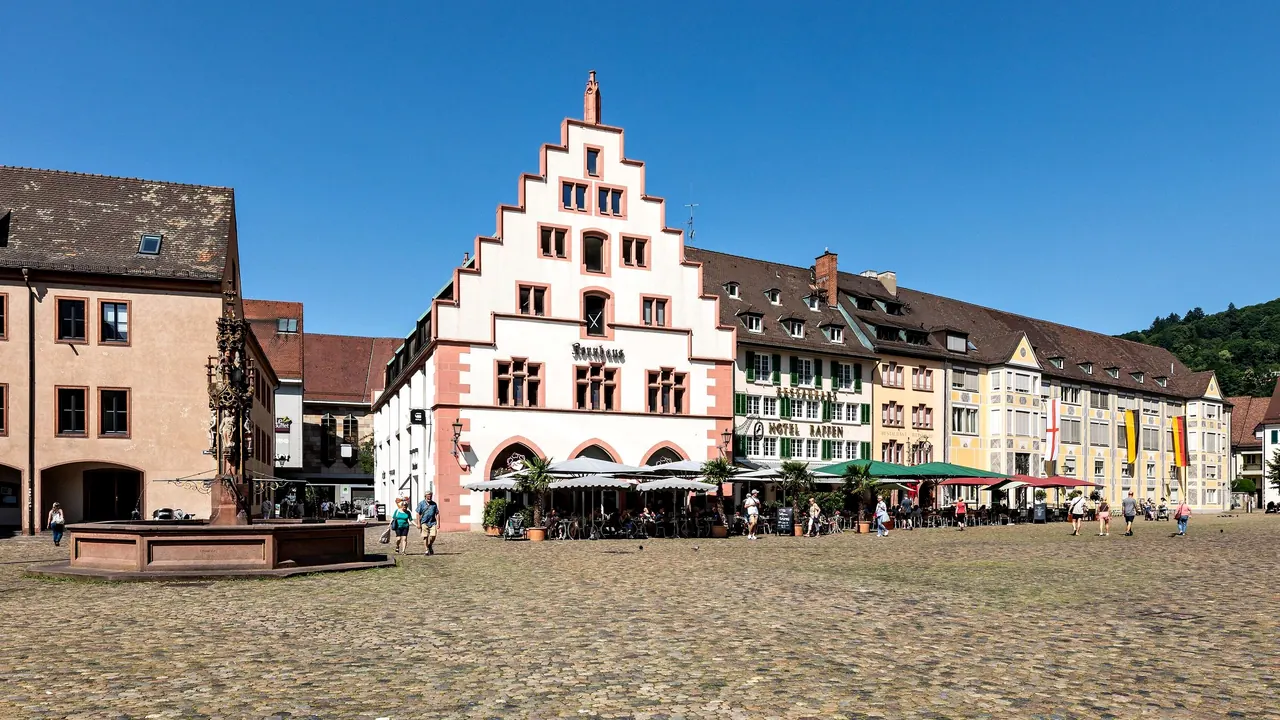
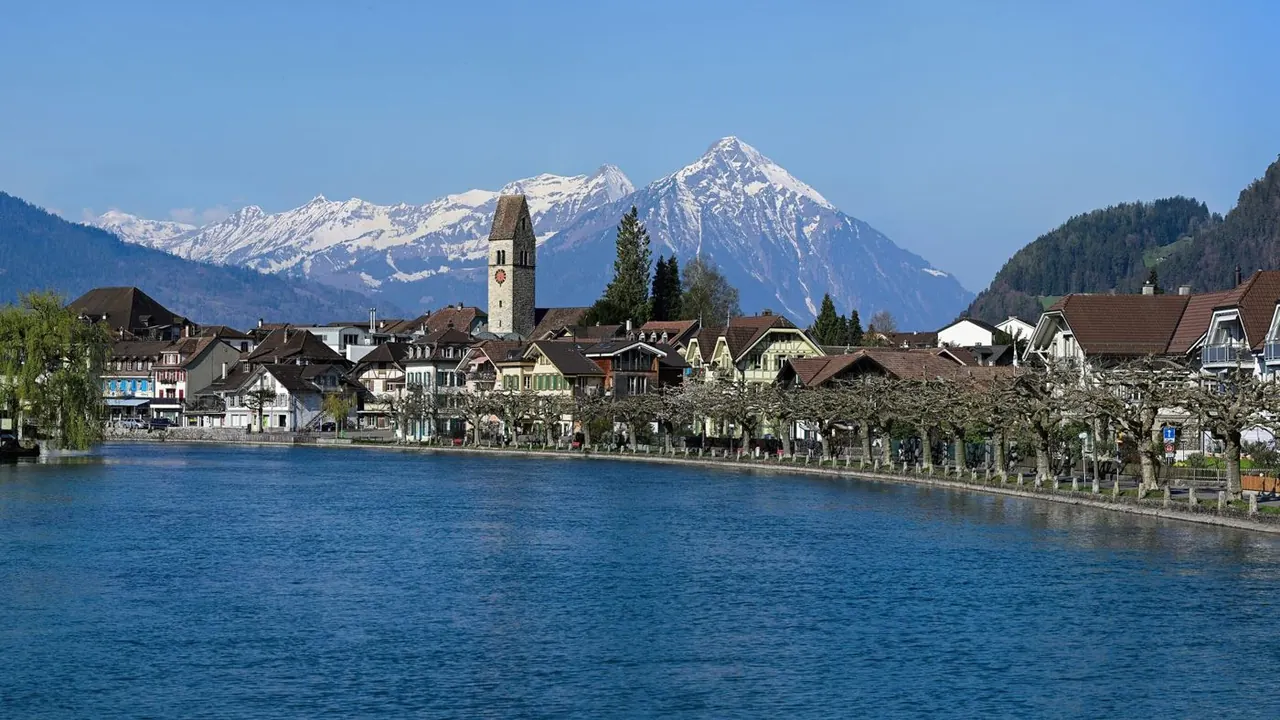
Photos: Freiburg by Dietmar Rabich, CC BY-SA 4.0, cropped; Interlaken by Roy Egloff, CC BY-SA 4.0, cropped.
Freiburg or Interlaken?
Our verdict in twelve categories, each scored against the same fixed benchmark cities, and the climate month by month, so you can choose for your trip.
Choose Freiburg for
- culture and sights
- prices
- food and drink
Freiburg suits travellers who want a real town as well as the landscape around it. You get a Gothic Münster and medieval gates, Baden cooking with Kaiserstuhl wine, student evenings in the old town and thermal baths a short ride south. The Black Forest starts at the edge of town, but its hills are gentle, and the whole stay costs noticeably less than one across the Swiss border.
Choose Interlaken for
- nature and the outdoors
- beaches
Come to Interlaken for the mountains. The Eiger, Mönch and Jungfrau, the waterfalls of Lauterbrunnen and the railway to the Jungfraujoch are all within an hour, and paragliding, canyoning and lake paddling all start from town. It is the place for active travellers who are out from early morning and happy to accept plain food, quiet evenings and full Swiss prices in return.
Scoreboard
Twelve categories on one fixed scale from 0 to 100. The shaded stretch is the gap between the two.
Your match
Pick a travel style or drag the sliders, and both match scores follow your weighting.
Wins on culture and sights and prices with your weighting.
Wins on nature and the outdoors and beaches with your weighting.
What matters to you?
Category by category
What the scores mean for a trip.
Beaches & swimming
Neither is a beach destination, but Interlaken makes the better summer swim. In a good year Lake Thun warms to around 21°C, with grassy lidos and shingle beaches at Neuhaus and along the shore towards Spiez. The glacial turquoise of Lake Brienz under the snow peaks is a sight in itself, if a cold one.
In Freiburg, a swim means cycling out to the gravel-pit lakes on the Rhine plain. The water there is pleasantly warm, but the shores are just grass and there is little scenery. The alternative is an hour's trip to the cooler Titisee or Schluchsee, and the city's open-air pools are packed in high summer.
Food & drink
Freiburg is the place to eat well. Its Baden cooking has a French touch: Schäufele, Black Forest ham, mountain trout and spring asparagus, served with dry Pinot from the Kaiserstuhl. The daily market around the Münster is a meal in itself, and the surrounding region has some of Germany's best fine dining, even if the international choice is thin.
Interlaken's food fills you up but rarely impresses. Expect fondue, raclette and rösti for visitors, plus Indian and Asian places for the international crowd. The better meals are up the valleys, on a hut terrace above Grindelwald or at a mountain dairy selling Alpine cheese.
Culture & sights
The gap here is wide. Freiburg has a real old town to explore, with the red sandstone Münster and its tower you can climb, the Historisches Kaufhaus on the market square, the Martinstor and Schwabentor gates and the Bächle channels along the streets. The Augustinermuseum adds fine medieval art. Much of the centre was rebuilt after the war, but it still makes a rewarding day or two.
Interlaken's own sights amount to the grand hotels and the Kursaal along the Höheweg, plus a few old timber houses in Unterseen. Anyone after architecture or museums takes the train to Bern or Thun.
Nightlife
Thanks to its students, Freiburg has the livelier evenings. There are pubs and wine bars in the lanes around the Martinstor, beer gardens, summer nights on the squares and by the Dreisam, and a few clubs for techno and indie.
Interlaken goes to bed early, because most people are up for the first mountain train or a paragliding flight. A backpacker cluster of pubs and basement clubs and the casino in the Kursaal are about all there is, and the Höheweg is quiet well before midnight.
Nature & outdoors
Both sit on the edge of serious landscape, but Interlaken's is on another scale. The Eiger, Mönch and Jungfrau, the cliffs and waterfalls of Lauterbrunnen and the Aletsch glacier seen from the Jungfraujoch at 3,454m are all within an hour by rail. Cable cars make high trails easy to reach from Grindelwald First, the Schynige Platte and Mürren, and adventure sports from paragliding to rafting on the Lütschine start straight from town.
Freiburg's outdoors is gentler and more varied. You can take the cable car up to the Schauinsland ridge, hike or ski on the Feldberg, walk the Ravenna gorge and cycle easily through the Kaiserstuhl vineyards. A lost view matters less there, whereas in Interlaken low cloud can hide the peaks for days.
Day trips
Both make excellent bases, for different kinds of outing. Freiburg's advantage is having three countries close by: Basel's museums by train, Colmar and the Alsace wine villages of Riquewihr and Eguisheim, and Strasbourg's cathedral and Petite France quarter. Closer to home are Staufen, Breisach and Baden-Baden. These are trips for old towns, wine and art.
Interlaken's outings mix lakes, castles and cities. Bern's arcaded old town is under an hour away, paddle steamers stop below the castles at Thun, Spiez and Oberhofen, Ballenberg has its open-air museum, and Lucerne is reached by the line over the Brünig Pass. Every one of these trips works by train, while Alsace is easier with a car.
Good for families
Both are safe and easy with children, but the fun comes in different forms. Freiburg has Europa-Park, Germany's largest theme park, about 40 minutes away, along with the free Mundenhof animal park, the Bächle channels for toy boats and the summer swimming lakes. In Interlaken the journey is the treat: rack railways, gondolas and lake steamers, then playgrounds and toboggan runs at the top, the St Beatus caves and the farm animals at Ballenberg.
Rainy days are hard to fill in both places. Interlaken adds the problem of high altitude for very young children, and its paths only really suit pushchairs on the valley floor.
Getting around
Freiburg is a city for trams and bicycles, while in Interlaken the trains are part of the sightseeing. Freiburg's old town is small and largely car-free, with most sights within a twenty-minute walk, and a dense tram network runs out to the suburbs and the Schauinsland cable car. Bike lanes run everywhere across the flat centre, and regional trains climb the Höllental into the Black Forest.
Interlaken itself takes about twenty minutes to cross on foot, from one station to the other along the Höheweg. Beyond the town, narrow-gauge lines to Lauterbrunnen and Grindelwald connect with cog railways, gondolas and lake steamers, so you can see the whole Jungfrau region without a car. Wengen and Mürren don't allow cars anyway. Many hotels in both places give guests a local transport card, but you may have to stand on Interlaken's busiest mountain trains in summer.
Shopping & style
Freiburg is the better place to browse, though it is still modest. There are chains along Kaiser-Joseph-Strasse, independent boutiques and bookshops in the Gerberau and Konviktstrasse quarters, and the Münster market for local wine, schnapps and ham.
Interlaken's Höheweg is aimed at tour groups, with large watch and jewellery stores, army knives, chocolate and outdoor gear, and almost no independent shops. Cuckoo clocks are sold in both, but the one local craft worth seeking out here is woodcarving from Brienz.
Affordability
Freiburg is much the cheaper base, though rooms are its weak point. Hotels fill up on summer weekends and during trade fairs, and many visitors stay in the Black Forest villages nearby, where rooms are easier to find. Getting about by tram costs only a moderate fare. Costs jump on a day trip across the border into Switzerland.
Swiss prices are where Interlaken starts. Hotels, meals and drinks are all charged at full Swiss rates, and paragliding or canyoning adds a large sum on top of the mountain fares. Hostels, supermarket picnics, a regional pass and walking from the valley floor all help, but there is no cheap way to see the Jungfrau region properly.
Live music & performing arts
Freiburg has a proper year-round stage. There is opera, drama and dance at Theater Freiburg, the Freiburger Barockorchester at the Konzerthaus, a small student jazz scene and the summer Zelt-Musik-Festival in its tent village.
Interlaken's highlight is the open-air William Tell, played by local amateurs in the woods each summer. Beyond that there are occasional Kursaal concerts and folklore evenings with yodelling and alphorns. For a real orchestra or theatre you have to go to Bern.
Wellness & relaxation
Freiburg is in spa country. There is a thermal bath on the city's eastern edge, Bad Krozingen's warm outdoor pools are twenty minutes south, Badenweiler has a modern thermal bath next to Roman ruins, and Baden-Baden is an hour away by train. Afterwards you come back to an unhurried town of café terraces and riverside paths.
Interlaken has no thermal waters of its own, so relaxing means a spa in one of the grand hotels on the Höheweg or the town's public wellness area. The real calm is outside the busy, activity-focused centre, on a slow steamer crossing or up in Wengen or Mürren.
When should you go?
Pick your month. The climate figures are measured averages, not a forecast.
Freiburg in July
Interlaken in July
Daytime high, °C
Rainfall in the month, mm
Where the figures come from
Interlaken has no rain gauge within 25 km of the centre, so its rainfall comes from a gridded climate dataset read at the city rather than from a gauge further away.
Interlaken's sunshine is measured 66 km from the centre, at Sion.
Temperature and rainfall are climate normals, averaged over the years shown. Freiburg: 1991-2020 normals, Freiburg (0.6 km from centre). Interlaken: 2005-2020 (sunshine 1961-1990, rainfall 1991-2020) normals, Meiringen / Unterbach (19.3 km from centre).
From spring to autumn, Freiburg is the warmer of the two, with July afternoons around 27°C against about 24°C in Interlaken. Both are at their best for walking and hiking in late spring and September. Both also have their wettest spell in early summer, but Interlaken's is heavier, at around 125mm a month from June to August, and that rain often brings cloud down over the peaks. Its lakes are only warm enough to swim in during July and August, the same short window as Freiburg's gravel pits and open-air pools.
Winter is cold in both places. Interlaken's January stays just above freezing at 3°C, and its high ground turns over to skiing. Freiburg stays a few degrees milder in town, and its snow is up on the Feldberg. The two get similar sunshine through most of the year, but Interlaken is somewhat sunnier in autumn.
Which traveller are you?
For a culture and arts trip, Freiburg is the clear pick. The Münster, the medieval sculpture in the Augustinermuseum, opera at Theater Freiburg and the Freiburger Barockorchester fill two or three days. Interlaken's own sights take an hour, and its stage is mostly summer folklore.
On an outdoors trip, Interlaken wins outright. Cog railways and cable cars take you up to high trails under the Eiger and Jungfrau within an hour, and paragliding, canyoning and rafting all start in town. Freiburg's Black Forest is lovely but gentler.
On a tight budget, your money goes much further in Freiburg. Rooms cost more than the city's size suggests, but market sausages, student-quarter restaurants and a free Münster keep each day cheap. In Interlaken the mountain railways alone would use up a lean budget.
Before you go
| Measure | Freiburg | Interlaken |
|---|---|---|
| Official language | German | French, German, Italian, Romansh |
| Currency | Euro (EUR) | Swiss Franc (CHF) |
| Sockets | CF230 V, 50 Hz | CJ230 V, 50 Hz |
| Driving side | Right | Right |
| Time zone | UTC+1, UTC+2 in summer | UTC+1, UTC+2 in summer |
| Emergency number | 112 | 112 |
| Elevation | 278 m | 571 m |
| Main airport | EuroAirport Basel–Mulhouse–Freiburg (BSL)50 km from centre112 non-stop destinations | Zürich Airport (ZRH)100 km from centre226 non-stop destinations |
| Public holidays this year | 12 days | 10 days |
By the numbers
| Measure | Freiburg | Interlaken |
|---|---|---|
| City population | 238,299 | 6,123 |
| People per km² | 1,558 | 1,424 |
| Museums within 10 km | 13 | 3 |
| UNESCO World Heritage sites within 50 km | 2 | 2 |
Where else could you go?
Every comparison below shares a destination with this one, so you can follow Freiburg or Interlaken somewhere new.
- Colmarvs Freiburg
- Bernvs Interlaken
- Baselvs Freiburg
- Lucernevs Interlaken
- Strasbourgvs Freiburg
- Zermattvs Interlaken