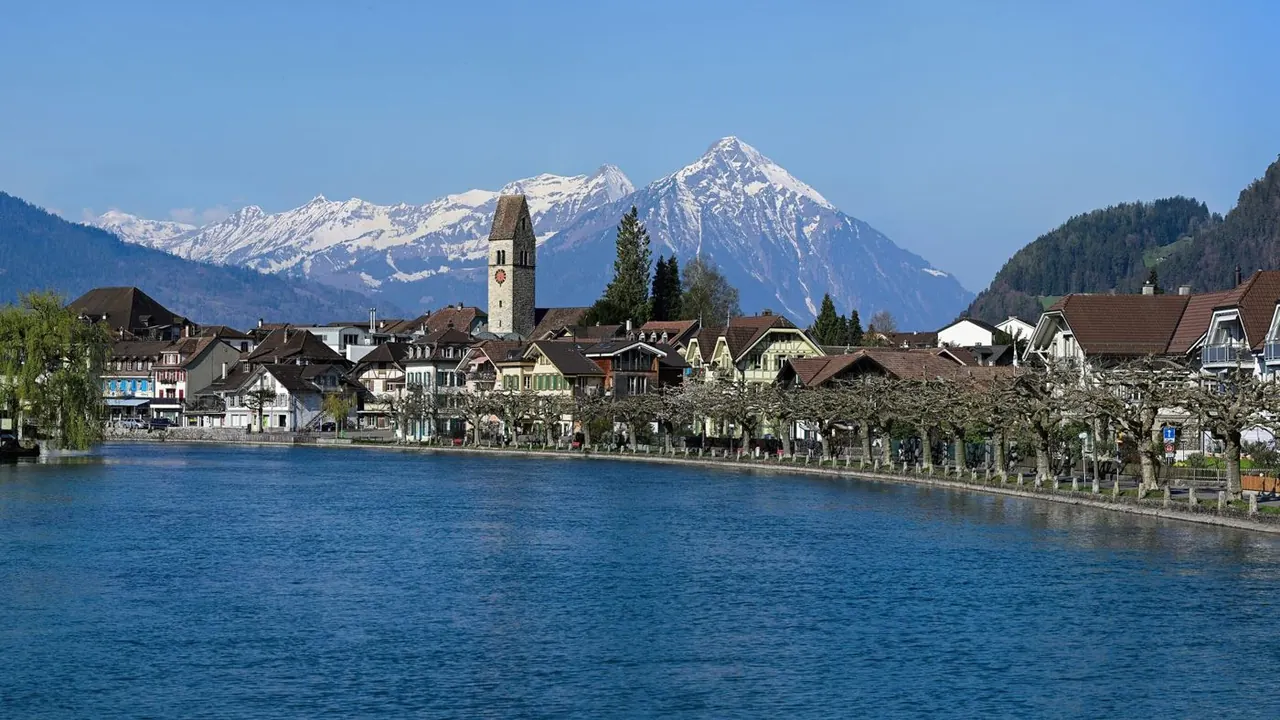
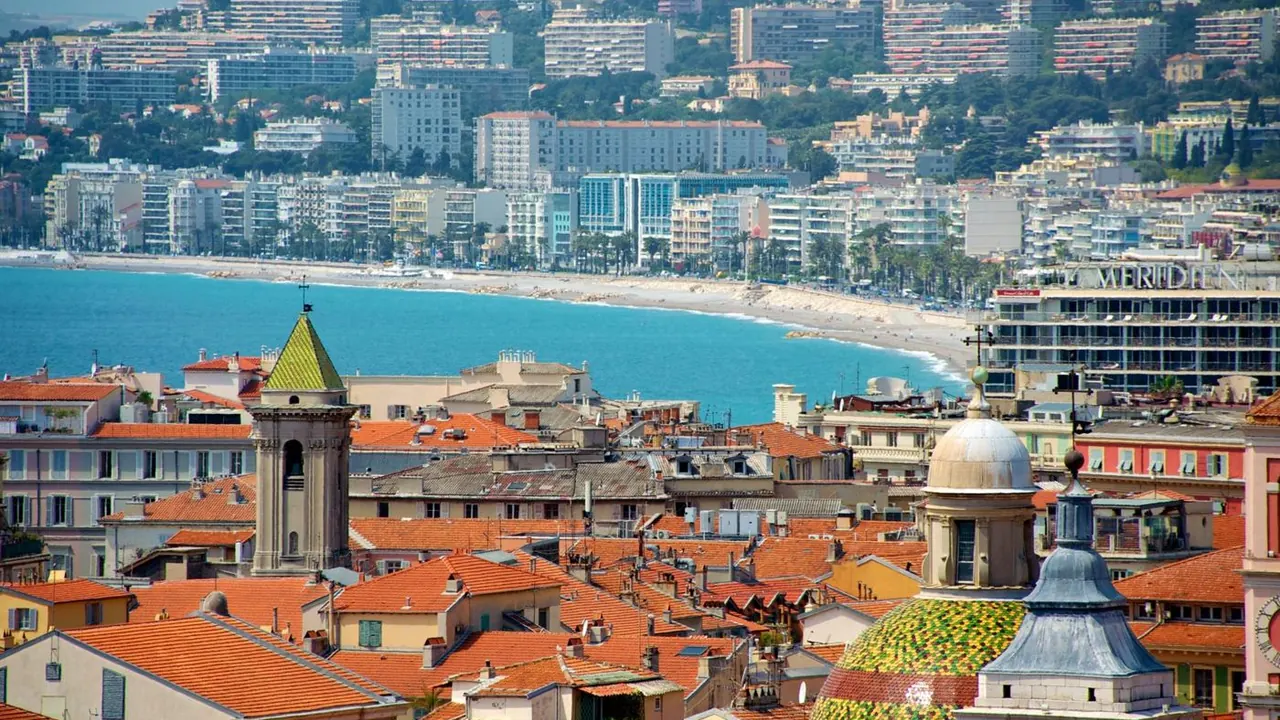
Photos: Interlaken by Roy Egloff, CC BY-SA 4.0, cropped; Nice by Daniel Stockman, CC BY-SA 2.0, cropped.
Interlaken or Nice?
Our verdict in twelve categories, each scored against the same fixed benchmark cities, and the climate month by month, so you can choose for your trip.
Choose Interlaken for
- nature and the outdoors
- families
- getting around
Interlaken is the choice for a trip built around the mountains. Trains, gondolas and cog railways put the Eiger, the Lauterbrunnen valley and the high trails within an hour, and the town is a base for paragliding, canyoning and winter skiing. It is also easy with children, provided they enjoy being outdoors. In return you get early, quiet evenings, plain food and very high costs, so it suits travellers who measure a day by what they did outside.
Choose Nice for
- culture and sights
- beaches
- food and drink
Nice gives you a whole city where Interlaken gives you a base. It has a sea to swim in for half the year, an old town with a cooking tradition of its own, art museums on the Cimiez hill, and a coastline of towns from Monaco to Antibes that you can reach without a car. The outdoors is still close at hand, but in Nice it fills an afternoon rather than the whole trip. Choose it if you want sun, food, culture and evenings out in one place, at a cost that is high but more forgiving than Swiss levels.
Scoreboard
Twelve categories on one fixed scale from 0 to 100. The shaded stretch is the gap between the two.
Your match
Pick a travel style or drag the sliders, and both match scores follow your weighting.
Wins on nature and the outdoors and families with your weighting.
Wins on culture and sights and beaches with your weighting.
What matters to you?
Category by category
What the scores mean for a trip.
Beaches & swimming
Nice lives on its shoreline. The 7km pebble beach under the Promenade des Anglais is fit for swimming from June to October, and sandier, calmer coves at Villefranche, Cap Ferrat and Juan-les-Pins are a short ride away. Bring water shoes or rent a lounger, because the stones are hard going.
Interlaken offers a swim, not a beach trip. Lake Thun warms up enough in July and August for its grassy lidos, while Lake Brienz is a striking turquoise but colder. It is a lovely way to cool off after a mountain day, under snow peaks, but not something to plan a stay around.
Food & drink
Nice has a cuisine you can name: socca hot from the wood oven, pissaladière, stuffed vegetables and a much-argued salade niçoise, with the Cours Saleya market and small Bellet vineyards behind it. Eat in the family places of Vieux Nice and around the port, and skip the set-menu terraces.
In Interlaken, the meals worth remembering happen outside town. Restaurants in the town serve dependable fondue, rösti and international dishes, but the best eating is cheese bought at mountain dairies and lunch on a hut terrace above Grindelwald or Mürren.
Culture & sights
There is a real gap here. Interlaken's own sights fit into a short stroll: the grand hotels and Kursaal on the Höheweg and a few timber houses in Unterseen. Anything more means a trip to Bern or Thun.
Nice can fill two or three days with culture. Vieux Nice's ochre lanes and baroque chapels sit under Castle Hill, the Belle Époque villas and the Russian Orthodox Cathedral recall the winter-resort years, and the art museums in Cimiez and MAMAC are the reason many visitors come.
Nightlife
Nice is where you will want to stay out. The lanes of Vieux Nice fill with wine and cocktail bars, and in summer the port and beach clubs keep people out late, although the city has few clubs worth seeking out. Interlaken's nights are a few backpacker pubs, a basement club or the casino, and most people are in bed early before a morning train up the mountain.
Nature & outdoors
Both sit at the foot of the Alps, but Interlaken is right among them. The Jungfraujoch, the waterfalls of Lauterbrunnen, the Schynige Platte ridge and the ski slopes of Wengen and Mürren are all reached by rail. The town is also a world centre for paragliding and canyoning. Its one weakness is cloud that can hide the peaks for days.
Nice puts sea and mountains side by side. You get headland paths on Cap Ferrat, cycling on the corniches, diving and kayaking offshore, and the Mercantour and the Esterel within reach. Most of this takes planning, and summer heat limits hiking to the early morning.
Day trips
Both are excellent bases, and Nice has slightly more variety. Monaco, Èze, Menton, Antibes, Cannes, Grasse and Saint-Paul-de-Vence are mostly under an hour away, with Italy a short train ride along the coast.
From Interlaken, the trips mix towns and lakes. You can go to Bern's arcaded old town, by steamer to the castles at Thun, Spiez and Oberhofen, to the woodcarvers of Brienz and the Ballenberg open-air museum, or over the Brünig Pass to Lucerne.
Good for families
Interlaken turns the transport itself into the entertainment. Cog railways, gondolas, cliff walks, summer toboggan runs, the St Beatus caves and the farm animals at Ballenberg fill long days, though rainy days are hard to fill and the highest summits are a lot for toddlers.
Nice suits families in a gentler, city way. It has the water jets of the Promenade du Paillon, Parc Phoenix and a flat promenade for pushchairs. Pebbles, crowds and heat in midsummer are the main drawbacks.
Getting around
Neither needs a car, and Interlaken's network is a little more complete. Mainline trains, mountain railways, gondolas and lake steamers connect so well that the whole Jungfrau region can be done on one transport card, and the town itself is a flat walk between two stations.
Nice works more like a normal city. Its centre is walkable, a tram runs to the airport, buses climb to Cimiez, and coastal trains run to Monaco and Cannes. Summer crowds slow both places down, and in Nice the coast roads are slow as well.
Shopping & style
Nice is the better place to browse. Avenue Jean Médecin has the high-street chains, the streets around rue Paradis have the fashion houses, the old town sells olive oil, soaps and Provençal fabrics, and the Cours Saleya turns into an antiques market on Mondays. Interlaken's Höheweg mostly sells watches, army knives and souvenirs to tour groups, and the woodcarving of Brienz is its one real local craft.
Affordability
Neither is cheap, but Interlaken is the harder on your wallet. Swiss prices for hotels and meals are only the start, because the mountain railways and the Jungfraujoch are what really push up the bill. Picnics and transport passes help only so much.
Nice is easier to manage on a budget. The trams and coastal trains are inexpensive, so the day trips cost little, and socca and market food keep meals cheap. Spring and late autumn bring hotel prices down.
Live music & performing arts
Nice has a season, and Interlaken mostly has summer shows. The Opéra de Nice, the Philharmonic, the national theatre, the July jazz festival and the February Carnival give the city a real calendar. In Interlaken it is the open-air William Tell in the woods, folklore evenings and the lake-stage musical at Thun, with Bern the place to go for an orchestra.
Wellness & relaxation
The two are about level here, and neither has a bathing tradition. In both, spa time means the big hotels.
What differs is the kind of calm. Interlaken's comes from mountain quiet in Wengen or Mürren and slow steamer crossings, away from the busy town centre. Nice's is a seaside rhythm of early swims and evening walks on the promenade, with thalassotherapy along the coast. It is at its most restful out of season.
When should you go?
Pick your month. The climate figures are measured averages, not a forecast.
Interlaken in July
Nice in July
Daytime high, °C
Rainfall in the month, mm
Where the figures come from
Interlaken has no rain gauge within 25 km of the centre, so its rainfall comes from a gridded climate dataset read at the city rather than from a gauge further away.
Temperature and rainfall are climate normals, averaged over the years shown. Interlaken: 2005-2020 (rainfall 1991-2020) normals, Meiringen / Unterbach (19.3 km from centre). Nice: 1991-2020 normals, Nice (8 km from centre).
Interlaken has one clear season. From June to September days are mild, reaching about 24°C in July, which is right for high trails and the lakes, although July and August are also the wettest summer months and cloud can sit on the peaks. Winter is cold, with highs around 3°C in January, and that is when the ski areas take over. Spring and late autumn fall between the two and suit valley walks more than summits.
Nice is warm for much longer, and the two cities line up quite differently over the year. The sea is fit for swimming from June to October and peaks at about 25°C in August. July and August are the driest and sunniest months but hot enough to make midday walking hard, so May, June and September are kinder for exploring on foot. The rain arrives in autumn, peaking at about 138mm in November. Winter is mild enough for walking in town, so Nice works as a city break in the months when Interlaken is given over to skiing.
Which traveller are you?
On an outdoors trip, Interlaken is hard to beat. Mountain railways and cable cars lift you straight onto trails below the Jungfrau, and paragliding, rafting and canyoning all start from town. Nice has fine coastal paths and the Mercantour, but they are a side attraction there.
For a culture and arts trip, Nice is the obvious pick. The Matisse and Chagall museums, MAMAC, the baroque chapels of Vieux Nice and the art villages inland give you days of material. Interlaken has almost nothing of its own, and its culture means a train to Bern.
On a family trip with children, Interlaken has the edge. Rack railways, lake steamers, summer toboggan runs and summit playgrounds hold children's attention all day. Nice offers easy splash parks and the promenade, but its pebble beaches and summer heat make days with small children harder work.
Before you go
| Measure | Interlaken | Nice |
|---|---|---|
| Official language | French, German, Italian, Romansh | French |
| Currency | Swiss Franc (CHF) | Euro (EUR) |
| Sockets | CJ230 V, 50 Hz | CE230 V, 50 Hz |
| Driving side | Right | Right |
| Time zone | UTC+1, UTC+2 in summer | UTC+1, UTC+2 in summer |
| Emergency number | 112 | 112 |
| Elevation | 571 m | 0 m |
| Main airport | Zürich Airport (ZRH)100 km from centre226 non-stop destinations | Nice-Côte d'Azur Airport (NCE)6 km from centre130 non-stop destinations |
| Public holidays this year | 10 days | 11 days |
By the numbers
| Measure | Interlaken | Nice |
|---|---|---|
| City population | 6,123 | 357,737 |
| People per km² | 1,424 | 4,975 |
| Museums within 10 km | 3 | 17 |
| UNESCO World Heritage sites within 50 km | 2 | 2 |
| Swim season, months above 21 °C | - | 4 months |
Where else could you go?
Every comparison below shares a destination with this one, so you can follow Interlaken or Nice somewhere new.