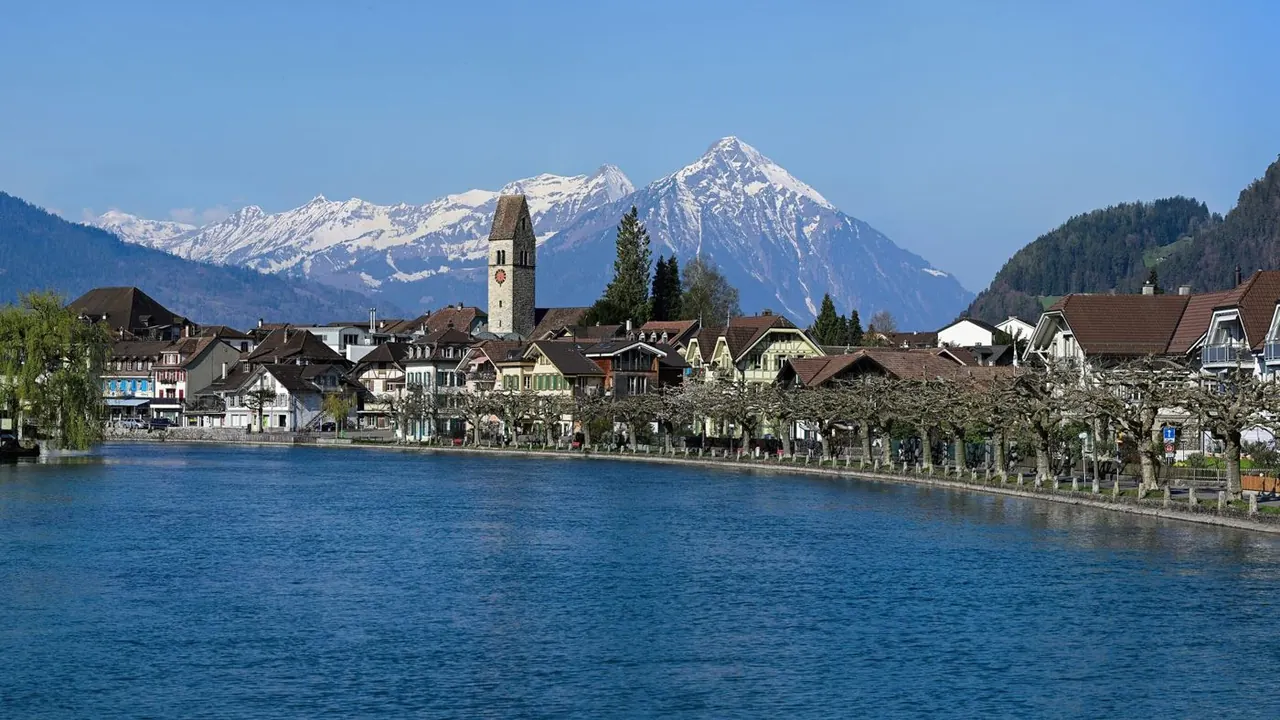
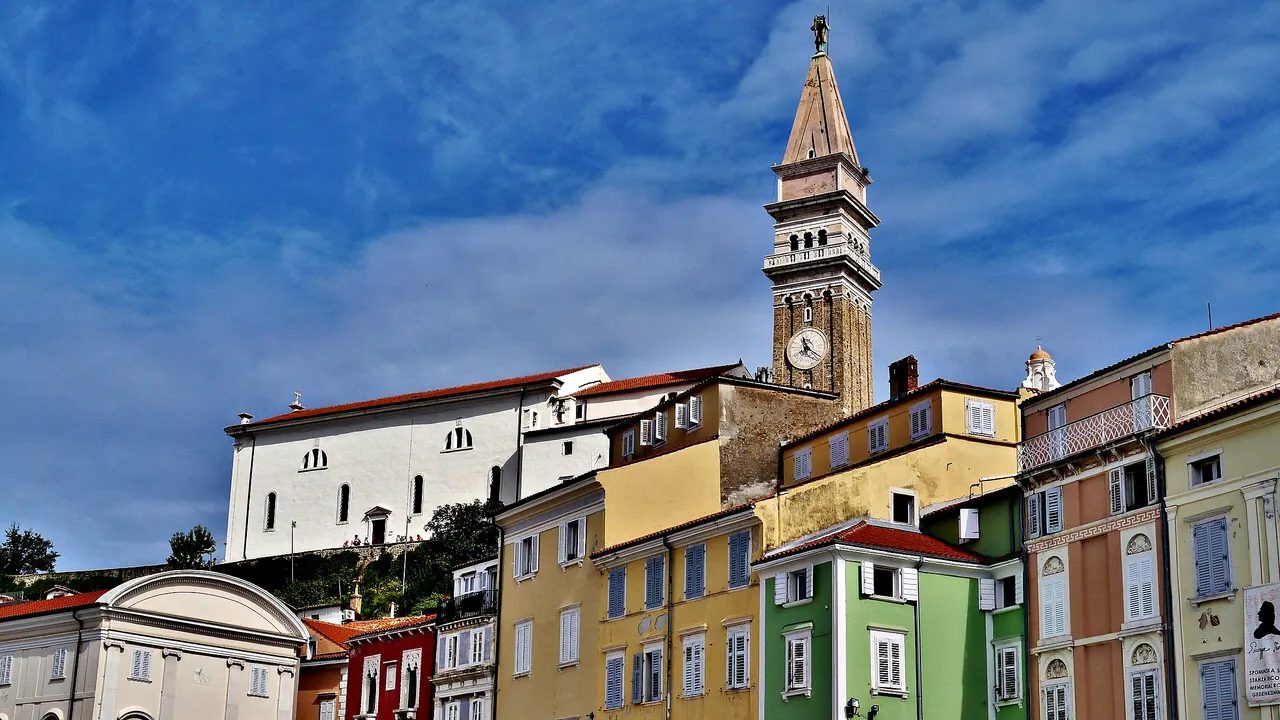
Photos: Interlaken by Roy Egloff, CC BY-SA 4.0, cropped; Piran by Zairon, CC BY-SA 4.0, cropped.
Interlaken or Piran?
Our verdict in twelve categories, each scored against the same fixed benchmark cities, and the climate month by month, so you can choose for your trip.
Choose Interlaken for
- nature and the outdoors
- families
- getting around
Interlaken is the choice for travellers who come for mountains rather than towns. The Jungfrau peaks, the Lauterbrunnen valley and a dense web of trains, cable cars and lake steamers put glaciers, high trails and adventure sport within easy reach, and families find the whole system simple to use. Expect to pay heavily for this, and to find little to do in the town itself once cloud closes in.
Choose Piran for
- prices
- culture and sights
- beaches
Piran suits a slower, warmer trip by the sea. Its Venetian old town is worth seeing in its own right, the Adriatic is warm enough to swim in every day through summer, and the salt-pan spas and car-free lanes make it easy to rest. It costs far less than the Bernese Oberland. The outdoors here is gentle coast and karst rather than high mountains, though, and getting beyond the town usually means driving.
Scoreboard
Twelve categories on one fixed scale from 0 to 100. The shaded stretch is the gap between the two.
Your match
Pick a travel style or drag the sliders, and both match scores follow your weighting.
Wins on nature and the outdoors and families with your weighting.
Wins on prices and culture and sights with your weighting.
What matters to you?
Category by category
What the scores mean for a trip.
Beaches & swimming
Neither has sandy beaches with rows of sunbeds, but Piran is much the better place to swim. You can get into clear Adriatic water from the ladders and rocks along the seafront and around the Punta, or from the pebbles at Fiesa. Portoroz's small beach and the cliff-backed shore at Strunjan add sand and quiet, and the season runs all summer.
Interlaken's swimming is a summer extra. There are lidos and shingle on Lake Thun at Neuhaus, and a colder dip in turquoise Lake Brienz at Bönigen. It is lovely under the snow peaks, but cool and brief.
Food & drink
Piran eats better, though neither is a place to travel to for food. Grilled fish, squid and scampi buzara by the harbour come with Istrian olive oil, truffles and Malvazija or Refosk from the hills, and salt from the nearby pans, so meals feel local even when the menus repeat.
Interlaken's restaurants serve fondue, raclette and rösti alongside Indian and Asian kitchens. The food is reliable but forgettable. The best eating is up at hut terraces and mountain dairies, or in a supermarket picnic.
Culture & sights
Piran is itself the sight: a Venetian Gothic peninsula of lanes and small squares around the oval Tartini Square, with St George's campanile and the old walls above. The museums are small: a maritime museum, an aquarium and the Minorite cloister. A day covers them, but the town is a pleasure to wander.
Interlaken has almost nothing to compare. The grand hotels and Kursaal along the Höheweg and a few timber houses in Unterseen are about all there is. For history and architecture you take the train to Bern or Thun.
Nightlife
Both towns go quiet early, but the evenings feel different. In Piran an evening means a glass of Malvazija on Tartini Square or a sunset drink on the Punta, with the beach bars, casino and summer clubs of Portoroz a few minutes away. Interlaken's evenings are younger and a little rowdier: backpacker pubs, sports bars and a couple of basement clubs near the hostels, busiest in summer and the ski season, plus the Kursaal casino.
Nature & outdoors
Interlaken is one of Europe's great mountain bases. Within an hour lie the Eiger, Mönch and Jungfrau, the waterfalls of the Lauterbrunnen valley and the railway to the Jungfraujoch above the Aletsch glacier, and cable cars lift you onto high trails at First, Schynige Platte and Mürren. Paragliding, canyoning, rafting and winter skiing add to all this. Only low cloud gets in the way.
Piran's outdoors is pleasant but small in scale. It offers the flysch cliffs and coastal path at Strunjan, wading birds in the Secovlje salt pans, the Parenzana cycle route inland and the Skocjan caves on the Karst.
Day trips
Both are strong bases, but for different kinds of outing. From Interlaken, trains and lake steamers reach Bern's arcaded old town, Thun's castle, the lakeside castles at Spiez and Oberhofen, Ballenberg's open-air museum and Lucerne over the Brünig Pass.
Piran's outings cross borders. You can reach Trieste's Habsburg squares, Rovinj, Porec and the Istrian hill towns of Motovun and Groznjan, as well as Predjama Castle, Ljubljana and, by summer boat, Venice. The range is wider, but harder to reach without driving.
Good for families
Interlaken does more for children. Rack railways, gondolas and steamers are an adventure in themselves, and the summit stations have playgrounds, cliff walks and summer toboggan runs. The St Beatus caves and Ballenberg's farm animals add variety. The catches are wet days and altitudes that can trouble toddlers.
Piran is safe and car-free, with a calm, warm sea and a small aquarium. But swimming is off concrete ledges, the lanes are steep, and beyond the shallow sandy beach at Portoroz there is little else for children.
Getting around
Interlaken is the easier place to explore without a car. Trains, cog railways, gondolas and steamers connect so neatly that the whole Jungfrau region and Bern can be reached by public transport. The flat town is a short walk between its two stations. Only summer crowds on the mountain trains spoil it.
Piran is simple on foot, with a car-free old town and a shuttle to the garage and Portoroz. But there is no railway and the regional buses are slow, so the Karst and Istria really call for a hire car.
Shopping & style
Neither is worth a shopping trip, and both lean towards souvenirs. Interlaken's Höheweg is lined with watch and jewellery stores, army knives, cuckoo clocks and chocolate, and Brienz woodcarving is the one genuine local craft. Piran's best buys are things to eat and drink: sea salt and salt flower from Secovlje, Istrian olive oil and coastal wine, plus a few galleries in the lanes.
Affordability
The gap here is wide. Interlaken charges full Swiss rates for rooms, meals and drinks, and the mountain railways, the Jungfraujoch above all, add a large sum on top. Hostels and picnics help only at the margins.
Piran is mid-priced for Western Europe. Old-town rooms and waterfront tables cost more in high summer, but staying in Portoroz or coming out of season brings the bill down to a fair level.
Live music & performing arts
Both offer small-scale performance, mostly in summer. Interlaken's signature event is the amateur open-air William Tell in the woods, along with folklore evenings of yodelling and alphorns, and Bern's theatre and orchestra are under an hour away. Piran leans classical, with Tartini concerts in churches, the monastery cloister and on the square, and the little Tartini Theatre for recitals.
Wellness & relaxation
Piran is the more restful choice. Portoroz grew up as a spa town around seawater pools, brine baths and salt-pan mud, and there is an open-air thalasso spa among the Secovlje lagoons. The car-free town itself slows you down, especially in May, June and September.
Interlaken relies on hotel spas along the Höheweg and a public wellness area. The centre is busy with coach groups and backpackers, so calm is found on the lakeshore, aboard the steamers or up in Wengen and Mürren.
When should you go?
Pick your month. The climate figures are measured averages, not a forecast.
Interlaken in July
Piran in July
Daytime high, °C
Rainfall in the month, mm
Where the figures come from
Interlaken has no rain gauge within 25 km of the centre, so its rainfall comes from a gridded climate dataset read at the city rather than from a gauge further away.
Interlaken's sunshine is measured 66 km from the centre, at Sion.
Temperature and rainfall are climate normals, averaged over the years shown. Interlaken: 2005-2020 (sunshine 1961-1990, rainfall 1991-2020) normals, Meiringen / Unterbach (19.3 km from centre). Piran: 2005-2020 (sunshine 1991-2020, rainfall 1991-2020) normals, Portoroz (1.2 km from centre).
Interlaken is at its best in summer and winter. From June to September the valley is mild enough for walking, and the lakes can be swum in during July and August, when highs reach about 24°C. Summer is also the wettest time, with around 125mm a month, and rain brings the cloud down over the peaks even though these are the sunniest months. From November to March the town is cold and dim, and people come then for the skiing above it rather than the streets.
Piran is warmer all year, and its rain comes at a different time. The beach season runs from June to September, with the sea at 25°C in July and August. July highs of about 30°C make the steep lanes hard going at midday, so June and September give the best balance of warm water and comfortable walking. May is just as pleasant on foot, but the sea is still cool, at around 18°C. Rain builds from September, making autumn the wettest season, and winters are mild compared with the Alps but grey and quiet.
Which traveller are you?
On an outdoors trip, Interlaken is in a different league. Glacier views from the Jungfraujoch, high trails reached by cable car, paragliding, canyoning and winter skiing all start from town. Piran offers coastal paths, kayaking and cycling at a far gentler pitch.
For a beach and sun trip, Piran is the clear pick. The Adriatic is warm enough to swim from June to September, and the platforms below the walls, Fiesa cove and the sand at Portoroz are close at hand. Interlaken's cool lakes suit only a brief summer dip.
On a tight budget, Piran makes your money go much further. Simple konobas, local wine and swimming that costs nothing keep a stay fair. In Interlaken, hotels and mountain railways run at full Swiss rates, and there is no cheap way up to the peaks.
Before you go
| Measure | Interlaken | Piran |
|---|---|---|
| Official language | French, German, Italian, Romansh | Slovene |
| Currency | Swiss Franc (CHF) | Euro (EUR) |
| Sockets | CJ230 V, 50 Hz | CF230 V, 50 Hz |
| Driving side | Right | Right |
| Time zone | UTC+1, UTC+2 in summer | UTC+1, UTC+2 in summer |
| Emergency number | 112 | 112 |
| Elevation | 571 m | 7 m |
| Main airport | Zürich Airport (ZRH)100 km from centre226 non-stop destinations | Trieste Airport (TRS)34 km from centre32 non-stop destinations |
| Public holidays this year | 10 days | 21 days |
By the numbers
| Measure | Interlaken | Piran |
|---|---|---|
| City population | 6,123 | 3,787 |
| People per km² | 1,424 | 85 |
| Museums within 10 km | 3 | 5 |
| UNESCO World Heritage sites within 50 km | 2 | 4 |
| Swim season, months above 21 °C | - | 4 months |
Where else could you go?
Every comparison below shares a destination with this one, so you can follow Interlaken or Piran somewhere new.