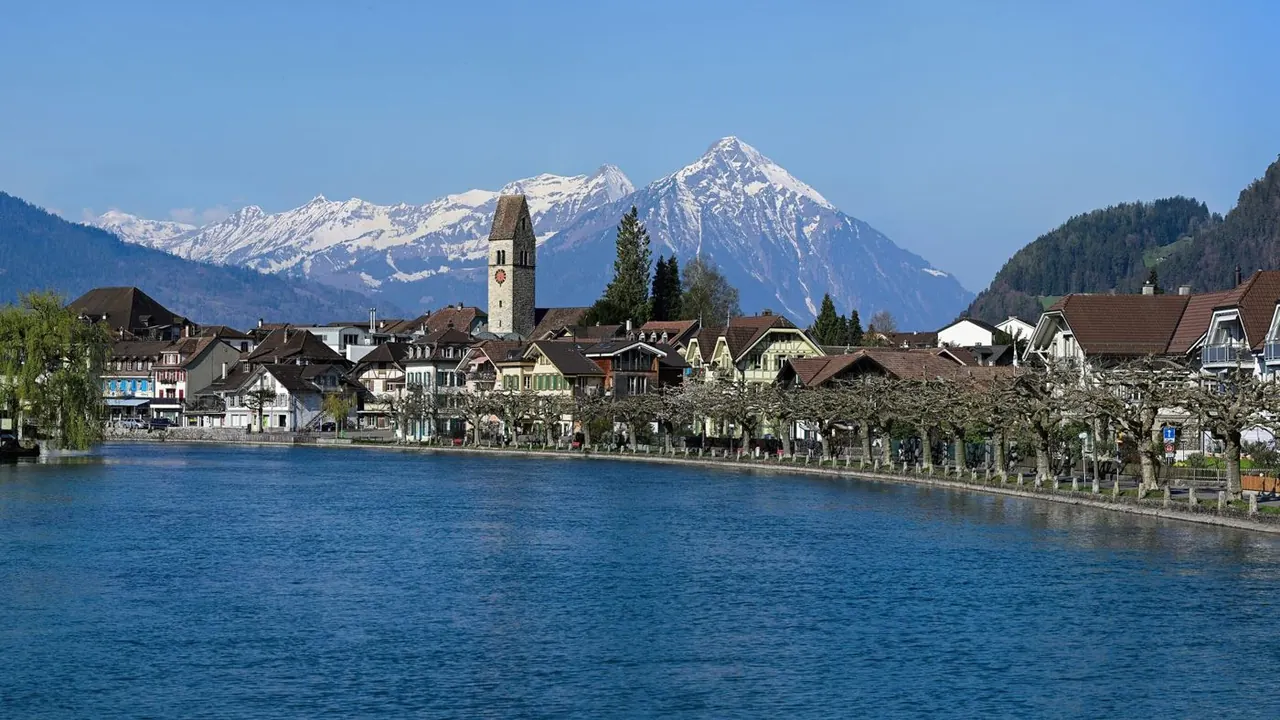
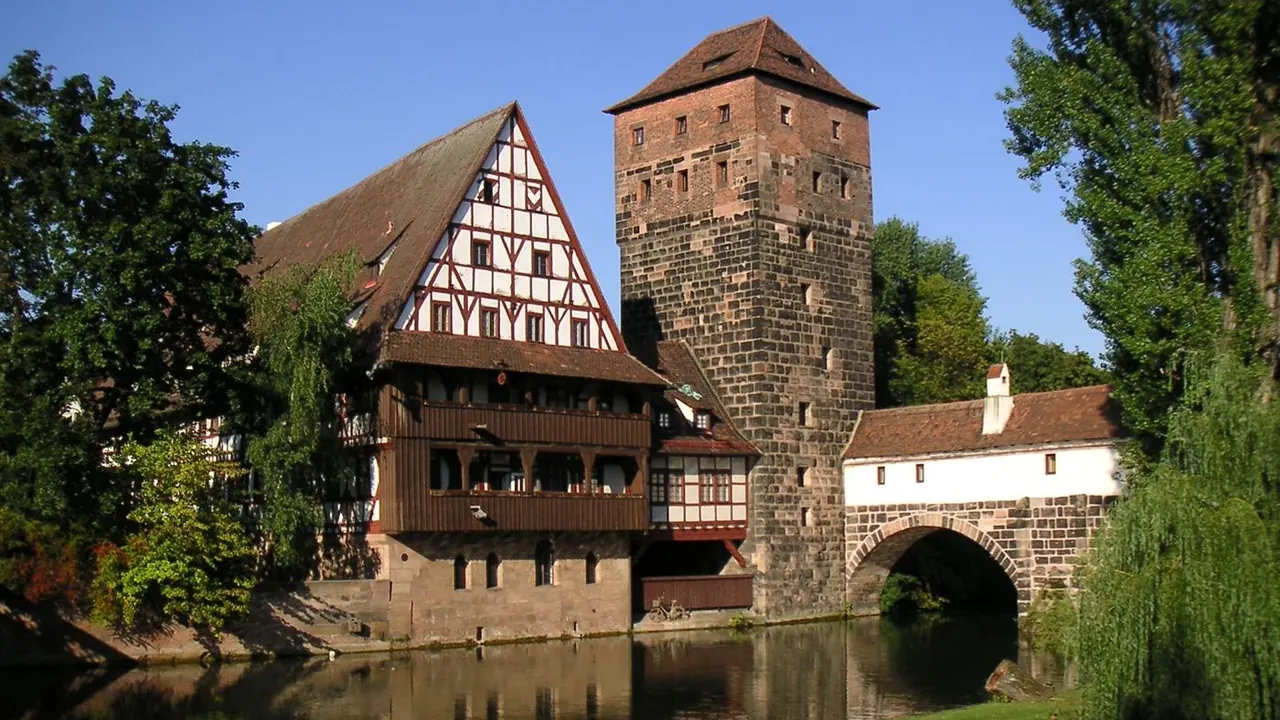
Photos: Interlaken by Roy Egloff, CC BY-SA 4.0, cropped; Nuremberg by Horst Gutmann, CC BY 2.0, cropped.
Interlaken or Nuremberg?
Our verdict in twelve categories, each scored against the same fixed benchmark cities, and the climate month by month, so you can choose for your trip.
Choose Interlaken for
- nature and the outdoors
- beaches
- families
Interlaken is for people who come to be outside. The Eiger, Mönch and Jungfrau, the Lauterbrunnen valley and a dense web of mountain trains and cable cars are all within easy reach, and paragliding, canyoning and skiing are run straight from town. Families will be happy here too. Just accept that the town itself has little to see, eats plainly, goes quiet early and costs a great deal.
Choose Nuremberg for
- culture and sights
- prices
- live music and the arts
Nuremberg is the better pick for a city trip. The walled old town, the Kaiserburg, the Germanisches Nationalmuseum and the Rally Grounds give it real historical weight, and the taverns, Franconian beer, Gostenhof bars and a working opera house fill the evenings. It is also far kinder to the wallet, with forests and limestone country for walkers but nothing like the Alps.
Scoreboard
Twelve categories on one fixed scale from 0 to 100. The shaded stretch is the gap between the two.
Your match
Pick a travel style or drag the sliders, and both match scores follow your weighting.
Wins on nature and the outdoors and beaches with your weighting.
Wins on culture and sights and prices with your weighting.
What matters to you?
Category by category
What the scores mean for a trip.
Beaches & swimming
Neither place is a beach destination, but Interlaken at least has lakes on its doorstep. In July and August you can step from town onto the lidos and shingle at Neuhaus on Lake Thun, or brave the colder turquoise water at Bönigen on Lake Brienz, with snow peaks behind you.
Nuremberg's nearest open water is the Franconian Lake District, about an hour south. It has slightly warmer reservoirs and small sandy strips, but it is an outing rather than part of the day, so in the city itself swimming means pools.
Food & drink
Nuremberg gives you food with a local identity: finger-sized bratwurst grilled over beechwood, Schäufele with crackling, Lebkuchen and, above all, beer from Franconia's many small breweries, poured in old town taverns and riverside beer gardens.
Interlaken's restaurants serve fondue, rösti and international menus that are dependable but rarely more. The best eating there is up in the mountains, at a hut terrace or a dairy selling Alpine cheese, and many visitors get by on picnics.
Culture & sights
This is the widest gap between the two. Nuremberg's walled old town, the Kaiserburg, St Sebaldus and St Lorenz and the Germanisches Nationalmuseum could fill several days. The Rally Grounds documentation centre and Courtroom 600 add a sobering chapter of twentieth-century history.
Interlaken grew up as a base for the mountains. Its sights amount to the grand hotels and Kursaal on the Höheweg and a few old timber houses in Unterseen, so for history you have to take the train somewhere else.
Nightlife
Nuremberg makes for a better night out, though mostly in bars rather than clubs. You can start in the old town taverns and wine bars, then head to the small bars and alternative venues of Gostenhof, with students on the riverbanks in summer. Interlaken turns in early, because people are up early for the mountains. Evenings there come down to a few backpacker pubs and basement clubs, the Kursaal casino and a quiet drink on the Höheweg.
Nature & outdoors
Interlaken is one of the great Alpine bases. The Jungfraujoch railway climbs above the Aletsch glacier, Trümmelbach's meltwater roars inside the rock, and trails from Grindelwald First, Schynige Platte and Mürren are reached without effort. Add paragliding over the Höhematte, rafting, lake paddling and winter skiing, with weather the only real limit.
Nuremberg offers pleasant rather than dramatic country. There is the Reichswald at the edge of town, and the limestone towers, caves and climbing crags of Franconian Switzerland are an hour away. It is good for walkers and cyclists, but there are no mountains.
Day trips
Both are excellent bases, but for different kinds of outing. From Interlaken the trips mix mountains and lakes. Paddle steamers call at castle towns such as Spiez and Oberhofen, and you can reach Bern's arcades in under an hour, the Ballenberg open-air museum, or Lucerne over the Brünig Pass.
From Nuremberg the outings are almost all about historic towns. Bamberg, Regensburg and Würzburg are each about an hour away, Rothenburg and Dinkelsbühl lie on the Romantic Road, and Bayreuth's opera houses and Munich are also within reach.
Good for families
Interlaken has the edge for families, because getting around is the fun part. Cog railways, gondolas and steamers lead to summit playgrounds, cliff walks and summer toboggan runs, with the St Beatus caves and Ballenberg's farm animals as backups. Rainy days are hard to fill, though, and the highest summits can be too much for toddlers.
Nuremberg works best when the weather turns. It has a toy museum, a railway museum with real locomotives and a zoo set in old quarries, and at Christmas a children's market with carousels.
Getting around
Interlaken's transport is built for the mountains rather than the town. The centre is a flat twenty-minute walk between its two stations. The real network starts there: mainline trains, narrow-gauge lines up to Lauterbrunnen and Grindelwald, cog railways, gondolas and lake steamers all link up, so you can reach the whole Jungfrau region, including car-free Wengen and Mürren, without a car. The catch is crowding on the most popular mountain trains in summer.
Nuremberg works the other way round. Almost everything you will want lies inside walls about 1.5km across, so you simply walk, and the only real effort is the cobbled climb to the castle. For the outskirts, U-Bahn, trams and S-Bahn run on one ticket to the zoo, the Rally Grounds and Fürth.
Shopping & style
Nuremberg has more to buy that belongs to the place. There is Lebkuchen in decorated tins, wooden toys and tin figures, the craft workshops of the Handwerkerhof and, in Advent, the stalls of the Christkindlesmarkt, though the main streets are mostly chain stores. Interlaken's Höheweg caters to tour groups with watch and jewellery stores, army knives and cuckoo clocks. Carvings from Brienz are its one real local craft.
Affordability
This gap will shape most budgets. Interlaken charges full Swiss prices for beds and meals, and the mountain railways, especially to the Jungfraujoch, add a large sum that no pass or picnic fully offsets.
Nuremberg is mid-priced, with filling tavern meals, cheap beer and inexpensive transport. Its one trap is hotel rates during trade fairs and the Advent market, so book around those weeks.
Live music & performing arts
Nuremberg has a real season. The Staatstheater stages opera, ballet and drama in its Art Nouveau house, two orchestras perform, and summer brings free folk music at the Bardentreffen and a large open-air concert in the Luitpoldhain. Interlaken's performances are smaller and tied to the summer. The best known is the amateur open-air William Tell in the woods, alongside folklore evenings with alphorns and yodelling, and for anything bigger you go to Bern.
Wellness & relaxation
Nuremberg is slightly better for a classic spa day. It is a short U-Bahn ride to the large thermal spa with sauna gardens in Fürth, and Bad Windsheim's saline pools are about an hour away, though you should expect the German habit of nude, mixed saunas.
Interlaken has no thermal water. Its calm comes from hotel spas, steamer crossings and quiet mornings in Wengen or Mürren, away from the coach groups in town.
When should you go?
Pick your month. The climate figures are measured averages, not a forecast.
Interlaken in July
Nuremberg in July
Daytime high, °C
Rainfall in the month, mm
Where the figures come from
Interlaken has no rain gauge within 25 km of the centre, so its rainfall comes from a gridded climate dataset read at the city rather than from a gauge further away.
Temperature and rainfall are climate normals, averaged over the years shown. Interlaken: 2005-2020 (rainfall 1991-2020) normals, Meiringen / Unterbach (19.3 km from centre). Nuremberg: 1991-2020 normals, Nuernberg (5.5 km from centre).
Through the year the two climates run close, with Nuremberg a touch warmer in summer. June to August is the time for swimming in either place, and also for the high trails above Interlaken. Interlaken's July highs reach about 24°C, though it rains steadily through the summer and low cloud can hide the peaks. Nuremberg reaches about 25°C in July and August with long sunny days, but July is also its wettest month at around 77mm, so expect showers. May, June and September are the most comfortable months for walking its old town.
Winter is cold in both, with highs only a few degrees above freezing. In Interlaken that cold is useful, because it brings snow to the ski areas, although December is its wettest winter month. In Nuremberg winter means short, dark days, best suited to the Advent market and an afternoon in a museum.
Which traveller are you?
On an outdoors trip, Interlaken has no real rival here. Rack railways and gondolas carry you up to high trails under the Jungfrau, and paragliding, rafting and skiing all start from town, while Nuremberg's forests and Franconian Switzerland are gentler, walking-pace country.
For a culture and arts trip, Nuremberg wins easily. It has the imperial castle, the Gothic churches, Dürer's house, a great national museum and the sites of the Nazi era and the war crimes trials, plus opera and ballet in the evening. Interlaken has almost nothing comparable in town.
On a trip on a tight budget, Nuremberg makes far more sense. Tavern meals, local beer and transport are all cheap if you avoid trade fair weeks. In Interlaken, full Swiss prices and costly mountain railways make even a careful stay expensive.
Before you go
| Measure | Interlaken | Nuremberg |
|---|---|---|
| Official language | French, German, Italian, Romansh | German |
| Currency | Swiss Franc (CHF) | Euro (EUR) |
| Sockets | CJ230 V, 50 Hz | CF230 V, 50 Hz |
| Driving side | Right | Right |
| Time zone | UTC+1, UTC+2 in summer | UTC+1, UTC+2 in summer |
| Emergency number | 112 | 112 |
| Elevation | 571 m | 209 m |
| Main airport | Zürich Airport (ZRH)100 km from centre226 non-stop destinations | Nuremberg Airport (NUE)5 km from centre56 non-stop destinations |
| Public holidays this year | 10 days | 12 days |
By the numbers
| Measure | Interlaken | Nuremberg |
|---|---|---|
| City population | 6,123 | 531,159 |
| People per km² | 1,424 | 2,848 |
| Museums within 10 km | 3 | 50 |
| UNESCO World Heritage sites within 50 km | 2 | 1 |
Where else could you go?
Every comparison below shares a destination with this one, so you can follow Interlaken or Nuremberg somewhere new.